Since '02 xBhp is different things to different people. From a close knit national community of
bikers to India's only motorcycling lifestyle magazine and a place to make like-minded biker
friends. Join us
xBhp was born more than 16 years ago and since then we've had a chance to ride or drive hundreds of machines
running on two wheels or four wheels, and sometimes even three wheels. We are not done yet, and this list is
still growing. In these pages, we take a deep dive in the treasure trove of our ride experiences and bring
you all that we have ridden or driven.
Machines Done 433
|
Total Cubic Capacity 178731
|
BHP 56456
The ‘Stang joins xBhp’s Ranks!
5,038 V8CC460BHP570NM
Oct 2026
Sundeep Gajjar
Cars
I have ridden over 80,000 km in Australia on some of the finest motorcycles. Open roads, unending highways, golden sunsets, and incredible coastlines: the lure and charm of Australia cannot be overstated. The latest of those escapades was on a Ninja H2. I have had the Ninja H2 in Australia for around 10 years now. Why not anything else? Well, there is nothing better. I had it reflashed; it makes around 275 bhp at the crank, and that makes it ‘ample’ for any sort of job.
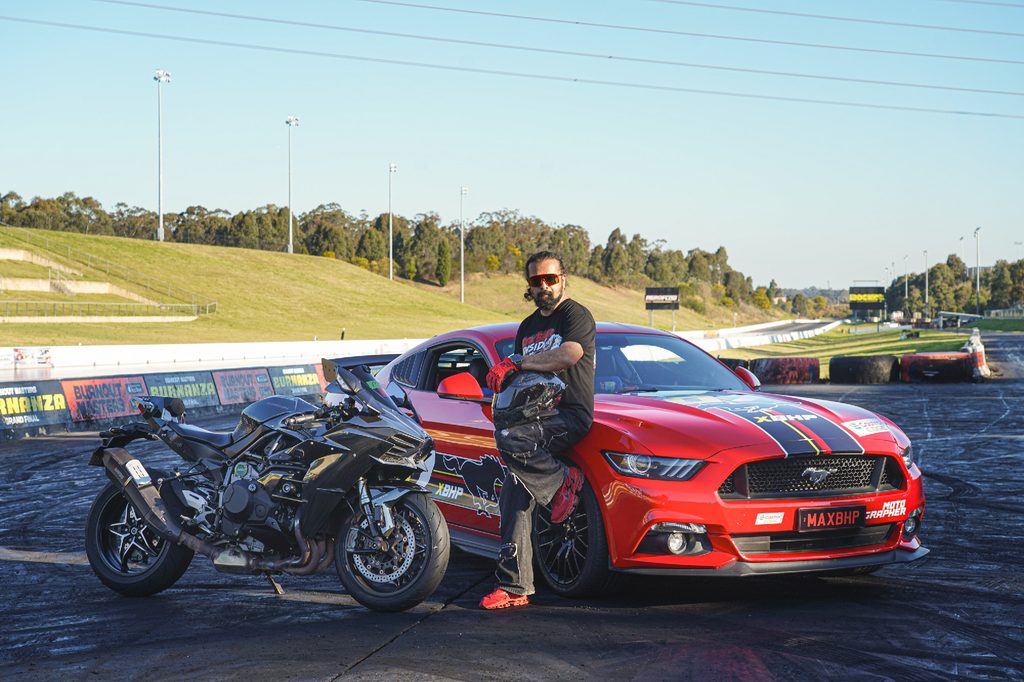
I have taken it around the continent, and drag raced it on one of the world’s finest drag strips- the Sydney Dragway. With a motorcycle like that, you know I have been to this place a fair few times, and once more, I find myself at the Sydney Dragway. But this time, it is not to see the predictable result of 275 supercharged horses in a straight line. This time it is to unveil my latest acquisition, a sports car so iconic that it needs no introduction.
Sydney Dragway is one of the best places to test your machines, or even yourself. Whether you want to see if the latest modification on your car/motorcycle has had the desired effect, or just want to see if your cat-like reflexes are still ticking along, Sydney Dragway is the place to do it. Along with the dragstrip, they have a skid pan for drifting and a burnout pit for, well, burnouts. While the place is usually busy with competitions and such, they still have enough public days for you to have some fun. Check them out at www.sydneydragway.com.au
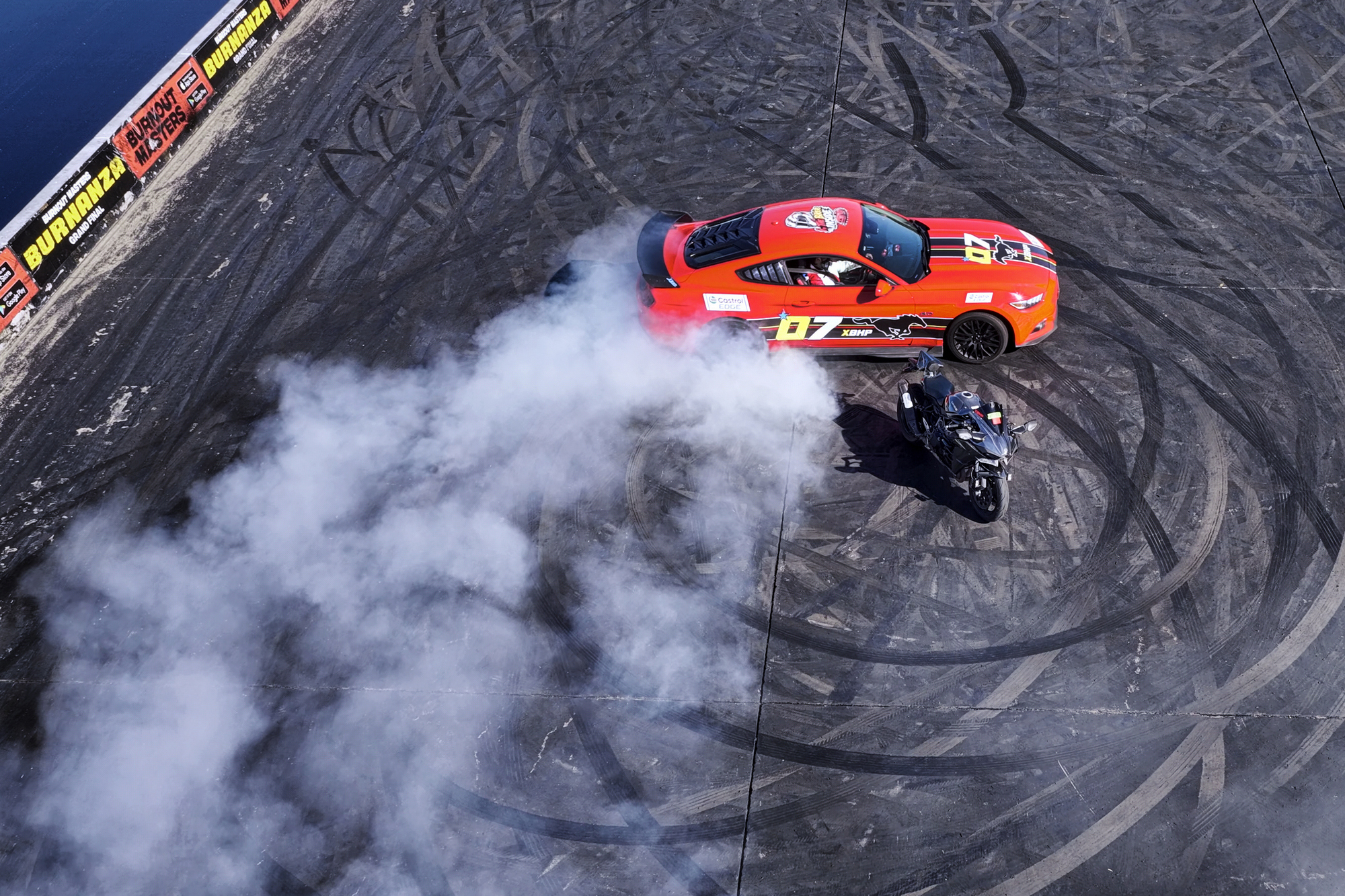
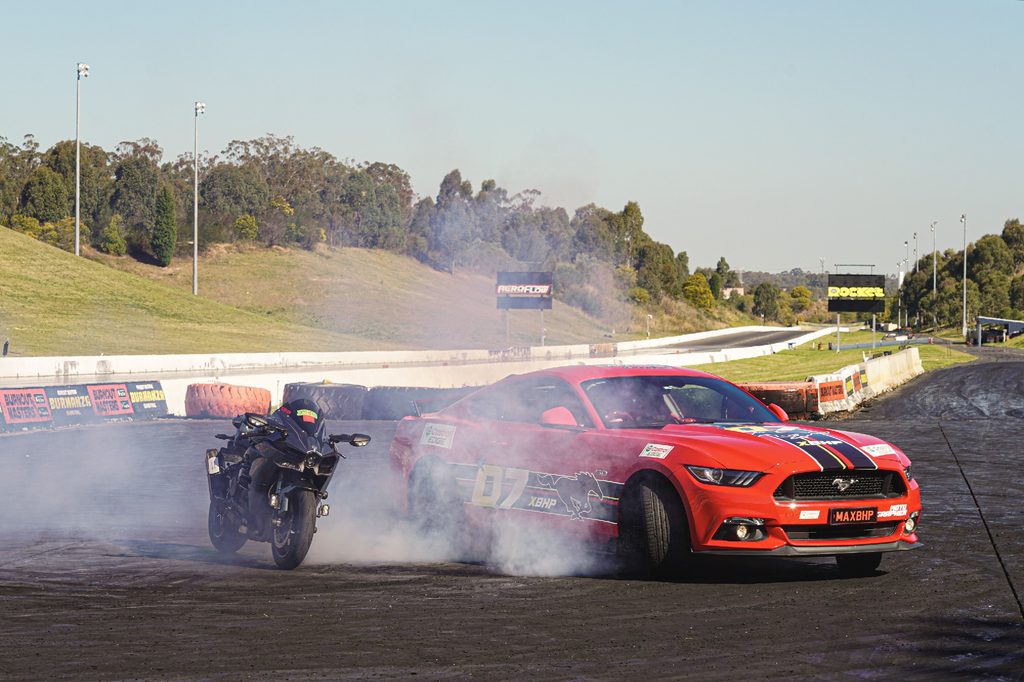
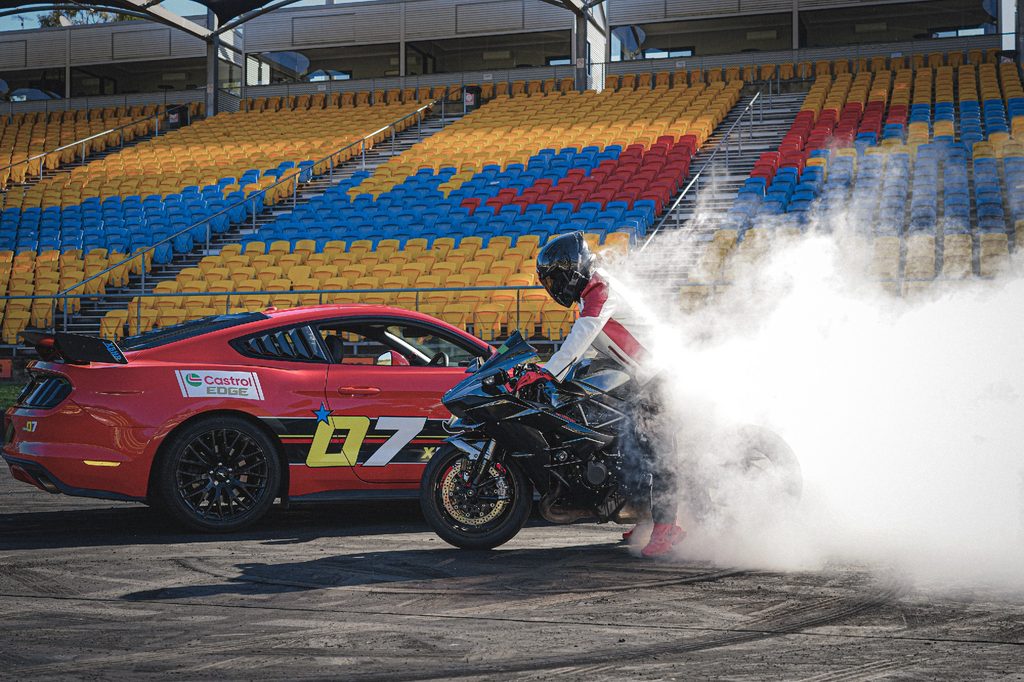
My love for Sydney Dragway and what it offers has been explained. This would also help explain the sheer joy when they told me I could unveil my latest sports car there, shoot with it, and even have it to myself for a while. So, under the hot sun on a cool day with winter waning, I had the car under red wraps with the Ninja H2 flanking it; its chrome shining bright as ever. The stage was set, and the proceedings began with a customary burnout on the Ninja H2.
I am a visual artist, so theatrics is something I cannot do without, especially on an occasion like this. The smoke built, and the supercharger shriek reverberated through the empty grandstands: pantomime drama. As the smoke cleared, I got off the motorcycle, and it was time to take the cloth off. I know I am building suspense with text on a page that already has the photo of the car, but as I said… theatrics… always.
All that said, the feeling I had at that moment was something special. I have seen a Mustang GT before. I have driven one. And I knew that was the car under the wraps. Yet, in that moment, I felt like this was it. The itch to drive it, drift it, floor it, and go bonkers had been getting stronger over the past few days, but with the veil finally off, I could scratch that itch with all my might!
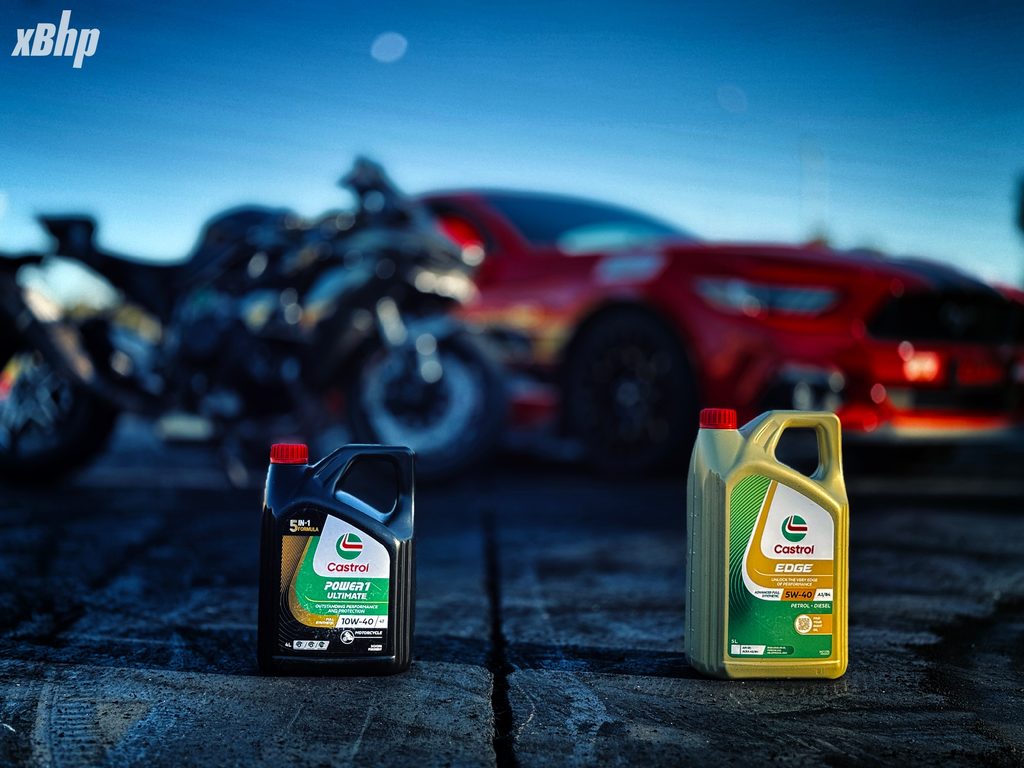
I have an xDrive M340i that I converted to RWD for epic drifts. Drifting means constant high revs, and that is hard on the engine. How do I make sure that it all goes without a hitch? Castrol EDGE. It is a fully synthetic engine oil with their patented PowerBoost Technology™ that combines contact-performance additives that adapt dynamically to the surfaces of fast-moving engine components with high-quality full-synthetic base oils, so you get an instant boost of power whenever you need it. With all that, and my own experience over the years, Castrol EDGE was the obvious choice for my shiny new Mustang GT.
And this is one of those moments when a hero’s grandeur comes to a screeching halt in a Marvel movie. I had access to the burnout pit but not the skid pad. It was busy. Drifting on the pad would have been better since it had asphalt, but it is what it is. In the burnout pit, the tyres gripped, and I could not drift smoothly. I gave it a mighty shot, though. A few rolling burnouts, a somewhat-circle around the H2 and tons of smoke. The itch was partially scratched, but I had to make do with it.
At this point, I also got a coolant temperature warning in the Mustang GT. It was obvious. I pushed the engine too hard in a bid to drift on a not-so-conducive surface. This is also where I really appreciated what Castrol EDGE did for the engine. Ever since my pursuit of four wheels began, I have only trusted Castrol EDGE to take care of the cars. From my M340i to Thar ROXX, if it has four wheels and a suck-squeeze-bang-blow engine, it has to have Castrol EDGE.
Now, after the unveiling and penchant for drama, it was time to hit the road with the Mustang GT, chasing the quintessential feeling of sunset and open roads.
Before that, you must be wondering why the Mustang GT. Well, the simple answer is that it is a Mustang, for God’s sake. Eleanor from Gone in 60 Seconds, Razor’s Mustang in Need for Speed: Most Wanted, or Toby Marshall’s 2013 Ford Mustang Shelby GT500 in the Need for Speed movie; the car is an icon, a dream for many. It may not be a proper supercar, but it is affordable and one of the best-selling sports cars in the world. It is the poster car for the typical American Muscle Dream.
Personally speaking, my car journey started relatively late. I was around 30 and had a humble Suzuki Ritz. 70 horses, front wheel drive, it stayed with me for 10 years, and I barely drove it: around 3,000 km over those 10 years. That was a time when I thought of cars as cages. I had driven some good ones but never felt like they were for me.
Then Mahindra brought out the new Thar in 2020, and something changed. I simply wanted that car. And I got it. It also had the distinction of being the first petrol-automatic to be modified by Bimbra 4×4. We took it around India not once but thrice during various editions of the #roadTripUnited. Then came the MINI Cooper S 3-door, my first sports car. It was fun, but I outgrew it rather quickly: a situation not helped by the fact that I was consistently driving 500+ bhp press cars around the world.
Then came the BMW M340i. That beautiful B58 engine and all-round capability: it was a mature decision. It is a car that you can have a lot of fun in, but it was not restricted to just fun. Something was amiss, though. It shared the engine with a Supra and a Z4, but it was not those cars. I still felt the need for something iconic, and the Ford Mustang GT was the answer. As I mentioned, I regularly drive cars over 600 horses and sometimes even more, but I cannot afford those cars. So, Mustang GT it was.
Easy to carry around and an absolute pint-sized powerhouse, the Acer Swift 5 is our laptop of choice on the go.
The one I got has a Gen3 Ford Coyote, a 5.0L naturally aspirated V8 belting out 460 pretty ponies. And in the process of producing that kind of power, it sounds pretty rad too, even inside the cabin. Moreover, it is rear-wheel drive, so no need to fiddle with phones and thumb drives to disable all-wheel drive like I have to with my M340i. So, all of that combined, the Mustang GT was the only logical answer to my quest to own an icon.
Now, back to the drive. I had chosen to head into the Blue Mountains. The drive from Sydney towards Lithgow is fairly decent, although it is slow going, with the road speed limits keeping you in check and the looming threat of a speeding fine. Australia is often called a nanny state, and now you know why. I took the beautiful Jenolan Caves Road towards Oberon, one of the highest towns in the Blue Mountains.
The roads aren’t particularly wide, but the smooth, flowing tarmac makes for a great drive, with some fantastic views as you cut through the mountains. The eucalyptus trees release oil into the atmosphere, which, under the right conditions, creates the characteristic blue haze that gives the Blue Mountains their name.
About the car, the Mustang GT has 570 Nm of torque arriving at 4,500 rpm. That gives it a character that always seems to want the rear to step out, and on wet mountain roads in the morning or evening, that can quickly turn into a spin, even with the traction control switched on. The Mustang GT has earned itself a bit of a reputation as a ‘crowd basher’, thanks to the number of videos showing people losing control and crashing into crowds or trees. Thankfully, we know better than to do that.
The interior feels solid and comes with plenty of physical buttons; a far cry from the modern cars of today, with their giant screens and touch-sensitive controls. I am a big advocate of the ‘BBB’ or ‘Bring the Buttons Back’ movement, so you know how much I loved the Mustang’s old-school interior. Moreover, a car that has ‘Ground Speed’ written on its speedometer is clearly meant for someone who appreciates speed and style. And the Mustang has plenty of both, straight from the factory.
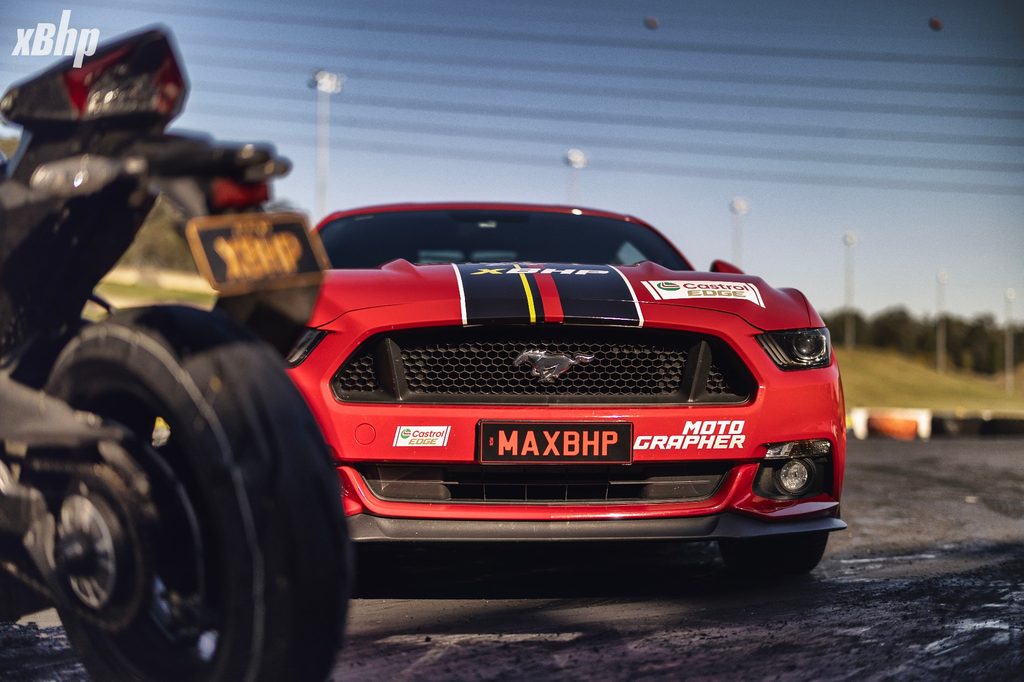
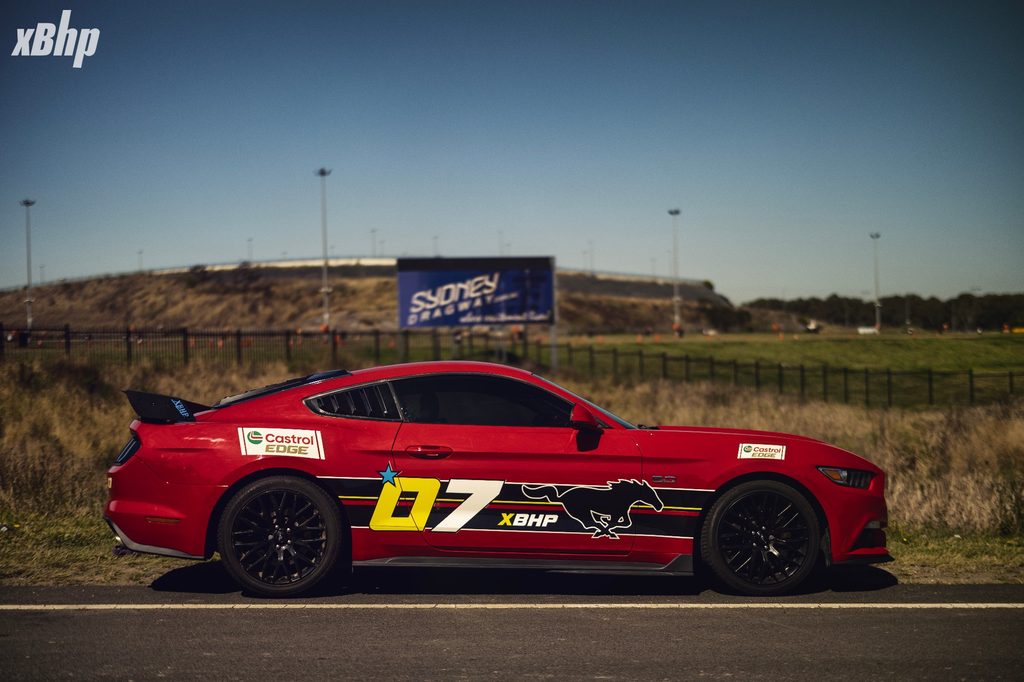
Apart from that, I also added some of my own touches, with custom interior parts and a few additions to the exterior, including a GT-style spoiler, side skirts and a front lip. The stock rear diffuser was already perfect, especially with its colour matching the main body of the car. And then there was the custom livery, which I designed, as I do with all my machines, before the unveiling.
The next stop was Bathurst. It is best known for the Bathurst 1000, the Australian Supercars Championship round held on the Mount Panorama circuit. And this was the highlight of my first trip with the Mustang GT. Why? Because if you own a 2018 Ford Mustang GT 5.0 V8 in Australia, there is a little more to the car than just its American muscle car heritage. It is also part of Australia’s long history of Ford V8 racing, including the legendary Ford versus Holden rivalry.
In 2019, the Mustang replaced the Ford Falcon in the Australian Supercars Championship and won the championship in its debut season. It also conquered Mount Panorama that year. Today’s Supercars Mustangs run a 5.4-litre naturally aspirated V8 producing around 600 horsepower. My own Mustang has the five-litre Coyote V8, from the same engine family, and that connection makes it a little more special to me.
The reason why Castrol EDGE is so good is because of Castrol’s experience in motorsports. An example is the Tickford Racing team competing in the Supercars Championship since 2003. Over the years, Castrol has played an integral role in Tickford’s journey. With their bespoke Castrol EDGE formulation, they have helped the team push the limits of the Ford Coyote 5.4-litre V8 engine, extracting every little bit of performance from it. If Castrol EDGE can handle front-running cars in one of the world’s most competitive touring car series, I know what I am going for when it comes to my own Mustang GT.
There is another link between my Mustang and Australian Supercars racing, and that is Castrol EDGE. My car runs on Castrol EDGE, a fully synthetic engine oil designed for high-performance engines, while Castrol has a long history in motorsport, including its association with Ford racing in Australia. Tickford Racing is one of the prominent teams carrying that legacy forward, campaigning the Ford Mustang in the Supercars Championship. These race cars endure high temperatures, sustained high RPM and enormous mechanical loads. My road-going Mustang is obviously a very different machine, but the basic idea remains the same: getting the best out of a naturally aspirated Ford V8. For me, using Castrol EDGE is another small connection between my own driving adventures and the wider world of Ford performance.
The highlight, of course, was getting to drive my Mustang around Mount Panorama. It was surreal seeing the grid markings painted on the road and the race signage still in place. It was difficult to wrap my head around the fact that this was also a public road, with a 60 km/h speed limit, and not a race track in the conventional sense! I was fortunate enough to experience the circuit in two very different ways. In 2025, I watched the Bathurst 1000 unfold here. Now, I was driving around the same track when there was no race on. Both experiences were special, but being behind the wheel of my own Mustang on those very roads was something else.
The Bathurst 1000 is one of the biggest events on the Australian motorsport calendar. The race covers 1,000 kilometres over 161 laps of the 6.213-km Mount Panorama circuit, with two drivers sharing the car for a gruelling endurance battle. The track combines high-speed sections with tight corners, blind crests and steep elevation changes, with concrete walls leaving little room for mistakes.
There is a lot more to it than just going fast. Qualifying and the Top Ten Shootout determine the starting order, but the race itself is a test of strategy, tyre management, fuel stops and consistency over several hours. And then there is Mount Panorama itself. For much of the year, it is a public road. When the Supercars arrive, it becomes one of the most demanding circuits in motorsport.
The Australian Supercars Championship sits in the top tier of Australian touring car racing. It was formerly known as the V8 Supercars Championship, so it must give you an idea about the rules: all cars must be front-engined, rear-wheel-drive and powered by 5.4 to 5.7-litre V8 engines producing around 600 horsepower. At the moment, the manufacturers include Ford, fielding the Mustang; Chevrolet, fielding the Camaro; and Toyota, fielding a GR Supra. In the packed calendar, the series features iconic endurance races such as the Sandown 500 and the Bathurst 1000. I had the pleasure of visiting the venue for the latter- Mount Panorama Circuit, a 6.213 km long street circuit where, over 161 gruelling laps, the drivers cover a race distance of 1,000 km. Truly hallowed ground and a truly iconic start to my adventures with the Mustang GT.
For generations, the mountain was the setting for the fierce Ford-versus-Holden rivalry. That battle has since evolved, with the Ford Mustang taking on the Chevrolet Camaro, while Toyota joining the Supercars field in 2026. Seeing the Mustang arrive in the championship in 2019 and win in its very first season was a memorable moment for Ford fans like me. Also, here’s another interesting tidbit: Bathurst is recognised as Australia’s first inland European settlement. Not bad for a place that has become synonymous with one of the country’s biggest motorsport events!
For me, driving the Mustang around Mount Panorama was truly the highlight of the trip, and a pretty perfect debut for the car. And there was more to see than just the circuit. I also came across a Nissan GT-R meet, with a smaller Hyundai N Line gathering taking place nearby. They were an unusual sight among the cars on the circuit, although the Toyota Supra fitted right in!
Leaving Bathurst behind, it was time for more mountain driving. This stretch had its own highlights, including wind turbines and a small detour to one of the many lakes in the region. I took the Goulburn Road out of Bathurst and headed towards the Crookwell wind farm, where I happened to come across a tree painted blue. Australia can surprise you in the most unexpected ways. From there, it was time to get back on the M31 and head towards Sydney.
As we move further into the electric vehicle age, I find myself appreciating the naturally aspirated V8 even more. There is something about a five-litre engine breathing freely, delivering its power without turbos or electric assistance, that still makes the experience special. Of course, enjoying powerful machines also means looking after them, and regular maintenance is part of the deal. Having spent decades using Castrol oils in superbikes, I was happy to carry that experience over to sports cars as well. After all, the machines may be different, but the need to keep their engines running at their best remains the same.