


Since '02 xBhp is different things to different people. From a close knit national community of bikers to India's only motorcycling lifestyle magazine and a place to make like-minded biker friends. Join us

Castrol Power 1

Clean visor equals clear vision.

Our Partner

Announcement

Collapse
No announcement yet.

Turning a Motorcycle

Collapse
X
 
  • Filter
  • Time
  • Show
Clear All
new posts

  • Turning a Motorcycle

    The real fun and thrill of motorcycling lies in taking fast turns. For a true blue motorcyclist, the straight portions of the roads exist just to take him from one turn to the next! Here, the main aim is to get across these turns safely and quickly. The less time you spend going around a corner, the more you enjoy doing it!

    The rider's body position during the turn has a great effect on how smooth and steady he is during the turn. His weight should be distributed between the handlebars, the seat and the foot-pegs. Elbows should be slightly bent to absorb the road shocks and counter braking forces, and the legs should be kept ready to shift the body weight and take an active role in controlling the bike. An upright body position helps keep you alert and gives a higher line of sight in traffic. While leaned into a turn, keep your body in the same plane as the bike, although you may prefer to keep your head vertical. In short, keep the angle of your body parallel to the angle of the bike and your head upright. When you corner, there is a balance point where your body weight will seems to disappear from the bike, making you and your bike as one single entity.

    Basically, all corners can be sub-divided into three parts: the entry, the mid-turn and the exit. For a fast and a quick turn, all these three need to be integrated into one fluid movement. The start of your corner is from the moment you can see it. From this time on, you should start planning your braking, estimate the speed and the gear at which you will enter and the type of line you would take through the entry. Set yourself up to enter the turn at its extreme outside. If it were a left hander, you would be on the extreme right of the road (or lane) and vice versa for a right hander. Finish braking just as you begin to lean your bike in and your eyes should be looking ahead hunting out the apex. The apex of a corner is the point where you are closest to the interior of the corner. If on an unfamiliar road and the exit is not visible, try to stay out as wide as possible. Match your speed to the curvature of the turn that is visible. Going towards the inside too soon, you may find that if the turn tightens up, you would exit far out into the opposite lane (or into the divider) with injurious results.

    As you tighten your line towards the apex of the turn, your eyes leave the apex and hunt out the exit. Sweep towards the apex on a partial throttle (engine not accelerating, but not giving any engine braking either) to balance the bike. At this point, you will be at maximum lean. On an unfamiliar road, look at where the point where the two opposite edges of the road converge. If this point appears to come closer to you - the turn is tightening up. If the point goes away from you - you're getting to the exit and it's opening out. If it stays constant then the turn is continuing at a constant radius. Once past the apex, start straightening up the bike and feed in power progressively, smoothly accelerating out of the turn towards the next.

    Remember: slow in and fast out. Complete all your braking and gear changing before leaning the bike into the turn. Hold constant throttle while turning and increase power while straightening up and exiting.
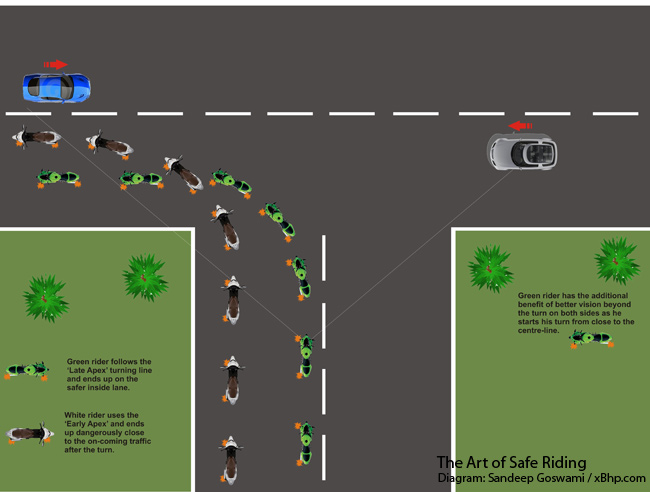


    The perceived safest area of a turn is on the inside and this is where the problems begin. The rider steers in too early leading to an early apex. This then leaves most of the actual steering for late in the turn and often results in inadvertently drifting wide at the exit. A proper cornering line for a constant radius turn begins with a wide entrance from the outside of the turn. This is followed by a definite turn-in that gets most of the steering done early and sets up for a late apex (somewhere around the mid-point of the curve) and a straighter line at the exit. By using a late apex (see figure above and photo below) on the street, you get to do more braking while straight up, you get a better view of the exit of the corner, and you minimize the amount of time you are near the edge of the road (or the centerline). Along with all this, make yourself look farther into the turn and you will end up feeling more in control. By placing your attention farther ahead, you give yourself more time to prepare for whatever comes up and you get fewer surprises.
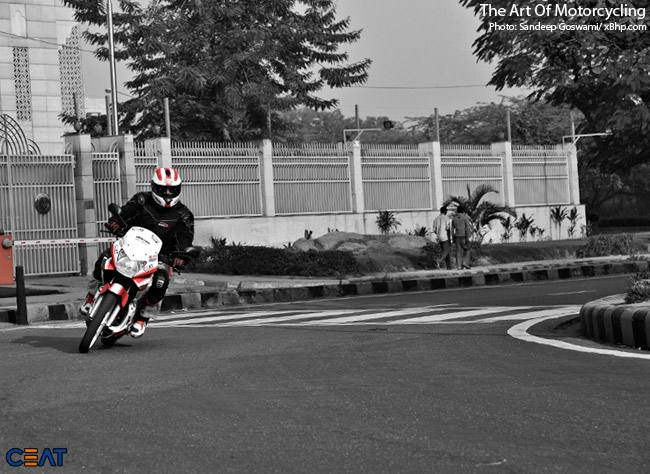

    Photo: Late Apex Turn


    Photo: Early/Late Apex for a single lane turn


    Now that you have learnt about the best cornering line through turn, the way to go faster is to get more weight transfer without more lean. Remember that leaning is just a method of transferring weight to the inside as you hurtle through a corner. The farther you can lean, the more weight you can transfer and the faster you can go through the corner.
    Transferring weight without increasing lean is called 'hanging off', and involves sliding your body off the seat towards the inside of the turn. To start with, try sticking your knee out towards the inside of the turn. That is a little weight transfer. See if it helps. But be sure to make all such weight shifts while the bike is upright. Once comfortable with the knee out, try sliding your butt towards the inside of the seat, along with the knee sticking out. You will have reached the limits of hanging off, and the cornering speed, when your butt is completely off the inside edge of the seat and your knee, along with whatever is on the bike that drags, is skimming the pavement around the turn. Obviously, you shouldn't be attempting such riding on normal public roads. This riding on the limit is strictly for the racetracks.

    Posting Replies to this Article

    Want to add to this article? Great! But please don't start repeating what has already been stated here. And people who post subsequent to additions by others are advised to go through these additional posts too and not repeat whatever has already been said.
    • Only comments which add on value to the article will be approved.
    • You may add on more points, pointers to the subject relating to this article.
    Last edited by Old Fox; 12-29-2009, 05:10 PM.
    sigpic

  • #2
    You say that for a left turn one should take the extreme right position on the road. I agree that this is true to keep yourself well balanced through the curve and you are not dangerously close to oncoming traffic when one finishes the curve. However, if we take into account legalities, if it is a left turn at an intersection and not a curve, we have to stay to the Left Lane to turn Left. Else if we take left from the right most Lane, we would be in the line of oncoming traffic coming from behind us.
    The Wheel was a great invention; Two Wheels with a Motor in between was even better!


    BMW Motorrad Days 2011

    Xbhp's Indo-French Kashmir-Ladakh Tour

    Comment


    • #3
      Originally posted by ken cool View Post
      You say that for a left turn one should take the extreme right position on the road. I agree that this is true to keep yourself well balanced through the curve and you are not dangerously close to oncoming traffic when one finishes the curve. However, if we take into account legalities, if it is a left turn at an intersection and not a curve, we have to stay to the Left Lane to turn Left. Else if we take left from the right most Lane, we would be in the line of oncoming traffic coming from behind us.
      Your standpoint is right and most such urban 'T-intersections' will have a stop-light for right turning traffic anyway which means that lane is cut-off and impractical for the left turner. When the traffic and road environment is crowded enough for legalities to become paramount, the rider will be at a low enough speed through the turn to make the demarcation between 'entry, apex, exit' rather redundant. In our typical urban scenario, except during very late or early morning hours, rarely can a T-point (as the one illustrated), be taken at speeds fast enough to justify 'setting up for the turn'. The context of the above write-up lies in the call to stress the need for planning, setting up and executing a turn as a maneuver that requires more thought than straight line riding. And the 'T-intersection' example makes for an easy visual pointer to the need to apex late to gain in terms of improved vision across the maneuver, ensure safety post maneuver and conscious application of specific skills to execute the maneuver. A similar diagram could be constructed to show a sharp left-hander on a single lane highway where the direct utility of this technique is equally demonstrable but then again single-lane highway situations are also rare.

      As for coming in the way of traffic coming from behind the rider, the rear-view mirrors and 'keep that neck on the swivel' should provide enough clues to that. A skilled rider is someone who is aware of his riding environment 360 deg around him. A slight move towards the right lane to make more space, trafficators blinking away to glory showing the rider's intention to turn left, rear checked visually not once but twice and more and the turn gets executed smoothly. Is done and can be done in a routine basis. The diagram is not to scale and the extreme right position is sort of exaggerated to accentuate the difference between the 'late apex' and the 'early apex'. In real life, the rider may not have to go all the way to the extreme right (as the diagram depicts) to gain the benefits of this technique.
      I don't let my motorcycles interfere with my motorcycling...

      Join xBhp On

      Comment


      • #4
        The last para makes it easier to comprehend. One does not need to go to extreme right to take a left.
        The Wheel was a great invention; Two Wheels with a Motor in between was even better!


        BMW Motorrad Days 2011

        Xbhp's Indo-French Kashmir-Ladakh Tour

        Comment


        • #5
          Hi Folks,
          I think the pic below gives us an idea of apex line turning...its taken from Proficient Motorcycling - The Ultimate Guide to riding well..a good book according to me..i just scanned and uploaded it

          Comment


          • #6
            Originally posted by Shreyas82 View Post
            Hi Folks,
            I think the pic below gives us an idea of apex line turning...its taken from Proficient Motorcycling - The Ultimate Guide to riding well..a good book according to me..i just scanned and uploaded it

            [ATTACH]16722[/ATTACH]
            Don't think the example of 'T' junction to talk about late apex'ing is correct, as at junction we should slow-look-go. As no matter how late we apex, we will miss the person standing on road side to cross the road (on the left side), or a fast coming vehicle from right side (seeing the junction is empty).
            The picture from Proficient Motorcycling shows it with the right place as an example, a curve.
            2000 Suzuki Fiero | 2004 Bullet Electra | 2004 RX135 | 2005 CBZ | 2009 Karizma | 2009 Punto 1.4 Petrol | 2011 Yamaha YZF-R15

            Nav is back !!!
            Getting Leh'ed. Since 2007...

            Comment


            • #7
              U Turn

              We have always been talking and leaning about taking corners, however we forget about taking the biggest corner which is U turn and double quick apex. It has always been the most interesting thing for me to learn and still learning the ways to take the perfect U-Turn and goes quick on Double apex, following pics may help us all understanding how to take U-Turn and Double apex

              Braking-Acceleration point


              When to fix the speed and lean

              sigpic

              Comment


              • #8
                Originally posted by nav75 View Post
                Don't think the example of 'T' junction to talk about late apex'ing is correct, as at junction we should slow-look-go. As no matter how late we apex, we will miss the person standing on road side to cross the road (on the left side), or a fast coming vehicle from right side (seeing the junction is empty).
                The picture from Proficient Motorcycling shows it with the right place as an example, a curve.
                I wouldn't summarily dismiss the T-junction as not useful in discussing the late/early apexing while turning. There are two assumptions behind not seeing value in using the T-junction as an example.

                1. The apexing is only about turns at appreciable speed.

                2. That all T-junctions are urban in context, with medium to high traffic density and cluttered with a profusion of the human element (vis-a-vis cyclists, pedestrians etc)

                #1 is not entirely true. Late apex is as much about ending up with a safer line as also about improving vision across the field of the maneuver. The inside line on exit improves safety margins against errant on-coming drivers who might use a portion of the rider's lane. But being able to see better across the turn is equally important and a decided movement to the right before turning left undoubtedly gives improved field of vision. This applies to any except the densest of traffic density situatuion. And that too because then the rider would be slow enough to be able to either stop or change direction very quickly.

                #2 T-junctions abound, both within cities and out on the open road, that are wide enough and experience a low enough traffic density to warrant their use as a relevant example. They can be ridden through in a flow. Again, I repeat what I've stated in my post above in reply to Ken's query. These figures/diagrams are NOT TO SCALE and the positioning of vehicles has been exaggerated just as a visual aid. This is not a real-situation simulation.

                The picture taken from David L Hough's excellent book is of course a wonderful example though a little difficult to identify with at first sight for us in India as it assumes right-handed traffic while we are used to left-handed traffic in the Indian context. And instructions like positioning a bike on the road and at speed, need to be free from any such ambiguity. @shreyas82 needs to add a note beneath the picture in this respect.

                Seeing the confusion that's apparently sprouted out of my use of the T-junction view as the sole example, here's another of a typical single-lane road turning left. Hope this clarifies and makes up for the deficiencies that arose from the T-junction thing.

                I don't let my motorcycles interfere with my motorcycling...

                Join xBhp On

                Comment


                • #9
                  Old Fox sir, I was hoping you could help me out with this situation:

                  I'm approaching a T-intersection and I want to turn left. The left turn is a blind turn in the sense that there is a wall and I cant see anything on the road leading left, till I'm into the turn.
                  Adding to this there is sand spilt from a passing truck at the intersection, spread out over quite an area. I cant see the sand till I'm at the apex of the turn! And it not being a traffic signal, traffic is approaching from the right side of the T also!

                  Whats the ideal speed and method of taking this turn? I've been in this situation once and the bike skid on the sand and I was sprawled on the road! Thankfully neither me nor my ride were hurt
                  Last edited by anirban13; 10-23-2010, 02:50 AM.

                  Comment


                  • #10
                    Re: Turning a Motorcycle

                    Old Fox sir, I read your article in the magazine about the aspects of cornering (i think it was in part 2), that you spoke about what to do when the turn tightens up or we realize that our entry speed was too high and not we are fast approaching the edge of the road. Here you mentioned that instead of braking, we should increase counter-steer and accelerate out of the turn.

                    I could not understand the physics of it: From the drawing of the Kamm's circle, it seemed that tighter turns lead to reduced available traction. Also what i understood from the previous articles on braking, etc. is that the available traction is a constant value and depends on the rubber and tarmac. Now if we are going to accelerate out of the turn, it leads to rearward weight transfer. This leads to a lighter front end and smaller rubber contact patch (atleast this is what i can imagine, similar to what happens to the rear wheel when there is forward weight transfer on braking). This makes it easy to steer, but due to the smaller contact patch, there is less road grip. Also we are increasing our stress on the centripetal force because we are now accelerating at a smaller turning radius. And we may cross the limit stated by the Kamm's circle.

                    On the other hand, if we brake, it seems even worse. We load the front-fork (due to forward weight transfer) and it makes it difficult to steer and we risk running wide. Although the forward weight transfer leads to a bigger contact patch and we can increase the road grip until we reach the limit stated by the Kamm's circle.

                    So eventually i am not sure which is the lesser of the two evil.


                    Second question:
                    While entering a corner, i guess this is the order of activities to be followed:
                    1. align the bike on the outside of a turn, parallel to the outer median, to prepare for a late apex
                    2. braking before the turn
                    3. down-shifting
                    4. inner weight shift
                    5. loading outer foot-pegs
                    6. pushing the inner handle-bar


                    Do you think i got the order correct? Is there anything that should be done together (such as inner weight shift and loading outer footpegs and ...)


                    Originally posted by anirban13 View Post
                    Old Fox sir, I was hoping you could help me out with this situation:

                    I'm approaching a T-intersection and I want to turn left. The left turn is a blind turn in the sense that there is a wall and I cant see anything on the road leading left, till I'm into the turn.
                    Adding to this there is sand spilt from a passing truck at the intersection, spread out over quite an area. I cant see the sand till I'm at the apex of the turn! And it not being a traffic signal, traffic is approaching from the right side of the T also!

                    Whats the ideal speed and method of taking this turn? I've been in this situation once and the bike skid on the sand and I was sprawled on the road! Thankfully neither me nor my ride were hurt
                    Anirban, i think all this assumes that there are no obstacles in your line of travel. If we are not sure about this before approaching a turn, then the best bet is to reduce speed to a level where we can think that we can stop incase if such a situation arises.
                    Last edited by pradeepa; 09-03-2014, 07:07 PM. Reason: reply to Anirban added

                    Comment


                    • #11
                      Re: Turning a Motorcycle

                      Hello Old Fox Sir,

                      Anything thing that you would like to say. Your inputs would be much appreciated.

                      Thanks.

                      Comment


                      • #12
                        Re: Turning a Motorcycle

                        Originally posted by pradeepa View Post
                        Old Fox sir, I read your article in the magazine about the aspects of cornering (i think it was in part 2), that you spoke about what to do when the turn tightens up or we realize that our entry speed was too high and not we are fast approaching the edge of the road. Here you mentioned that instead of braking, we should increase counter-steer and accelerate out of the turn.

                        I could not understand the physics of it: From the drawing of the Kamm's circle, it seemed that tighter turns lead to reduced available traction. Also what i understood from the previous articles on braking, etc. is that the available traction is a constant value and depends on the rubber and tarmac. Now if we are going to accelerate out of the turn, it leads to rearward weight transfer. This leads to a lighter front end and smaller rubber contact patch (atleast this is what i can imagine, similar to what happens to the rear wheel when there is forward weight transfer on braking). This makes it easy to steer, but due to the smaller contact patch, there is less road grip. Also we are increasing our stress on the centripetal force because we are now accelerating at a smaller turning radius. And we may cross the limit stated by the Kamm's circle.

                        On the other hand, if we brake, it seems even worse. We load the front-fork (due to forward weight transfer) and it makes it difficult to steer and we risk running wide. Although the forward weight transfer leads to a bigger contact patch and we can increase the road grip until we reach the limit stated by the Kamm's circle.

                        So eventually i am not sure which is the lesser of the two evil.

                        Second question:
                        While entering a corner, i guess this is the order of activities to be followed:
                        1. align the bike on the outside of a turn, parallel to the outer median, to prepare for a late apex
                        2. braking before the turn
                        3. down-shifting
                        4. inner weight shift
                        5. loading outer foot-pegs
                        6. pushing the inner handle-bar


                        Do you think i got the order correct? Is there anything that should be done together (such as inner weight shift and loading outer footpegs and ...)
                        Hello Old Fox Sir,

                        Anything thing that you would like to say. Your inputs would be much appreciated.

                        Thanks.
                        My apologies for having missed your query. I was not subscribed to this thread and so was not aware till @The Monk alerted me to it.

                        Realizing you are turning at a lesser rate than the turn is tightening up on you means the situation is messed up! You in all probability entered too fast and so are now squeezed for room. From here I'll try and respond to each of your statements:

                        The Kamm's circle diagram is a figure depicting the relative quantum of available traction and not the absolute. Meaning that is shows that there is some reserve traction available but not how much. That is just a visual depiction of estimates of proportions. It is only the rider who gets to feel and know first hand the exact magnitude of available traction at any point of time.

                        The available traction is not a constant but a highly variable thing - of course with an ultimate cap on its value. I say it is variable because it depends directly on the load on the contact patch. And also that you talk of traction of both the tyres that affect the bike independently. Lose traction on any of the two and a slide and fall becomes highly probable. So the rider has to manage not just the sum total of traction from both the tyres but also that of individual ones. Which is where choosing accelerating over braking turns out to be a better choice. Why is what you asked- right?

                        The primary requirement for a motorcycle to go through a turn is proper steering control. Which calls for an unloaded front since it is not only fighting the force that wants to make the trye slide outwards but is also responsible for inducing a direction change. Two demands. Put on a third by braking and whatever traction you gain by increasing the load on the front patch (since braking means a front weight transfer) is more than offset by the triple demands of maintaining steering, maintaining grip in a leaned condition and also providing braking. You have a higher probability of breaking through the ultimate limit of available traction for that tyre. And losing your front means a sure fall.

                        Now on the other hand if you accelerate, the tyre camber reaction (you probably read about this in the same article) will tend to tighten the turn by itself. The rear tyre gets loaded which has more reserve traction at hand and so can absorb the additional demand. The weight transfer in case of acceleration is a lot gentler too compared to braking. And the front goes a little light (of course that also reduces the available traction) but the amount lost is not so much as to leave the tyre unable to meet with its steering and tractive demands. Why? Because the 'pressing down' by your suspension and the combined weight share of the rider + motorcycle on the front does not just vanish on accelerating. Whatever loads up the front in a turn, the minimum I mean, is still sufficient to produce enough traction.

                        And most importantly a very few of us are so gifted or brave to really truly know the ultimate traction limits of our tyres. We tend to undershoot with our demands on it due to that mix of fear and caution that keeps us alive. So invariably we have enough traction at hand to increase that lean angle and accelerate out of the turn, however disbelieving we are of that possibility. Braking not just puts simultaneous demands on BOTH the tyres but is also very prone to be overdone, at least by an 'ordinary' rider in a panic situation. And even a teeny-weeny bit of overuse can induce a lock, slide and fall before the rider even realises what happened.

                        One last line - it is a lot easier to add to the motive inertia in tiny increments and get away with it than to try and subtract that inertia in large chunks. Acceleration is adding a little bit to speed, to the already existing inertia due to motion. Braking is trying to take away that speed.

                        As for the order of action before a turn, you got it right. Just that good riding is smooth riding. And to be smooth you need to think organic. Like the roots of a tree blend into becoming the trunk which in turn blends into becoming branches to thinner branches and eventually into leaves. You see no discrete separation between the various parts - each is fluidly blended into becoming the next form. Thats how a good rider blends in all the actions on his bike. There's a lot of overlap between the braking, the down shift, the weight shift, the counter-steering, the throttling in and out etc that make for the turning maneuver. Getting the blending right is about the unity between man and machine. And there's no short cut to it. Miles and hours on the saddle - learning and riding is what it takes.
                        Last edited by Old Fox; 09-15-2014, 05:44 PM.
                        I don't let my motorcycles interfere with my motorcycling...

                        Join xBhp On

                        Comment


                        • #13
                          Re: Turning a Motorcycle

                          Hello Old Fox Sir,

                          After reading about Kamm's circle at this link: http://arxiv.org/pdf/1008.5041 , i understood that its the net vector of forces of centripetal and acceleration/braking which decides on whether we will cross the limits of static friction or not. Since braking, as you pointed out, induces huge amount of forces, compared to acceleration, we most probably will overshoot the limits on braking instead of acceleration. This, however, reaffirms the quote: "Slow in, fast out".

                          Thanks for the information :-)

                          Comment


                          • #14
                            Re: Turning a Motorcycle

                            Originally posted by Old Fox View Post
                            Now on the other hand if you accelerate, the tyre camber reaction (you probably read about this in the same article) will tend to tighten the turn by itself. The rear tyre gets loaded which has more reserve traction at hand and so can absorb the additional demand. The weight transfer in case of acceleration is a lot gentler too compared to braking. And the front goes a little light (of course that also reduces the available traction) but the amount lost is not so much as to leave the tyre unable to meet with its steering and tractive demands. Why? Because the 'pressing down' by your suspension and the combined weight share of the rider + motorcycle on the front does not just vanish on accelerating. Whatever loads up the front in a turn, the minimum I mean, is still sufficient to produce enough traction.

                            And most importantly a very few of us are so gifted or brave to really truly know the ultimate traction limits of our tyres. We tend to undershoot with our demands on it due to that mix of fear and caution that keeps us alive. So invariably we have enough traction at hand to increase that lean angle and accelerate out of the turn, however disbelieving we are of that possibility.
                            Thanks Old Fox for explaining this even I have faced this situation once on the right side turn when a bus came to my path from left to right and I was already on a very low angle can't lean further , I don't know from studies or due to keith code i have it in my mind that I have to accelerate and not brake and look where you want to go (obliviously away from bus in my path ) . So I did exactly the same Accelerated and leaned a bit more got the bike away from bus and made it upright and braked , finally took a deep breath thanks to these Knowledgeable people ,sharing there knowledge.. Saved my life
                            Last edited by D.j; 02-04-2016, 05:55 AM.
                            >>>>Beware of Zombies<<<<
                            The Best way is a Highway!!!!!

                            Comment


                            • #15
                              Re: Turning a Motorcycle

                              Wow, its really good to see threads starting up on topics like These, also earlier i saw a topic about braking techniques. Good to see people highlighting finer equally important aspects of riding other than the general topics on bike specs and ownership experiences!!

                              Comment

                              Working...
                              X
