


Since '02 xBhp is different things to different people. From a close knit national community of bikers to India's only motorcycling lifestyle magazine and a place to make like-minded biker friends. Join us

Castrol Power 1

All the gear all the time (ATGATT).

Our Partner

Announcement

Collapse
No announcement yet.

Riding in Rains

Collapse
X
 
  • Filter
  • Time
  • Show
Clear All
new posts

  • Riding in Rains

    Liquid sunshine brings out the best and worst of all riders. Riding in the wet requires you to be aware of the low friction conditions that exist between the tyres and the road. This can be dangerous but if you are cautious and aware of the hazards, it is no more dangerous than any other normal day. And it is only through riding in the rain that you become aware of your own capabilities and limitations and those of your bike and its tyres in such weather. Tyres have grooves in their tread and their purpose is to remove water from under the contact patch. Obviously, if the tyre is worn smooth with no grooves left, water on the road stays trapped under the tyre and it slips. Tyres in good condition inflated to the recommended pressure go a long way in improving the grip.

    Apart from good tyres, the trick to maintaining traction when riding is smoothness. All transitions i.e. acceleration, braking, gear shifting and turning should be accomplished smoothly. Be gentle in braking and acceleration and follow the widest possible arcs during cornering. Remember road grip is already fighting a loosing battle with slippery conditions. Your tire traction is cut by as much as TWO-THIRDS on wet roads. Don't make it worse for the tyres by demanding too much from them and in too short a time. Retaining your traction in the wet is far easier than regaining it. a slide that can be corrected in the dry will almost certainly take you down in the wet.

    Brake gently, using more of the rear brake than the front (just the opposite of what you would do in the dry). Keep checking your brakes for effectivity when riding in heavy rain or through deep water. Drum brakes, though difficult to get wet from inside, take time in drying and become effective again. If wet, ride a while with the brake applied partially. The heat generated due to friction between the brake shoes and the drum will soon dry it out. Discs usually work fine though there may be a tiny delay before full effectivity as the pads wipe water from the disc surface.

    The roads are at their slipperiest after a light shower. Rubber powder from tyres along with dust and oil, when mixed with water, forms a very slippery concoction. Let consistent heavy rain wash off the roads clean before expecting respectable amounts of traction. Oil droppings from four-wheelers are concentrated around the middle of the road, at stoplights, near petrol stations and toll collection booths. Large trees, whose inviting shade is a great stopping zone for vehicles are also virtual oil reservoirs. Take it easy with the brakes and the throttle when passing through any of these. Painted strips, old metal manhole covers, wet leaves and railroad tracks at crossings are very slippery customers even in the dry and more so when wet. Avoid abrupt changes in direction, braking and accelerating over these.
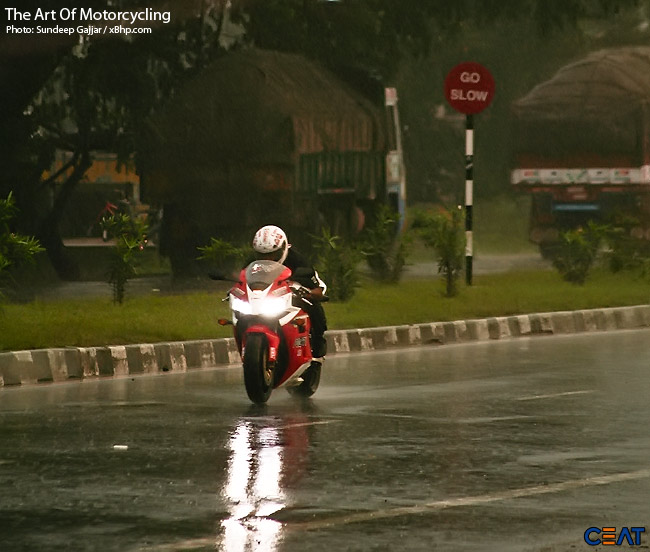


    Hydroplaning is the result of your tires moving fast across a wet surface - so fast that they do not have sufficient time to channel that moisture away from the center of the tire. The result is that the tire is lifted by the water away from the road and all traction is thus lost. Skimming stones across a pond or water skiing are great examples. The tyres on the bike work like skis and the rider has no control over direction. Tread design, tread depth, weight of motorcycle, tire pressure and depth of water all play a part in determining at what speed the tire will begin to hydroplane.

    In the event of hydroplaning, do not apply your brakes or try to steer the bike in any direction but the straight-ahead. If you know that you are going to be riding in the rain, add some 3-5 psi of pressure in your tires. Increasing the tire pressure makes its contact patch smaller. In other words, it increases the weight per square inch of the contact patch so that it takes more 'uplift' by water to cause hydroplaning. And just as increasing pressure makes the contact patch smaller, it also tends to spread out the tread grooves which, in turn, makes it easier to squeeze out water away from the contact patch.

    Wear a proper rain suit and helmet while riding in the rain. The discomfort of being wet distracts the rider from paying full attention to his riding. Also, raindrops can be very painful when they hit an unprotected face. A good clean visor keeps this unnecessary pain away and you don't have to squint your eyes against the rainy onslaught. Squinting the eyes cuts down the much-needed peripheral vision. Use reflections on a wet road to your advantage. Walls, electric poles, overhead cables and parked vehicles all work as reflecting surfaces that can enable you to see around corners. But avoid all shiny spots on the road like plague. They could mean either a puddle, slippery paint or oil.

    Posting Replies to this Article

    Want to add to this article? Great! But please don't start repeating what has already been stated here. And people who post subsequent to additions by others are advised to go through these additional posts too and not repeat whatever has already been said.
    • Only comments which add on value to the article will be approved.
    • You may add on more points, pointers to the subject relating to this article.
    Here are some photos of riding in rains

    Click image for larger version

Name:	22713175_1682927458386515_4333707428589254575_o.jpg
Views:	1
Size:	85.3 KB
ID:	1967788
    That is Ninja H2 during #powerTrip360

    Click image for larger version

Name:	DSK_Benelli_899_rain_anniversary_delhi_1.jpg
Views:	1
Size:	73.7 KB
ID:	1967789

    Click image for larger version

Name:	DSK_Benelli_899_rain_anniversary_delhi_3.jpg
Views:	1
Size:	96.6 KB
ID:	1967790
    xBhp's Benelli 899 during xBhp's 12th anniversary ride

    Click image for larger version

Name:	IMG_5875-Edit.jpg
Views:	1
Size:	97.2 KB
ID:	1967791
    Aprilia RSV4 in pune, shot during #100Motorcycles

    Click image for larger version

Name:	IMG_9777.jpg
Views:	1
Size:	94.3 KB
ID:	1967792
    BMW S1000RR and the Mini Cooper Countryman, riding towards Nainital during xBhp's #DriverVsRider Episode 3 : Pocket Rockets

    Click image for larger version

Name:	IMGP4433.jpg
Views:	1
Size:	82.7 KB
ID:	1967793

    Click image for larger version

Name:	IMGP4439.jpg
Views:	1
Size:	82.0 KB
ID:	1967794
    Indian Motorcycles during our ride to Chittorgarh last year with IMRG
    Last edited by sunilg; 06-18-2019, 05:04 PM.
    sigpic

  • #2
    1) Ride at speeds below your average cruising speeds. Riding in the rains is primarily to enjoy the scenery & the vistas along with the beautiful climate. Remember it is not to race that you ride but to experience nature. Cruising also helps in getting the opportunity to watch of lot of things which are otherwise missed in a dash to reach the destination

    2) Riding / cruising at 60-70 kmph also enables you to control your vehicle much easier than at 80-90.

    3) Apply rain protector liquid on your visor (difficult to obtain in India though), else keep a separate cloth (preferable one without threads / cotton popping out) handy on the bike. wherever you slow down/stop use the cloth to wipe the visor

    4) Potholes are a big accident waiting to happen if you are on an uncharted territory. It is always with caution that one should approach a pothole filled with water as it’s depth is difficult to gauge from above. There have been cases in the past where rims, spokes, alloys have bent/broken, front wheels completely locking & throwing the rider off. Added caution while crossing a pothole is always advisable.

    5) Bullock carts, horses, cows ,dogs ,villagers – only one advice – respect them. In any kind of touring be it rains or otherwise it is these unknown people who lend a helping hand in whatever situation you are trapped.

    All these are just some of the things, small as they may seen are important to note & follow.

    Some points will be added later on with respect to visibility & safety.
    sigpic

    Comment


    • #3
      night time riding in rains...

      1. make sure all the lights are functional. headlights are for your convenience and tail lights are for others to see you. in rains, indicators are much more visible than hand signals. use them wisely.

      2. wear brightly coloured rain gear like yellow, white, fluorescent green etc.. it is good idea to select rain gear with reflective piping as it increases our visibility to others.

      3. potholes are almost invisible at nights, especially when a thousand lights are reflecting from the wet surface. ride slow and safe.

      4. maintain larger distances from the vehicle ahead so that there is enough time to react to sudden situations.
      a larger distance also prevents from flying muck from the tires of vehicle ahead which is very difficult to clean from the visors.

      5. dont wipe the visors with bare hands or dusty/dirty cloth. use a soft clean cotton cloth for the purpose.

      6. make the bike visible. some small 3m reflecting stickers on the rear mudguard especially white ones and rear of the helmets are a good way to be more visible at nights!.

      7. accelerate and brake in a gentle manner. sudden of both these actions tend to increase chances of traction loss.

      8. use good tires with good amount of threads on it.

      9. the lights from the vehicles glare from the droplets accumulated on the visors, i dont know how to deal with this problem. ride slow and keep wiping the visor is the only solution i know.

      10. overtaking is a skill in rains. when the vehicle gives pass, its a bad idea to accelerate madly. rather accelerate gently and progressively. since the visibility is low in rains, make sure of all the objects ahead before overtaking.

      11. giving pass to vehicles behind is also a decision to be taken carefully. give proper signals and reduce speed progressively while giving pass.

      12. turns may not be visible as easily as in normal day night time riding. it is better to slow in advance.

      13. dont try to lean the bike on curves.

      14. on mountains, the soil from the slopes may be very very slippery. try to avoid soil and gravel as much as possible.


      ... if anyone has more to add, please do the needful...
      ride safe and enjoy:-)


      saj*
      you wanna know me?

      COME RIDE WITH ME!!!!

      Comment


      • #4
        For riding in the rain here are some thoughts that can help:

        Lights: Keep your Parking lights ON or on Low Beam.


        Ride slow : After or In the rain, when usually road gets wet, the Firction, Traction diminishes.. So it is advisable to ride slow and steady to get a better control on it and if anything happens you get time to correct it!

        Braking: It is advisable to use Engine braking during rains, and ifyou are to use the brakes ,Be Gentle on Brakes,as harsh braking may lock up the wheels,and cause them to skid.

        Road grip : If your tyre is old, or you are facing big issues with road grip, a temporary solution is to lower the tyre pressure slightly (5-6 psi will do) to get better grip till you can replace the tyre.

        Clear vision : If your helmet visor does not have anti-fog capabilities, then you should keep it open slightly to maintain the best vision possible. If you still have issues, wear a balaclava and open the visor fully. The balaclava will ease the pain caused by rain drops while riding at high speeds.
        If you have got any kind of Wax polish, Apply a very thin Coat of it!

        Take off the glasses : Specs can also cause vision problems. In most cases, you vision will improve if you take them off.

        Wear Rain Protective Stuffs : Covering up your arms and legs is a good idea as it prevents the rain drops from hitting the body directly. High speed raindrops are painful. You can use rain Coat's etc..
        Also, keep some polythenes with you,keep your valuables in that polythene along with a DRY Handkercheif!

        Wear gloves : You wet hands can lose grip on the handlebars. Wear gloves to make sure you retain control of the bike.

        Watch out for hail-storms : Look for shelter at the first sign of a hail-storm, and not a tree on the side of the road. For hail-storms, you need a strong structure to protect you and your bike. It should be wide enough to prevent any harm from any direction. Petrol pumps are a good place or any concrete structure will probably be fine.

        Maintain distance from the vehicle in front : Not only will it help you brake effectively, it will also minimize the dirt spray on your helmet and clothes.

        Toll : If you are riding on way that has got a toll booth,instead of Currency note,use COINS.

        Rain protectors : I've seen people riding air-cooled bikes with a large cardboard just in front of the engine to prevent their trousers from getting dirty. This can harm the engine. Carry the 'work bag' if arriving clean is important.

        IF you are riding to WORK in Rain:

        Rain Coats: The best option to save you.

        Carry a bag : You rode to work, you can't roam around wet and dirty all day. So keep some Clothes, A pair of undergarments,and a COMB, by which you can get dressed back into a human being,bychanging in the washroom!

        Leave early : Try to start early from home if it raining,because the traffic gets slow..


        I know this is not complete, But please feel free to input more to complete it!
        Happy Riding !!
        Cheers
        LP
        " Nothing Z Forever,Except D Change "

        Spiti ||Binsar || Lansdowne

        Click Here to Subscribe to the xBhp Delhi SMS Channel
        Click here to See my Photography Work

        sigpic

        Comment


        • #5
          Tips

          All these tips are really very useful, for new as well as for experienced riders. One never knows as to what happens on the next turn. So an advice please follow the simple instructions given by our friends as it will not only help us but save others as well.

          Thanks a lot guys!!

          Comment


          • #6
            Tips to cheat the Rains!

            As all of us who have bikes use them for going to work, so here are a re few tips which I follow to be on time and be prepared for the rains as well..

            1> Always wear a proper Rain Coat specially the ones with Pants.

            2> Wear shorts and a Tshirt below the Rain Suit as you will not have the tension of them getting wet even if water seeps in from the Rain Coat.

            3> Carry your work clothes in a well sealed bag to avoid getting them wet.

            4> If you have a helmet with black visors do change them to the transparent ones as they help a lot, the black one will make the view difficult.

            5> Most important calculate as to what time you usually leave for office and accordingly leave alomst half an hour to 45 min early. Trust me you will get all the time to change as well.

            6> Check you tyre pressure and brakes, also dont forget to check the lights specially the tail light, as its helps the person driving/riding behind you.

            7> Avoid overtaking on flyovers and highways as you never know if its OIL or Water, and also avoid Potholes.

            *** Last drive safely, there is someone waiting for you at home ***

            Comment


            • #7
              Originally posted by The Art Of Safe Riding View Post

              In the event of hydroplaning, do not apply your brakes or try to steer the bike in any direction but the straight-ahead. If you know that you are going to be riding in the rain, add some 3-5 psi of pressure in your tires. Increasing the tire pressure makes its contact patch smaller. In other words, it increases the weight per square inch of the contact patch so that it takes more 'uplift' by water to cause hydroplaning. And just as increasing pressure makes the contact patch smaller, it also tends to spread out the tread grooves which, in turn, makes it easier to squeeze out water away from the contact patch.
              Originally posted by L.P. View Post
              For riding in the rain here are some thoughts that can help:

              Road grip : If your tyre is old, or you are facing big issues with road grip, a temporary solution is to lower the tyre pressure slightly (5-6 psi will do) to get better grip till you can replace the tyre.

              we have got some conflicting suggestions here.

              earlier, i too used to think that decreasing the tyre pressure help increase the tyre grip, but after reading a few articles on the internet about hydroplanning and tyre traction, i now think that increasing the pressure a bit might actually increase the grip.

              also i have read in articles that hydroplanning generally happens with cars and that too with less air pressure, since bike tyres have a curved profile, there are negligible chances of hydroplanning.

              expert, help here.
              Last edited by princesirohi; 06-25-2011, 02:52 AM.
              sigpic

              Tyre Sizes _ Spark Plugs

              Headlight Focus _ Fork Oils

              All India xBhp Couple Riders Thread

              Ashtavinayak + Shirdi
              Purandar
              Raigad
              Dapoli
              Aurangabad
              Kaas Plateu & Thoseghar Waterfalls
              Purandar

              Comment


              • #8
                One most important thing I do for effective braking and cornering is keep checking to friction of the road with my foot.. There are different kind of road surfaces and due to different amount of rainfall on them, there are always different road frictions during rain..

                I know what kind of sole my shoe has and while riding on the road I put my left leg softly on the road and rub it on road surface for a second or two (be sure at that time there are no pebbles or stones or potholes or uneven surface on the road when you do this or else you might get hurt)

                Doing this i get a first hand experience of what is the friction the road has to offer to me, and my mind does all the calculation of how comfortable I am braking on this surface with the kind of tyre I have.

                This needs good amount of experience to know the level of grip your tyres provide, calculating it with the way you brake and eventually relating it with they way your foot slides on the road surface.

                It helps me... I dont know how many of you have tried this.. but i suggest you guys to try this.. It really works....
                THE RACE NEVER ENDS..

                Comment


                • #9
                  do not forget to get the bike serviced before the rains start.

                  this should include cleaning, oiling, a visual inspection of tyres/brakes/lights and change if required.

                  get fuel tank cleaned up and ensure that water bypass pipe is not clogged, if your tank has one. this helps if you park outside in rains.

                  do not get tempted to ride faster if others are doing so on the road. Stopping in rains is tricky than riding through.

                  keep judging your brakes and apply them after intervals. Applying brakes creates heat and helps to displace water around liners/pads. This way the brakes remain more effective and ready if you need them all of a sudden.

                  Comment


                  • #10
                    You missed out the fact that one should turn their headlights on while riding in the rain.

                    Comment


                    • #11
                      Originally posted by The Art Of Safe Riding View Post

                      Brake gently, using more of the rear brake than the front (just the opposite of what you would do in the dry).
                      Why more rear? true even when both wheels have discs?

                      Originally posted by darkknight View Post
                      3) Apply rain protector liquid on your visor (difficult to obtain in India though), else keep a separate cloth (preferable one without threads / cotton popping out) handy on the bike. wherever you slow down/stop use the cloth to wipe the visor
                      Any brand in mind? Can I get here in the US? I have a everclear visor that does not fog up from the inside of the helmet. That helps for sure

                      Originally posted by L.P. View Post
                      [FONT=Century Gothic][SIZE=3]
                      Braking: It is advisable to use Engine braking during rains, and ifyou are to use the brakes ,Be Gentle on Brakes,as harsh braking may lock up the wheels,and cause them to skid.
                      I experienced the contrary. downshifting caused the rear wheel to torque and lose traction on many occasions. maybe i was doing it wrong, but on a downslope with hydroplaning kicking in, i had some rear slides...not pleasant!..but i do get your point....i engine brake in my cage many a times.

                      Comment


                      • #12
                        does decreasing the tire pressure a little help in riding in the rain??
                        the tyres on the apache slip even on dry roads with small patches of water so when it rains i have to ride at speeds around 35-40
                        Last edited by revvhard; 10-04-2011, 10:12 PM.
                        Life should not be a journey to the grave with the intention of arriving safely in a pretty and well preserved body, but rather to skid in broadside, in a cloud of smoke, thoroughly used up, totally worn out, and loudly proclaiming, 'Wow! What a Ride!' -Hunter S. Thompson

                        Comment


                        • #13
                          Originally posted by revvhard View Post
                          does decreasing the tire pressure a little help in riding in the rain??
                          Quite the opposite mate!
                          Always assume the other guy will mess up - Ride Defensively!

                          Comment


                          • #14
                            Riding during rains.

                            Hi all!

                            First, warm wishes for the winter season just round the corner.
                            Now, straight to the topic - riding in rains.
                            I live in Chennai and I cross the entire length of IT Expressway daily in order to reach and return from office (Adyar to Sipcot). It has been pouring heavily nowadays.

                            Lets consider today's incident; I was returning early (my luck ) from office at around 2 PM. Started well from Sipcot (One end of the expressway) I'd barely done 2 kms when it started down-pouring like anything. I stopped and put on my rain coat and continued. But boy, rain drops were hurting me. I couldn't see anything properly through the helmet visor. The road was open and there were no interceptors; courtesy - rains .

                            I struggled to keep up at 45 kmph due to the wind blast from the right side when I saw a CBR 250R cross me at a blinding speed. No idea what was on the freak's mind! He was no less than 100 I am sure! But to my utter sorrow, he skid some 200 metres ahead into a pool of mud.
                            God's grace he was ok. There were scratches and I could see the paint missing from the fairing on the left. I learnt he braked hard due to a dog!

                            Hence, I have a few questions:-
                            1. How to ride in rains?
                            2. Can we continue counter steering as on a normal day?
                            3. I have been practicing cornering for 3 months now, but today I didn't dare attempt any corner above 30 kmph.
                            Question:- can we corner as effectively in rains?
                            4. Should we ride with the helmet visor closed (poor visibility) or open (you certainly get a face wash...)?
                            5. Is riding over 50 kmph during heavy rains sane?

                            I request sincere help from all XBHPians. I have learnt a lot many things in the past 5 months here. Help me one more time.
                            Got a $5 head? Get a $5 helmet.
                            Because everyone who passes, isn't a martyr!

                            Bullet Service Guide CBR 250R Parts Manual Fz16 service manual - https://drive.google.com/file/d/0B1-...VFQmJzakk/view
                            Hero Moto Corp Bikes' Parts RE STD 350 Wiring Diagram (CI) Service Manual - Classic 350/500
                            ZMR parts - https://drive.google.com/file/d/0B-U...it?usp=sharing
                            P200NS Spares' prices - https://docs.google.com/spreadsheet/...taGd5R2c#gid=0

                            Comment


                            • #15
                              Hi, I have put in some of my inputs.

                              Originally posted by Divya Sharan View Post
                              Hence, I have a few questions:-
                              1. How to ride in rains? Ride normally,just be careful, cut down your speed because you don't see the road ahead as well as in sunshine. Front brakes is a no-no during rains
                              2. Can we continue counter steering as on a normal day? Yes
                              3. I have been practicing cornering for 3 months now, but today I didn't dare attempt any corner above 30 kmph.
                              Question:- can we corner as effectively in rains? No. Not on public roads where surface condition is not guaranteed.
                              4. Should we ride with the helmet visor closed (poor visibility) or open (you certainly get a face wash...)? Buy this: Moto Solutions
                              Close your visor and see the rain disappear. This is not expensive and lasts a long time.

                              5. Is riding over 50 kmph during heavy rains sane? If the road condition, traffic and visibility permits, sure.

                              Comment

                              Working...
                              X
