


Since '02 xBhp is different things to different people. From a close knit national community of bikers to India's only motorcycling lifestyle magazine and a place to make like-minded biker friends. Join us

Castrol Power 1

Keep your helmet tightly strapped up.

Our Partner

Announcement

Collapse
No announcement yet.

Group Riding

Collapse
X
 
  • Filter
  • Time
  • Show
Clear All
new posts

  • Group Riding

    Riding in a group can be fun. A well co-ordinated group on the road is a sight to see. and riding as a part of a group gives each rider a sense of camaraderie and security of numbers. To make a group ride the pleasant affair that it is, there should be a system of riding that is agreed upon by all its members. The riding formation, signals for communicating when on the move, handling of novice members by the experienced members and tackling emergencies should all be a well rehearsed routine for a cohesive group. Prior to every ride, the group should get together to discuss the route details along with any new issues of relevance to the ride apart from rehearsing the existing system. In an order of subject, the following things are worth working on before any and every group ride.
    • Review where we are going and what route we will be taking. Also talk about the distances that are expected to be covered between breaks.
    • Describe how to handle lane changing. Discuss way-points along the day's ride that could work as converging points if the group splits apart. Exchange mobile phone numbers, if any, to get in touch in such a contingency.
    • Specify, demonstrate and explain each hand-signal that would be used.
    • Determine the riding experience of everyone who is new to the group, brief him specifically about things other experienced members take for granted (combining tasks on stops, drinking water frequently to avoid dehydration etc.).
    • Assign (to new people only) 'SLOT' positions that they are to ride in until the leader (who rides behind to assess their riding) is satisfied with their abilities to handle their bikes
    • Invite all the riders to do a 'walk around' their bikes to ensure all is in order and then to take a quick look at the bikes on either side of them for the same reason.

    Remember, you cannot enjoy tomorrow's ride unless you live through today's. And it is the responsibility of each person in the group to ensure that everyone does just that. Safety is of paramount importance and the most significant commandment being 'Thou shalt not hit the bike in front of you'. Riding at a safe distance means following the '2 second rule'. Each bike follows the one in front separated by a distance it would cover in 2 seconds at that speed and under the road conditions the group is riding in.
    For example, in rain either the whole group slows down or the individual riders increase their separation to compensate for increased braking distances need in the wet. The average rider takes almost 1 full second to recognize and then to react to an UNEXPECTED threat. (About 1/2 second if the threat is anticipated.) The '2-second Rule', in other words, provides 1 full second of distance between bikes in order to provide sufficient time for following bikers to recognize and react to unexpected threats. So, if all the riders in the group have roughly similar skill levels, no matter what the rider in front does, the one following should be able to avoid hitting him. Since gravity either aids or detracts from the ability of your brakes to stop your bike based on whether you are on an incline or a decline, following distances must be significantly increased to maintain the safety margin if you are riding downhill - and the steeper the slope, the wider those distances should be.
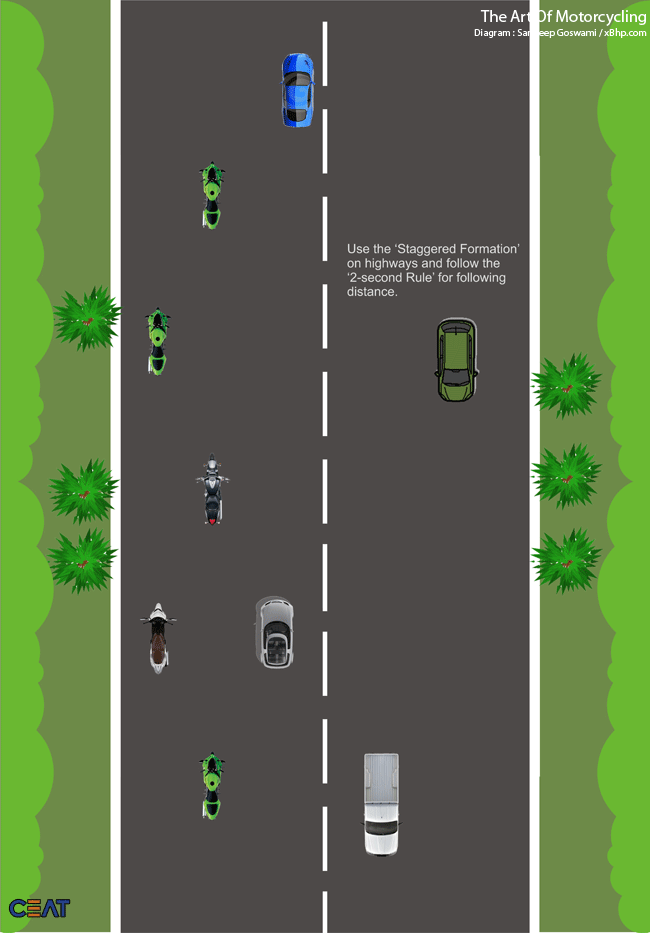


    Also, the distances between bikes should be nearly doubled when riding twisty roads. Remember, The '2-second rule' means that, in staggered formation, there is a ONE second spacing between each bike, thus a TWO second spacing between bikes in the same track. A larger gap usually results in a group that is spread so far out that it introduces new safety problems - like it encourages other vehicles to dart into the gaps between bikes. To avoid undue inadvertent spread-out, the group can adopt these measures.
    • Lead bikes should change speed more gradually. All bikes in a group can react to changes in speed of bikes that are farther ahead of them than just the one immediately ahead. The members of a group should not crank their throttles up to excessive speeds just to keep the group spacing 'correct'.
    • A good group leader does NOT accelerate within 15 seconds of entering a curve (assuming he has to then slow down before actually entering that curve. Remember, fast in and slow out of a turn!) The '1-second between bikes' rule should be abandoned whenever the group is riding on twisty roads - it makes sense only when traveling in a straight line on open highway.
    • Never allow a group to become larger than SIX bikes if even one of the riders is inexperienced with group riding. Never larger than EIGHT bikes even if all are familiar with the riding habits of each other.

    Here are some of the hand signals to be used by a group on the road:

    These T-hands imply 'I need help'. For someone stranded by the road-side, maybe with some mechanical failure or even a puncture, this sign indicates the need for help.
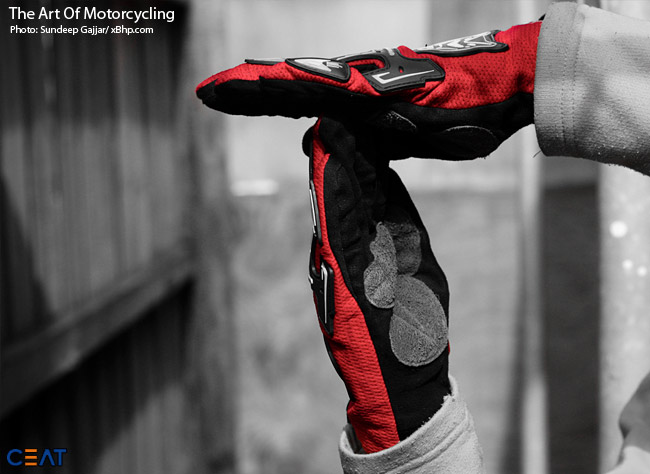

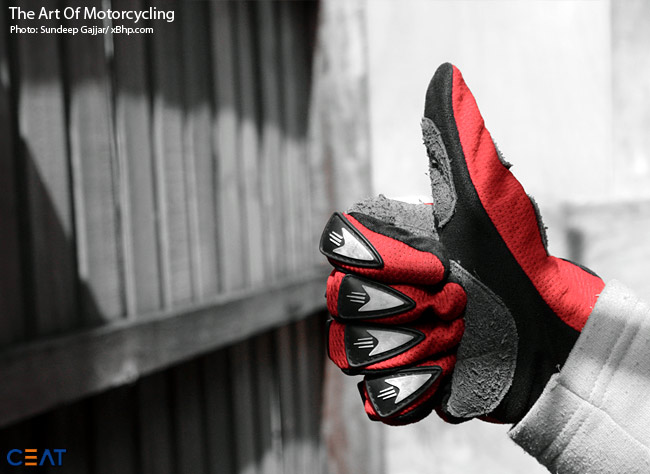
    This thumbs up is the universal okay sign. For the group, when this comes from the leader, it is a signal to get moving. 'Everything is okay. Lets go.'


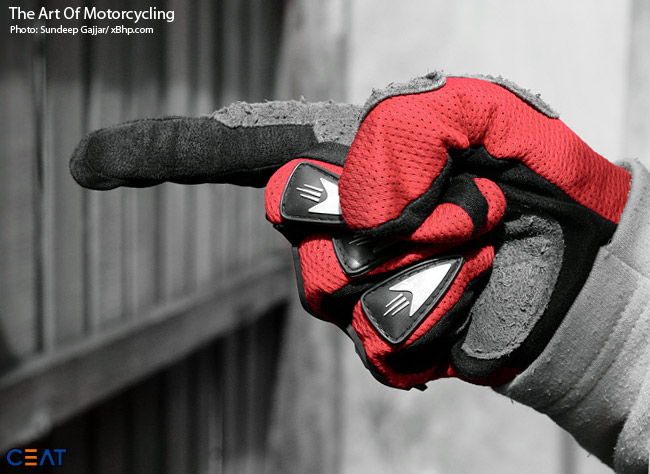
    The pointing finger is used for just what it is. To point the way we are supposed to be heading. Used at intersections, forks in the road and possible diversion points to indicate the road to take.


    The thumbs down says I need to stop for some reason right now. Get behind me, move to the side of the road and stop behind me when I do. A vigorous up and down 'thumbs down' means I need to stop immediately (I got a wasp trapped in my helmet!!).
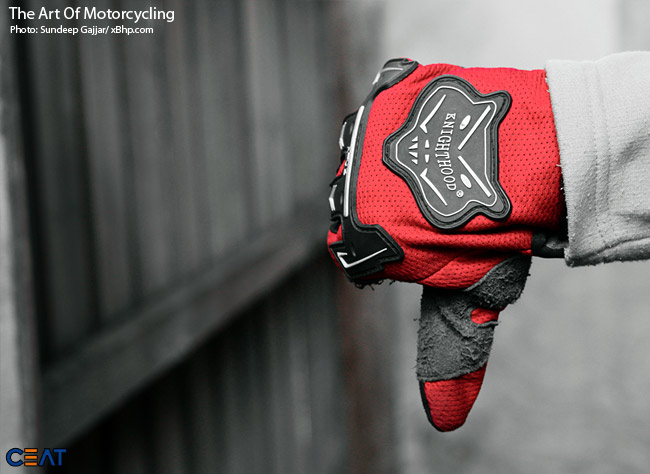


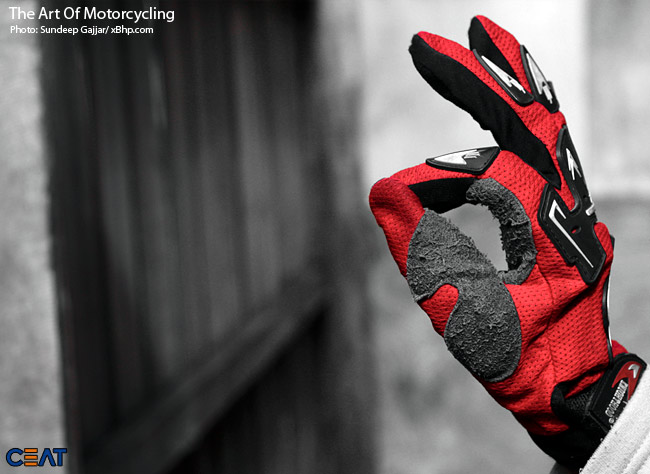
    This is the universal 'looking good' sign. Used as an expression of appreciation that could be for anything (a well executed maneuver, a great stretch of twisty road, beautiful scenery, the bike running well etc. etc.)


    Being in a group means some new responsibilities and behaviors apply. You ride at the speed the group rides, you stay in the lanes chosen by the lead bike, You stop when and where the group stops. When riding in a group there is certainly some team work going on, but each and every person in that group is expected to 'ride their own ride'. Some in the group have more stamina, some have better night vision, some have better navigation skills, some have better familiarity with the surroundings, some are better diplomats and so each 'specialist' has his own role to play at the appropriate time. Strategic decisions (destination) remain the leader's responsibility while tactical decisions (how) might well come from the members.

    Photo: At the least the leaders should keep their headlight on for easy visibility.
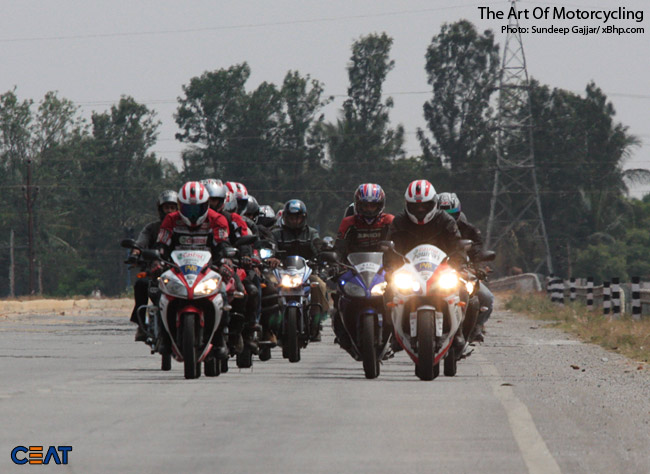

    Photo: Group riding also means stopping at roadsides where there is a lot shoulder space availaible.


    Posting Replies to this Article

    Want to add to this article? Great! But please don't start repeating what has already been stated here. And people who post subsequent to additions by others are advised to go through these additional posts too and not repeat whatever has already been said.
    • Only comments which add on value to the article will be approved.
    • You may add on more points, pointers to the subject relating to this article.
    Last edited by Old Fox; 12-29-2009, 05:07 PM.
    sigpic

  • #2
    Basic but important skills required

    Basic skills

    A few basic skills are needed in order to successfully ride with any group. You must be capable of riding a straight line, controlling your speed, anticipating possible problems and watching the road ahead of you. At the same time, be alert for activity in your peripheral vision.

    Lead Bike--A person who rides in the most forward position in a group and who relays information to all other riders in the group via hand signals. The Lead Bike determines the group’s direction, speed, choice of lane, and formation. He or she often must make quick navigation decisions in the face of road hazards, changes in road surface conditions, poor signage, construction and other obstacles while maintaining control of his or her bike and communicating to those following. If there are three groups on a ride, there will be three Lead Bikes.

    Drag Bike-- A person who rides in the last position in a group. The Drag Bike must secure a lane for the rest of the group during lane changes into faster traffic (move first to block oncoming traffic) and close the door (move to block passing traffic) when a lane is lost in a merging lane situation. Usually this is the most experienced rider in a group, for the Drag Bike is the rider who stops to assist a rider who has mechanical trouble, loses control, or drops out of a ride for some other reason. The Drag Bike should be prepared to render aid to a downed or disabled rider in a group. If at all possible, the Drag Bike should have a co-rider who can assist with traffic control if a serious problem arises. If there are three groups on a ride, there will be three Drag Bikes. The rider in this position is sometimes called the tail gunner.

    Hold your line -- If you have watched a professional race, you know that every rider needs to "hold a line." This means that rider need to be capable of riding a line parallel with the edge of the road.

    Practice this skill by riding 12 to 24 inches to the right of the white shoulder line while trying to keep parallel with that line.

    Group rides incorporate pace lines—or some version thereof—into their sessions. In its most basic form, a pace line occurs when one rider pulls a line of other riders behind them. Each person follows the rider in front of them by staying within a 2-3 bike length of their leader's rear wheel.

    Control your speed -- Fast accelerations or jerky braking motions disrupt the line and can cause a crash.

    Keep eyes and ears open -- The first person in the group can see clear road. Thus, they need to point out road hazards—as do the rest of the people in the line. Pointing out hazards and verbal communication skills are important. For this reason, do not use headphones in a group riding situation.

    When you are following someone, avoid getting a visual fixation on their rear wheel. Look several feet ahead, keeping the distance between your front wheel and the rider ahead of you in your peripheral vision. Watch for road hazards as well as motion to either side of the pace line.

    Though we all get our machines with the rear view mirrors fixed on them, but some of us get them removed. One must keep them there to see cars and other vehicles approaching from the rear. A rear view mirror mounted on your bikes can be very helpful when watching for cars and other fast moving vehicles.

    Maintain the motion of the other riders in your peripheral vision. Watch for sudden changes in cadence—this usually signals some sort of problem.

    Practice

    This column just scratched the surface of group riding skills. Once you master the basics, you should continue to hone your skills.

    Remember: in group rides smart riders often have the advantage over strong riders.
    Last edited by manan_in_2000; 12-04-2009, 07:18 PM.
    sigpic

    Comment


    • #3
      An extensive guide...

      Source: Riding Etiquette

      Motorcycle EtiquetteGroup Riding Etiquette Hand Signals
      please pass all signals to riders behind you.


      START ENGINES:
      With your right or left arm extended, move your


      LEFT TURN:
      Raise your left arm horizontal with your elbow fully extended.


      RIGHT TURN:
      Raise your left arm horizontal with your elbow bent 90 degrees vertically.


      HAZARD LEFT:
      Extend your left arm at a 45 degree angle and point towards the hazard.


      HAZARD RIGHT A:
      Extend your right arm at a 45 degree angle and point towards the hazard.


      HAZARD RIGHT B:
      Extend your left arm upward at a 45 degree angle with your elbow bent to 90 degrees and point towards the hazard over your helmet.


      SPEED UP:
      Raise your left arm up and down with your index finger extended upward. This indicates the leader wants to speed up.


      SLOW DOWN:
      Extend your left arm at a 45 degree angle and move your hand up and down.


      Extend your left arm at a 45 degree angle with the palm of your hand facing rearward.


      SINGLE FILE:
      Position your left hand over your helmet with your fingers extended upward. This indicates the leader wants the group in a single file formation. Usually this is done for safety reasons.


      STAGGERED or SIDE-BY-SIDE FORMATION:
      Extend your left arm upward at a 45 degree angle with your index and pinkie finger extended. This indicate that it is safe to return to staggered formation.


      TIGHTEN UP:
      Raise your left arm and repeatedly move up and down in a pulling motion. This indicates the leader wants the group to close ranks.


      TICKED OFF:
      Extend your left arm straight out with your elbow bent 90 degrees. Carefully extend your middle finger to clearly demonstrate your dissatisfaction with the other guy. NOTE: It is not recommended you do this when you are alone.


      Rules: Who Needs Them?
      Some Common Group Riding Terms
      Normal Group Riding Maneuvers Changing Lanes as a Group
      Checking Out The Curves
      Hand Signals Exceptions to Normal Guidelines
      sigpic

      Comment


      • #4
        Motorcycle Group Riding Signals

        thought this might be a help to us.mods please merge it with other threads if it exist.


        Source: http://blog.motorcycle.com/2009/05/1...-safety-month/

        Comment


        • #5
          Art of Safe Group Riding

          I was searching the net for information on safe group riding and stumbled upon this fanatstic article by Mr.Nick Ienatsch in 1991. Even though it was 17 years ago, it can still apply today. In the quest for all of us to become better riders, it is important to search for and gain as much knowledge as possible. We must be "students" of the sport. Enjoy the read!

          The Pace - Nick Ienatsch - Motorcyclist magazine

          Even though the article is for high-powered motorcycles, India has suddenly been flooded by some crazily powered machines or rather owning such a machine has become as easy as buying vegetables from the market and it really pains me when I see so many wannabe Rossis on the road driving recklessly, without considering the consequences and the concern for other automobiles...

          The amount of power these fantastic machines breath is mind-boggling so is the kind of braking they posses, provide the rider can harness these in the right manner and in the right place...

          Asking every xbhpian to ride safe and to spread the same to their loved ones...

          Ride Safe
          Hammer the racetrack. Pace yourself on the street.

          IBA Number: 47054

          Comment


          • #6
            Thread Merged
            Join xBhp On

            Comment


            • #7
              @vikaskurup: nest pics describing the techniques there

              just one caution as we can make out this is meant for regions where traffic moves on right side of the road unlike in India where we move on the left side. we need to adapt(?) it properly.
              RX 135

              Save the endangered species!! Save the Two Strokes!!

              http://www.facebook.com/group.php?gi...&v=info&ref=mf

              Comment


              • #8
                Originally posted by manan_in_2000 View Post
                Staggered formation: a formation of motorcyclists in a group in which the Lead Bike rides in the left track of a lane, the next bike in the right track(slot), and the next bike in the left track, and so on. Bikes in a group generally maintain a minimum interval of two seconds travel time between bikes in the same track, and one second travel time between each bike in the group.

                Slot: any position within a group in the right track of a lane, farthest from oncoming traffic.
                Just to bring to peoples notice that these are for countries with a left hand drive orientation... In right hand drive orientation countries like ours these will be flipped the other way round...
                "stay hungry, stay foolish."

                To those who have attitude... My middle finger salutes you...!

                Rajmachi Conquered...!
                sigpic

                Comment


                • #9
                  One more article on "Riding in Group"
                  Click here.!!!
                  sigpic

                  Comment


                  • #10
                    Re: Group Riding

                    Click image for larger version

Name:	group3.jpg
Views:	1
Size:	91.3 KB
ID:	1967858

                    Click image for larger version

Name:	rain2.jpg
Views:	1
Size:	57.3 KB
ID:	1967859

                    Click image for larger version

Name:	group5.jpg
Views:	1
Size:	94.6 KB
ID:	1967860

                    Some group riding shots from our previous rides!

                    ----consecutive posts auto-merged-----

                    Originally posted by The Art Of Safe Riding View Post
                    Riding in a group can be fun. A well co-ordinated group on the road is a sight to see. and riding as a part of a group gives each rider a sense of camaraderie and security of numbers. To make a group ride the pleasant affair that it is, there should be a system of riding that is agreed upon by all its members. The riding formation, signals for communicating when on the move, handling of novice members by the experienced members and tackling emergencies should all be a well rehearsed routine for a cohesive group. Prior to every ride, the group should get together to discuss the route details along with any new issues of relevance to the ride apart from rehearsing the existing system. In an order of subject, the following things are worth working on before any and every group ride.
                    • Review where we are going and what route we will be taking. Also talk about the distances that are expected to be covered between breaks.
                    • Describe how to handle lane changing. Discuss way-points along the day's ride that could work as converging points if the group splits apart. Exchange mobile phone numbers, if any, to get in touch in such a contingency.
                    • Specify, demonstrate and explain each hand-signal that would be used.
                    • Determine the riding experience of everyone who is new to the group, brief him specifically about things other experienced members take for granted (combining tasks on stops, drinking water frequently to avoid dehydration etc.).
                    • Assign (to new people only) 'SLOT' positions that they are to ride in until the leader (who rides behind to assess their riding) is satisfied with their abilities to handle their bikes
                    • Invite all the riders to do a 'walk around' their bikes to ensure all is in order and then to take a quick look at the bikes on either side of them for the same reason.

                    Remember, you cannot enjoy tomorrow's ride unless you live through today's. And it is the responsibility of each person in the group to ensure that everyone does just that. Safety is of paramount importance and the most significant commandment being 'Thou shalt not hit the bike in front of you'. Riding at a safe distance means following the '2 second rule'. Each bike follows the one in front separated by a distance it would cover in 2 seconds at that speed and under the road conditions the group is riding in.
                    For example, in rain either the whole group slows down or the individual riders increase their separation to compensate for increased braking distances need in the wet. The average rider takes almost 1 full second to recognize and then to react to an UNEXPECTED threat. (About 1/2 second if the threat is anticipated.) The '2-second Rule', in other words, provides 1 full second of distance between bikes in order to provide sufficient time for following bikers to recognize and react to unexpected threats. So, if all the riders in the group have roughly similar skill levels, no matter what the rider in front does, the one following should be able to avoid hitting him. Since gravity either aids or detracts from the ability of your brakes to stop your bike based on whether you are on an incline or a decline, following distances must be significantly increased to maintain the safety margin if you are riding downhill - and the steeper the slope, the wider those distances should be.


                    Also, the distances between bikes should be nearly doubled when riding twisty roads. Remember, The '2-second rule' means that, in staggered formation, there is a ONE second spacing between each bike, thus a TWO second spacing between bikes in the same track. A larger gap usually results in a group that is spread so far out that it introduces new safety problems - like it encourages other vehicles to dart into the gaps between bikes. To avoid undue inadvertent spread-out, the group can adopt these measures.
                    • Lead bikes should change speed more gradually. All bikes in a group can react to changes in speed of bikes that are farther ahead of them than just the one immediately ahead. The members of a group should not crank their throttles up to excessive speeds just to keep the group spacing 'correct'.
                    • A good group leader does NOT accelerate within 15 seconds of entering a curve (assuming he has to then slow down before actually entering that curve. Remember, fast in and slow out of a turn!) The '1-second between bikes' rule should be abandoned whenever the group is riding on twisty roads - it makes sense only when traveling in a straight line on open highway.
                    • Never allow a group to become larger than SIX bikes if even one of the riders is inexperienced with group riding. Never larger than EIGHT bikes even if all are familiar with the riding habits of each other.

                    Here are some of the hand signals to be used by a group on the road:

                    These T-hands imply 'I need help'. For someone stranded by the road-side, maybe with some mechanical failure or even a puncture, this sign indicates the need for help.


                    This thumbs up is the universal okay sign. For the group, when this comes from the leader, it is a signal to get moving. 'Everything is okay. Lets go.'


                    The pointing finger is used for just what it is. To point the way we are supposed to be heading. Used at intersections, forks in the road and possible diversion points to indicate the road to take.


                    The thumbs down says I need to stop for some reason right now. Get behind me, move to the side of the road and stop behind me when I do. A vigorous up and down 'thumbs down' means I need to stop immediately (I got a wasp trapped in my helmet!!).


                    This is the universal 'looking good' sign. Used as an expression of appreciation that could be for anything (a well executed maneuver, a great stretch of twisty road, beautiful scenery, the bike running well etc. etc.)


                    Being in a group means some new responsibilities and behaviors apply. You ride at the speed the group rides, you stay in the lanes chosen by the lead bike, You stop when and where the group stops. When riding in a group there is certainly some team work going on, but each and every person in that group is expected to 'ride their own ride'. Some in the group have more stamina, some have better night vision, some have better navigation skills, some have better familiarity with the surroundings, some are better diplomats and so each 'specialist' has his own role to play at the appropriate time. Strategic decisions (destination) remain the leader's responsibility while tactical decisions (how) might well come from the members.

                    Photo: At the least the leaders should keep their headlight on for easy visibility.


                    Photo: Group riding also means stopping at roadsides where there is a lot shoulder space availaible.

                    Click image for larger version

Name:	group3.jpg
Views:	1
Size:	91.3 KB
ID:	1967858

                    Click image for larger version

Name:	rain2.jpg
Views:	1
Size:	57.3 KB
ID:	1967859

                    Click image for larger version

Name:	group5.jpg
Views:	1
Size:	94.6 KB
ID:	1967860

                    Some group riding shots from our previous rides!
                    (Been There Done That) x 3.25

                    Comment


                    • #11
                      Re: Group Riding

                      I also like this

                      Comment

                      Working...
                      X
