








 Tweet
Tweet
Few riders realize that the front brake is the most effective in a two wheeler. Just using the rear brake allows you to barely use some 30% of the total braking force possible. Using the front brake is like pushing the bike from its front against its direction of motion and this is far more effective that trying to pull it to a stop by hanging from behind it. Moreover, using the front brake throws a lot of weight on the front tyre and this allows it to grip the road better. Grade your braking so that some 70% of the braking effort comes from the front brake while the remaining 30% from the rear wheel. The rear brake is primarily to stabilize the bike and preventing a violent weight transfer onto the front wheel. Too much rear brake will lock up the rear wheel and the bike slides out of control. The only precautions while making full use of the front brake is to keep the bike upright and avoid its full application on wet or gravel roads. In slippery conditions, use the rear brake sparingly while making the most of the available engine braking. And while in a turn, try and straighten up the bike as much as possible before applying the brakes. Stop turning before you start braking.
Get used to the front fork dive on applying the front brakes. Be smooth but firm in the brake application (squeeze the lever as if it is the trigger of a gun, don't grab it). The harder you learn to apply the front brake and the sooner you can get it to its full power, the shorter will be your stopping distance.
Tips about braking:
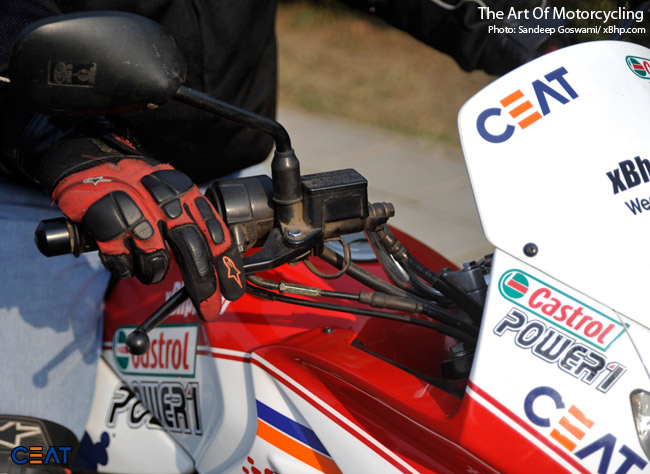
Ride with two fingers covering the front brake lever. In case of an emergency the natural reflex of clenching the fist automatically applies the brake. (By the way, almost all of the power in your fingers is in the first two.) To come to a smooth halt, bring the rear brake alone into action while releasing the front one just before coming to a full stop. The jolt that arises on stopping, from the front forks dive, does not happen this way.
Photo: Stopping distances for the three different brake combinations
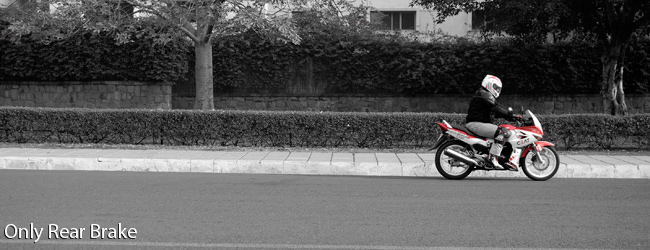
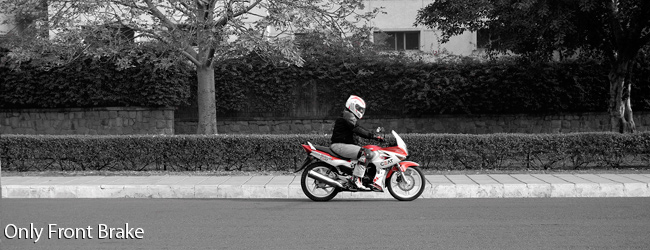
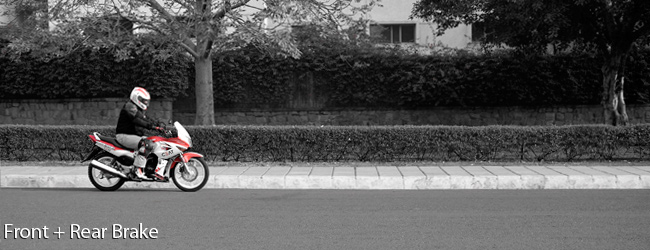
Photo (below): Ideal configuration for panic braking
REPRODUCING POST FROM HERE ON PAGE 6 FOR EASY REFERENCE
There's a well known adage in aviation, particularly for fighter pilots, and it goes like this:
When an emergency arises your performance drops to the lowest level of training.
I have never come across a more realistic observation of deterioration of skills when under hostile fire. Practicing for emergencies is as good as the emergency simulation you do, actually a little worse than that. Which is why you need to practice so much that the needed actions become second nature, a 'reflex'. And practicing the 'right' technique is critical because the 'reflex', once embedded in muscle memory, will not allow you to think and correct it if its wrong.
What Tenhut, csgup1, rossiter and quite a few others have put forth here is about not just the need to learn the skills but the criticality of learning the RIGHT technique. Becoming a proficient motorcyclist is a lifelong endeavor. You are either busy learning new skills or practicing old ones.
Braking is a very 'critical' skill for a motorcyclist. The real art in going fast is to know when to go slow and how to go slow. And getting it right, practicing it right and executing it right is what will keep you alive. Its one major 'vital' in the Vital few and trivial many aspects of motorcycling. Learning braking in real life urban riding situations is about including road traction assessment into your braking action. Practice the gentle squeeze to firm squeeze technique any and every time you brake while riding. Feel the firming up of the front brake lever under you fingers. Scan the road ahead for adjustments to braking. Check those RVM's before, during and after braking. Feel the weight transfer drop the front and know that the rear has gone light by an equivalent amount. Practice each and every time you brake, so much so that you unthinkingly brake like that everytime. Aim for a point to stop and see how well you assessed the distance and braking effort needed. See that little piece of paper on the road, try to steer around it while you brake. Set up your line and entry speed to those turns to perfection. In a well set-up turn, whether on road or on track, you'll not need emergency mid-turn corrections. It is only when you set up a turn on assumptions rather than knowledge of the road/track ahead that you need mid-course corrections.
Incessant learning is essentially what it is all about. Remember that a skilled rider will use his skilled brain to avoid needing those superior skills. Paradoxical but actually the only real way of enjoying your motorcycling and yet staying alive doing it.
Lots of useful information has been shared about 'trail braking' here. I'll add a visual aspect to it and start with a diagram that I've taken from a book 'Sport Riding Techniques' by Nick Ienatsch.

The orthodox riding technique states that we finish all our braking and gear shifting while the bike is upright, enter the turn on constant throttle and just past the apex, feed in the throttle progressively. But the preferred method now is using 'trail braking'. Trail Braking is a technique where the rider progressively reduces his braking force as he gets deeper into the turn and closer to the apex. This progressive and smooth reduction in braking is to use a progressively larger share of traction for turning, a need that hits its maximum at the apex, where the braking input is reduced to zero. Trail braking has two major benefits: 1. It allows for braking while turning, allowing the rider more control over his situation. and 2. The rider can carry speed deeper into the turn and by slowing progressively towards the apex, has more reserve traction to trade for the same needed for turning.
Post-apex, progressively opening the throttle makes for gradual rearward weight transfer allowing the rear tyre time to gain traction and transfer power for acceleration.
In practice, the overlap between trail braking and powering out is a smooth blend, always balancing the available traction to the traction needs.
Trail braking is a difficult skill to master primarily because as you brake during the turn, you put additional loads on the contact patches which are already fighting a hard battle for traction by countering the outward tangential force. Adding braking loads to the equation takes you closer to the edge of the traction envelope and even a slight excess in loading can lead to a washout.
As for the unassailable logic of favouring the front brakes, the related and at times disconcerting nose-dive and what happens when we do so was something I had posted earlier in another thread here quite sometime back. Reproducing the same below to maintain continuity as has been the case with the trail braking part above which is also taken from the same thread:
I guess we need to get back to high-school physics to clear this thing about forward weight transfer under braking, its benefits and demerits in its entirety.
Weight transfer is a physical reality that has to happen, whether there is a suspension system pre se or not. Refer to the fig in my previous mail that I am reproducing below:

Braking produces a force (because the rider/bike combo is in motion and braking means deceleration) that has eventually to act through the front tyre contact patch where it is countered by the force of friction between the road and the contact patch. Since the connection between the contact patch and the rest of the bike is primarily through the fork, a large component of this force travels down the forks. The exact quantum of this force transfer can be calculated by referring to the fig below:

As the forks are raked at an angle to the vertical, the force transferred through them can be calculated as a product of the total force and the Cosine of the angle of application of the force. Here the angle is the 'rake' angle minus 90deg (since the rake angle is measured against the vertical). Assuming a rake angle of 25deg and a braking force of 1N, the force component acting down the forks would be = 1 (N) x Cos(65) = 0.4226. Meaning that some 42% of the braking force shall act through the forks.

Let us assume a ZMA (about 150kg) with a rider weighing 70kg coming to a panic stop. Stock tyres on clean tarmac can give a decelration equal to about 1G i.e. about 9m/sec2
So the total force generated would be like F= M x A = 220 x 9 = 1980N
1980N x 0.42 = 836N = 85kg (appox)
So the forks get pressed downwards by a force equivalent to 85kgs. No wonder they get compressed.
As you can see, the 'softness' or 'stiffness' of the suspension set-up has no meaning for weight transfer. The 'weight Transfer' is a Force that is generated due to braking. It is just that with a softer suspension, you get a larger deflection of the springs, more dive and so it 'feels' like there has been a LOT of weight transfer occurring.
USEFUL CONTENT FROM OTHER MEMBERS
Get used to the front fork dive on applying the front brakes. Be smooth but firm in the brake application (squeeze the lever as if it is the trigger of a gun, don't grab it). The harder you learn to apply the front brake and the sooner you can get it to its full power, the shorter will be your stopping distance.
Tips about braking:
- Roll off the throttle.
- Apply the brakes simultaneously to settle the bike.
- Increase front lever pressure as you decrease rear pedal pressure.
- As you near a stop, decrease front lever pressure and increase rear pedal pressure, if necessary.
Ride with two fingers covering the front brake lever. In case of an emergency the natural reflex of clenching the fist automatically applies the brake. (By the way, almost all of the power in your fingers is in the first two.) To come to a smooth halt, bring the rear brake alone into action while releasing the front one just before coming to a full stop. The jolt that arises on stopping, from the front forks dive, does not happen this way.
Photo: Stopping distances for the three different brake combinations
Photo (below): Ideal configuration for panic braking
REPRODUCING POST FROM HERE ON PAGE 6 FOR EASY REFERENCE
There's a well known adage in aviation, particularly for fighter pilots, and it goes like this:
When an emergency arises your performance drops to the lowest level of training.
I have never come across a more realistic observation of deterioration of skills when under hostile fire. Practicing for emergencies is as good as the emergency simulation you do, actually a little worse than that. Which is why you need to practice so much that the needed actions become second nature, a 'reflex'. And practicing the 'right' technique is critical because the 'reflex', once embedded in muscle memory, will not allow you to think and correct it if its wrong.
What Tenhut, csgup1, rossiter and quite a few others have put forth here is about not just the need to learn the skills but the criticality of learning the RIGHT technique. Becoming a proficient motorcyclist is a lifelong endeavor. You are either busy learning new skills or practicing old ones.
Braking is a very 'critical' skill for a motorcyclist. The real art in going fast is to know when to go slow and how to go slow. And getting it right, practicing it right and executing it right is what will keep you alive. Its one major 'vital' in the Vital few and trivial many aspects of motorcycling. Learning braking in real life urban riding situations is about including road traction assessment into your braking action. Practice the gentle squeeze to firm squeeze technique any and every time you brake while riding. Feel the firming up of the front brake lever under you fingers. Scan the road ahead for adjustments to braking. Check those RVM's before, during and after braking. Feel the weight transfer drop the front and know that the rear has gone light by an equivalent amount. Practice each and every time you brake, so much so that you unthinkingly brake like that everytime. Aim for a point to stop and see how well you assessed the distance and braking effort needed. See that little piece of paper on the road, try to steer around it while you brake. Set up your line and entry speed to those turns to perfection. In a well set-up turn, whether on road or on track, you'll not need emergency mid-turn corrections. It is only when you set up a turn on assumptions rather than knowledge of the road/track ahead that you need mid-course corrections.
Incessant learning is essentially what it is all about. Remember that a skilled rider will use his skilled brain to avoid needing those superior skills. Paradoxical but actually the only real way of enjoying your motorcycling and yet staying alive doing it.
Lots of useful information has been shared about 'trail braking' here. I'll add a visual aspect to it and start with a diagram that I've taken from a book 'Sport Riding Techniques' by Nick Ienatsch.
The orthodox riding technique states that we finish all our braking and gear shifting while the bike is upright, enter the turn on constant throttle and just past the apex, feed in the throttle progressively. But the preferred method now is using 'trail braking'. Trail Braking is a technique where the rider progressively reduces his braking force as he gets deeper into the turn and closer to the apex. This progressive and smooth reduction in braking is to use a progressively larger share of traction for turning, a need that hits its maximum at the apex, where the braking input is reduced to zero. Trail braking has two major benefits: 1. It allows for braking while turning, allowing the rider more control over his situation. and 2. The rider can carry speed deeper into the turn and by slowing progressively towards the apex, has more reserve traction to trade for the same needed for turning.
Post-apex, progressively opening the throttle makes for gradual rearward weight transfer allowing the rear tyre time to gain traction and transfer power for acceleration.
In practice, the overlap between trail braking and powering out is a smooth blend, always balancing the available traction to the traction needs.
Trail braking is a difficult skill to master primarily because as you brake during the turn, you put additional loads on the contact patches which are already fighting a hard battle for traction by countering the outward tangential force. Adding braking loads to the equation takes you closer to the edge of the traction envelope and even a slight excess in loading can lead to a washout.
As for the unassailable logic of favouring the front brakes, the related and at times disconcerting nose-dive and what happens when we do so was something I had posted earlier in another thread here quite sometime back. Reproducing the same below to maintain continuity as has been the case with the trail braking part above which is also taken from the same thread:
I guess we need to get back to high-school physics to clear this thing about forward weight transfer under braking, its benefits and demerits in its entirety.
Weight transfer is a physical reality that has to happen, whether there is a suspension system pre se or not. Refer to the fig in my previous mail that I am reproducing below:
Braking produces a force (because the rider/bike combo is in motion and braking means deceleration) that has eventually to act through the front tyre contact patch where it is countered by the force of friction between the road and the contact patch. Since the connection between the contact patch and the rest of the bike is primarily through the fork, a large component of this force travels down the forks. The exact quantum of this force transfer can be calculated by referring to the fig below:
As the forks are raked at an angle to the vertical, the force transferred through them can be calculated as a product of the total force and the Cosine of the angle of application of the force. Here the angle is the 'rake' angle minus 90deg (since the rake angle is measured against the vertical). Assuming a rake angle of 25deg and a braking force of 1N, the force component acting down the forks would be = 1 (N) x Cos(65) = 0.4226. Meaning that some 42% of the braking force shall act through the forks.
Let us assume a ZMA (about 150kg) with a rider weighing 70kg coming to a panic stop. Stock tyres on clean tarmac can give a decelration equal to about 1G i.e. about 9m/sec2
So the total force generated would be like F= M x A = 220 x 9 = 1980N
1980N x 0.42 = 836N = 85kg (appox)
So the forks get pressed downwards by a force equivalent to 85kgs. No wonder they get compressed.
As you can see, the 'softness' or 'stiffness' of the suspension set-up has no meaning for weight transfer. The 'weight Transfer' is a Force that is generated due to braking. It is just that with a softer suspension, you get a larger deflection of the springs, more dive and so it 'feels' like there has been a LOT of weight transfer occurring.
- Learn to depend upon and use the front brake to fulfill most of your braking needs.
- The rear brake is useful mostly under low traction situations or at low speeds where front end dive leads to instability. (Eg: lane splitting as a stop light)
- Braking is not just about 'braking' but also about reading the road that you'll be braking upon.
- Practice, practice and practice but practice right. Learn it wrong and it takes longer to get rid of wrong learning that it takes to learn right. And to know whats right, you have lots of people on this forum and the internet as a vast repertory of information.
USEFUL CONTENT FROM OTHER MEMBERS
Tenhut:
1. OMG...sorry but tap-release-tap is the worst kinda braking you can do on bikes. Seriously, it will only destabilize the bike. You are supposed to use the brake levers as a "regulator" and not as an on-off "switch".
You start with gentle pressure on the front lever gradually giving the lever hell. When you apply gentle pressure the weight of the bike shifts forward. The front tyre now gets more contact patch to take more braking input. That's the only reason why you should be gentle first and then you MUST go on increasing the braking( with more contact patch the tyre has enough braking traction to take a lot of braking abuse).
Grabbing the lever in panic braking doesn't allow the front contact patch to widen and hence the front skids. Its not because the force was too much. The same force if applied after making sure of the front contact patch will stop the bike without the front skidding.
2. John Hopkins was Kieth Codes Student. Kieth advocates trail-braking (not always) in some corners. That's braking at the entrance of the corner and gradually letting go of the lever completely when you hit the apex. Its braking when in lean. Its why 90% of the riders crash when in lean. They wash their front due to excess braking. Don't try trail braking. Its not a way to get faster...its only to be used as a tool if you think you have overcooked your corner. Tbh if you overcook the corner
Trail braking is done when you are battling on a rcae track and too much money is on stake.
3. Best Advice ! Balls of your feet should be on the pegs. Always..it also adds stability to the bike cause your calves and thighs are acting as another set of springs giving you extra suspension. Of course in the beginning all the spring action your legs go through will make you tired and you may think its not working for you. It does..for everyone..just a matter of time before you get used to it.
Someone asked if braking will be different for a chopper. Forget chopper/scooties..it will be different when you are going uphill (more weight on the rear= rear brake can now be applied without skidding) or downhill (more weight on the front = using the rear brake is suicidal)
Its easier to ignore the rear brake altogether. When you run out of the front brake pads..switch them with your rear ones.
On choppers/bullets/scooties where you sit upright you brake the rear. Basically whichever wheel has more weight on it you brake that more.
4. Many people think that the way one rides on the track is not the way one shouldnt ride on the streets. The answer to that is of course blowing in the wind and the answer is that one simply shouldn't ride on the streets like one does on the track. What it however simply means is one should be riding maybe at 50% or 60% of ones riding potential on the streets. At the track you can push yourself to beyond 100%
So basically it boils down to riding slow on the streets and fast on the track.
Does braking, throttle control, body position also change on the track and on the street?
NO...whatever you learn at the track are simply the most effective tools to handle your bike and to keep it stable. And why would you not want to keep the bike stable on the streets. So not using the rear on the streets isnt so weird because only racers do that at the tracks.
Using the rear is too much of a trouble with too huge a risk with minimal rewards. Hence the common advice of ignoring it. You can ofcourse use it as much as you want. You will however be better off focussing more on the front as in 9 out of 10 times the front is more than sufficient to stop your bike from any speeds.
5. The rewards of using the rear brake are minimal and the risks associated are insane. If you want that ounce of more braking power you have to use the rear brake. That ounce is what I chose to ignore.
6. On the road make sure you never get into a situation where you have to steer under braking. Its risky as it is on the track...on the streets with multiple unkowns and surface irregularities in the roads its best avoided.
That said u will have times where you just need to brake when steering.
Straighten your bike ....be gentle on the brakes...thats all u can do assuming that you are looking in the right direction.
When you ride everyday try feeling the wheels with your mind. When u brake everyday focus on whats happening with the wheels without looking at them( u cant look at them when on bike anyways). Feel what they are doing..when there are bumps in the road focus on the moments where the wheels are gliding and where they are catching traction again...you develop a sense of traction when you get good at this.
1. OMG...sorry but tap-release-tap is the worst kinda braking you can do on bikes. Seriously, it will only destabilize the bike. You are supposed to use the brake levers as a "regulator" and not as an on-off "switch".
You start with gentle pressure on the front lever gradually giving the lever hell. When you apply gentle pressure the weight of the bike shifts forward. The front tyre now gets more contact patch to take more braking input. That's the only reason why you should be gentle first and then you MUST go on increasing the braking( with more contact patch the tyre has enough braking traction to take a lot of braking abuse).
Grabbing the lever in panic braking doesn't allow the front contact patch to widen and hence the front skids. Its not because the force was too much. The same force if applied after making sure of the front contact patch will stop the bike without the front skidding.
2. John Hopkins was Kieth Codes Student. Kieth advocates trail-braking (not always) in some corners. That's braking at the entrance of the corner and gradually letting go of the lever completely when you hit the apex. Its braking when in lean. Its why 90% of the riders crash when in lean. They wash their front due to excess braking. Don't try trail braking. Its not a way to get faster...its only to be used as a tool if you think you have overcooked your corner. Tbh if you overcook the corner
- Look at the exit (or a safe passage on the streets)
- Maintain the throttle at whatever it is at...dont decrease..dont increase..contrary to your instincts if you let off the throttle you will go wider.
- Counter steer harder and lean harder.
- Pray !
Trail braking is done when you are battling on a rcae track and too much money is on stake.
3. Best Advice ! Balls of your feet should be on the pegs. Always..it also adds stability to the bike cause your calves and thighs are acting as another set of springs giving you extra suspension. Of course in the beginning all the spring action your legs go through will make you tired and you may think its not working for you. It does..for everyone..just a matter of time before you get used to it.
Someone asked if braking will be different for a chopper. Forget chopper/scooties..it will be different when you are going uphill (more weight on the rear= rear brake can now be applied without skidding) or downhill (more weight on the front = using the rear brake is suicidal)
Its easier to ignore the rear brake altogether. When you run out of the front brake pads..switch them with your rear ones.
On choppers/bullets/scooties where you sit upright you brake the rear. Basically whichever wheel has more weight on it you brake that more.
4. Many people think that the way one rides on the track is not the way one shouldnt ride on the streets. The answer to that is of course blowing in the wind and the answer is that one simply shouldn't ride on the streets like one does on the track. What it however simply means is one should be riding maybe at 50% or 60% of ones riding potential on the streets. At the track you can push yourself to beyond 100%
So basically it boils down to riding slow on the streets and fast on the track.
Does braking, throttle control, body position also change on the track and on the street?
NO...whatever you learn at the track are simply the most effective tools to handle your bike and to keep it stable. And why would you not want to keep the bike stable on the streets. So not using the rear on the streets isnt so weird because only racers do that at the tracks.
Using the rear is too much of a trouble with too huge a risk with minimal rewards. Hence the common advice of ignoring it. You can ofcourse use it as much as you want. You will however be better off focussing more on the front as in 9 out of 10 times the front is more than sufficient to stop your bike from any speeds.
5. The rewards of using the rear brake are minimal and the risks associated are insane. If you want that ounce of more braking power you have to use the rear brake. That ounce is what I chose to ignore.
6. On the road make sure you never get into a situation where you have to steer under braking. Its risky as it is on the track...on the streets with multiple unkowns and surface irregularities in the roads its best avoided.
That said u will have times where you just need to brake when steering.
Straighten your bike ....be gentle on the brakes...thats all u can do assuming that you are looking in the right direction.
When you ride everyday try feeling the wheels with your mind. When u brake everyday focus on whats happening with the wheels without looking at them( u cant look at them when on bike anyways). Feel what they are doing..when there are bumps in the road focus on the moments where the wheels are gliding and where they are catching traction again...you develop a sense of traction when you get good at this.
Posting Replies to this Article
Want to add to this article? Great! But please don't start repeating what has already been stated here. And people who post subsequent to additions by others are advised to go through these additional posts too and not repeat whatever has already been said.
Want to add to this article? Great! But please don't start repeating what has already been stated here. And people who post subsequent to additions by others are advised to go through these additional posts too and not repeat whatever has already been said.
- Only comments which add on value to the article will be approved.
- You may add on more points, pointers to the subject relating to this article.





Comment