







 Tweet
Tweet
Exclusive xBhp preview of the latest Virtual Reality Dirt Bike Race simulation brought by TVS Motors.
Motorcycling is majorly visual i.e. depends a lot on what the rider sees. Vision is also one of the finest, fastest and most consummate of our senses, capable of processing colossal amounts of data accurately’ continuously and in real time. Imagine a camera that shoots videos with each frame about 57 megapixels in size and does so at the rate of some 16 frames per second day in and day out. That’s what the eye does and that’s what the brain processes during every waking moment of our life. In fact ‘reality’ itself is defined by what we see more than what we feel, hear or smell. Which takes us to a very interesting innovation to be put forward by TVS Motors at this upcoming Auto Expo 2014.
The world of Virtual Reality (VR) is probably more familiar to this generation than mine whose closest brush with high tech visually interactive games was through arcade games like Space Invaders, Galaga etc. The enormous advances in computing prowess available with even modest home-use desk top set-ups today allied with amazing display capabilities allow a vastly improved and closer-to-reality visual display of video imagery than could have been imagined then. TVS Motors (in conjunction with Nextwave Multimedia, a Chennai based gaming and digital media organization) have developed Racing Aces, a VR Dirt Bike Racing simulation that the visitors to the stall of TVS Motor Company at the Auto Expo 2014 would be able to experience firsthand.
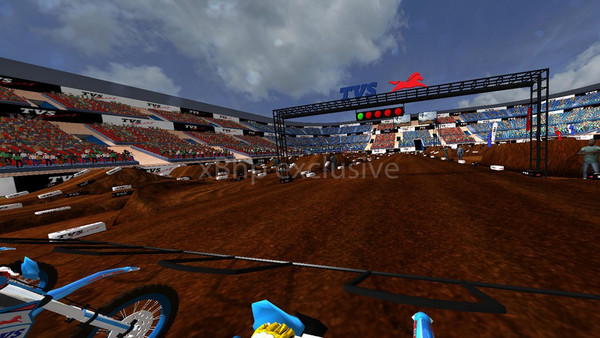
What makes this VR simulation different? Unlike other VR games and simulations you might be familiar with, Racing Aces is developed for display in Oculus Rift, the next-gen VR technology platform. The experience is totally immersive. The viewer is right inside the virtual environment. And because of that it is 360-degree experience for him. He can turn his head and have a real life like experience in the simulated environment. I flew in to Chennai for a day to experience Racing Aces first hand and came away thoroughly impressed. Strap on the Oculous Rift (more on that later) headset, wear headphones for the audio and you’ll walk into an astoundingly real ‘virtual reality’ experience. The full 360o view means you see video imagery around you as naturally as you do in the real world. Look down and you see your hands gripping the bar ends of the dirt bike you’re supposed to be riding. Look left and right and you see other riders astride their bikes ready for the world go! Look up and that beautifully rendered partly cloudy sky comes in sight. The visuals get rendered in real time, without any lag whatsoever and the entire peripheral vision is filled up as in the real world. The usual FOV (field-of-vision) of VR headsets is about 40o-45o whereas the Oculus Rift headset gives you a full 110o FOV. Adding to the realism is the nil lag between your head movement and rendering of the image on the display. Whip your head left, right, up or down and the scenes are always there as they should be and dynamic too i.e. containing video imagery.
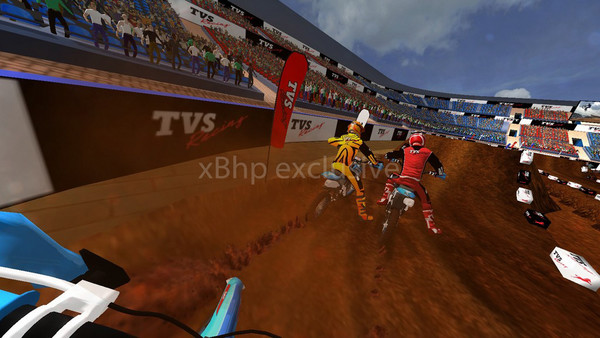
Oculus Rift VR head-set is a head-mounted display unit which the user straps on and views the game, or in the case of 'Racing Aces', the racing simulation, which is loaded on a normal PC's hard drive. Weighing some 400 gms, it is strapped on like a head-mounted light. Still in development stage, the display resolution is 1280 x 800. The next generation of the device are going to be of much higher resolutions. The 2K resolution devices are expected to be out by mid 2014, and the 4K by end of this year. At this high resolution the high-fidelity virtual experience will be truly mind blowing. And far exceed the viewing of 3D stereoscopic movies in theaters. The full 3D stereoscopic display is rendered through video interlacing and is visually very fluid. So much so that the whole experience creates a conflict between our sense of balance and the visual input. The brain senses that the body is still but the eyes present a conflicting image of riding over huge jumps, falling into voids, skidding and sliding around in the mud and careening towards other racers, an image so realistic that you’d flinch on hitting someone, grip the chair on a jump and brace yourself for the landing! The sensory conflict can even induce nausea which thankfully subsides the moment the viewer closes his eyes for a moment.
Check out details about the Oculus Rift technology as their website here.
The idea of developing 'Racing Aces' was born when Pallab Roy, Senior Manager Marketing at TVS Motor Company and Nextwave Multimedia, a Chennai-based gaming and digital media organization got together to explore options of developing something for the TVS Motor's stall at the AutoExpo, that would engage the visitors using high technology. Various options were considered. Nextwave was already into the new Oculus Rift VR technology and had done the groundwork development of the engine. So, when Pallab Roy saw a demo, he knew he had got the 'high technology' he wanted to wow the visitors to the TVS stall with. The question remained about effectively using this revolutionary VR technology. Nextwave suggested a game, but Pallab Roy suggested a dirt bike racing simulation since he wanted to project TVS Racing. And the idea of 'Racing Aces' was born!
This is what Pallab Roy had to say about Racing Aces: "The whole idea is to make people realize what we at TVS Motor Company do to make products for them. Racing, has always has been one of the most significant vertical for us to develop technical advancements in bikes. We actually are the first company in India to have a Factory-owned racing team. Things like Short-stroke engine, Roto-petal discs are all born due to our in-depth understanding of Racing. Also, Racing per se has always been a subject of interest and excitement for people at large.
While exploring possible technological avenues to engage people at Auto Expo, I chanced upon Oculus Rift and I knew that this technology has the potential to educate people about racing while giving them the full excitement and feeling of a racer - a great medium to converge Excitement and Education. We have used Aravind KP, our ace racer and national supercross champion, as the 'narrator and guide' of this overall experience."
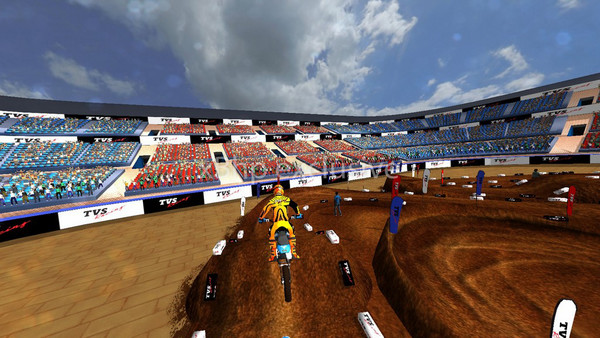
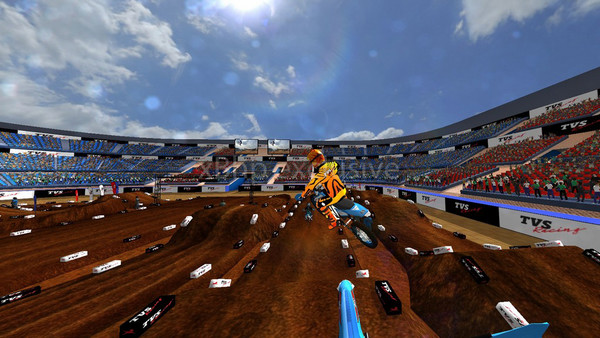
These screen-shots though high in detail in no way come close to seeing the images as a dynamic video rendered over one's entire field of vision.
Nextwave's graphics and Oculus Rift technology team visited the racing tracks of TVS at Hosur to study the tracks, talk to KP Aravind, India's leading dirt track bike racing champion, and see him doing his signature unbelievable and very impressive dirt-ride and jumps. Equipped with this knowledge, the graphics team created the tracks for the simulation, while the technology team, started to build the 'physics' which would determine the behaviour of the virtual bike on the track and in relation to the other bikes in the simulated environment. With the addition of sound effects of bikes starting, roaring, crowds cheering, the metallic clashing when bikes would collide, and so on, the environment was ready to give the visitor the life-like thrill of racing the TVS RTR 300 FX on a professional dirt bike race track. In fact the visitors experiencing Racing Aces at the TVS stall will find it all the more real and exciting as they get to sit astride a real dirt-racing bike, the TVS RTR 300FX while engaged in the virtual race.
The Oculus Rift technology allied with an efficient virtual engine as developed for this simulation has immense possibilities contained within. Rider training is one which will allow the rider to experience dangerous aspects of motorcycling like low-sides, high sides, tank slappers etc within the safe ambit of it being a simulation, a very real one but a simulation nevertheless. Even motorcycle maintenance can be taught using this tool, the viewer being able to witness an engine being taken apart in 3D and put back together. Properly developed applications could even visually show possible faults within the machine and how it would affect the rest of the machinery. For example the engine could be run virtually without oil and the viewer gets to see how metal to metal contact between components deprived of the lubrication wear out and eventually the engine seizes. Being virtual, on-line e-learning is as open to this VR application as is anything else.
As an after-thought and just for comparison purposes, I wanted to know the basic hardware configuration needed to run Oculus Rift VR simulation successfully on and got this answer from the developers:
2GB RAM
Intel Core i3 Processors or above/ AMD Phenom II Processors or above
Mid Range Gaming Graphics card with at least 2 video outputs
Set of Standard headphones
Racing Aces in its present form is an amazing experience for any motorcyclist. Even though this demo version has you sitting passively through a couple of laps, the next stage of making you an active participant in the race would be even more mind-blowing.
Motorcycling is majorly visual i.e. depends a lot on what the rider sees. Vision is also one of the finest, fastest and most consummate of our senses, capable of processing colossal amounts of data accurately’ continuously and in real time. Imagine a camera that shoots videos with each frame about 57 megapixels in size and does so at the rate of some 16 frames per second day in and day out. That’s what the eye does and that’s what the brain processes during every waking moment of our life. In fact ‘reality’ itself is defined by what we see more than what we feel, hear or smell. Which takes us to a very interesting innovation to be put forward by TVS Motors at this upcoming Auto Expo 2014.
The world of Virtual Reality (VR) is probably more familiar to this generation than mine whose closest brush with high tech visually interactive games was through arcade games like Space Invaders, Galaga etc. The enormous advances in computing prowess available with even modest home-use desk top set-ups today allied with amazing display capabilities allow a vastly improved and closer-to-reality visual display of video imagery than could have been imagined then. TVS Motors (in conjunction with Nextwave Multimedia, a Chennai based gaming and digital media organization) have developed Racing Aces, a VR Dirt Bike Racing simulation that the visitors to the stall of TVS Motor Company at the Auto Expo 2014 would be able to experience firsthand.
What makes this VR simulation different? Unlike other VR games and simulations you might be familiar with, Racing Aces is developed for display in Oculus Rift, the next-gen VR technology platform. The experience is totally immersive. The viewer is right inside the virtual environment. And because of that it is 360-degree experience for him. He can turn his head and have a real life like experience in the simulated environment. I flew in to Chennai for a day to experience Racing Aces first hand and came away thoroughly impressed. Strap on the Oculous Rift (more on that later) headset, wear headphones for the audio and you’ll walk into an astoundingly real ‘virtual reality’ experience. The full 360o view means you see video imagery around you as naturally as you do in the real world. Look down and you see your hands gripping the bar ends of the dirt bike you’re supposed to be riding. Look left and right and you see other riders astride their bikes ready for the world go! Look up and that beautifully rendered partly cloudy sky comes in sight. The visuals get rendered in real time, without any lag whatsoever and the entire peripheral vision is filled up as in the real world. The usual FOV (field-of-vision) of VR headsets is about 40o-45o whereas the Oculus Rift headset gives you a full 110o FOV. Adding to the realism is the nil lag between your head movement and rendering of the image on the display. Whip your head left, right, up or down and the scenes are always there as they should be and dynamic too i.e. containing video imagery.
Oculus Rift VR head-set is a head-mounted display unit which the user straps on and views the game, or in the case of 'Racing Aces', the racing simulation, which is loaded on a normal PC's hard drive. Weighing some 400 gms, it is strapped on like a head-mounted light. Still in development stage, the display resolution is 1280 x 800. The next generation of the device are going to be of much higher resolutions. The 2K resolution devices are expected to be out by mid 2014, and the 4K by end of this year. At this high resolution the high-fidelity virtual experience will be truly mind blowing. And far exceed the viewing of 3D stereoscopic movies in theaters. The full 3D stereoscopic display is rendered through video interlacing and is visually very fluid. So much so that the whole experience creates a conflict between our sense of balance and the visual input. The brain senses that the body is still but the eyes present a conflicting image of riding over huge jumps, falling into voids, skidding and sliding around in the mud and careening towards other racers, an image so realistic that you’d flinch on hitting someone, grip the chair on a jump and brace yourself for the landing! The sensory conflict can even induce nausea which thankfully subsides the moment the viewer closes his eyes for a moment.
Check out details about the Oculus Rift technology as their website here.
The idea of developing 'Racing Aces' was born when Pallab Roy, Senior Manager Marketing at TVS Motor Company and Nextwave Multimedia, a Chennai-based gaming and digital media organization got together to explore options of developing something for the TVS Motor's stall at the AutoExpo, that would engage the visitors using high technology. Various options were considered. Nextwave was already into the new Oculus Rift VR technology and had done the groundwork development of the engine. So, when Pallab Roy saw a demo, he knew he had got the 'high technology' he wanted to wow the visitors to the TVS stall with. The question remained about effectively using this revolutionary VR technology. Nextwave suggested a game, but Pallab Roy suggested a dirt bike racing simulation since he wanted to project TVS Racing. And the idea of 'Racing Aces' was born!
This is what Pallab Roy had to say about Racing Aces: "The whole idea is to make people realize what we at TVS Motor Company do to make products for them. Racing, has always has been one of the most significant vertical for us to develop technical advancements in bikes. We actually are the first company in India to have a Factory-owned racing team. Things like Short-stroke engine, Roto-petal discs are all born due to our in-depth understanding of Racing. Also, Racing per se has always been a subject of interest and excitement for people at large.
While exploring possible technological avenues to engage people at Auto Expo, I chanced upon Oculus Rift and I knew that this technology has the potential to educate people about racing while giving them the full excitement and feeling of a racer - a great medium to converge Excitement and Education. We have used Aravind KP, our ace racer and national supercross champion, as the 'narrator and guide' of this overall experience."
These screen-shots though high in detail in no way come close to seeing the images as a dynamic video rendered over one's entire field of vision.
Nextwave's graphics and Oculus Rift technology team visited the racing tracks of TVS at Hosur to study the tracks, talk to KP Aravind, India's leading dirt track bike racing champion, and see him doing his signature unbelievable and very impressive dirt-ride and jumps. Equipped with this knowledge, the graphics team created the tracks for the simulation, while the technology team, started to build the 'physics' which would determine the behaviour of the virtual bike on the track and in relation to the other bikes in the simulated environment. With the addition of sound effects of bikes starting, roaring, crowds cheering, the metallic clashing when bikes would collide, and so on, the environment was ready to give the visitor the life-like thrill of racing the TVS RTR 300 FX on a professional dirt bike race track. In fact the visitors experiencing Racing Aces at the TVS stall will find it all the more real and exciting as they get to sit astride a real dirt-racing bike, the TVS RTR 300FX while engaged in the virtual race.
The Oculus Rift technology allied with an efficient virtual engine as developed for this simulation has immense possibilities contained within. Rider training is one which will allow the rider to experience dangerous aspects of motorcycling like low-sides, high sides, tank slappers etc within the safe ambit of it being a simulation, a very real one but a simulation nevertheless. Even motorcycle maintenance can be taught using this tool, the viewer being able to witness an engine being taken apart in 3D and put back together. Properly developed applications could even visually show possible faults within the machine and how it would affect the rest of the machinery. For example the engine could be run virtually without oil and the viewer gets to see how metal to metal contact between components deprived of the lubrication wear out and eventually the engine seizes. Being virtual, on-line e-learning is as open to this VR application as is anything else.
As an after-thought and just for comparison purposes, I wanted to know the basic hardware configuration needed to run Oculus Rift VR simulation successfully on and got this answer from the developers:
2GB RAM
Intel Core i3 Processors or above/ AMD Phenom II Processors or above
Mid Range Gaming Graphics card with at least 2 video outputs
Set of Standard headphones
Racing Aces in its present form is an amazing experience for any motorcyclist. Even though this demo version has you sitting passively through a couple of laps, the next stage of making you an active participant in the race would be even more mind-blowing.





Comment