







 Tweet
Tweet

Hello Bhpians!
After many users have requested for a NEW MOTORCYCLE RUNNING-IN thread, it's about time I share my experiences and what to follow and what not to follow. This thread will be brief about how to run-in or bed-in a new motorcycle and throw in some light on whats and ifs. As always, I would love to hear from our Bhpians and add in their eagle-eyed observations and experiences posted here, so that it helps everyone and makes one concise list of Dos and Don'ts.
RUNNING-IN
=========
What is this? Running-in or bedding-in or the honeymoon phase of the bike is nothing, but, a manufacturer recommended methodology to make sure your bike or car's engine is run at a certain speed for a specific period of time. This is either in KMs or speed or for a specific set of services i.e. first, second, third services or a combination of all which is duly also mentioned in your manual. Why do manufacturers do this? Why can't we gun it like Michael Dunlop or Guy Martin off the showroom? For one reason. WEAR UNIFORMITY!
What is WEAR UNIFORMITY
===================
Wear uniformity is nothing but making sure the metal to metal contact made by the components inside your engine, are mated to each other in a way that reduces friction and helps the lubricating medium, oil, to allow maximum lubrication between them and minimum metal to metal wear. Which parts of an engine do require the first and foremost bedding-in process?
It's your bore/piston or cylinder-piston kit.
Freshly honed cylinder
================
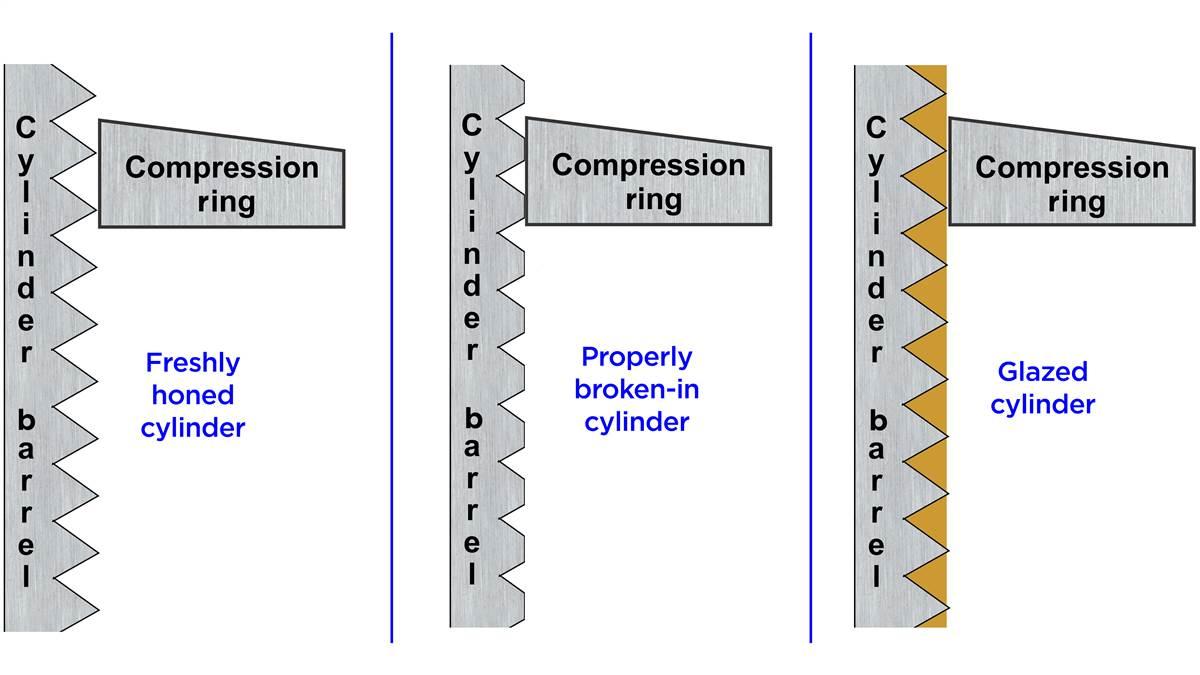
The bore and piston are the first thing in mind of any manufacturer when it comes to bedding in process. This process helps smoothen out the microscopic peaks/ridges present in a new piston and the inner surface of the bore. When these ridges are mated and wore out good, this positively affects the piston lubrication and compression of the engine.
Here's a picture depicting a perfectly honed bore/piston kit. What's Glazing, we'll get onto it in a moment.
Glazing
=====
Glazed Bore Kit. Notice mirror like uneven finish!
This is not what we want.
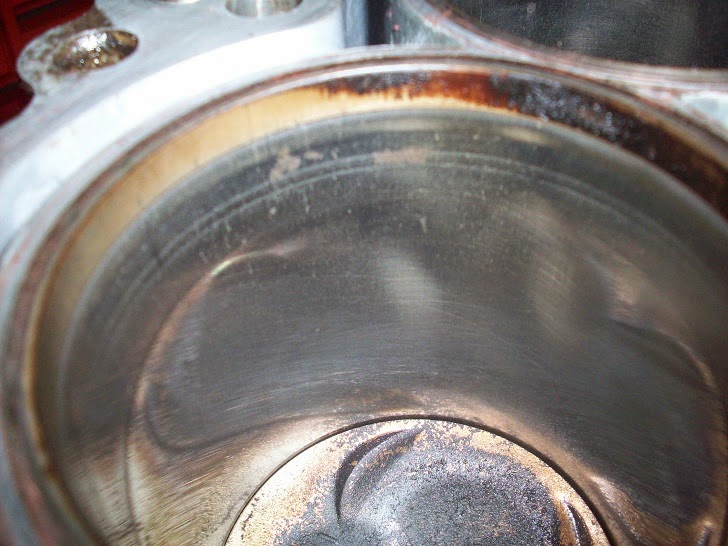
Glazing is nothing but a shiny surface. Although a shiny looking bore is what we're looking for, what we don't want is a wear pattern is that is glazed on the one side of either the bore or piston and the other side broken-in well. This often occurs after an engine has been run at idle or very light load for a sufficient enough time. As a visual reference, imagine the microscopic cross-section of a freshly honed cylinder wall as similar in appearance to the side view of a hack saw blade with multiple peaks and valleys. Now imagine looking at a used hack saw blade where the teeth have worn nearly smooth. That’s what a glazed cylinder wall would present to the rings. This is a big topic, but I am sharing the basics here, so that we get an idea of what goes inside the very important component that' the bore and piston kit. When a cylinder is glazed, the oil consumption is increased due to not perfect mating of the either of the piston or bore surface and starts burning oil, which is not what we want.
With that out of the way, let's come to the main topic, HOW DO WE RUN-IN.
Amazingly, it's not rocket-science. Though some of you may heard of Motoman method apart from the factory specified running in method. Motoman method is nothing but running a brand new vehicle at full throttle for a few KMS and doing the same every once or twice every time the vehicle is operated. The reason? This method, as per users, vouches that it helps bed a given engine's components faster, by making the internals moving fast and slow and fast which makes the engine operate at varying RPMs which accelerates the metal to metal contact and in turn helps faster for the bore/piston to bed in evenly, as opposed to slow, lazy fixed RPM ride, which in turn what the above topic discusses, GLAZING.
Running an engine at a same RPM and at slow speeds will not give an engine the edge to have a uniform surface to surface wear, which is the reason it's advised to vary the RPM and at varying speeds. What this does is, it helps the engine get a feel for itself, the heat factor, the friction factor and overall it helps these metal to metal surface bed in with each other so that they are uniform. Same goes for piston/bore and meshed system such as gear cogs and what not.
Okay. I got it. What about factory bedding in process? Is it Bakwaas?
================================================
Absolutely not. In fact, modern motorcycles these days come filled with semi-synthetic to full synthetic oil right from the factory after being dynoed. Most have a notion that this dyno is a run-in process from the factory, which it isn't. They aren't running-in your bike, they are making sure what they've assembled is assembled right and working fine without blowing after reaching you. . With metallurgy improving so much these days, and tolerances so fine, most modern vehicles can be gunned out right from the factory. Running in was a process for old dinsoaurville engines that were crude when machining weren't that great as we have now and tolerances were high and hence the the running in process with mineral oil. But it's a good thing isn't it? Manufacturers have stuck to it age until now to follow something that helps to take it easy on a new vehicle.
Bottomline and key takeaways: Dos and Don'ts
===============================
1. Stick to varying engine RPMs on a new vehicle. You can easily touch 80 to 90 kmph on top gear without a fuss on new modern bikes. Try not to bog your bike down by sticking to extremely low RPM. The key to engine bedding-in is friction itself which helps reduce friction later. Got the point?
2. Use manufacturer recommended oil for bedding-in process. Using more silkier oil than the recommended during the bedding-in process will not help in the cylinder/piston to bed in properly due to the extreme lubricating properties of superior synthetic oils. Remember, friction is what we need to make sure the bedding in happens as it should be. Stick to manufacturer recommended grade and/or viscosity index, irrespective of brand. Don't go overboard.
3. Make sure you follow your servicing schedule carefully. During the bedding-in process, it's common to see flakes of metal shavings getting filtered through your oil strainer or in your engine oil, which is perfectly normal. The sooner these are drained, the better it is for the engine.
4. Try not to rev the nuts of a motor, especially during the bedding in process. It's okay to go above the peak power RPM, but not to hit the limiter frequently. Variability of the RPM is key.
5. Make sure you have a check on your engine oil color irrespective even if you vehicle is new. It gives you an insight into the health of your motor.
6. The same thing applies for your newly rebuild engine also.
===========================================
If you've replaced your bore and piston or did a half engine work, it's recommended to follow the same bedding in procedure to make sure the new piston, rings and the newly honed cylinder kit are properly bedded-in. It's advised to use semi-synthetic to normal mineral oil for engine rework-rebuild bedding in procedures. Try not to use full synthetic oil.
Hope this helps fellow Bhpians to get an idea as to how and why a run-in is recommended.
Requesting our Bhpians to add in their articles on the same topic that they find useful.
Ride safe!
Cheers!
VJ
After many users have requested for a NEW MOTORCYCLE RUNNING-IN thread, it's about time I share my experiences and what to follow and what not to follow. This thread will be brief about how to run-in or bed-in a new motorcycle and throw in some light on whats and ifs. As always, I would love to hear from our Bhpians and add in their eagle-eyed observations and experiences posted here, so that it helps everyone and makes one concise list of Dos and Don'ts.
RUNNING-IN
=========
What is this? Running-in or bedding-in or the honeymoon phase of the bike is nothing, but, a manufacturer recommended methodology to make sure your bike or car's engine is run at a certain speed for a specific period of time. This is either in KMs or speed or for a specific set of services i.e. first, second, third services or a combination of all which is duly also mentioned in your manual. Why do manufacturers do this? Why can't we gun it like Michael Dunlop or Guy Martin off the showroom? For one reason. WEAR UNIFORMITY!
What is WEAR UNIFORMITY
===================
Wear uniformity is nothing but making sure the metal to metal contact made by the components inside your engine, are mated to each other in a way that reduces friction and helps the lubricating medium, oil, to allow maximum lubrication between them and minimum metal to metal wear. Which parts of an engine do require the first and foremost bedding-in process?
It's your bore/piston or cylinder-piston kit.
Freshly honed cylinder
================
The bore and piston are the first thing in mind of any manufacturer when it comes to bedding in process. This process helps smoothen out the microscopic peaks/ridges present in a new piston and the inner surface of the bore. When these ridges are mated and wore out good, this positively affects the piston lubrication and compression of the engine.
Here's a picture depicting a perfectly honed bore/piston kit. What's Glazing, we'll get onto it in a moment.
Glazing
=====
Glazed Bore Kit. Notice mirror like uneven finish!
This is not what we want.
Glazing is nothing but a shiny surface. Although a shiny looking bore is what we're looking for, what we don't want is a wear pattern is that is glazed on the one side of either the bore or piston and the other side broken-in well. This often occurs after an engine has been run at idle or very light load for a sufficient enough time. As a visual reference, imagine the microscopic cross-section of a freshly honed cylinder wall as similar in appearance to the side view of a hack saw blade with multiple peaks and valleys. Now imagine looking at a used hack saw blade where the teeth have worn nearly smooth. That’s what a glazed cylinder wall would present to the rings. This is a big topic, but I am sharing the basics here, so that we get an idea of what goes inside the very important component that' the bore and piston kit. When a cylinder is glazed, the oil consumption is increased due to not perfect mating of the either of the piston or bore surface and starts burning oil, which is not what we want.
With that out of the way, let's come to the main topic, HOW DO WE RUN-IN.
Amazingly, it's not rocket-science. Though some of you may heard of Motoman method apart from the factory specified running in method. Motoman method is nothing but running a brand new vehicle at full throttle for a few KMS and doing the same every once or twice every time the vehicle is operated. The reason? This method, as per users, vouches that it helps bed a given engine's components faster, by making the internals moving fast and slow and fast which makes the engine operate at varying RPMs which accelerates the metal to metal contact and in turn helps faster for the bore/piston to bed in evenly, as opposed to slow, lazy fixed RPM ride, which in turn what the above topic discusses, GLAZING.
Running an engine at a same RPM and at slow speeds will not give an engine the edge to have a uniform surface to surface wear, which is the reason it's advised to vary the RPM and at varying speeds. What this does is, it helps the engine get a feel for itself, the heat factor, the friction factor and overall it helps these metal to metal surface bed in with each other so that they are uniform. Same goes for piston/bore and meshed system such as gear cogs and what not.
Okay. I got it. What about factory bedding in process? Is it Bakwaas?
================================================
Absolutely not. In fact, modern motorcycles these days come filled with semi-synthetic to full synthetic oil right from the factory after being dynoed. Most have a notion that this dyno is a run-in process from the factory, which it isn't. They aren't running-in your bike, they are making sure what they've assembled is assembled right and working fine without blowing after reaching you.
. With metallurgy improving so much these days, and tolerances so fine, most modern vehicles can be gunned out right from the factory. Running in was a process for old dinsoaurville engines that were crude when machining weren't that great as we have now and tolerances were high and hence the the running in process with mineral oil. But it's a good thing isn't it? Manufacturers have stuck to it age until now to follow something that helps to take it easy on a new vehicle. Bottomline and key takeaways: Dos and Don'ts
===============================
1. Stick to varying engine RPMs on a new vehicle. You can easily touch 80 to 90 kmph on top gear without a fuss on new modern bikes. Try not to bog your bike down by sticking to extremely low RPM. The key to engine bedding-in is friction itself which helps reduce friction later. Got the point?
2. Use manufacturer recommended oil for bedding-in process. Using more silkier oil than the recommended during the bedding-in process will not help in the cylinder/piston to bed in properly due to the extreme lubricating properties of superior synthetic oils. Remember, friction is what we need to make sure the bedding in happens as it should be. Stick to manufacturer recommended grade and/or viscosity index, irrespective of brand. Don't go overboard.
3. Make sure you follow your servicing schedule carefully. During the bedding-in process, it's common to see flakes of metal shavings getting filtered through your oil strainer or in your engine oil, which is perfectly normal. The sooner these are drained, the better it is for the engine.
4. Try not to rev the nuts of a motor, especially during the bedding in process. It's okay to go above the peak power RPM, but not to hit the limiter frequently. Variability of the RPM is key.
5. Make sure you have a check on your engine oil color irrespective even if you vehicle is new. It gives you an insight into the health of your motor.
6. The same thing applies for your newly rebuild engine also.
===========================================
If you've replaced your bore and piston or did a half engine work, it's recommended to follow the same bedding in procedure to make sure the new piston, rings and the newly honed cylinder kit are properly bedded-in. It's advised to use semi-synthetic to normal mineral oil for engine rework-rebuild bedding in procedures. Try not to use full synthetic oil.
Hope this helps fellow Bhpians to get an idea as to how and why a run-in is recommended.
Requesting our Bhpians to add in their articles on the same topic that they find useful.
Ride safe!
Cheers!
VJ






Comment