








 Tweet
Four years after its debut (born from a concept presented at EICMA 2019), the Ducati DesertX project started from scratch, keeping in mind the goal of raising the bar in terms of overall effectiveness. The result is a motorcycle that has been refined and improved in all its aspects, without, however, being conceptually revolutionised. Thanks to the new polymer tank, slimmer and lighter, the centre of gravity has been lowered, and the contact area with the seat has been reduced.
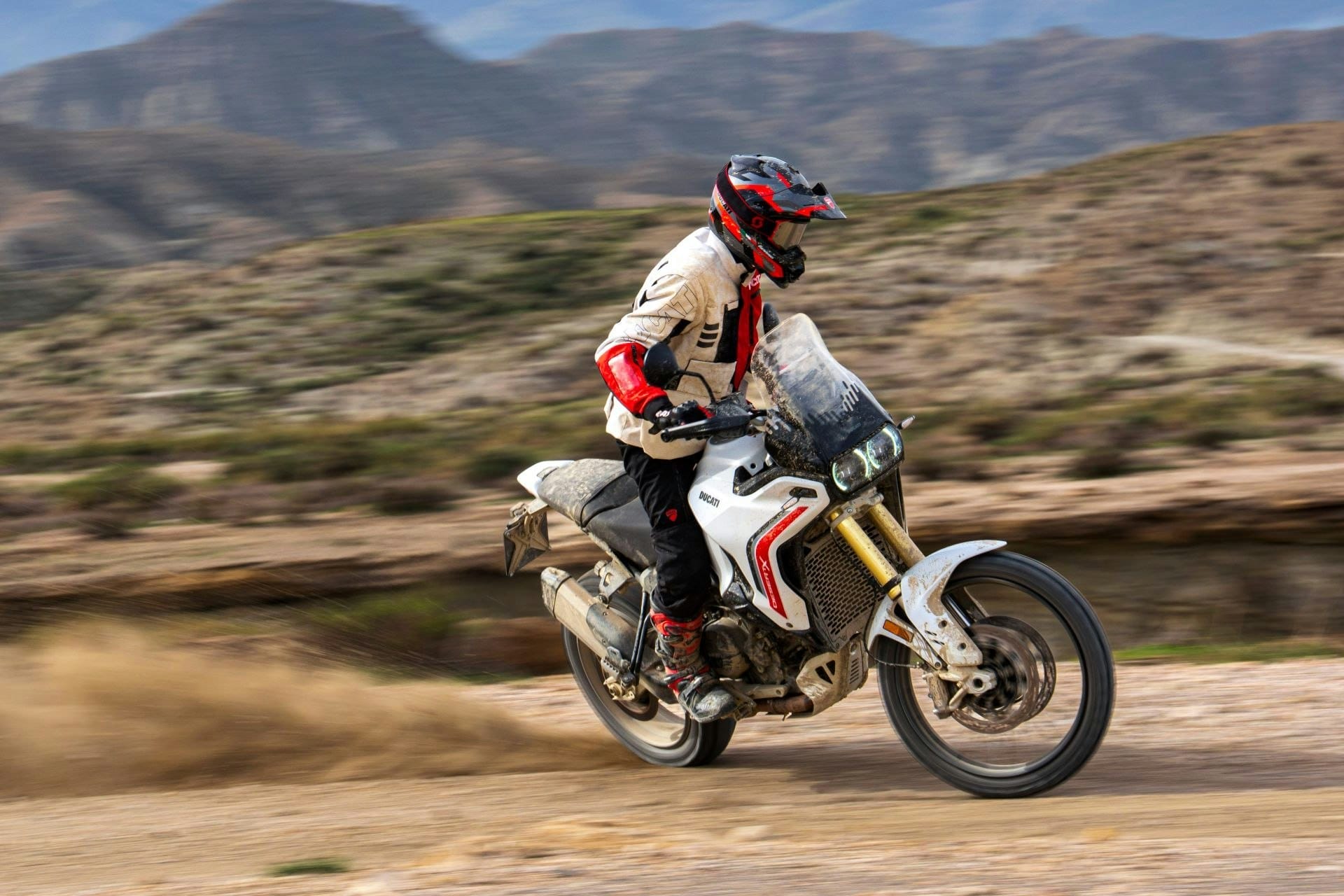
The front section is also a couple of centimetres lower, contributing to a more streamlined overall appearance. The seat is 88 cm from the ground, reduced by 4 cm by adopting optional lowered seats and suspension. Its beating heart is the more compact and lighter V2, with the IVT variable intake valve timing system. Power figures are confirmed: 110 hp and 92 Nm. Upstream of the final drive, obviously chain-driven, is a 6-speed gearbox served by Ducati Quick Shift 2.0 without external sensors. The gear ratios are specific, with the first gears rather short and suitable for off-road use, and the sixth gear more extended (according to initial rumours, at 130 km/h the V2 would run at around 5,800 rpm).
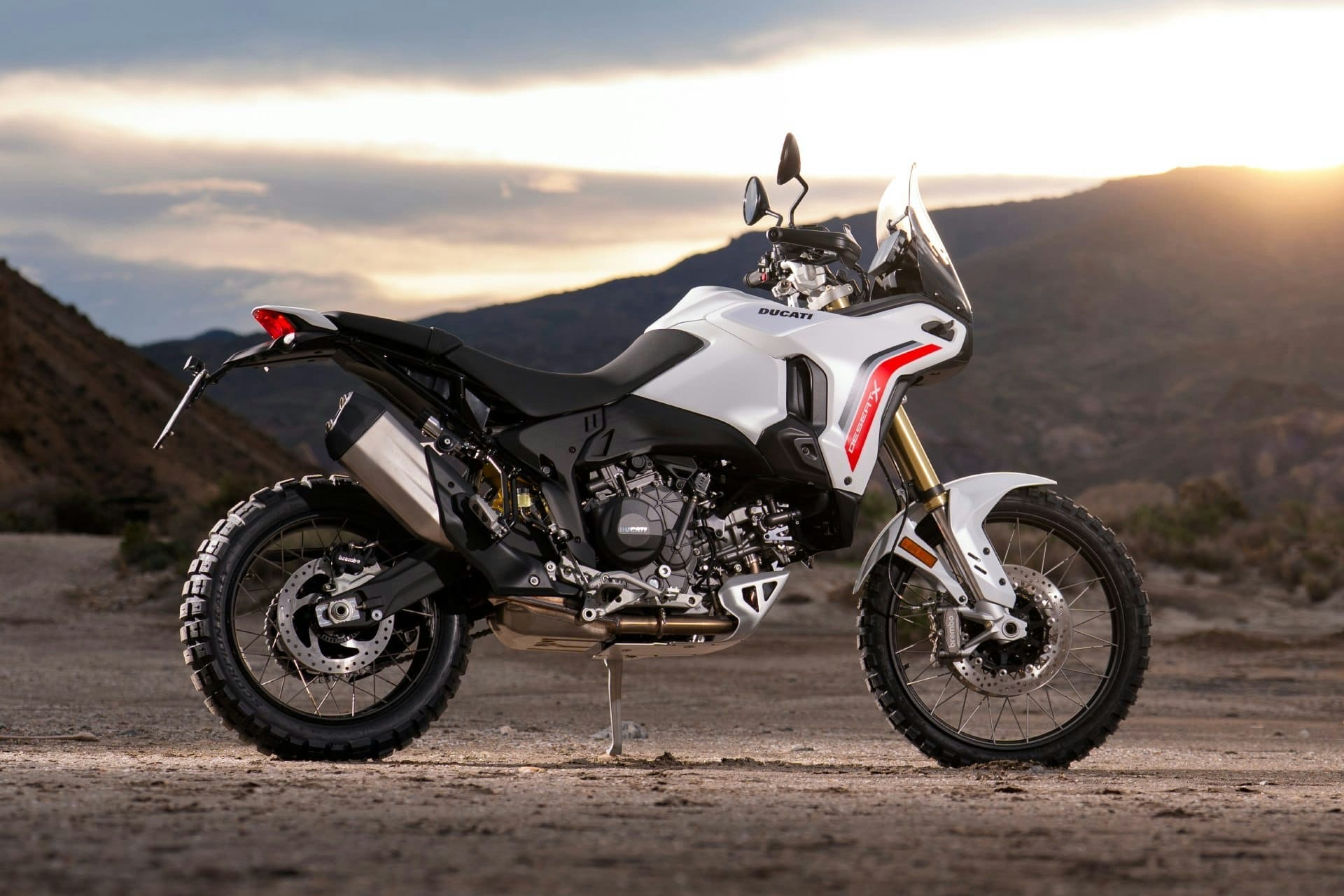
The trellis frame has been replaced by an aluminium monocoque structure, which uses the engine as a stressed member (it also supports the swingarm). It also integrates the airbox (12.5 litres capacity); its new position also offers better access to the air filter. The swingarm (made of aluminium alloy) has also changed, now operating the monoshock via a new progressive linkage. The Kayaba monoshock provides 220 mm of wheel travel and is fully adjustable, as is the upside-down fork. The wheels are 21‘ at the front and 18’ at the rear and are fitted with 90/90 and 150/70 tyres respectively.
The braking system is by Brembo. Based on a 6-axis inertial platform, the Ducati DesertX’s electronics ensure that the various controls are optimised for off-road use and can be customised in terms of calibration. “Enduro” and “Rally” options, designed for off-road use, are added to the Riding Modes predefined for asphalt (Touring, Urban, Sport and Wet). Four Power Modes are available, including the opportunity to reduce power to 95 or 75 hp. A version of the new DesertX, with power limited to 35 kW, for A2 licence holders is also offered.
The front section is also a couple of centimetres lower, contributing to a more streamlined overall appearance. The seat is 88 cm from the ground, reduced by 4 cm by adopting optional lowered seats and suspension. Its beating heart is the more compact and lighter V2, with the IVT variable intake valve timing system. Power figures are confirmed: 110 hp and 92 Nm. Upstream of the final drive, obviously chain-driven, is a 6-speed gearbox served by Ducati Quick Shift 2.0 without external sensors. The gear ratios are specific, with the first gears rather short and suitable for off-road use, and the sixth gear more extended (according to initial rumours, at 130 km/h the V2 would run at around 5,800 rpm).
The trellis frame has been replaced by an aluminium monocoque structure, which uses the engine as a stressed member (it also supports the swingarm). It also integrates the airbox (12.5 litres capacity); its new position also offers better access to the air filter. The swingarm (made of aluminium alloy) has also changed, now operating the monoshock via a new progressive linkage. The Kayaba monoshock provides 220 mm of wheel travel and is fully adjustable, as is the upside-down fork. The wheels are 21‘ at the front and 18’ at the rear and are fitted with 90/90 and 150/70 tyres respectively.
The braking system is by Brembo. Based on a 6-axis inertial platform, the Ducati DesertX’s electronics ensure that the various controls are optimised for off-road use and can be customised in terms of calibration. “Enduro” and “Rally” options, designed for off-road use, are added to the Riding Modes predefined for asphalt (Touring, Urban, Sport and Wet). Four Power Modes are available, including the opportunity to reduce power to 95 or 75 hp. A version of the new DesertX, with power limited to 35 kW, for A2 licence holders is also offered.


