








 Tweet
Tweet
It looks like this year's EICMA will be lit-up like a Christmas tree and with this piece, we have a feeling that a lot of the lights will be orange. We are aware that KTM will be unveiling quite a few revised models with significant changes in addition to some new ones. A revamped KTM 1290 Superduke R, updated 390 Duke and RC 390, and the much-awaited KTM 390 Adventure. But here, we'll talk about a new KTM 1290 Super Adventure that has been spied sporting radar-based rider-assistance system!

Taking a look at the above photo should make the presence of a radar-assist system clear. Another pointer to the fact that the bike might debut at EICMA this year is the near-finished form of the motorcycle. Coming back to the presence of a radar-based-assist system, the headlight is a departure from the recent philosophy of KTM, at least when it comes to headlights.
Instead of compact LED-based headlight, we have an oversized headlight dictating the front fascia. See that arch-shaped cut-out right on the tip of the nose? It misleads one into thinking that it is an air-intake, but look closely and it reveals the distinct shape of a Bosch Mid-Range Radar (MRR).
The adoption of this tech is not surprising considering the fact that last year KTM revealed a prototype fitted with the Bosch radar system. The same system is what we see at the front of this seemingly new KTM 1290 Super Adventure for 2020. The rear-facing radar that was present on the prototype might also be included in the package of the upcoming 2020 model. But most of the heavy lifting is handled by the front radar as it monitors the traffic ahead.
Tied to the ride-by-wire throttle and the ABS braking system, it helps the motorcycle to automatically accelerate and gently brake to keep pace with traffic ahead. Under automation, it can only gently brake but the system warns the rider if a vehicle in the front comes to a sudden halt. The rear-facing radar is designed to provide similar warnings if there’s a fast-approaching vehicle from behind, as well as acting as a blind-spot monitoring system.
But then, KTM is not the only brand chasing after radar tech. We also posted an article about Ducati working on something similar. Another thing that is revealed from the photos is the fact that the system needs a clear view. It cannot be masked or shrouded or hidden under some flashy panels. How manufacturers come up with ways to do so is gonna be something interesting and may mark a shift in the way the front fascias of motorcycles are designed. For now, KTM, being KTM, has put it up right up there for all to see.
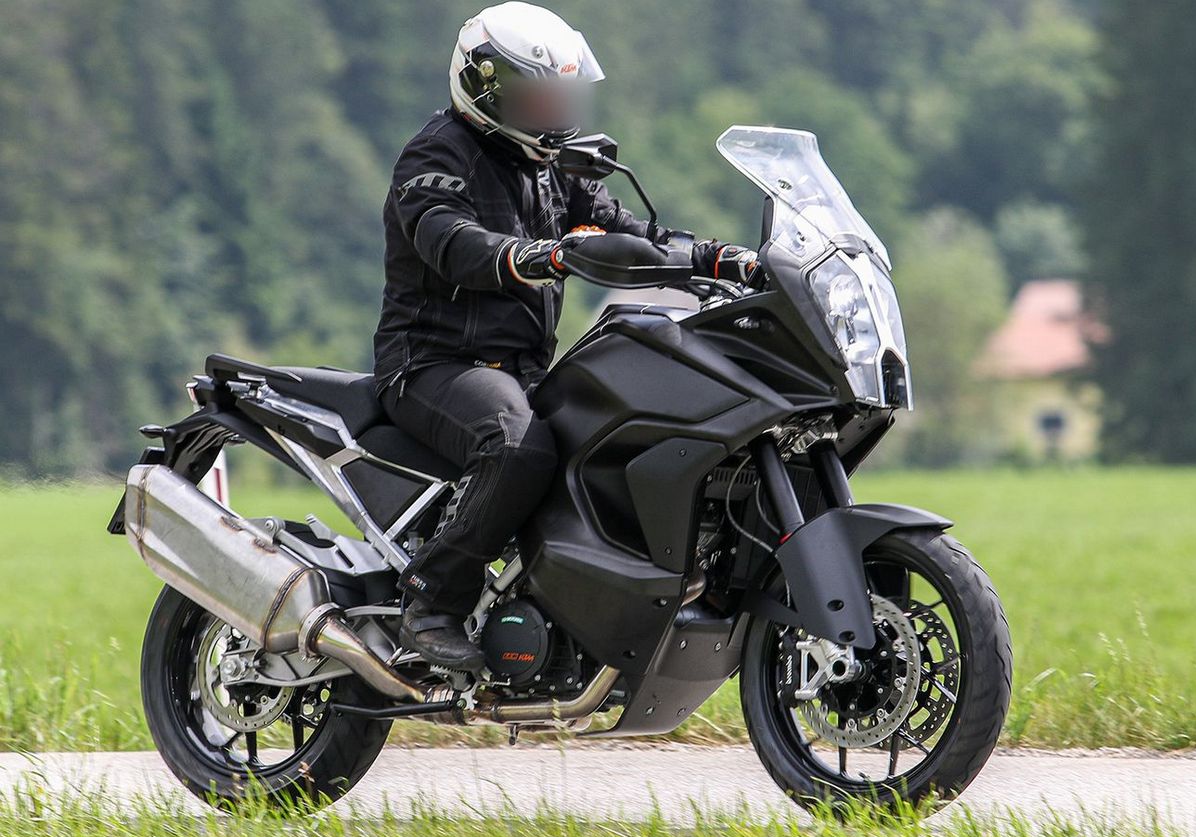
Moving on from the radar system, the new KTM 1290 Super Adventure is bound to undergo a lot of other changes too. Firstly, we expect to see two variants, the road-oriented S model with regular-sized alloy wheels and an R model with a larger front wheel with spokes on both the ends. The engine will be something along the lines of the existing LC8 V-twin but is sure to undergo changes to meet the Euro 5 emission norms. But we can rest assured that KTM will be keen to keep the power figure the same at 158 bhp. Or maybe, even more, to compensate for the weight gain.
In the chassis department, the main-frame appears to be the same as the existing model but the sub-frame is a new, aluminium unit. This must be a measure to keep the gained weight in check. The swingarm appears to be new as well but the forks and rear shock, as usual, are from WP, using the electronically controlled, semi-active kit.
Another crucial addition to the new KTM 1290 Super Adventure is the same fuel system design that debuted on the smaller 790 Adventure, shifting at least part of the fuel capacity into side-mounted tanks mounted low in the front fairing. This will lower the center of gravity making the motorcycle lighter to handle despite being heavier than the existing model.

Other than that, electronics are predictably the focus so, cornering ABS, adaptive suspension, cornering traction control, and a myriad of riding modes are sure to make an appearance. The dashboard might be a simple, tablet-style colour TFT display, with smartphone integration, turn-by-turn navigation, and multifunction bar controls to scroll through the ever-growing number of options. The addition of features related to the radar system is a given.
As we said, the new KTM 1290 Super Adventure might debut at this year's EICMA. And in addition to that, we might see some other eagerly awaited models from Mattighofen.
Source
Taking a look at the above photo should make the presence of a radar-assist system clear. Another pointer to the fact that the bike might debut at EICMA this year is the near-finished form of the motorcycle. Coming back to the presence of a radar-based-assist system, the headlight is a departure from the recent philosophy of KTM, at least when it comes to headlights.
Instead of compact LED-based headlight, we have an oversized headlight dictating the front fascia. See that arch-shaped cut-out right on the tip of the nose? It misleads one into thinking that it is an air-intake, but look closely and it reveals the distinct shape of a Bosch Mid-Range Radar (MRR).
The adoption of this tech is not surprising considering the fact that last year KTM revealed a prototype fitted with the Bosch radar system. The same system is what we see at the front of this seemingly new KTM 1290 Super Adventure for 2020. The rear-facing radar that was present on the prototype might also be included in the package of the upcoming 2020 model. But most of the heavy lifting is handled by the front radar as it monitors the traffic ahead.
Tied to the ride-by-wire throttle and the ABS braking system, it helps the motorcycle to automatically accelerate and gently brake to keep pace with traffic ahead. Under automation, it can only gently brake but the system warns the rider if a vehicle in the front comes to a sudden halt. The rear-facing radar is designed to provide similar warnings if there’s a fast-approaching vehicle from behind, as well as acting as a blind-spot monitoring system.
But then, KTM is not the only brand chasing after radar tech. We also posted an article about Ducati working on something similar. Another thing that is revealed from the photos is the fact that the system needs a clear view. It cannot be masked or shrouded or hidden under some flashy panels. How manufacturers come up with ways to do so is gonna be something interesting and may mark a shift in the way the front fascias of motorcycles are designed. For now, KTM, being KTM, has put it up right up there for all to see.
Moving on from the radar system, the new KTM 1290 Super Adventure is bound to undergo a lot of other changes too. Firstly, we expect to see two variants, the road-oriented S model with regular-sized alloy wheels and an R model with a larger front wheel with spokes on both the ends. The engine will be something along the lines of the existing LC8 V-twin but is sure to undergo changes to meet the Euro 5 emission norms. But we can rest assured that KTM will be keen to keep the power figure the same at 158 bhp. Or maybe, even more, to compensate for the weight gain.
In the chassis department, the main-frame appears to be the same as the existing model but the sub-frame is a new, aluminium unit. This must be a measure to keep the gained weight in check. The swingarm appears to be new as well but the forks and rear shock, as usual, are from WP, using the electronically controlled, semi-active kit.
Another crucial addition to the new KTM 1290 Super Adventure is the same fuel system design that debuted on the smaller 790 Adventure, shifting at least part of the fuel capacity into side-mounted tanks mounted low in the front fairing. This will lower the center of gravity making the motorcycle lighter to handle despite being heavier than the existing model.
Other than that, electronics are predictably the focus so, cornering ABS, adaptive suspension, cornering traction control, and a myriad of riding modes are sure to make an appearance. The dashboard might be a simple, tablet-style colour TFT display, with smartphone integration, turn-by-turn navigation, and multifunction bar controls to scroll through the ever-growing number of options. The addition of features related to the radar system is a given.
As we said, the new KTM 1290 Super Adventure might debut at this year's EICMA. And in addition to that, we might see some other eagerly awaited models from Mattighofen.
Source



Comment