







 Tweet
Tweet
I'm bringing back this thread because I feel that it helped a lot of guys in the old xbhp and also because dear ol' Ken is under the firm belief that my contributions to the forum these days ain't cuttin' it. 
I've lost a few images used in the old thread, but I'll update the posts if I find them. Anyway, here's a basic explanation of the various types of frames used in motorcycles:
----
TWIN SPAR:
The twin spar frame is the type of frame that is seen on almost all sportbikes these days. I.E. the type of frame that braces the engine from both sides, and does not have any section beneath the engine.
That's a Honda VTR frame that also uses the engine as a stressed member. Note the hollowed out inner sections. That saves weight. But more of that later.

The FZ1, FZ6 and the SV all have a variation of this theme. The SV in fact, has a twin spar-trellis hybrid frame. But the difference is, compared to most nakeds, the full on sportbikes have twin spars that use lighter alloys, die-cast sections(both FZs and the SV have die cast frames. The VTR has extruded beams which is heavier), and fewer welds. This makes them more rigid, as well as lighter.
Racebikes of course, use Carbon fibre instead of alloys which is even lighter and more rigid.
MONOCOQUE:
Think the bajaj scooters and Maruti cars. A monocoque is a type of frame structure that forms an integral part of the body. Not like an outline, which the twin spar does. The 12R and the 14 sport a monocoque design, which while not seen much, still is an integral part of the body no less. I'l let the picture do the talking. Compare this with the previous one and spot the differences:
The central section doubles as the airbox, btw.. more weight saving.
Large image. Click to view:
TRELLIS:
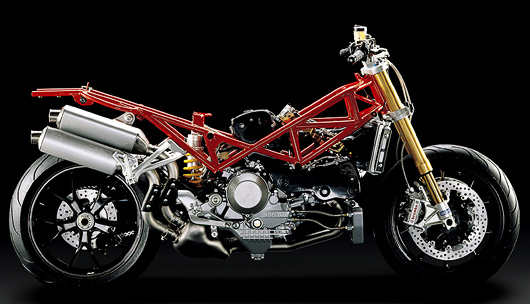
The red colored part is the trellis frame. Look carefully, and you shall see the three points at which the engine is mounted on to the frame (3 on each side, that is).
1) Between the two cylinders of the 'V'. The frame is triangulated here, and you see a black dot at the lower point of the triangle.
2) Towards the end of the engine block, above the rider footpegs and besides the monoshock. Again, the frame is triangulated here.
3) Directly above point no.2. And next to it is the monoshock top mount.
In addition to this, Ducatis usually sport a subframe that is bolted between the 2 cylinder heads. This adds some rigidity too, in addition to absorbing some vibrations. Look closely and you can sport it.
Which brings us to the next point: The engine is a fully stressed member of the chassis. I.E. Whatever forces the chassis is exposed to while the motorcycle is on the road, the engine absorbs a part of it too, unlike in a cradle type frame (more of that later).
The engine also doubles up as a swing arm pivot in the monster. Bikes such as the 999 and the 1098 have a seperate sub frame that extends from the trellis to do this job.
A trellis frame is made of small tubular sections of metal, while a twin spar, of large sections of it.
Trivia: A ducati engineer once remarked that when building a new frame, the initially build it as stiff as possible, and gradually remove cross beams from here and there to achieve the necessary flex, weight and cost parameters.
Trivia Numero Dos: There's another reason for small scale manufacturers like Ducati and MV sticking to the trellis. As you can see, the frames are made of metal tubes welded together. This manufacturing process is perfect for a low volume manufacturer as opposed to a die-cast twin spar which makes economic sense only when it's mass produced. (given the high expenses associated with creating the die and such).
WHY TRELLIS?
The trellis's strengths lie not just in lightness (this can be countered with a carbon fibre twin spar), but in providing just enough flex and awesome feedback to make one sweet handling motorcycle. Most of us know that in a motorcycle, if the chassis is too stiff, it actually hampers the handling as opposed to 4 wheelers where stiffer is always better. Watch any WSBK race where the bikes brake hard into a corner and you see that the ducati riders are a lot more comfortable (this is rapidly changing lately, BTW). The superior feedback from the trellis frame (along with the rider friendly power pulse of a V-twin) is to be thanked here.
If anyone has tried it out, it is easier to bend a metal tube than a large metal chunk. The same principle applies here.
The more cross beams in the trellis = More rigidity. Lesser cross beams, more flex. The chassis engineer's job is to strike a balance between the two.
Again, conventional logic implies that it is easier to vary these parameters by adding and removing small metal tubes than varying density and tensile strength of an alloy twin spar, and thus creating a new prototype every time.
BACKBONE:
The original CD 100 sported what can be called as a pressed metal backbone chassis. This, by the very definition, is a frame made of sheets of metal pressed into the desired shape, and not a Trellis (a network of metal tubes, round or square, welded together to form triangulated sections). This chassis acts like a spine for the motorcycle and is located centrally (A trellis has 2 sections that go around the engine). Initially, the CD 100 sported a "floating" engine that was hung from it, but two "pseudo" down tubes were added to the later versions which were in fact, only extentions from the crash guard (and thus, removable) and not really a part of the chassis.
Here's a pic of a tubular backbone chassis. Make out the differences between a trellis and this.

Here's a variation that uses square tubing. This is closer to the CD 100 frame and is a common design for off roading motorcycles (of yore. modern ones use a twin spar-cradle combo).
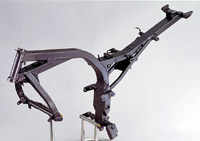
Speaking of downtubes, this is the sort of chassis that (almost) all indian bikes sport. This basically is a tubular backbone chassis with arms extending down from the head stock, and then curves under the engine and extends to meet the chassis again under the swing arm pivot). One arm means single cradle (like the Bajaj Boxer), 2 means double cradle (like the Bajaj Pulsar).
One thing that is worth noting is that in a cradle chassis, the engine is NOT a stressed member. I.E. the chassis shields (cradles ?) the engine against all the forces that the bike endures on the road. Makes sense for the smaller engines we have around here.
There is also a variation of this where the downtube does not cradle the engine, but bolts to it, thus making it a stressed member. This can be seen in the Bullets as well as the Yamaha YBX.
OTHER TYPES:
Well, there is the Benelli TnT frame, which is a combination of a Trellis front section screwed and glued-in to a die cast rear section. This one is indeed a very unique piece of kit.

P.S. The trellis looks a lot different that those found in the Ducatis coz of it's extremely curvy nature and lack of too many cross beams. But 'm guessing that the die cast rear section gives the additional rigidity needed, while the Trellis front section deals with flex parameters.
Again, note the hollowed in sections of the rear sub frame.
P.S. The Honda VTRs And earlier Fireblades had their swing arms pivoted on the engine directly too.
We had briefly mentioned the usage of carbon fibre in GP bikes. Well, here's one of the most innovative takes on the theme. No, it's not from any of the usual names, but from Cagiva, in their V593 GP bike, one of the most beautiful racebikes ever.

As we can see from the picture, the front part of the chassis is an alloy twin spar. But it is the rear part that is worth attention, as it is a self supporting carbon fibre structure. I.E. There is no separate bodywork and chassis, the bodywork IS the chassis! This is possible because of the superior strength to weight ratio of carbon fibre.
I've lost a few images used in the old thread, but I'll update the posts if I find them. Anyway, here's a basic explanation of the various types of frames used in motorcycles:
----
TWIN SPAR:
The twin spar frame is the type of frame that is seen on almost all sportbikes these days. I.E. the type of frame that braces the engine from both sides, and does not have any section beneath the engine.
That's a Honda VTR frame that also uses the engine as a stressed member. Note the hollowed out inner sections. That saves weight. But more of that later.
The FZ1, FZ6 and the SV all have a variation of this theme. The SV in fact, has a twin spar-trellis hybrid frame. But the difference is, compared to most nakeds, the full on sportbikes have twin spars that use lighter alloys, die-cast sections(both FZs and the SV have die cast frames. The VTR has extruded beams which is heavier), and fewer welds. This makes them more rigid, as well as lighter.
Racebikes of course, use Carbon fibre instead of alloys which is even lighter and more rigid.
MONOCOQUE:
Think the bajaj scooters and Maruti cars. A monocoque is a type of frame structure that forms an integral part of the body. Not like an outline, which the twin spar does. The 12R and the 14 sport a monocoque design, which while not seen much, still is an integral part of the body no less. I'l let the picture do the talking. Compare this with the previous one and spot the differences:
The central section doubles as the airbox, btw.. more weight saving.
Large image. Click to view:
TRELLIS:
The red colored part is the trellis frame. Look carefully, and you shall see the three points at which the engine is mounted on to the frame (3 on each side, that is).
1) Between the two cylinders of the 'V'. The frame is triangulated here, and you see a black dot at the lower point of the triangle.
2) Towards the end of the engine block, above the rider footpegs and besides the monoshock. Again, the frame is triangulated here.
3) Directly above point no.2. And next to it is the monoshock top mount.
In addition to this, Ducatis usually sport a subframe that is bolted between the 2 cylinder heads. This adds some rigidity too, in addition to absorbing some vibrations. Look closely and you can sport it.
Which brings us to the next point: The engine is a fully stressed member of the chassis. I.E. Whatever forces the chassis is exposed to while the motorcycle is on the road, the engine absorbs a part of it too, unlike in a cradle type frame (more of that later).
The engine also doubles up as a swing arm pivot in the monster. Bikes such as the 999 and the 1098 have a seperate sub frame that extends from the trellis to do this job.
A trellis frame is made of small tubular sections of metal, while a twin spar, of large sections of it.
Trivia: A ducati engineer once remarked that when building a new frame, the initially build it as stiff as possible, and gradually remove cross beams from here and there to achieve the necessary flex, weight and cost parameters.
Trivia Numero Dos: There's another reason for small scale manufacturers like Ducati and MV sticking to the trellis. As you can see, the frames are made of metal tubes welded together. This manufacturing process is perfect for a low volume manufacturer as opposed to a die-cast twin spar which makes economic sense only when it's mass produced. (given the high expenses associated with creating the die and such).
WHY TRELLIS?
The trellis's strengths lie not just in lightness (this can be countered with a carbon fibre twin spar), but in providing just enough flex and awesome feedback to make one sweet handling motorcycle. Most of us know that in a motorcycle, if the chassis is too stiff, it actually hampers the handling as opposed to 4 wheelers where stiffer is always better. Watch any WSBK race where the bikes brake hard into a corner and you see that the ducati riders are a lot more comfortable (this is rapidly changing lately, BTW). The superior feedback from the trellis frame (along with the rider friendly power pulse of a V-twin) is to be thanked here.
If anyone has tried it out, it is easier to bend a metal tube than a large metal chunk. The same principle applies here.
The more cross beams in the trellis = More rigidity. Lesser cross beams, more flex. The chassis engineer's job is to strike a balance between the two.
Again, conventional logic implies that it is easier to vary these parameters by adding and removing small metal tubes than varying density and tensile strength of an alloy twin spar, and thus creating a new prototype every time.
BACKBONE:
The original CD 100 sported what can be called as a pressed metal backbone chassis. This, by the very definition, is a frame made of sheets of metal pressed into the desired shape, and not a Trellis (a network of metal tubes, round or square, welded together to form triangulated sections). This chassis acts like a spine for the motorcycle and is located centrally (A trellis has 2 sections that go around the engine). Initially, the CD 100 sported a "floating" engine that was hung from it, but two "pseudo" down tubes were added to the later versions which were in fact, only extentions from the crash guard (and thus, removable) and not really a part of the chassis.
Here's a pic of a tubular backbone chassis. Make out the differences between a trellis and this.
Here's a variation that uses square tubing. This is closer to the CD 100 frame and is a common design for off roading motorcycles (of yore. modern ones use a twin spar-cradle combo).
Speaking of downtubes, this is the sort of chassis that (almost) all indian bikes sport. This basically is a tubular backbone chassis with arms extending down from the head stock, and then curves under the engine and extends to meet the chassis again under the swing arm pivot). One arm means single cradle (like the Bajaj Boxer), 2 means double cradle (like the Bajaj Pulsar).
One thing that is worth noting is that in a cradle chassis, the engine is NOT a stressed member. I.E. the chassis shields (cradles ?) the engine against all the forces that the bike endures on the road. Makes sense for the smaller engines we have around here.
There is also a variation of this where the downtube does not cradle the engine, but bolts to it, thus making it a stressed member. This can be seen in the Bullets as well as the Yamaha YBX.
OTHER TYPES:
Well, there is the Benelli TnT frame, which is a combination of a Trellis front section screwed and glued-in to a die cast rear section. This one is indeed a very unique piece of kit.
P.S. The trellis looks a lot different that those found in the Ducatis coz of it's extremely curvy nature and lack of too many cross beams. But 'm guessing that the die cast rear section gives the additional rigidity needed, while the Trellis front section deals with flex parameters.
Again, note the hollowed in sections of the rear sub frame.
P.S. The Honda VTRs And earlier Fireblades had their swing arms pivoted on the engine directly too.
We had briefly mentioned the usage of carbon fibre in GP bikes. Well, here's one of the most innovative takes on the theme. No, it's not from any of the usual names, but from Cagiva, in their V593 GP bike, one of the most beautiful racebikes ever.
As we can see from the picture, the front part of the chassis is an alloy twin spar. But it is the rear part that is worth attention, as it is a self supporting carbon fibre structure. I.E. There is no separate bodywork and chassis, the bodywork IS the chassis! This is possible because of the superior strength to weight ratio of carbon fibre.
 Thanks !





Comment