








 Tweet
Tweet
To most riders, 700 kilometers in a day seems like too much. For some riders, even 200 sound like too much. It shouldn't. If you are in reasonable shape, covering 500 to 600 kilometers in a day of riding on the open road or 300 odd kilometers in the hills should not be too strenuous. Riding long distance entails a re-calibration of your fatigue threshold. Like the 'second wind' experienced by a marathon runner, long hours in the saddle reveal similar reserves that exist within us. Usually, after 5 hours on the road, nearly every rider feels tired. Yet, pushing oneself even an hour beyond this apparent tiredness shows quite clearly that it will not get any worse. The body may feel a need to rest but the mind can push it on for twice that time without damage. The trick is in keeping your eyes on the target and paying attention to details.
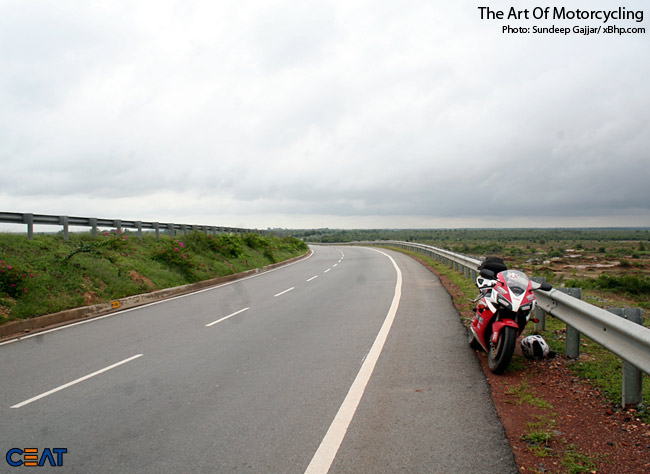
1. Keep your bike in top mechanical condition. A failure 2 days into the tour and in the middle of nowhere is a thoroughly avoidable event. The engine tuning, control cables, brake pads and fluid, tyres, electricals, drive chain and even the frame need periodic checks.
2. Carry all the relevant documents in original, with a photocopy placed elsewhere. The R/C Book, Pollution certificate and Insurance policy (even the cover note will suffice).
3. Being in a reasonably fit physical shape helps the rider stay alert even at the end of a 10-hour ride. Fitness stretches one's fatigue threshold.
4. Plan your route, along with any alternatives, and calculate equipment and financial requirements according to the longest probable route. Good road maps are a must. Especially the ones that show distances (with heights in case of hills) accurately and mark petrol pumps that actually exist. Being stranded without fuel is depressing at the best and life threatening at worst if you get caught at high altitude late in the day and without equipment to spend the night in the open.
5. On highways within our country, doing about 200 kms stretches between breaks is usually the limit.
6. Carry only as much luggage as is totally essential, but never skimp on tools and repair equipment. Carry all that you would need, short of towing another similar bike behind you. Tie the luggage securely on the bike. If riding one-up, tie it on the seat behind as it gives your back some added support and stops the wind from getting in from behind you.
7. Tie the bag so tight that it cannot be moved sideways or up and down at all. A loosely tied bag will keep sliding this way or that and apart from distracting you, could act as a pendulous mass in case of a rear wheel slide during panic stops. Being well behind the centre of gravity of the bike, even a 15kg bag could exert enough leverage to make the otherwise controllable slide totally wild.
8. Prefer a bag with side pockets that are not covered by the tie-down straps. Keep the frequently needed stuff like the water bottle, small tool kit, the first aid kit, spare goggles etc in them. Pack the bag such that the heavier things are at the bottom and the lighter ones on top. Keep extra clothes and rain gear outside the bag. Secure it on top with bungee cords or elastic net. Don't forget to wrap these things in a polythene bag first or the dust and grime enroute would not leave them worth wearing.
9. Keep a separate helmet at home for exclusive use during the long tours. Make sure its visor is clean, scratch-free and seals out the dust effectively. Following a truck or bus on a narrow and dusty mountain road at slow speed will prove you its real worth.
Photo: Keeping the visor clean is very important. Be wary of venings when there are a lot of bugs flying and splattering on your visor.

10. Wear a cotton or silk balaclava before putting on the helmet, whatever the weather. It protects the inside of your helmet from oily perspiration and stops insects from getting into your ears and nose if you need to ride with the visor open. Two thin cotton balaclavas inside a well fitting helmet can see you through the coldest ride.
11. Wear a cotton inner in summer (a cotton track suit is ideal), and preferably a wool one in winter. Au outer windproof jacket with a closed collar is useful, whatever the season. Even 20degC summer mornings can be uncomfortably cold when doing a 100-kmph for hours together. (Remember the wind-chill factor). Also, when riding in those hot summers, contrary to instinct, cover yourself well, leaving as little skin exposed as possible. The dry hot wind blows away perspiration before it can cool you and since every bit of liquid near the skin gets dried up almost immediately, you get dehydrated pretty soon. Clothes help retain this water. And keep drinking water or cold drinks frequently.
12. For cold weather riding, dress in layers comprising of wool, cotton and wind-proofs. A layer of cotton inners followed by a wool tracksuit, then a thin windproof jacket, which in turn is covered, by a heavier quilted windproof jacket can take you through sub-zero riding conditions. Gloves are a must but of the kind that don't compromise on feel and grip, whether wet or dry. To avoid wind-chilled hands in winters, wear latex rubber surgical gloves over woolen ones. Leather though, is ideal. Improvise a nape cover for the gloves using a non-slip type polythene bag.
13. Dress your lower extremities the same way as the top. Two layers, one cotton and the other wool followed by good windproof pants that close around the ankles are sufficient. Boots should have thick non-slip rubber soles, a metal reinforced toe cap and should reach above the ankles.
14. A set of dark glasses for bright sunlight and clear one's for night riding, are important. Needless to say, they should be scratch-free and a good fit.
15. The rain suit should be made of rubberised cloth and its seams must be double sealed, pasted together and not stitched. The stitch-holes will leak, no matter what the manufacturer claims.
16. However far or near the destination, try to leave early in the morning, pre dawn preferably. The sight of a new day breaking, while you ride, is somehow very rejuvenating. And the added benefit is of very little traffic so early in the day.
17. Take frequent breaks, at least every 2 hours, when on a long ride. After 10 hrs on the saddle, you might need to stop even more frequently, to fight fatigue. When riding in the cold, take frequent breaks for warm food and drinks. Do not keep riding until you get numb. You could be closer to hypothermia than you realise and could crash from delayed reactions.
Photo: Take frequent rests, remember its better to be late than to me Mr. Late!
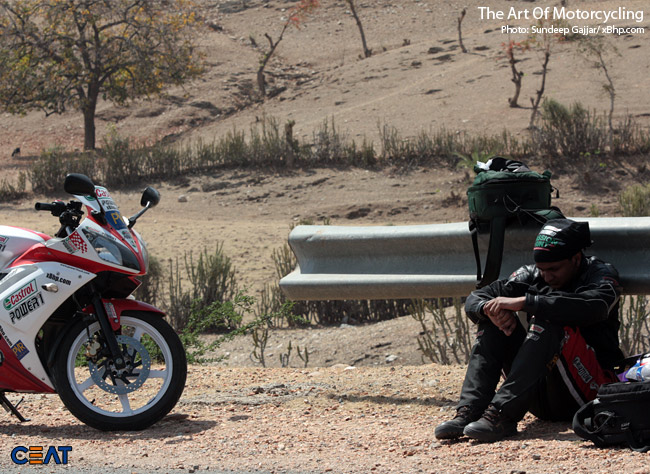
18. Drink lots of water on the way. The wind rushing past carries away more water from the rider's body than he would loose if walking or travelling in a covered vehicle. In cold weather, tea and coffee are good substitutes but for the frequent toilet breaks, since both of these are diuretics.
19. Keep a fuel log. It helps you monitor the mileage your bike is giving apart from keeping the fuel expenses in the picture. In areas where fuel stations are far and apart, you can easily assess whether you can make the distance or not.
20. Maintain a steady fast pace for long stretches. Rushing along for sometime and then stopping every hour will actually reduce the ultimate distance you cover in a given time span. Remember the Hare and the Tortoise!
21. Wrap sandwiches or paranthas in aluminum foil and clamp it somewhere on the engine casing. You get hot food whenever you stop for a tea break! A real treat in those chilling winter rides.
22. Ride the long road with the attitude of someone on a holiday. Leave that poisonous urban rush behind. Set a target for the day but don't keep chasing it all day. Relax! You are out for fun.
Photo: Be a tourist, not a man in a hurry. Absorb the beauty of your surroundings.
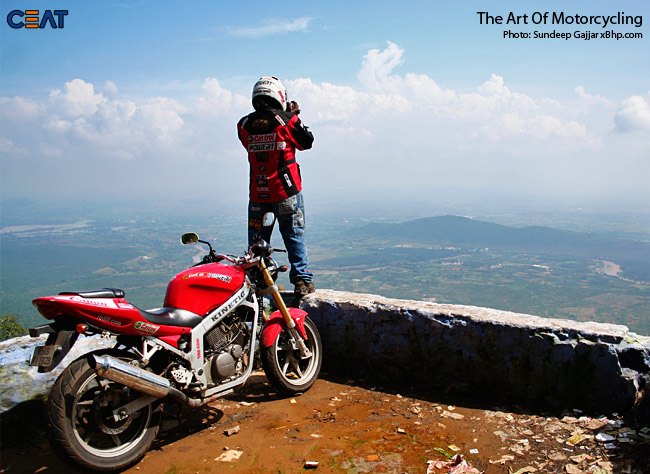
23. When in the hills, keep to your side and watch out for gravel, oil, water or pine needles on the inside of blind curves. In winter, during frosting conditions, watch out for the treacherous 'black ice'. Water or even moisture on the road gets frozen into clear ice and it is very-very slippery. This happens even on a bright sunny afternoon on the shady side of the mountain.
24. With snow or a crust of crunchy ice on the road, a bike ridden two up is more stable than with a single rider. Due to the added weight, the wheels an cut through the ice to grip the road.
25. If there's a stream flowing across the road, watch for slippery moss covered rocks underneath. Keep the bike upright and avoid sudden direction changes.
Photo: Cross a stream with care, especially in the mountains.
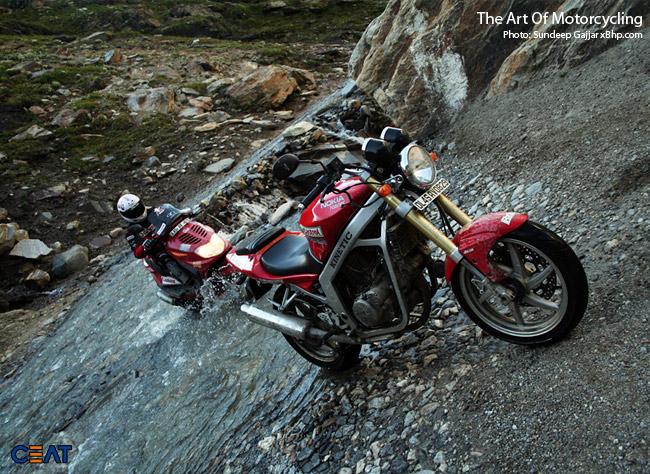 Photo: Take a powernap for 5-10 minutes in case of heavy fatigue. Riding with fatigue is a sure call for disaster.
41. Develop peripheral vision, that ability to be aware of what's going on in the far edges of your sight while looking straight ahead. While riding, fix your eyes on the road and traffic ahead and without moving your head, try to monitor the traffic on either side of you. We usually sacrifice side vision when we concentrate on what's ahead.
42. Braking performance is degraded when carrying a passenger, mainly because the added weight lengthens the stopping distance. Same with cornering. The extra weight takes up suspension travel and makes the bike less responsive to steering inputs. So take it easy when tow-up and extend those safety margins.
43. The passenger should hold on to the riders waist or lower chest. Grab rails leave the passengers wobbly, making the bike unsteady. Tell the passenger to look over your inside shoulder, stay in line with the bike, hold on to you and relax.
44. To cover long distances in a day, the first rule is to keep moving. Don't dawdle over lunch and tea breaks. Minimize your stops by combining tasks. Take a leak, drink water, change your jacket and tighten the luggage in one go. The second rule is to keep the stops short. Maintain a steady fast pace balancing the time gained against the risk factors. At the end of 100 kms, doing 95 instead of 85 makes you gain some 15 odd minutes. Which is about an hour less on a 400km ride. See if it is worth pushing yourself and your bike so close to the limits to gain just an hour in 8 hours of riding.
45. When riding through deep water that submerges the exhaust pipe, keep the bike in first gear and those RPM's up. If the engine stops, water will enter the tailpipe and maybe enter the engine. Do not attempt to re-start the engine as the water inside can severely damage it.
46. When riding through sand, drop tyre pressures by upto 40% (The idea here is to improve tyre floatation i.e. its ability to ride on top of the sand through increasing the contact patch), keep the bike in low gears and steer straight. In sand, always remember that the wheels have a tendency to dig in, so when coming to a halt, do so gently or the sand piles up ahead of the front wheel making the subsequent pick-up difficult.
Photo: Sand is a different ball game together. Riding on sand dunes is definitely not recommended a road bike with road tyres!
47. Keep a 2-mtr long piece of fuel pipe for emergency fuel transfers from one vehicle to another. Also, have a flat board of wood, about 12"X8" handy, to put under the main stand if you need to park your bike on soft ground. Otherwise, use only the side-stand, with a small flat rock placed under it, for parking on soft ground. Note: What appears to be hard ground now could become soft after even a short rain shower. Even hard tarmac becomes unusually soft on a very hot afternoon.
Travel the high road on a motorcycle for the fun of travelling. The highways are not proving grounds for speed and tricks. They are means of getting to far off places. Respect and be considerate for other road users, especially the villagers who were there before the highways came into being. Leave 'Mr. Hurry' and 'Miss Speeding' behind when you tie those bags. Wear your helmet, eye protection and proper safety gear. Just savour the freedom your mechanical steed provides you with and ride so that you can ride again and again.
1. Keep your bike in top mechanical condition. A failure 2 days into the tour and in the middle of nowhere is a thoroughly avoidable event. The engine tuning, control cables, brake pads and fluid, tyres, electricals, drive chain and even the frame need periodic checks.
2. Carry all the relevant documents in original, with a photocopy placed elsewhere. The R/C Book, Pollution certificate and Insurance policy (even the cover note will suffice).
3. Being in a reasonably fit physical shape helps the rider stay alert even at the end of a 10-hour ride. Fitness stretches one's fatigue threshold.
4. Plan your route, along with any alternatives, and calculate equipment and financial requirements according to the longest probable route. Good road maps are a must. Especially the ones that show distances (with heights in case of hills) accurately and mark petrol pumps that actually exist. Being stranded without fuel is depressing at the best and life threatening at worst if you get caught at high altitude late in the day and without equipment to spend the night in the open.
5. On highways within our country, doing about 200 kms stretches between breaks is usually the limit.
6. Carry only as much luggage as is totally essential, but never skimp on tools and repair equipment. Carry all that you would need, short of towing another similar bike behind you. Tie the luggage securely on the bike. If riding one-up, tie it on the seat behind as it gives your back some added support and stops the wind from getting in from behind you.
7. Tie the bag so tight that it cannot be moved sideways or up and down at all. A loosely tied bag will keep sliding this way or that and apart from distracting you, could act as a pendulous mass in case of a rear wheel slide during panic stops. Being well behind the centre of gravity of the bike, even a 15kg bag could exert enough leverage to make the otherwise controllable slide totally wild.
8. Prefer a bag with side pockets that are not covered by the tie-down straps. Keep the frequently needed stuff like the water bottle, small tool kit, the first aid kit, spare goggles etc in them. Pack the bag such that the heavier things are at the bottom and the lighter ones on top. Keep extra clothes and rain gear outside the bag. Secure it on top with bungee cords or elastic net. Don't forget to wrap these things in a polythene bag first or the dust and grime enroute would not leave them worth wearing.
9. Keep a separate helmet at home for exclusive use during the long tours. Make sure its visor is clean, scratch-free and seals out the dust effectively. Following a truck or bus on a narrow and dusty mountain road at slow speed will prove you its real worth.
Photo: Keeping the visor clean is very important. Be wary of venings when there are a lot of bugs flying and splattering on your visor.
10. Wear a cotton or silk balaclava before putting on the helmet, whatever the weather. It protects the inside of your helmet from oily perspiration and stops insects from getting into your ears and nose if you need to ride with the visor open. Two thin cotton balaclavas inside a well fitting helmet can see you through the coldest ride.
11. Wear a cotton inner in summer (a cotton track suit is ideal), and preferably a wool one in winter. Au outer windproof jacket with a closed collar is useful, whatever the season. Even 20degC summer mornings can be uncomfortably cold when doing a 100-kmph for hours together. (Remember the wind-chill factor). Also, when riding in those hot summers, contrary to instinct, cover yourself well, leaving as little skin exposed as possible. The dry hot wind blows away perspiration before it can cool you and since every bit of liquid near the skin gets dried up almost immediately, you get dehydrated pretty soon. Clothes help retain this water. And keep drinking water or cold drinks frequently.
12. For cold weather riding, dress in layers comprising of wool, cotton and wind-proofs. A layer of cotton inners followed by a wool tracksuit, then a thin windproof jacket, which in turn is covered, by a heavier quilted windproof jacket can take you through sub-zero riding conditions. Gloves are a must but of the kind that don't compromise on feel and grip, whether wet or dry. To avoid wind-chilled hands in winters, wear latex rubber surgical gloves over woolen ones. Leather though, is ideal. Improvise a nape cover for the gloves using a non-slip type polythene bag.
13. Dress your lower extremities the same way as the top. Two layers, one cotton and the other wool followed by good windproof pants that close around the ankles are sufficient. Boots should have thick non-slip rubber soles, a metal reinforced toe cap and should reach above the ankles.
14. A set of dark glasses for bright sunlight and clear one's for night riding, are important. Needless to say, they should be scratch-free and a good fit.
15. The rain suit should be made of rubberised cloth and its seams must be double sealed, pasted together and not stitched. The stitch-holes will leak, no matter what the manufacturer claims.
16. However far or near the destination, try to leave early in the morning, pre dawn preferably. The sight of a new day breaking, while you ride, is somehow very rejuvenating. And the added benefit is of very little traffic so early in the day.
17. Take frequent breaks, at least every 2 hours, when on a long ride. After 10 hrs on the saddle, you might need to stop even more frequently, to fight fatigue. When riding in the cold, take frequent breaks for warm food and drinks. Do not keep riding until you get numb. You could be closer to hypothermia than you realise and could crash from delayed reactions.
Photo: Take frequent rests, remember its better to be late than to me Mr. Late!
18. Drink lots of water on the way. The wind rushing past carries away more water from the rider's body than he would loose if walking or travelling in a covered vehicle. In cold weather, tea and coffee are good substitutes but for the frequent toilet breaks, since both of these are diuretics.
19. Keep a fuel log. It helps you monitor the mileage your bike is giving apart from keeping the fuel expenses in the picture. In areas where fuel stations are far and apart, you can easily assess whether you can make the distance or not.
20. Maintain a steady fast pace for long stretches. Rushing along for sometime and then stopping every hour will actually reduce the ultimate distance you cover in a given time span. Remember the Hare and the Tortoise!
21. Wrap sandwiches or paranthas in aluminum foil and clamp it somewhere on the engine casing. You get hot food whenever you stop for a tea break! A real treat in those chilling winter rides.
22. Ride the long road with the attitude of someone on a holiday. Leave that poisonous urban rush behind. Set a target for the day but don't keep chasing it all day. Relax! You are out for fun.
Photo: Be a tourist, not a man in a hurry. Absorb the beauty of your surroundings.
23. When in the hills, keep to your side and watch out for gravel, oil, water or pine needles on the inside of blind curves. In winter, during frosting conditions, watch out for the treacherous 'black ice'. Water or even moisture on the road gets frozen into clear ice and it is very-very slippery. This happens even on a bright sunny afternoon on the shady side of the mountain.
24. With snow or a crust of crunchy ice on the road, a bike ridden two up is more stable than with a single rider. Due to the added weight, the wheels an cut through the ice to grip the road.
25. If there's a stream flowing across the road, watch for slippery moss covered rocks underneath. Keep the bike upright and avoid sudden direction changes.
Photo: Cross a stream with care, especially in the mountains.
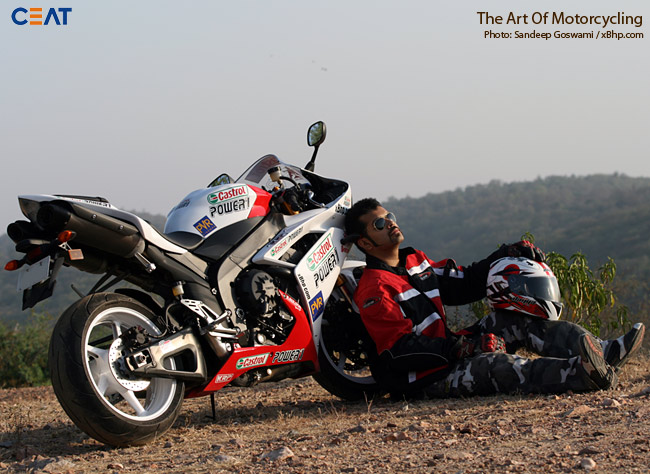
Photo: Take a powernap for 5-10 minutes in case of heavy fatigue. Riding with fatigue is a sure call for disaster.41. Develop peripheral vision, that ability to be aware of what's going on in the far edges of your sight while looking straight ahead. While riding, fix your eyes on the road and traffic ahead and without moving your head, try to monitor the traffic on either side of you. We usually sacrifice side vision when we concentrate on what's ahead.
42. Braking performance is degraded when carrying a passenger, mainly because the added weight lengthens the stopping distance. Same with cornering. The extra weight takes up suspension travel and makes the bike less responsive to steering inputs. So take it easy when tow-up and extend those safety margins.
43. The passenger should hold on to the riders waist or lower chest. Grab rails leave the passengers wobbly, making the bike unsteady. Tell the passenger to look over your inside shoulder, stay in line with the bike, hold on to you and relax.
44. To cover long distances in a day, the first rule is to keep moving. Don't dawdle over lunch and tea breaks. Minimize your stops by combining tasks. Take a leak, drink water, change your jacket and tighten the luggage in one go. The second rule is to keep the stops short. Maintain a steady fast pace balancing the time gained against the risk factors. At the end of 100 kms, doing 95 instead of 85 makes you gain some 15 odd minutes. Which is about an hour less on a 400km ride. See if it is worth pushing yourself and your bike so close to the limits to gain just an hour in 8 hours of riding.
45. When riding through deep water that submerges the exhaust pipe, keep the bike in first gear and those RPM's up. If the engine stops, water will enter the tailpipe and maybe enter the engine. Do not attempt to re-start the engine as the water inside can severely damage it.
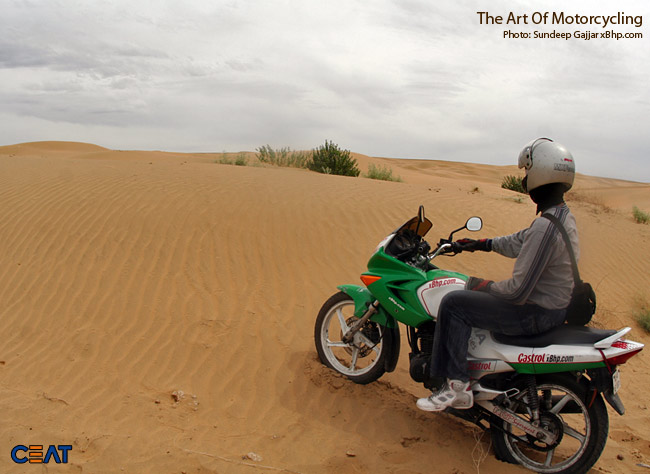
46. When riding through sand, drop tyre pressures by upto 40% (The idea here is to improve tyre floatation i.e. its ability to ride on top of the sand through increasing the contact patch), keep the bike in low gears and steer straight. In sand, always remember that the wheels have a tendency to dig in, so when coming to a halt, do so gently or the sand piles up ahead of the front wheel making the subsequent pick-up difficult.
Photo: Sand is a different ball game together. Riding on sand dunes is definitely not recommended a road bike with road tyres!
47. Keep a 2-mtr long piece of fuel pipe for emergency fuel transfers from one vehicle to another. Also, have a flat board of wood, about 12"X8" handy, to put under the main stand if you need to park your bike on soft ground. Otherwise, use only the side-stand, with a small flat rock placed under it, for parking on soft ground. Note: What appears to be hard ground now could become soft after even a short rain shower. Even hard tarmac becomes unusually soft on a very hot afternoon.
Travel the high road on a motorcycle for the fun of travelling. The highways are not proving grounds for speed and tricks. They are means of getting to far off places. Respect and be considerate for other road users, especially the villagers who were there before the highways came into being. Leave 'Mr. Hurry' and 'Miss Speeding' behind when you tie those bags. Wear your helmet, eye protection and proper safety gear. Just savour the freedom your mechanical steed provides you with and ride so that you can ride again and again.
Posting Replies to this Article
Want to add to this article? Great! But please don't start repeating what has already been stated here. And people who post subsequent to additions by others are advised to go through these additional posts too and not repeat whatever has already been said.
Want to add to this article? Great! But please don't start repeating what has already been stated here. And people who post subsequent to additions by others are advised to go through these additional posts too and not repeat whatever has already been said.
- Only comments which add on value to the article will be approved.
- You may add on more points, pointers to the subject relating to this article.


 )...chances are few more will follow after him in sometime,so be ready to brake if necessary
 .
.




Comment