







 Tweet
Tweet
 Valve clearance setting-RTR180
Valve clearance setting:
The valves are an integral part of an engine. They open and close, allowing in a mixture of air and petrol into the combustion chamber of the engine.After some period,the valves do not open enough, not allowing in enough air and fuel, or open too much, allowing in too much air and fuel. In either case, the engine will not function properly.Hence it becomes necessary to adjust the valves of your motorcycle to help it run smoothly.
To let the air/fuel mixture in to the engine we have intake valves. To let it out we have exhaust valves. However, if these valves don't open and close at the right time the engine will not run. Worse still, if the valves open at the wrong time they can be hit by the piston and bent.If you cannot get it exact then it is better to have a slightly slack tappet than a tight one.If both valves had no clearance, meaning they were both slightly held open all the time then that might give rise to some very severe starting difficulties, let alone running.Exhaust valves are more prone to damage since they run hotter than the intake valves.The intake valves are cooled by the incoming air and fuel.
Make sure you have all the necessary tools for this D.I.Y
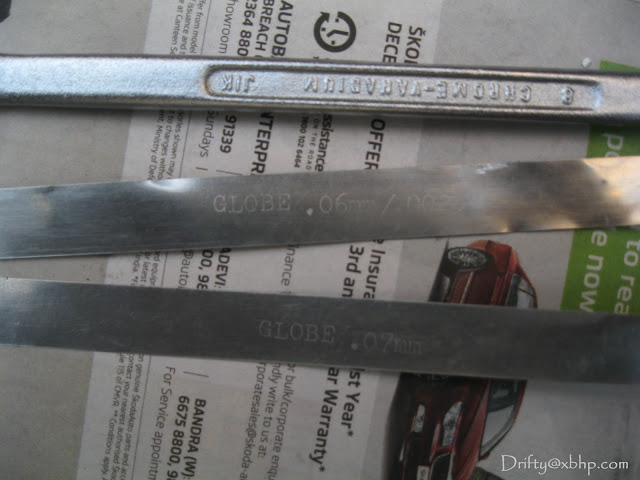
Feeler gauge:It helps you adjust the opening of the valve.The feeler gauge has a graduated thickness all around its outer edge, from very thin to thicker. The thickness are marked so that you can match the thickness of the gap to that required by the manufacturer. This tool is helpful for measuring the thickness of the gap on valves as well as spark plugs.
Before you start this,the engine needs to be completely cool,bone cold!
Tools required:
1)12mm spanner(to remove the tank)
2)17mm ring spanner
3)17mm open end spanner
4)9mm ring spanner
5)Tappet adjusting tool/Forceps
6)Feeler gauge strip(0.06mm,0.08mm)
7)10mm allen key
8)16mm spark plug spanner and a screw driver
9)16mm ring spanner(for removing spark plug)-optional

Feeler guage:

Procedure:
Remove the tank,remove the spark plug as well(optional)
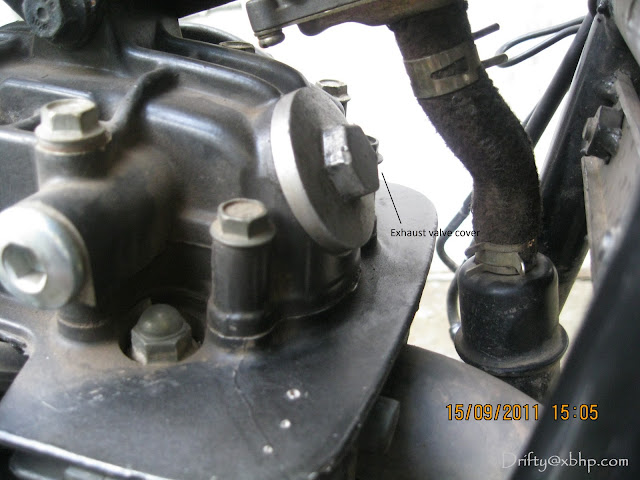
Step 1:Remove the intake and exhaust valve cover with the 17mm ring spanner.



Step 2:
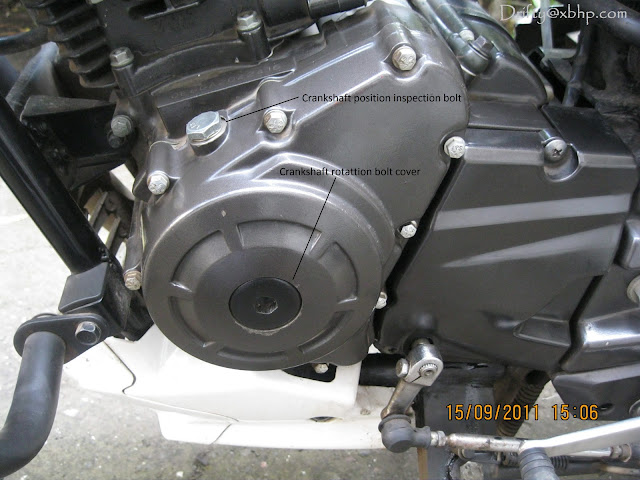
Remove the crankshaft position inspection bolt and crankshaft rotation bolt cover with the 17mm open end spanner and 10mm allen key respectively.


Step 3:
In a 4-stroke engine,the piston reaches TDC at two strokes-the compression stroke & exhaust stroke.During the compression stroke,both the inlet and exhaust valves are closed.It is this point we have to adjust the valve clearance.
This step is very critical.Now insert the spark plug spanner over the crankshaft rotation bolt and turn the screw driver in anti-clockwise direction until you see a ''T'' mark in the inspection window.
This is to ensure that piston is at the Top Dead Center(TDC) on the compression stroke(just after the inlet valve closes).Check for some movement in the rocker arms and valve (grab it with your fingers and move it up and down,there must be some play),this will ensure that the piston is at TDC of compression stroke.


Ok now you can proceed.
Step 4:
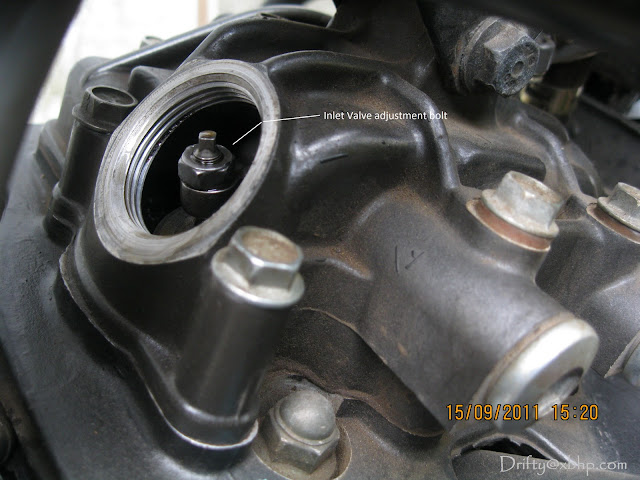

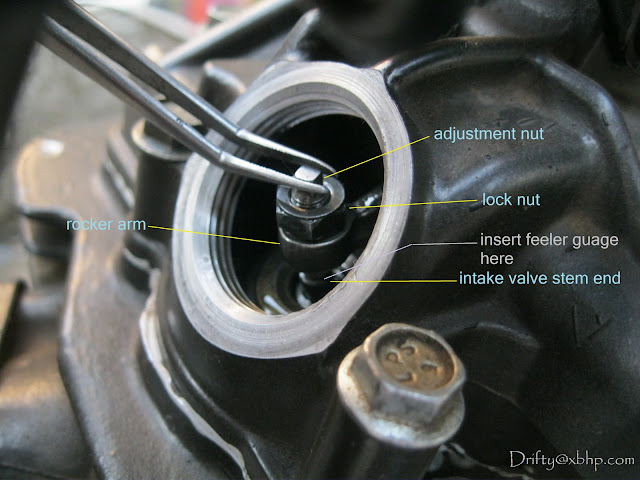
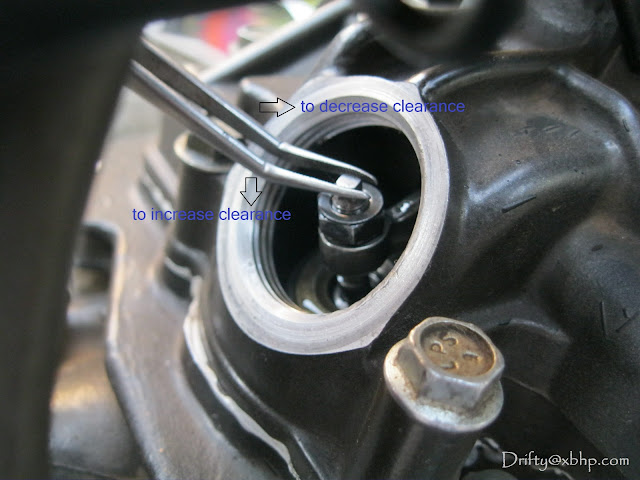
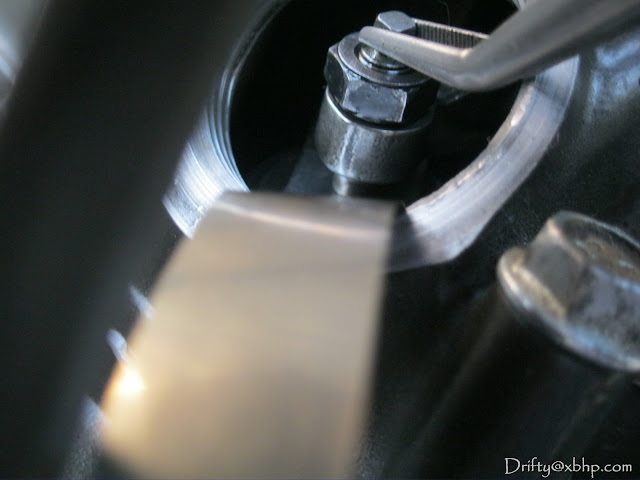
Now loosen the lock nut with a 9mm ring spanner and adjust the adjustment bolt.Rotate the adjusting screw in anti-clockwise direction to increase the clearance while clock wise direction will decrease the clearance.Insert the feeler gauge 0.06mm(for intake valves),with the help of tappet adjusting tool/forceps adjust the adjustment screw so that it touches the feeler gauge.Don't tight it or it will be difficult to remove the feeler gauge back.After this process hold the adjustment screw at the same position and tighten the locknut (make sure the adjusting screw don't rotate).Re-check the clearance,the feeler gauge should go in there with a slight resistance,if not,adjust again!
INTAKE VALVE:


EXHAUST VALVE:
Process is same for the exhaust valve as well.Here you need a 0.08 mm feeler gauge.Generally,there is more clearance left at the exhaust valves as they are exposed to hot burnt gases and work at higher operating temperatures than inlet valves.

Put back everything in reverse order.
TIPS:
1)Set the valve clearance when the engine is cold.
2)Always use a ring spanner only for opening the valve cover,as an open end spanner might slip and damage them as they are die-cast aluminium.
3)Ensure that the piston is at TDC compression stroke,setting it at any other stroke will affect the valve timing & damage the engine internals.
4)Always use a feeler gauge of recommended size for setting the clearance for more precision.
5)After adjusting valves, always re-measure the clearance and re-adjust if necessary.
6)Removing spark plug makes it easier to rotate the crank while you adjust the valves.
NOTE:This procedure is more or less the same for all bikes.
The valves are an integral part of an engine. They open and close, allowing in a mixture of air and petrol into the combustion chamber of the engine.After some period,the valves do not open enough, not allowing in enough air and fuel, or open too much, allowing in too much air and fuel. In either case, the engine will not function properly.Hence it becomes necessary to adjust the valves of your motorcycle to help it run smoothly.
To let the air/fuel mixture in to the engine we have intake valves. To let it out we have exhaust valves. However, if these valves don't open and close at the right time the engine will not run. Worse still, if the valves open at the wrong time they can be hit by the piston and bent.If you cannot get it exact then it is better to have a slightly slack tappet than a tight one.If both valves had no clearance, meaning they were both slightly held open all the time then that might give rise to some very severe starting difficulties, let alone running.Exhaust valves are more prone to damage since they run hotter than the intake valves.The intake valves are cooled by the incoming air and fuel.
Make sure you have all the necessary tools for this D.I.Y
Feeler gauge:It helps you adjust the opening of the valve.The feeler gauge has a graduated thickness all around its outer edge, from very thin to thicker. The thickness are marked so that you can match the thickness of the gap to that required by the manufacturer. This tool is helpful for measuring the thickness of the gap on valves as well as spark plugs.
Before you start this,the engine needs to be completely cool,bone cold!
Tools required:
1)12mm spanner(to remove the tank)
2)17mm ring spanner
3)17mm open end spanner
4)9mm ring spanner
5)Tappet adjusting tool/Forceps
6)Feeler gauge strip(0.06mm,0.08mm)
7)10mm allen key
8)16mm spark plug spanner and a screw driver
9)16mm ring spanner(for removing spark plug)-optional
Feeler guage:
Procedure:
Remove the tank,remove the spark plug as well(optional)
Step 1:Remove the intake and exhaust valve cover with the 17mm ring spanner.
Step 2:
Remove the crankshaft position inspection bolt and crankshaft rotation bolt cover with the 17mm open end spanner and 10mm allen key respectively.
Step 3:
In a 4-stroke engine,the piston reaches TDC at two strokes-the compression stroke & exhaust stroke.During the compression stroke,both the inlet and exhaust valves are closed.It is this point we have to adjust the valve clearance.
This step is very critical.Now insert the spark plug spanner over the crankshaft rotation bolt and turn the screw driver in anti-clockwise direction until you see a ''T'' mark in the inspection window.
This is to ensure that piston is at the Top Dead Center(TDC) on the compression stroke(just after the inlet valve closes).Check for some movement in the rocker arms and valve (grab it with your fingers and move it up and down,there must be some play),this will ensure that the piston is at TDC of compression stroke.
Ok now you can proceed.
Step 4:
Now loosen the lock nut with a 9mm ring spanner and adjust the adjustment bolt.Rotate the adjusting screw in anti-clockwise direction to increase the clearance while clock wise direction will decrease the clearance.Insert the feeler gauge 0.06mm(for intake valves),with the help of tappet adjusting tool/forceps adjust the adjustment screw so that it touches the feeler gauge.Don't tight it or it will be difficult to remove the feeler gauge back.After this process hold the adjustment screw at the same position and tighten the locknut (make sure the adjusting screw don't rotate).Re-check the clearance,the feeler gauge should go in there with a slight resistance,if not,adjust again!
INTAKE VALVE:
EXHAUST VALVE:
Process is same for the exhaust valve as well.Here you need a 0.08 mm feeler gauge.Generally,there is more clearance left at the exhaust valves as they are exposed to hot burnt gases and work at higher operating temperatures than inlet valves.
Put back everything in reverse order.
TIPS:
1)Set the valve clearance when the engine is cold.
2)Always use a ring spanner only for opening the valve cover,as an open end spanner might slip and damage them as they are die-cast aluminium.
3)Ensure that the piston is at TDC compression stroke,setting it at any other stroke will affect the valve timing & damage the engine internals.
4)Always use a feeler gauge of recommended size for setting the clearance for more precision.
5)After adjusting valves, always re-measure the clearance and re-adjust if necessary.
6)Removing spark plug makes it easier to rotate the crank while you adjust the valves.
NOTE:This procedure is more or less the same for all bikes.


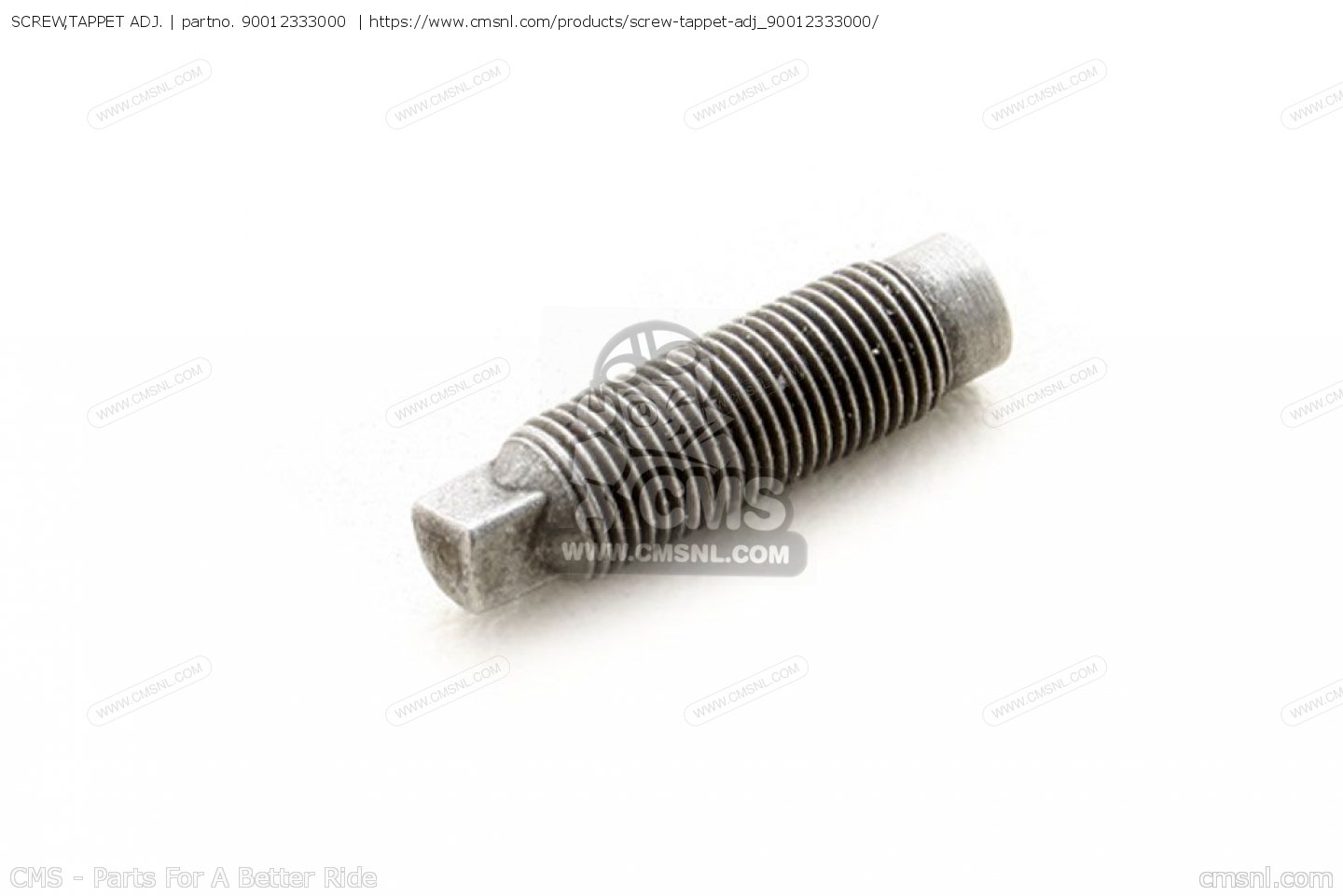
 . are tappets/valves different parts altogether ?? someone says its exhaust valves tight,but u said its inlet one, m confused





Comment