Since '02 xBhp is different things to different people. From a close knit national community of bikers to India's only motorcycling lifestyle magazine and a place to make like-minded biker friends. Join us

Castrol Power 1

All the gear all the time (ATGATT).

Our Partner

Announcement

Collapse
No announcement yet.

Electronics Scheme of Two Wheelers

Collapse
X
 
  • Filter
  • Time
  • Show
Clear All
new posts

  • #16
    Originally posted by NANOtechnology View Post

    Just as a query, i wish to know, weather is it possible to just wind 1 pole (of an 8 pole stator) with a thinner wire and route it to the stock RR to run the plug on the current provided by it ??
    (too much of a gamble? and trial and error, isn't it ??)
    I mentioned this as I've tried tapping one of the ends of the alternator (35 amp one) to the stock RR unit (maybe was too stupid) but after that, neither the alternator is keeping me happy, and I've even burned the stock RR unit.
    Possible provided enough voltage and current generation can be done....Here is a 3 phase Regulator Rectifier circuit if you are interested in building...the rectifier diodes(D1 to D6) and SCRs (T1 to T3)must be on a heatsink...Use Plastic power Rectifier diodes for ease of mounting .
    When Was The Last Time,You Did Something For The First Time.

    Comment


    • #17
      Originally posted by sajjt View Post

      Nano, what made u to think so? Just u fried the stock RR by giving a higher amps AC to feed the RR-TCI? Its obvious the lower rated diodes will conk off in no time with a boost in amps. If u feed the rewinded coil to the stock RR battery charging circuit, it will heat up instantly and conk off in no time due to this.

      DC feeded (read battery/RR) ignition will perform better than AC ignition in all rpm ranges provided the battery is in good conditions. But at the same time, over loading the electricals will lead to miss firing as the power requirements are higher than the generation on low rpms and obviously the ignition system suffers which leads to hickups. So its better to be judicious in loading the electricals atleast in low rpms.


      Nano, what about the other bikes with DC ignitions which runs on full DC like YFZ,P220, ZMA etc by stock? I guess, so long as the power generation and distribution is in balance, there won't be any battery drain and the system can do at par with the stock. Its the excessive load makes the battery condition worse AFAIK.
      Well, i personally feel that the DC feeded TCI/CDI units of full DC motorcycles DO NOT RUN only from the battery, it would tapp the current from the coil and the regulator that provides this current to the battery provides it to the ignition coil too, as thus these bikes can run without the battery.

      I tried to do the same thing, and However it was PSR who planted this idea in my head () but due to lack of communication it was never discussed and i did what i learnt from a single post.
      Was too busy and falling short of time to carry out a discussion, maybe i understood it in a wrong way, but i would request PSR to discuss it in the right way here though...

      Originally posted by psr View Post
      Possible provided enough voltage and current generation can be done....Here is a 3 phase Regulator Rectifier circuit if you are interested in building...the rectifier diodes(D1 to D6) and SCRs (T1 to T3)must be on a heatsink...Use Plastic power Rectifier diodes for ease of mounting .
      Well, as i have never been in an electrical background so i am finding it difficult to understand, but i guess this is what i was asking for all the while.
      I'll try to show it to a friend of mine and ask for his feedback (as he's a master in electricals) before commenting on the same.
      Thanks a lot PSR.

      We all owe you a lot for the knowledge and information that you have provided until now...
      Thanks would be a very small word...
      Giving a lot to a fiero.
      Expecting a lot from a fiero.

      Comment


      • #18
        Saw this thread just now. Looks lke nothing much is left to explain.

        Just one thing - the self check sequence on the console at start up is just a gimmick! Nothing much happens.. remove that console from the bike and give at 12V power, it will do pretty much the same thing.

        Also, Pulsars do have a BCU in between the switches and the bulbs/horns etc.
        Your biking tells a lot about the person you are!

        Comment


        • #19
          Hey Nano, thanks for the details of your experience.I appreciate your efforts in experimenting and creating standards rather than following the standards set by someone.

          Well this is basically just a schematic block diagram rather than being a circuit/wiring diagram.You know its basically like one of the text book types.So don't bother much about the color or number of wires connected to any particular component.

          Here s what i gather from your posts

          1. Regarding the Engine kill switch,the sole purpose is to cut off ignition,So i don't think the spark plug will run with the EK switch open.And from the diagram what PSR has posted i think EK is in line with the TCI/CDI and ignition switch will come before the common connector from the battery.

          2. As per your statement if ther is only one power input line to the TCI i.e the regulated AC line form the Alternator,then what about the case when starting the bike.The alternator does not hold any charge and merely generates it.So how will it feed the TCI when starting the bike.

          @psr : According to what you have mentioned in your previous post can you please clarify how does the supply switch over from the Alt+RR in low battery conditions.

          3. A lighting coil is a static coil with dedicated poles for charging the battery and also providing power to the HL circuit.So are these poles dedicated for the said purpose or when the HL is off the ALT+RR is completely utilised for charging ?

          @PSR

          Ji you ve just put my efforts to shame with that super simplified circuit .Very nice and that 3 phase one completely went over my head.
          @ Sajjt

          Thanks for pitching in.

          So what about all the bikes on full DC,how does the battery cope up with the load ? How do they manitain the generation and load consumption balance.

          Why is regulated DC signal better than regulated and rectified AC. Are there any power losses in the rectifier circuit.?

          @Abhijeet

          Thanks for replying,well as explained by psr,the self is a mere reset and self calibration of all the digital equipment.All the instruments going up at once does look like one fancy gimmick for us.

          And what s a BCU.

          @ Everyone

          Please dont write this thread off although there s not much left to explain let us put in place what is the existing setup of various bikes.

          How does the tacho sensor work? Is it like one of those sensors like the pulser coil (reed switch?) or is it a digital sensor.

          Can someone explain apart from these components what are the ones that change in an FI circuit.

          Without an ECU for the desi carburetted bikes,how is the engine desgined to follow a particular speed,torque curve ?


          Godspeed
          Revverend

          Comment


          • #20
            Originally posted by Revverend View Post

            1. Regarding the Engine kill switch,the sole purpose is to cut off ignition,So i don't think the spark plug will run with the EK switch open.And from the diagram what PSR has posted i think EK is in line with the TCI/CDI and ignition switch will come before the common connector from the battery.
            Wrong..an engine kill switch when on actually shorts the output of Ignitor to ground and hence prevent Ignition energy from reaching the plug.So open EK =engine on.

            2. As per your statement if ther is only one power input line to the TCI i.e the regulated AC line form the Alternator,then what about the case when starting the bike.The alternator does not hold any charge and merely generates it.So how will it feed the TCI when starting the bike.
            The usual generators in the bike use permanent magnet as ROTOR to excite Voltage in STATOR COIL...so any time the crankshaft rotates the generator will produce AC voltage in stator to be RR ed ..so a dc wired bike will start even without battery.

            @psr : According to what you have mentioned in your previous post can you please clarify how does the supply switch over from the Alt+RR in low battery conditions.
            There is no supply switch over from ALT+RR to battery..Whichever source has higher potential will supply the energy required.

            3. A lighting coil is a static coil with dedicated poles for charging the battery and also providing power to the HL circuit.So are these poles dedicated for the said purpose or when the HL is off the ALT+RR is completely utilised for charging ?
            Yes ..When the circuit demand is less ,the energy from stator will be wasted as heat by regulating circuit, by passing the energy to ground in the process of regulation.If the energy generated is equal to energy required ,no by pass to ground takes place.
            @PSR

            Ji you ve just put my efforts to shame with that super simplified circuit .Very nice and that 3 phase one completely went over my head.
            Sorry if i seemed to swamp you...Instead of one coil you have a set of three coils set at 120 degrees off phase with each other..this configuration gives more linear and higher capability to the energy developed.nothing confusing I hope..For cost and old design reason this is not integrated into old design bike engines...except ZMA/ZMR.

            Many things in life are simple, only we complicate them..
            @ Sajjt
            Thanks for pitching in.
            So what about all the bikes on full DC,how does the battery cope up with the load ? How do they manitain the generation and load consumption balance.
            As an example the ZMA generator is rated at 188 watts and at 12 volts it is 15 Amperes...so the battery depending on it's capacity and charge will supply current initially..what ever is needed above that will be taken care of ,IN ADDITION to battery,. by the Stator coil generation.If battery is dead or bad the supply and charging will be done by Stator coil energy.
            Why is regulated DC signal better than regulated and rectified AC. Are there any power losses in the rectifier circuit.?
            All vehicles run on Rectified and Regulated AC with Battery acting as a resevoir
            @Abhijeet

            Thanks for replying,well as explained by psr,the self is a mere reset and self calibration of all the digital equipment.All the instruments going up at once does look like one fancy gimmick for us.

            And what s a BCU.
            BODY CONTROL UNIT....unique to Pulsar family

            @ Everyone

            Please dont write this thread off although there s not much left to explain let us put in place what is the existing setup of various bikes.

            How does the tacho sensor work? Is it like one of those sensors like the pulser coil (reed switch?) or is it a digital sensor.
            Normally in bike the pulse from the pulse coil is amplified and used for tacho....as a tap off from the ignition circuit.

            Can someone explain apart from these components what are the ones that change in an FI circuit.
            Without an ECU for the desi carburetted bikes,how is the engine desgined to follow a particular speed,torque curve ?

            This needs more space and I will make a separate post


            Godspeed
            Revverend
            replies in bold.
            @Abhijeet, and @Sajit..sorry for posting replies to queries addressed to you both..thought i can post my view, and I welcome your posts ..
            Last edited by psr; 11-08-2011, 06:09 PM.
            When Was The Last Time,You Did Something For The First Time.

            Comment


            • #21
              Originally posted by Revverend View Post
              @Abhijeet

              Thanks for replying,well as explained by psr,the self is a mere reset and self calibration of all the digital equipment.All the instruments going up at once does look like one fancy gimmick for us.

              And what s a BCU.

              @ Everyone

              Please dont write this thread off although there s not much left to explain let us put in place what is the existing setup of various bikes.

              How does the tacho sensor work? Is it like one of those sensors like the pulser coil (reed switch?) or is it a digital sensor.

              Can someone explain apart from these components what are the ones that change in an FI circuit.

              Without an ECU for the desi carburetted bikes,how is the engine desgined to follow a particular speed,torque curve ?
              I am afraid, there is no actual calibration happening here in the speedo!

              It is just that at the time of startup, the needles are programmed to dance a bit.

              Ofcourse, in a FI bike, the fuel pump primes at startup. The needle dancing bit distracts the user and gives the pump sufficient time to prime.

              The CDI/AMI/TCI unit in a carb bike can be a digital device too. It has ignition maps which generally define the relation between the 3 parameters - engine speed (input from pulsar coil), engine load (input from throttle body reed switch) and spark advance. Note that - unlike in a ECU, fuel control is left to the carb.

              @PSR - You certainly dont need to apologize to anyone for sharing your knowledge!
              Your biking tells a lot about the person you are!

              Comment


              • #22
                1. Oh well so the EK switch is normally open when the engine is ON and grounds the charge from the TCI when closed. But nano says the spark plug ignites even when the EK switch is closed (OFF).How s that possible.

                2.Ah right !! Permanent magnet synchronous generator ? Well honestly i ve studied all about these during my engg and each and every term here sounds very familiar right from the alternator to the SCR s and IGBT s. Damn i should ve paid more attention.

                So theoretically the alternator should be able to start the combustion when the bike is pushed and subsequently the crank turns and triggers the generator.This should happen with any bike regardless of AC/DC or full DC setup ?

                3. Well this is one example of me complicating simple things as you have stated. Two power sources connected to a load and the load will be fed from the one with a higher potential.

                4. So the energy produced at the alternator stator is wasted at the RR which acts as a mere resistance when the HL is off. Can this wattage be tapped somewhere else ?

                5. I totally understand the three phase concept here.So ZMA/ZMR has a 3 phase circuit ?? Impressive.

                6.Well so in a full DC setup the battery is merely for sustaining the loads rather than supplying them.The alternator seems to be the quintessential component.

                How is the load balance achieved ? During design are the full DC bikes designed for battery running all the components and the alternator supporting them or vice versa.I am guessing its the latter.

                7. Body control unit ? sounds like a total fancy term. Is it just there for creating a USP for bajaj bikes or does it really serve a purpose.?

                8. I was expecting another reed switch attached to the crank for feeding the tacho.

                Thanks a lot psr and no harm in replying to all my posts.In fact it was the queries were addressed to everyone.

                I am waiting for the FI circuit.

                Comment


                • #23
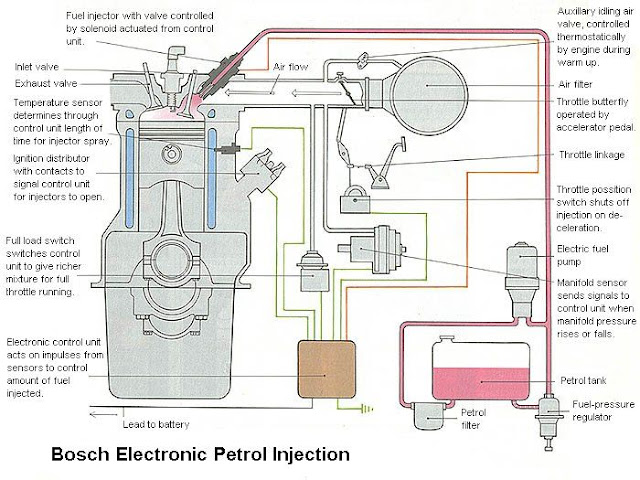
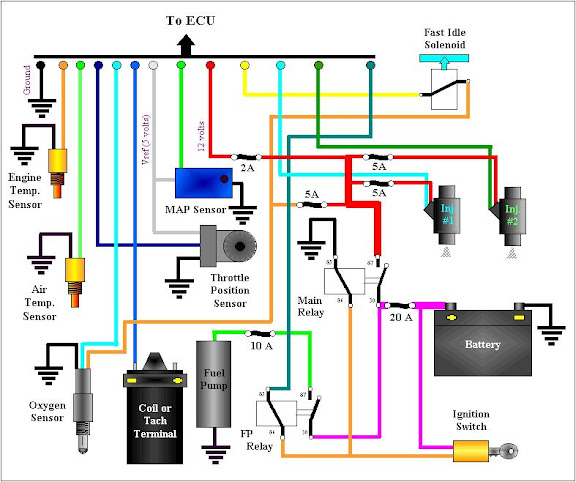
                  Fuel injection...simple

                  The Pictures are self explanatory...


                  When Was The Last Time,You Did Something For The First Time.

                  Comment


                  • #24
                    BCU is the little rectangular box with a butt-load of wires sitting below the digital speedometer console on a pulsar. This unit is present on all the digital console equipped pulsars except the P135.

                    The BCU is actually very intelligent in nature. It is basically a pack of relays and a logic circuit.

                    The BCU is not just a gimmick.

                    The BCU equipped pulsars have contact-free switches, meaning they don't have contact points in them to make or break the circuit. They are magnetically operated and they just send signals to the BCU. The contact free switches don't require any kind of protection from the rain. As there are no contact points nothing gets corroded or rusted and that is a very nice feature included on the pulsars.

                    The BCU is responsible for the following things on my P180UG3:
                    1. Running the starter
                    2. Killing the engine
                    3. Turning the headlights ON or OFF
                    4. Sounding the horn
                    5. Running and blinking the turn indicators and also shutting them down after the turn is completed [self-cancelled by a signal sent by a sensor mounted on the steering T] There is no flasher relay on the BCU enabled pulsars.
                    6. Switching between High and Low beams
                    7. Activating the Pass.
                    8. This is the most important of all: Disabling the starter after the engine cranks. This is done by the BCU itself. Once the engine starts running, a voltage is produced at the headlight wire. When the BCU senses this it immediately cuts off the starter switch. So when the engine is running, the starter cannot accidentally run.
                    9. Switching to the other beam if one of the filaments of the headlight bulbs conks off.

                    The 8th point is the one causing problems in all the UG3 pulsars and the P200 who have gone for Full DC. But it has a simple fix too. That fix has been discussed in detail by Rahuldevnath.

                    Since the P180UG3 has a CDI ignition, it runs without the battery and without the RR too! I know this for sure and Nano has seen it!

                    IMO the self test is a pure gimmick. As abhi pointed out, it just distracts the rider from cranking the engine for a while and this time is needed by the fuel pump to prime. I have been cranking the engine before the POST completes right from the beginning and since my bike is carburetted, its all fine
                    Last edited by pavanchirmade; 11-08-2011, 08:17 PM.

                    Comment


                    • #25
                      Originally posted by pavanchirmade View Post
                      Since the P180UG3 has a CDI ignition, it runs without the battery and without the RR too! I know this for sure and Nano has seen it!

                      IMO the self test is a pure gimmick. As abhi pointed out, it just distracts the rider from cranking the engine for a while and this time is needed by the fuel pump to prime. I have been cranking the engine before the POST completes right from the beginning and since my bike is carburetted, its all fine
                      The pulsar has a separate coil to generate the AC 200 volts which is then full wave rectified and stored in a capacitor to discharge as per pulse from pulse coil on the stator.Hence is not dependent on DC circuit for Ignition.But RR and battery exists for supply to other components like console, indicators, horns,BCU etc.
                      A fuel Injected engine is totally dependent on Battery and DC circuit.
                      When Was The Last Time,You Did Something For The First Time.

                      Comment


                      • #26
                        Yes once a friend's R15 stopped on the road because of the excessive electrical load of 2HIDs causing the battery going flat. Also many people have observed a reduced top end when running HIDs as the fuel pump spins slower due to lack of sufficient current.

                        PSR sir yes I had seen the yellow ignition pole when I was getting the stator re-wound

                        Comment


                        • #27
                          Originally posted by pavanchirmade View Post
                          Yes once a friend's R15 stopped on the road because of the excessive electrical load of 2HIDs causing the battery going flat. Also many people have observed a reduced top end when running HIDs as the fuel pump spins slower due to lack of sufficient current.

                          PSR sir yes I had seen the yellow ignition pole when I was getting the stator re-wound
                          I saw the yellow Ignition coil in your post when you were upgrading the coil...So my thanks to you for the knowledge sharing..
                          If the R15 stator is unable to supply the DC requirement of the bike then an upgrading with thicker wire for more current, like you had done, will solve the problem...Many times in my ZMA I had run the bike in night with headlight,indicator etc., WITHOUT BATTERY, without any issue(just to understand the stator capability,and if bike is dependent on battery, and if so how far).....I did notice the RR getting very hot, so i took a large size 16 gauge aluminum plate and bent it in half, and mounted the plate behind the RR as a heat sink for safety... I do have a 9 AH Amron
                          Last edited by psr; 11-08-2011, 09:32 PM.
                          When Was The Last Time,You Did Something For The First Time.

                          Comment


                          • #28
                            @ Revverend

                            1. Regarding the Engine kill switch,the sole purpose is to cut off ignition,So i don't think the spark plug will run with the EK switch open.And from the diagram what PSR has posted i think EK is in line with the TCI/CDI and ignition switch will come before the common connector from the battery.

                            2. As per your statement if ther is only one power input line to the TCI i.e the regulated AC line form the Alternator,then what about the case when starting the bike.The alternator does not hold any charge and merely generates it.So how will it feed the TCI when starting the bike.

                            3. Oh well so the EK switch is normally open when the engine is ON and grounds the charge from the TCI when closed. But nano says the spark plug ignites even when the EK switch is closed (OFF).How s that possible.
                            I think you misunderstood my comments, or maybe i haven't been able to explain it in a right way.
                            Let me try and do that again.

                            1.
                            True, the purpose is to cut off the supply.
                            But what i mentioned was that this switch doesn't route the current to the ignition coil through the kill switch, so that if the switch is open the current won't pass, i mentioned that if you do not have switches connected at all, and just have the ignition coil connected with the main wiring and ignition key switched on, the bike will fire, irrelevant of the switch, the interaction of the switch is to do with the TCI letting it know when to cut it off or not.

                            2.
                            Incorrect, i never said that there's a regulated AC line going the coil to the TCI, all i said was that there's just 1 line which supply the regulated current to the TCI (maybe i forgot to mention that this is DC current), now if your battery is NOT CONNECTED AT ALL this tci will still fire, but if your coil isn't connected, you'll have to manually route this input wire to the battery, even though its a DC line it works on the DC generated inside the regulator rather than tapping things directly from the battery, we can conclude this by the statement that when the battery is connected and the stock regulator isn't connected, we need to route this manually to the battery.
                            Having done that, i say all this.

                            3.
                            1 and 2 maybe clears it out this time....
                            Giving a lot to a fiero.
                            Expecting a lot from a fiero.

                            Comment


                            • #29
                              BUMP!


                              This was a nice discussion until everyone fell asleep

                              Comment


                              • #30
                                Originally posted by pavanchirmade View Post
                                BUMP!


                                This was a nice discussion until everyone fell asleep
                                Knock Knock....The thread starter disappeared and only we are into it. Most of us here,are aware of the Circuitry at work and only the queries bring us here for a healthy sharing of our knowledge.

                                When Was The Last Time,You Did Something For The First Time.

                                Comment

                                Working...
                                X