









Tag Archives: Kawasaki Ninja H2
Kawasaki Ninja H2 SX SE review: Supercharged for the long haul

 Sep 2018
 Sundeep Gajjar
 Bikes,Kawasaki,Motorcycles
There was a lot of commotion in the motorcycling world when Kawasaki introduced the Ninja H2, the only supercharged production motorcycle in the world. A supercharger in a motorcycle. The idea still sounds outlandish when one hears it. Even after the Ninja H2 has been around for a while. For all intents and purposes, the Ninja H2 is an extremist. Its track only big daddy, the Ninja H2R even more so. But these Ninjas have enjoyed a lot of acclaim for the engine and the design that would suit sci-fi movies more than any other bike in the world.


But these are extreme machines, not everyone wants a motorcycle like that. But Kawasaki wants everyone to want their Supercharged Ninjas. So, they made another supercharged motorcycle that tones down the aggression of the Ninja H2 and brings it down to the level of a sports-tourer. Supercharged sports-tourer mind you. They got the idea from our #powerTrip360 (where we did 20,000 kms in Australia on a Ninja H2 & a Ducati Panigale) perhaps, when we took the Ninja H2 for a 20,000 kms spin around Australia last year! Enter the Ninja H2 SX. And before we get down to the nitty-gritties, I’d like to tell you that it gets two variants— the Ninja H2 SX and the Ninja H2 SX SE. And if one takes a look at the Kawasaki website and goes to the H2 section in the models menu, they’ll find that what was once the world’s only supercharged production motorcycle, has turned into a big happy supercharged family of 5. Its also interesting that the 2019 iteration of the Kawasaki Ninja H2 has borrowed a few things from the H2 SX SE.
Text: Sunil Gupta
Photos: Sundeep Gajjar/Sunil Gupta

Shot with Sony Alpha Mirrorless cameras
Now, the Ninja H2 SX SE makes for a curious case. If one has already ridden an H2 (an H2 re-flashed to produce 280 bhp), and then takes an H2 SX SE out for a spin, they’ll find a world of difference between the two. The H2 SX SE seems so much more sedate and controlled. Not boring, because a supercharged motorcycle cannot simply be boring, but more Bruce Banner than The Hulk (GREEEN!). On the engine front, the motorcycle features the same one as the H2—998cc, inline-four and of course, supercharged. It makes the same amount of power, 197.4 bhp and just a tad bit more torque (137.3 Nm) as compared to the H2’s 133.5 Nm. Both these bikes achieve both these numbers (peak power and peak torque) at the same 11,000 RPM. But this is something on the paper, we need something that is on the road. On the road, the H2 SX SE is just amazing. Seldom one sees this kind of power being delivered in such a manner. The deliverance of that much power in such a controlled manner MUST surprise one. It is that smooth and linear. One might not even notice that this is a supercharged motorcycle if it wasn’t for the attention-seeking ‘Supercharged’ badging on the engine casing. The only other give away is the flutter, the famous ‘chirp’ of the supercharger that comes way down the rev range compared to the H2. There are 3 riding modes here—Low, Medium and Full i.e. 50%, 75% and 100% of the power. All the modes are very manageable and the H2 SX SE makes for a phenomenally strong case at being a sports-tourer. Our only gripe in this department was the dwindling front end during the on-off throttle transitions. Improvements in this department would have been much appreciated.


Apart from that, the gearbox was ultra-smooth because of the up-down quick-shifter. The handling front is where the focus should be because turning an all-out sportbike into a tourer comes with its own set of challenges. The suspension on the H2 SX SE is fully-adjustable and they try to strike the perfect balance between a sportsbike’s hard setup and a tourer’s soft setup. We say ‘try’ because the suspension seemed soft enough to insulate the rider from the undulations on the road, but they seemed a bit unsettled during side-to-side transitions and sometimes under hard braking as well.
The relaxed geometry did pave way for comfort but gave away a little bit of nimbleness in return. The brakes are one of the best in the business and they are expected to be like that because after all they have to put a stop to a 200 kg, 197 bhp monster. The ABS seemed to work well in all the scenarios and inspires a lot of confidence in the rider. The ergonomics create a very mild rider’s triangle. The stance is still sporty but just a little bit, it is quite relaxed when compared to the H2 and long hours on the saddle make for a time well spent. The seat, though well-padded, does tend to mistreat the derriere of the rider after some time. The taller windscreen, heated grips and a 12v power socket are the added amenities that the H2 SX SE gets over the H2 SX.
One of the best features though is the cornering headlight which sees the addition of a set of 3 LEDs on either side of the headlight that illuminates the periphery according to the lean angle. Coming to the electronics, in addition to the riding modes, it features cornering ABS, multi-level traction control and engine braking control. Cruise control and an assist and slipper clutch are also standard. The SE addition gets a TFT dash, quick-shifter, launch control and cornering headlight.


TRIP 360: Putty road is a road in Australia that links the suburbs of Sydney to the Hunter Region in New South Wales. It is a mountainous road and therefore it naturally attracts a lot of motorcyclists and naturally, that’s the reason why we chose this road to test out the Ninja H2 SX SE.
We would like to conclude this review by saying that the H2 SX SE is an amazing motorcycle and should appeal to a wider audience because of its sedate nature and the electronics package on offer makes it an even more manageable motorcycle. If one wants to prove to someone that supercharger does not always point to the extreme end of the spectrum, they can only quote the H2 SX as an example. The only thing needed from Kawasaki now is a supercharged street-fighter. And a supercharged ADV. And a supercharged cruiser. No, maybe not. And in the end, we’d like to say a big thanks to BikeBiz Kawasaki in Sydney for trusting us with this beautiful beast from their stable.

Castrol POWER1: Engines live on heat and can also die if there’s too much of it. Engine oil is one big element that greatly contributes towards thermal balance. The engine and transmission oils both not just reduce friction but also prevent too much heat generation and also help transfer heat from internal hot zones to the atmosphere. In the H2, the designers have built a single lubrication system in the interest of compactness. It provides cooling oil for the engine components, supercharger and transmission. Oil jets lubricate the supercharger chain at the contact points where the chain meets the upper and lower gears. In addition, the supercharger drive train’s lower gear has an oil passage. Inside the engine, there are two oil jets per cylinder to ensure the hot pistons are effectively cooled. Transmission oil jets (first use in a Kawasaki motorcycle) enable a compact transmission with durability. Oil quality is a vital aspect that directly affects both performance and reliability. And that is why we were using our trusted Castrol POWER1 in the Ninja H2 during the #powerTrip360, our 20,000 kms ride across Australia last year. From doing almost 300 on a racetrack to doing 1700 km in 17 hours on a road environment in hot and sultry conditions, the bike and the Castrol POWER1 oil worked in terrific harmony.


Riding Gear: Rynox Gears

Helmet: SMK Helmets


H2O: Kawasaki Ninja H2 Review: First Impression
 Oct 2015 Sunil Gupta
Bikes,Kawasaki,Motorcycles
Oct 2015 Sunil Gupta
Bikes,Kawasaki,MotorcyclesWhat do you exactly do when someone offers you to ride one of the most breathtaking motorcycles on the planet? It depends on what kind of person you are! This well could be taken as the new personality type test, especially for the petrol heads, and finally Dr. Freud could be given a backseat! I’ll tell you what I did – just managed to stop myself from acting like a neurotic and snatching the key from the owner and gulped all the saliva that I was drooling and in the most nonchalant way possible swung my leg over the Kawasaki Ninja H2 and thumbed the starter. Revved it a little and heard the supercharger flutter through the sweet inline four sound that we are used to.
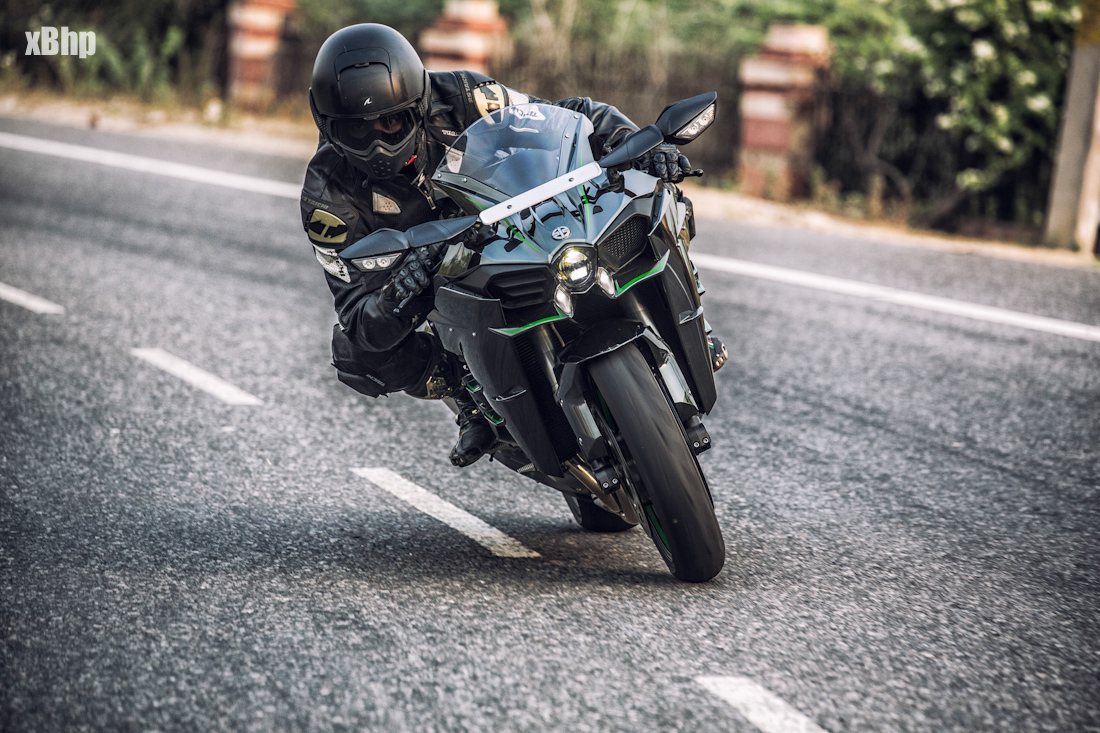
This was it. One of the most hyped motorcycles in recent times was now under me, right here in Delhi! The marketing, drama and buzz that was created around the launch of this bike, banked primarily on the social media and seeding videos, sound of the bike and image teasers. I tell you – it was worth it!
I first saw its demonic version, the H2R at INTERMOT 2014, and then finally the road legal angelic H2 at the EICMA later in 2014. The strange logo on the front intrigued the whole world, but now of course we know it to be the Kawasaki River Logo, the historic emblem of the Kawasaki Heavy Industries. This means that it’s one of the very rare times other divisions of KHI have any input in one of its smallest divisions – motorcycles.
The year 2015 looks like there is a renewed interest from the JapFours in building something extra ordinary, in this case building something beyond belief, or that’s how Kawasaki puts it. Suddenly the whole spectrum is alive again: the low capacity yet very important 250 CC segment, the middle weight 300-650 CC and the superbikes for the Japanese manufacturers.
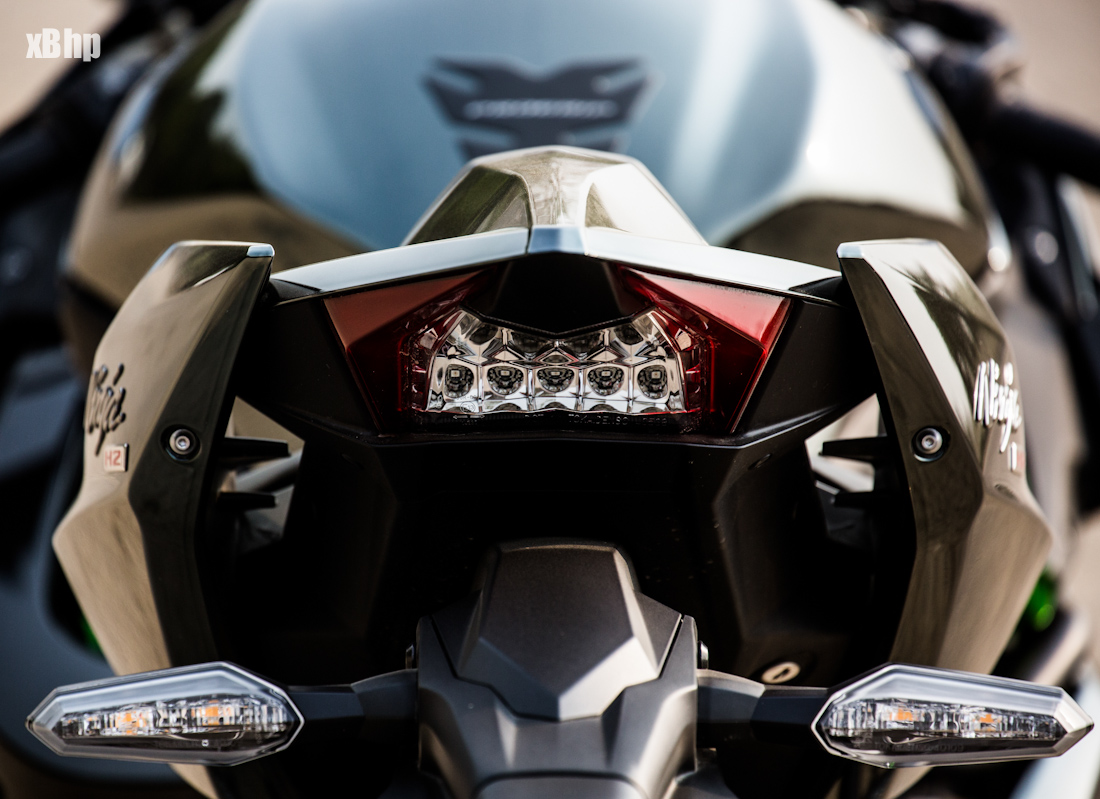
Coming back to the main subject at hand, the H2 looks astonishing, and the finish of the bike is beyond anything I have seen – right from the immaculately laser-cut frame tubes in the green trellis frame down to the last nut and bolt. The major contributor to the aura of the bike is the paint job that almost has a mirror finish, thanks to a layer of actual silver(!) over the base black coat. The intense looking headlight assembly also contributes to the overall futuristic and bold styling. It is not a typical Kawasaki design. This might be the only Ninja as well which doesn’t come in the trademark green, and I think even they know it Batman and Darth Vader like black.
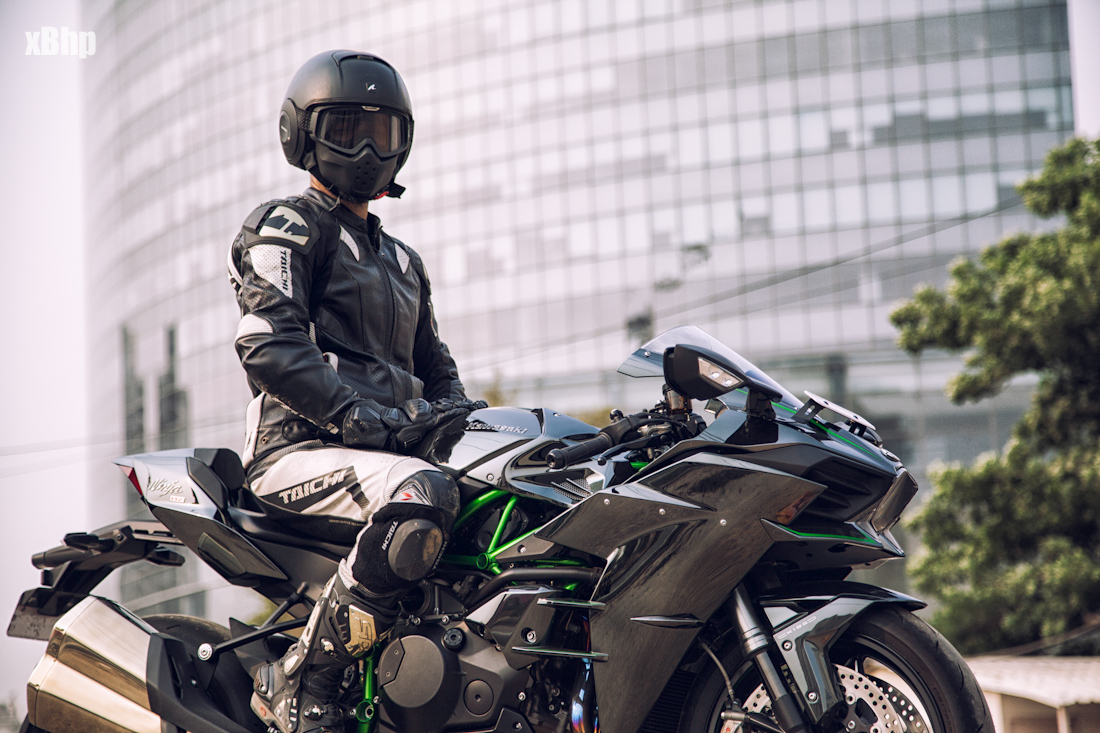
The bike itself is not as compact as the modern superbikes that are meant to be track tools, nor is it as big as a supertourer like the Hayabusa or ZX14. It sits somewhere in between and it definitely looks bigger than it is thanks to the generous use of bodywork.
And of course the biggest thing that makes the H2 unique is that there is no other supercharged production bike in the market.
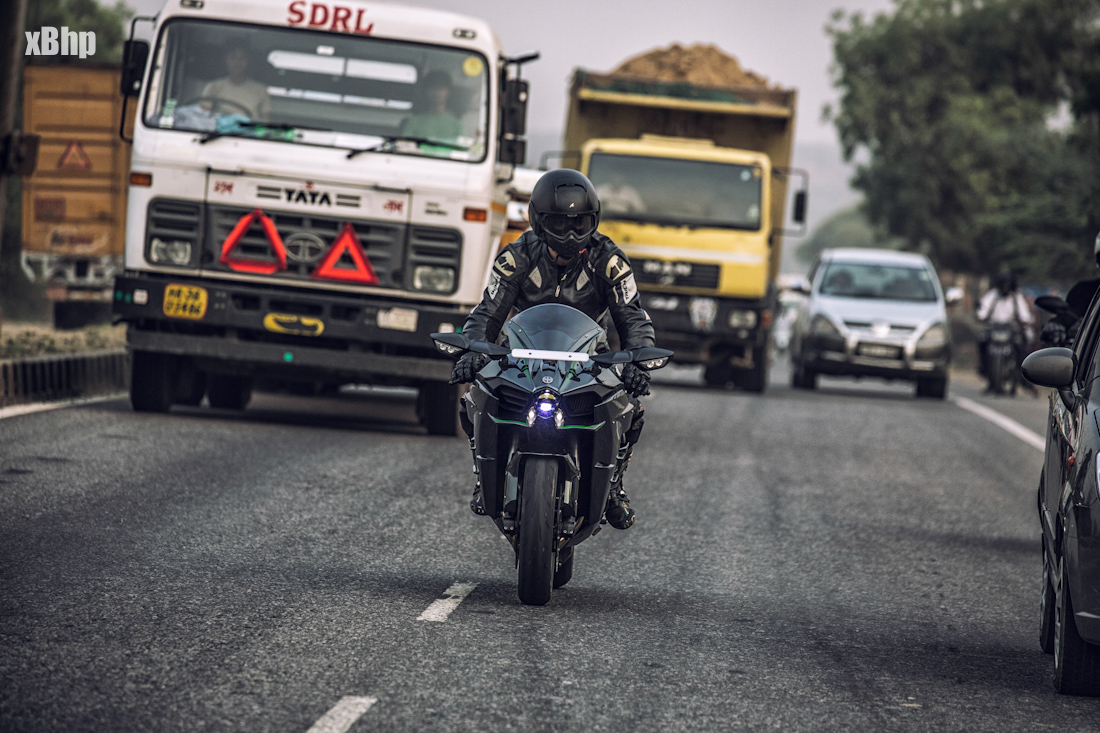

Riding the H2 on Delhi roads is not exactly what you would term as ‘reviewing’ such a motorcycle or even getting the right impression. But let me tell you, we all know it’s bloody fast and it’s got host of technology stuffed into it. It is a landmark motorcycle and no matter what flowery language I put down to say this, this bikes needs no reviews, it needs to be bought (if you have the money) and ridden.

There is a lot of tech inside the bike too, along with the engine which has been developed from ground up to accommodate the supercharger without an intercooler to keep things cool. To achieve this, Kawasaki took help from its aerospace division, much like you probably take help from your colleague to put together that presentation – “Hey, guys, can you leave designing the planes, jets and whatever useless stuff and work on something actually exciting that can be used on planet Earth?” ”Yea, sure” どうも有難う(thanks!).

That was it. This is how big Kawasaki’s prowess is. Motorcycles are but a hobby for them. Delving into how they managed to keep things cool despite adding the supercharger without an intercooler actually makes riding the bike more interesting, especially in a hot country like India. From using a heat dissipating superalloy named Inconel to using 35% more oil (4.9 litres) than standard litre-class bikes to get rid of that heat, it’s an engineering marvel in itself.
I pushed the bike while being a gentleman and remembering not to drop it or let any elephant, cow, dog, man, cycle, plane, tree, etcetera objects which so widely populate the Indian roads crash into it.
Fifty odd kilometres later I came down the bike, carefully swinging my legs over the rear cowl unit as not to scratch it and handed the keys back over to the humble owner. We needed something exciting and affordable like this to stir things up, I am not sure for how long I have to wait for another landmark moment like this, but I hope it’s soon, both for the motorcycling industry and as a motorcyclist.
While the 200 odd horsepower seemed enough for the H2, I cannot even begin to imagine what the H2 R will be like with an additional 125 horse power and 15 odd kgs off it.




