








Tag Archives: VESPA
Vespa

 May 2016
 xBhp
xBhp Bikes,Brands,Scooters,Vespa
 The original idea of designing a scooter was to provide affordable two-wheel transportation to masses which should be easy to operate and maintain. Although scooters were in production from the early 20th century, it was only after the World War II that they started to become mainstream and their design associable.
Vespa and Lambretta were the first ones to start producing scooters in mass numbers. However, it was Vespa that attained global popularity first as a prominent scooter maker.
The original idea of designing a scooter was to provide affordable two-wheel transportation to masses which should be easy to operate and maintain. Although scooters were in production from the early 20th century, it was only after the World War II that they started to become mainstream and their design associable.
Vespa and Lambretta were the first ones to start producing scooters in mass numbers. However, it was Vespa that attained global popularity first as a prominent scooter maker.
 Vespa is an Italian scooter company since 1946 and owned by Piaggio. After the WW2, the need of a practical and affordable means of transport became paramount and hence, Piaggio ideated to mass produce scooters.
Distinctly Different
The design of a scooter is distinctly different from a motorcycle starting from the front body panel acting as a shield for the rider’s legs extending into a flat floorboard and then into a shell which houses the engine and all or most electricals.
Piaggio readied their first scooter in 1944 which was officially called the MP5, however, the design was discarded and the scooter was redesigned. The second design was accepted and the owner of Piaggio, Enrico Piaggio, said that the scooter looked like a Wasp. Who would have guessed that this casual statement from Piaggio would give birth to the most famous Scooter company in the world?
Apparently, the Italian word for “Wasp” is “Vespa” and this is how the Vespa brand came to be.
Vespa is an Italian scooter company since 1946 and owned by Piaggio. After the WW2, the need of a practical and affordable means of transport became paramount and hence, Piaggio ideated to mass produce scooters.
Distinctly Different
The design of a scooter is distinctly different from a motorcycle starting from the front body panel acting as a shield for the rider’s legs extending into a flat floorboard and then into a shell which houses the engine and all or most electricals.
Piaggio readied their first scooter in 1944 which was officially called the MP5, however, the design was discarded and the scooter was redesigned. The second design was accepted and the owner of Piaggio, Enrico Piaggio, said that the scooter looked like a Wasp. Who would have guessed that this casual statement from Piaggio would give birth to the most famous Scooter company in the world?
Apparently, the Italian word for “Wasp” is “Vespa” and this is how the Vespa brand came to be.
 From Ordinary to Vintage
The first Vespa was publicly launched in 1946 and from then on, Vespa went on to become the standard in affordable scooters. The design of its scooters has always been quite recognizable giving them their own identity compared to others in the market.
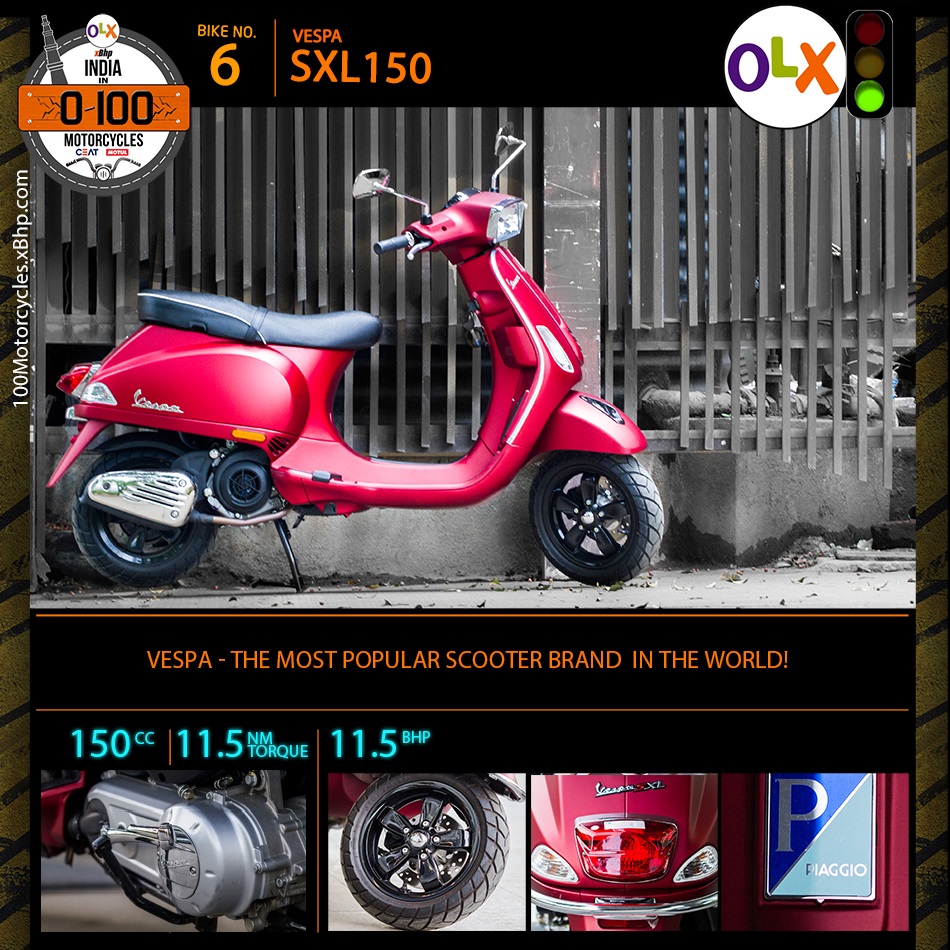
This would also imply that the latest generation of Vespa scooters manages to look classy and vintage. This is quite wonderfully highlighted in one of their newest scooters, Vespa SXL 150. Even a single feature like the headlight design is enough to instil a feeling of nostalgia and this is exactly how the SXL 150 comes across.
From Ordinary to Vintage
The first Vespa was publicly launched in 1946 and from then on, Vespa went on to become the standard in affordable scooters. The design of its scooters has always been quite recognizable giving them their own identity compared to others in the market.
This would also imply that the latest generation of Vespa scooters manages to look classy and vintage. This is quite wonderfully highlighted in one of their newest scooters, Vespa SXL 150. Even a single feature like the headlight design is enough to instil a feeling of nostalgia and this is exactly how the SXL 150 comes across.


 Making Its Own Space in the Scooter Market
Today, there are lots of scooters in the Indian market which has been made possible by the Honda Activa. It quite literally dominates the scooter segment. However, TVS is giving a decent competition to Honda with their Jupiter brand. In this crowd of similar looking scooters, Vespa has its own identity and offers an up-market ownership experience.
Making Its Own Space in the Scooter Market
Today, there are lots of scooters in the Indian market which has been made possible by the Honda Activa. It quite literally dominates the scooter segment. However, TVS is giving a decent competition to Honda with their Jupiter brand. In this crowd of similar looking scooters, Vespa has its own identity and offers an up-market ownership experience. Vespa SXL150 & VXL150 Review
 Oct 2015 Sunil Gupta
Scooters,Vespa
Oct 2015 Sunil Gupta
Scooters,VespaVespa has been in the Indian market for quite some time now with their line of scooters and they have had reasonably good sales numbers as well considering their positioning in the premium segment. At a time when there was very little variety in the Indian scooter market, they’ve been a breath of fresh air for those who could afford to spend more. They pushed the envelope once again recently when they launched their range of 150cc scooters – Vespa VXL and SXL, the largest engine capacity scooters in India. A very bold decision we must say considering that no other manufacturer has thought of venturing into the territory of ‘maxi scooters’ in India as yet.

We got to ride the Vespa VXL and SXL recently in Pune and here’s what we think of them. Both these scooters, the VXL & the SXL, are available in the 125 cc variant as well. Visually the only thing that differentiates between a 125 cc and the 150 cc VXL and SXL is the 150 badge on the rear left of the scooter. Everything else just looks the same. But since we’ve already covered the 125 ones, we’ll focus on the bigger Vespas in this article.

Styling wise, both the SXL and VXL have been able to maintain classic retro styling that Vespa is known for. They are available in a range of bright attractive colours, including with a matte finish. The paint quality is just top class. There’s just the right amount of chrome thrown in here and there, including around the headlights and fully chrome rear view mirrors. Both these scooters also come fitted with trendy alloy wheels with single sided suspension at the front and rear. Here the SXL gets the blackened alloy instead of the regular ones on the VXL. The handlebar grips are comfortable. The switchgear is borrowed from the earlier Vespas that are available in India and the quality of plastic on them is good. The overall fit and finish of the scooter is typical Vespa like – impeccable. The front of the scooter has been tweaked a bit. There is a new oyster-shaped digital console that has a fuel gauge, trip meter, and a clock to keep a check on time. The speedometer remains an analogue unit.

There’s ample spacing on both the scooters in the form of underseat storage that is good enough to keep a half face helmet along with other small items. There is storage option provided just below the handlebar as well in the form of 2 small pockets on the SXL, which is just good enough to keep small items like spare keys, etc. The VXL gets a lockable storage space, which is handy if you want to keep your belongings like documents, etc. safe. Other major differences between the SXL and the VXL are the shape of the headlights – The SXL has a rectangular headlight while the VXL gets a rounded one. There is no rear grab rail in the SXL either.
Vespa VXL150


The steel monococque chassis of the new Vespa duo, a standard with all Vespas sold in India, gives them a very solid feel while riding and instils confidence in the rider. The riding stance is pretty upright and the ride doesn’t feel cramped. The hydraulic suspension setup did feel a ‘little’ stiff on the bumpy roads, though it wasn’t really a deal breaker. A telescopic suspension at the front would’ve made things better. The wider Maxxis rubber provided good grip in general, but it didn’t inspire much confidence while riding on wet tarmac. Braking did feel sufficient and progressive with the 200 mm single disc at the front and 140 mm drum at the rear.
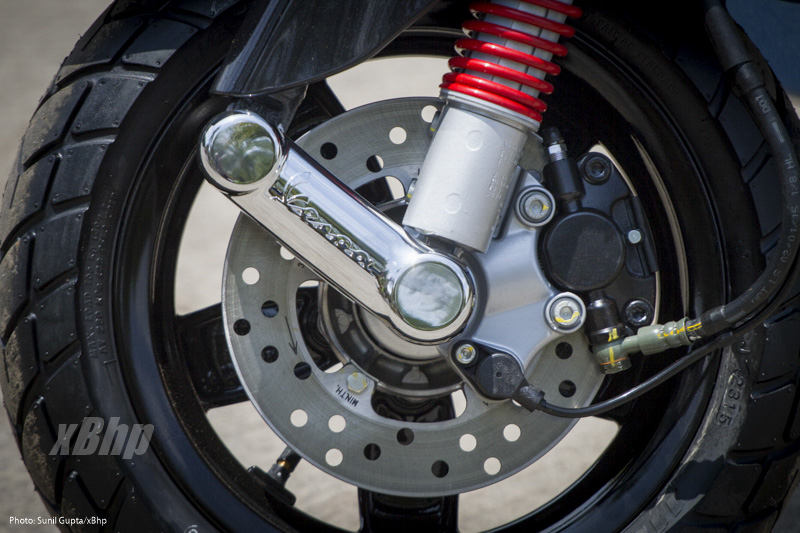


Now we come to the most interesting part – the 150 cc single cylinder, air-cooled carburetted engine that has been put in the Vespa VXL and the SXL makes them the most powerful scooters in the country as of date. This engine makes 11.6 PS of power at 7000 RPM and 11.5 Nm of torque at the 5500 RPM mark, which is delivered to the rear wheel via CVT transmission.

The ‘upgrade’ in power figures is readily noticeable as soon as you jump from their smaller capacity siblings onto the bigger Vespa. The engine does have more grunt and is quicker off the mark. It has got a sweet midrange and the power delivery is smooth without any major peaks or troughs, which makes it an ideal machine for commuting in the city and also cruising on the highways while maintaining a decent speed even with a pillion on board. It feels smoother as well across the rev range without any noticeable vibrations.



Vespa GTS300 Ridden
 Feb 2011 Sunil Gupta
Scooters,Vespa
Feb 2011 Sunil Gupta
Scooters,VespaManga le Mele
Text & Photos: Sundeep Gajjar / motoGrapher.com
It has been wisely said that fashions and seasons always return. Something similar is stated by the idiom, ‘History repeats itself’. A new geared scooter with Vespa lineage, if introduced in the Indian market, would justify both the above quotes. And the Vespa GTS300, a Vespa with the largest engine capacity ever made, can carry the weight of both history and fashion on its capable shoulders. The scooter once dominated the Indian two-wheeler market and some forty years ago, Bajaj Auto was building the Vespa scooter under license from Piaggio. A split with Piaggio around 1970 saw Bajaj Auto go independent on both the design and engineering. But even then their design retained the monocoque chassis, a Vespa hallmark.

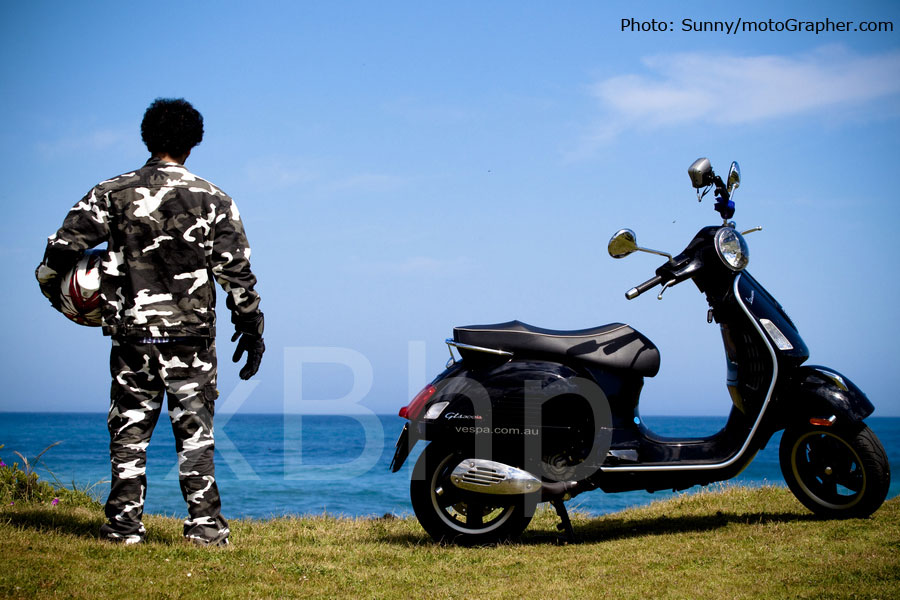


Vespa is to scooters what Ducati is to motorcycles and Ferrari is to sportscars. It is an iconic brand and for well more than half a century, people the world over have been riding Vespa scooters and been happy doing so. The current crop of Vespa GT series traces its origins to the GT 125 that came up when the previous PX series was killed off by stringent emission norms across most of the globe. The GT series is characterized by liquid-cooled 4-stroke engines with CVT drives but with the characteristic monocoque chassis intact. The Vespa GTS300 is a recent upgrade of the GTS250 that has been selling well for quite a while. 278cc liquid cooled 4-stroke with electronic fuel injection developing 22 bhp and 22 Nm of torque at 5000 rpm. This scooter’s engine specs beat most of the motorcycles being made and sold in our country. It is actually capable of displaying 130kph plus on its clear analog speedometer, can sprint from standstill to 100 kph in 14 secs, can effortlessly cruise all day long at above 100 kph and do this for 25 kms using just 1 ltr of petrol. Tempting eh!
The Vespa’s have always looked like …well…Vespas. Pretty, retro and yet fetching. And so does the GTS300. Round headlamps, straight handlebars with instrument console, switchgear and headlamp integrated into it. The rounded ‘duck-wing’ side cowls that cover the sides and the usual single-piece seat with the fuel-filling point underneath. Scooters have evolved equally well as motorcycles on the handling and braking front and this is quite evident when you ride the Vespa GTS300. Its single sided front suspension and dual shocks at the rear (adjustable for pre-load) when allied with 12-inch wheels makes for a pretty sure-footed scoot. Hustle it through the twisties and its only the ground-clearance limits announced by the floor-board grinding away that stops you from leaning further. Bumps or tarmac ripples, even in the middle of a turn, cannot upset its line and it tracks true to the riders inputs.


Braking is great, what with discs both up front and at the rear and their amazing feedback. The 130 section rear tyre provides a wide enough contact patch to handle traction loads on a rear-engined scooter. And the front 120 section is the perfect choice for light steering, great grip and wonderful braking. The wheelbase, at 1370mm, is about 20mm more than our homegrown Bajaj P220 DTSi, promising swell straight-line stability, even in strong cross-winds. The torque engine allied with low gearing (typical of scooters and CVT’s) makes for very peppy pick-ups and the rider can outpace virtually any and every element of traffic from stop-lights. And the high top speed, good stability, powerful brakes and comfortable ergos make the Vespa GTS300 a very strong contender for highway runs. Storage space is good, with enough space under-seat for a small bag (maybe a camera kit or something) and a smallish glove compartment up front. The seats are comfortable with the pillion being even better off than the rider. Lights are about adequate though the horn is weak, as is the case with even far larger bikes.
The Vespa GTS3000 would make for a very attractive scooter if introduced into the Indian market. And it would make a lot of sense too with lots of power, great handling, tubeless tyres, wonderful braking and those aesthetically pleasing ‘traditionally Vespa’ lines that define its shape. We still have scooters in our blood. It is just that we are waiting for something that bridges the retro and the modern the way the Vespa GTS300 does. Bring it on…..one in Montebianco white for me please!
The 300CC provided for a surprising amount of punch despite the gearless arrangement. I did half of the Great Ocean Road on the Vespa and back to Melbourne with a pillion managing to hit speeds of 100+ with extreme ease. The CoG was also good for a scooter and at speeds like those, and good braking was a boon. I was initially a little uncomfortable on bends but that gave way confidence a few turns later. There is hardly anything to say about the looks, it is an all time classic!
Specifications
ENGINE TYPE: Single cylinder, four-stroke, four-valve, electronic injection, catalytic QUASAR
CYLINDER CAPACITY: 278cc
BORE x STROKE: 2.95″ x 2.48″ (75 mm x 63 mm)
MAX POWER AT SHAFT: 15.8 Kw (22 hp) at 7,500 rpm
MAX TORQUE: 22.3 Nm at 5,000 rpm
MAX SPEED: 129 km/h
FUEL / TANK CAPACITY: Unleaded (9 litres)
MILEAGE: 24-26 kpl
COOLING SYSTEM: Liquid
LUBRICATION: Wet sump and chain-driven lobe pump; intake and delivery filters
IGNITION: Electronic (with inductive discharge, variable spark advance and three-dimensional mapping)
GEARS: CVT (Continuously Variable Transmission) with torque server
CLUTCH: Automatic centrifugal dry clutch with dampers
CHASSIS: Load-bearing sheet steel chassis with welded structural supports
FRONT SUSPENSION: Single arm, dual chamber hydraulic shock absorber with coaxial spring
REAR SUSPENSION: Two dual effect shock absorbers with adjustable preload
FRONT BRAKE: 220 mm disc
REAR BRAKE: 220 mm disc
FRONT TYRE: Tubeless 120 / 70, 12″
REAR TYRE: Tubeless 130 / 70, 12″
LENGTH: 1941 mm
WIDTH: 755 mm
WHEELBASE: 1369 mm
SEAT HEIGHT: 790 mm
DRY WEIGHT: 148 kg
AVAILABLE COLORS: Shiny Black, Dragon Red, Montebianco White, Titanium


