

Since '02 xBhp is different things to different people. From a close knit national community of bikers to India's only motorcycling lifestyle magazine and a place to make like-minded biker friends. Join us

Castrol Power 1

Red to green – let the cager go first.

Our Partner

Announcement

Collapse
No announcement yet.

Braking

Collapse
X
 
  • Filter
  • Time
  • Show
Clear All
new posts

  • #76
    Guys..did the same mistake again..:-( It was raining lightly. I was riding my friend's platina. Then, there was an auto wala preparing for a U turn, may be a 50m infront. He was just moving to the center, slowly, and was giving indication. I, to my instinct, simply sounded the horn. I still dont know why, but that auto wala was surprised and suddenly stopped, right in the middle of the road, right infront of me. There was nothing much i could do. Pressed the rear one, which instantly got locked, skidded, and fell. I was lucky enough to walk away with only 3 stitches and some bruices. I blame the bike. It has stupidly lock maniac rear brakes.
    MOTORCYCLING IS AS MUCH ART AS IT IS SCIENCE

    Comment


    • #77
      Why use the rear brakes and even if you use, why grab it?

      Brakes aren't switches. Progression and modulation is the key.

      @Pradeep - Try to gauge the traction levels. The front lever provides immense feedback and shall protest prior to locking up and you shall slide only if your wheels are pointed in either direction.

      It had rained heavily yesterday and while braking hard, my toe triggered the rear brakes.(I left it at that moment) It slided, but as OF said, its safe & predictable, but once I braked hard with the front, the bike stopped real quick. (Helps if you blip and go down the 'box)

      Nothing shall help more than riding as much as you can and practicing emergency braking maneuvers. (I am culprit and miss my riding nowadays due to work )

      Comment


      • #78
        a few days back, i was touring with my wife, it was around 9 PM and i was cruising comfortably at around 80 KMPH, suddenly there was a patch of road which was freshly laid ( may be a few days back) so perfectly smooth but it had lot of sand on it ( the way they put it to avoid sticking) but this time the sand was a little more than usual, it was a stretch of around 20 mtr.s, after covering around 5 mtr.s i saw that the patch ends and there is a pothole or rather a ditch approx. 1 feet deep and throughout the width of road (so there was no way to steer around it), i started braking progressively using front more then rear (but using some amount of rear brake) soon i realized i have reached the limit, and any more application of front will cause it to skid since i am on a layer of sand, so increased rear brake pressure and after some time it locked and bike skidded a few mtr.s with rear locked and front still maintaining same amount of brake but front wheel not locked. since i was riding double seat, i think the rear took some time to lock, and that saved us. we came to near stop and bike speed was reduced to say around 5-10 KMPH so it can take the plunge into 1 feet deep trench slowly. and then we stopped safely.

        now, i want to know, in these conditions, was my technique correct.

        i am expecting really experience riders like old fox to comment.

        my approximation regarding distances in mtr.s may be slightly incorrect or at best only approximate.
        sigpic

        Tyre Sizes _ Spark Plugs

        Headlight Focus _ Fork Oils

        All India xBhp Couple Riders Thread

        Ashtavinayak + Shirdi
        Purandar
        Raigad
        Dapoli
        Aurangabad
        Kaas Plateu & Thoseghar Waterfalls
        Purandar

        Comment


        • #79
          Over these years, I have developed a habit of using the front brake 70% and rear brake 30% at normal times.

          When I have to brake hard, I apply both the front and rear brakes simultaneously for a fraction of a second (this gives the initial big retardation) and release both brakes for the next fraction. I repeat this process until I reach a complete halt. This helps me in avoiding a wheel lock or a skid.

          Using either of the brakes individually can result in a bad wheel lock and one may end up skidding (learned this from personal experience).

          Under normal riding conditions when I am aware that I need to stop after a specific distance, I use engine braking to some extent and shift to lower gears matching the bike's speed. This ensures that the brake usage is minimal.

          PS: What I follow may not be ideal but I have not faced any problems using this technique.
          Signals which are timed for 50 Kmph are also timed for 100 Kmph :)

          Comment


          • #80
            Originally posted by princesirohi View Post
            a few days back, i was touring with my wife, it was around 9 PM and i was cruising comfortably at around 80 KMPH, suddenly there was a patch of road which was freshly laid ( may be a few days back) so perfectly smooth but it had lot of sand on it ( the way they put it to avoid sticking) but this time the sand was a little more than usual, it was a stretch of around 20 mtr.s, after covering around 5 mtr.s i saw that the patch ends and there is a pothole or rather a ditch approx. 1 feet deep and throughout the width of road (so there was no way to steer around it), i started braking progressively using front more then rear (but using some amount of rear brake) soon i realized i have reached the limit, and any more application of front will cause it to skid since i am on a layer of sand, so increased rear brake pressure and after some time it locked and bike skidded a few mtr.s with rear locked and front still maintaining same amount of brake but front wheel not locked. since i was riding double seat, i think the rear took some time to lock, and that saved us. we came to near stop and bike speed was reduced to say around 5-10 KMPH so it can take the plunge into 1 feet deep trench slowly. and then we stopped safely.

            now, i want to know, in these conditions, was my technique correct.
            There are two ways of looking at this.

            1. Imagine your total traction reserves as a pie in your hand. While braking, accelerating or turning, you bite a chunk out of the pie and some gets leftover in your hand to hold on to. Now when you hit a sandy patch, the pie suddenly shrunk to say half its size. A bite as before would end up chewing up your hand. Moral of the story: you in all probability out-rode your headlights i.e. you were riding faster than the speed from which you could safely brake your bike within the distance illuminated by your headlights. Of course when you did brake, the slowing down was almost at the edge of available traction.

            2. As for the technique, there was a fundamental flaw. Braking depends entirely upon the weight on the contact patch (keeping other things like coefficient of friction etc constant which were in this case once you were on the sandy surface) Braking with the front, even in such low traction conditions is possible with a sensitive and experienced hand and was the right thing to do. The problem began when you started using the rear brake harder while keeping the front on as before. The front brake takes away weight from the rear and as long as you're using the front brake the rear gets weighed down less. Which makes it easier to lock. The right technique would have been to either continue focusing on using the front brake as best possible with light rear brake without adding the distraction of the stronger usage of the rear or getting partially off the front brake to get some weight back on the rear and then using the rear brake.

            The fact is that there is no clear and repeatable technique in situations like the one you've described. You're already too deep into the fight between low available traction and high demand from the rider. You're lucky to have gotten away with just a scary slide. The real skill lies in not just having the skill to ride through a panic situation but in being able to predict and avoid a panic situation in the first place.
            I don't let my motorcycles interfere with my motorcycling...

            Join xBhp On

            Comment


            • #81
              @OF - Any braking pointers for, with pillions as I believe the dynamics of a bike change a hell lot with a pillion under emergency braking, its scary.

              (I as a thumb rule cruise/ride at almost half the speed of my normal with a pillion)

              Comment


              • #82
                Originally posted by Old Fox View Post
                There are two ways of looking at this.

                1. Imagine your total traction reserves as a pie in your hand. While braking, accelerating or turning, you bite a chunk out of the pie and some gets leftover in your hand to hold on to. Now when you hit a sandy patch, the pie suddenly shrunk to say half its size. A bite as before would end up chewing up your hand. Moral of the story: you in all probability out-rode your headlights i.e. you were riding faster than the speed from which you could safely brake your bike within the distance illuminated by your headlights. Of course when you did brake, the slowing down was almost at the edge of available traction.

                yes, you are right, i outrode my headlights, which by chance were left on at dipper position. normally, my funda is like this - never drive beyond your visual and braking range. but somehow i breached my own principle and arrived at the panic situation and that is how we all arrive at the panic situations, by disregarding some basic fundamental things.

                2. As for the technique, there was a fundamental flaw. Braking depends entirely upon the weight on the contact patch (keeping other things like coefficient of friction etc constant which were in this case once you were on the sandy surface) Braking with the front, even in such low traction conditions is possible with a sensitive and experienced hand and was the right thing to do. The problem began when you started using the rear brake harder while keeping the front on as before. The front brake takes away weight from the rear and as long as you're using the front brake the rear gets weighed down less. Which makes it easier to lock. The right technique would have been to either continue focusing on using the front brake as best possible with light rear brake without adding the distraction of the stronger usage of the rear or getting partially off the front brake to get some weight back on the rear and then using the rear brake.

                The fact is that there is no clear and repeatable technique in situations like the one you've described. You're already too deep into the fight between low available traction and high demand from the rider. You're lucky to have gotten away with just a scary slide. The real skill lies in not just having the skill to ride through a panic situation but in being able to predict and avoid a panic situation in the first place. true, anticipation is the key. even i always try to predict and avoid panic situations, but on that instance, everything went for a toss. it was getting late, i was also a bit tired by riding all day, we were in the middle of a jungle, and we had lot of kms to cover before our next halt. all these made me to push harder. anyway, its good no damage occured.
                ok. so brake harder on the wheel which has weight and therefore most traction. but like described, you are on sandy patch, using your front brake as hard as possible on sand, and you feel that this is teh limit------my question is whether --
                1) you will hold on to whatever front brake is able to give without skidding (which you have already reached.)
                or
                2) you will release teh front and apply the rear, so that weight transfer can take place, and then brake with rear. but remember this will take some time and you have only limited distance in front of you to brake safely
                or
                3) do what i had done or something else.
                sigpic

                Tyre Sizes _ Spark Plugs

                Headlight Focus _ Fork Oils

                All India xBhp Couple Riders Thread

                Ashtavinayak + Shirdi
                Purandar
                Raigad
                Dapoli
                Aurangabad
                Kaas Plateu & Thoseghar Waterfalls
                Purandar

                Comment


                • #83
                  Originally posted by sheelpriye View Post
                  @OF - Any braking pointers for, with pillions as I believe the dynamics of a bike change a hell lot with a pillion under emergency braking, its scary.

                  (I as a thumb rule cruise/ride at almost half the speed of my normal with a pillion)
                  Your thumb rule is pretty apt for the conditions Sheel. The presence of a pillion effectively shifts the composite C of G backwards and probably a trifle higher (what with those sporty seats that perch the pillion a lot higher than the rider). As such there's a greater amount of forward weight transfer and also it happens at a faster rate. This is where caution as in your thumb rule comes into play. The quicker rate of forward weight transfer might overwhelm the front tyre traction limits pretty quickly and you might end up with a front slide happening quicker than it would happen had you been riding solo.

                  Also the rear gets weighed off faster with a pillion (contrary to the thought that a pillion means greater weight on the rear). There is more weight on the rear but then there's an equally large proportion of it that gets transferred forward under braking. And so the rear would break lose just as quickly.

                  Moral: Keep a large safety net of traction and performance at hand when you ride two-up.

                  Originally posted by princesirohi View Post
                  ok. so brake harder on the wheel which has weight and therefore most traction. but like described, you are on sandy patch, using your front brake as hard as possible on sand, and you feel that this is teh limit------my question is whether --
                  1) you will hold on to whatever front brake is able to give without skidding (which you have already reached.)
                  or
                  2) you will release teh front and apply the rear, so that weight transfer can take place, and then brake with rear. but remember this will take some time and you have only limited distance in front of you to brake safely
                  or
                  3) do what i had done or something else.
                  Both 1. and 2. will do fine though as you rightly point out in '2', there's little time and distance in spare to shift braking priority. But a partial release of the front brake with simultaneous application of the rear would make a rear slide less probable.

                  All said and done, such 'sudden' braking needs are best avoided. As is said by some wiseguy in aviation: safety is a priority only till it impacts schedule . Don't let that happen.
                  I don't let my motorcycles interfere with my motorcycling...

                  Join xBhp On

                  Comment


                  • #84
                    Originally posted by Old Fox View Post
                    safety is a priority only till it impacts schedule . Don't let that happen.
                    very well said.
                    sigpic

                    Tyre Sizes _ Spark Plugs

                    Headlight Focus _ Fork Oils

                    All India xBhp Couple Riders Thread

                    Ashtavinayak + Shirdi
                    Purandar
                    Raigad
                    Dapoli
                    Aurangabad
                    Kaas Plateu & Thoseghar Waterfalls
                    Purandar

                    Comment


                    • #85
                      What an interesting thread with so much relevant info!

                      I agree 100% in that trail braking has no place on public roads, or maybe as a last resort. But when offroading, as Old Fox pointed out, I find that a tab on the rear brake tightens up the suspensions, pulls the back end in, thus lowering the bike, and applies a little more weight to the front tyre, which, when done with measure, means I can get round a bend with more stability. Of course since offroad tracks/bends vary all the time, I only use this when it makes sense. And like anything else it becomes more natural with practice.

                      I'm lucky to have made friends and to ride with some very good enduro/motocross riders here in Portugal, one of them is now amongst the top enduro riders in the world. When riding with them, or rather trying to keep up with them..., I notice that trail braking is quite common. It could be that this is a more effective technique on offroad bikes due to their softer suspensions.

                      Just a quick note on replacing brake pads or brake shoes. New pads/shoes should always be fitted to rectified or new discs/drums. If not they just wear out so much faster. A good (and willing) metal turner will be able to rectify used discs or drums for much less money than it is to buy new ones. Brake drums and discs often have a wear limit stamped on them, and, from experience, can be rectified at least once. Too many garages nowadays just throw discs away and put new ones in when they can perfectly be rectified and serve during the life of another set of brake pads. This I find is increasingly the case in the automotive industry, the throw-away culture...
                      Learn from the mistakes of others. You won't live long enough to make all of them yourself.

                      Comment


                      • #86
                        Originally posted by The Art Of Safe Riding View Post
                        Few riders realize that the front brake is the most effective in a two wheeler. Just using the rear brake allows you to barely use some 30% of the total braking force possible. Using the front brake is like pushing the bike from its front against its direction of motion and this is far more effective that trying to pull it to a stop by hanging from behind it. Moreover, using the front brake throws a lot of weight on the front tyre and this allows it to grip the road better. Grade your braking so that some 70% of the braking effort comes from the front brake while the remaining 30% from the rear wheel. The rear brake is primarily to stabilize the bike and preventing a violent weight transfer onto the front wheel. Too much rear brake will lock up the rear wheel and the bike slides out of control. The only precautions while making full use of the front brake is to keep the bike upright and avoid its full application on wet or gravel roads. In slippery conditions, use the rear brake sparingly while making the most of the available engine braking. And while in a turn, try and straighten up the bike as much as possible before applying the brakes. Stop turning before you start braking.

                        Get used to the front fork dive on applying the front brakes. Be smooth but firm in the brake application (squeeze the lever as if it is the trigger of a gun, don't grab it). The harder you learn to apply the front brake and the sooner you can get it to its full power, the shorter will be your stopping distance.

                        Tips about braking:
                        • Roll off the throttle.
                        • Apply the brakes simultaneously to settle the bike.
                        • Increase front lever pressure as you decrease rear pedal pressure.
                        • As you near a stop, decrease front lever pressure and increase rear pedal pressure, if necessary.

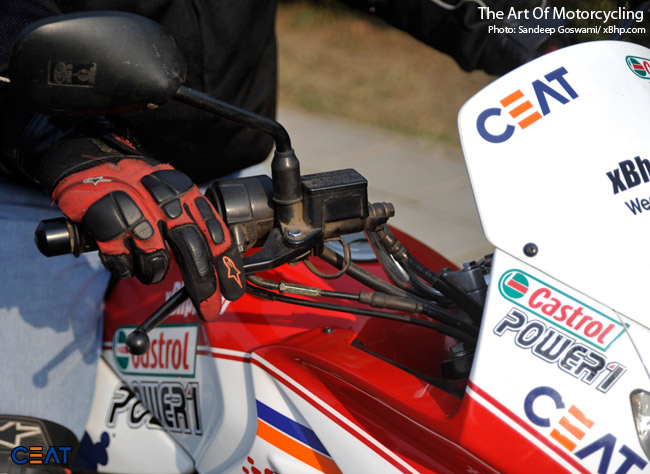
                        Ride with two fingers covering the front brake lever. In case of an emergency the natural reflex of clenching the fist automatically applies the brake. (By the way, almost all of the power in your fingers is in the first two.) To come to a smooth halt, bring the rear brake alone into action while releasing the front one just before coming to a full stop. The jolt that arises on stopping, from the front forks dive, does not happen this way.

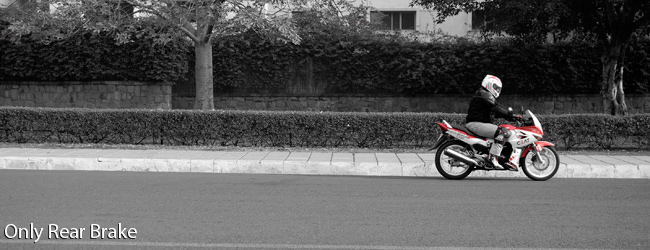
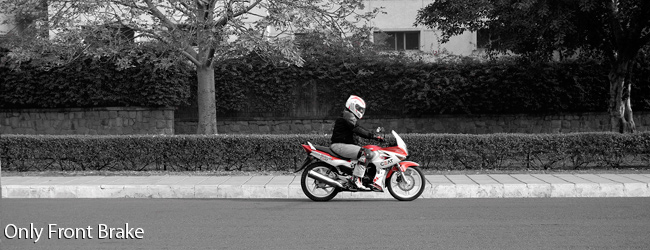
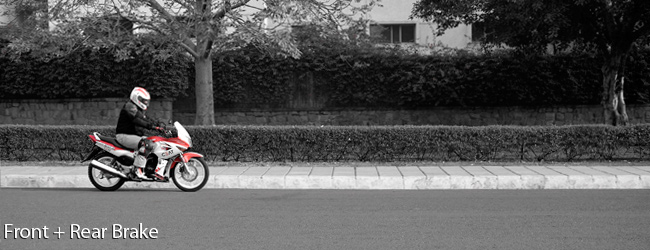
                        Photo: Stopping distances for the three different brake combinations


                        Photo (below): Ideal configuration for panic braking


                        REPRODUCING POST FROM HERE ON PAGE 6 FOR EASY REFERENCE

                        There's a well known adage in aviation, particularly for fighter pilots, and it goes like this:

                        When an emergency arises your performance drops to the lowest level of training.

                        I have never come across a more realistic observation of deterioration of skills when under hostile fire. Practicing for emergencies is as good as the emergency simulation you do, actually a little worse than that. Which is why you need to practice so much that the needed actions become second nature, a 'reflex'. And practicing the 'right' technique is critical because the 'reflex', once embedded in muscle memory, will not allow you to think and correct it if its wrong.

                        What Tenhut, csgup1, rossiter and quite a few others have put forth here is about not just the need to learn the skills but the criticality of learning the RIGHT technique. Becoming a proficient motorcyclist is a lifelong endeavor. You are either busy learning new skills or practicing old ones.

                        Braking is a very 'critical' skill for a motorcyclist. The real art in going fast is to know when to go slow and how to go slow. And getting it right, practicing it right and executing it right is what will keep you alive. Its one major 'vital' in the Vital few and trivial many aspects of motorcycling. Learning braking in real life urban riding situations is about including road traction assessment into your braking action. Practice the gentle squeeze to firm squeeze technique any and every time you brake while riding. Feel the firming up of the front brake lever under you fingers. Scan the road ahead for adjustments to braking. Check those RVM's before, during and after braking. Feel the weight transfer drop the front and know that the rear has gone light by an equivalent amount. Practice each and every time you brake, so much so that you unthinkingly brake like that everytime. Aim for a point to stop and see how well you assessed the distance and braking effort needed. See that little piece of paper on the road, try to steer around it while you brake. Set up your line and entry speed to those turns to perfection. In a well set-up turn, whether on road or on track, you'll not need emergency mid-turn corrections. It is only when you set up a turn on assumptions rather than knowledge of the road/track ahead that you need mid-course corrections.

                        Incessant learning is essentially what it is all about. Remember that a skilled rider will use his skilled brain to avoid needing those superior skills. Paradoxical but actually the only real way of enjoying your motorcycling and yet staying alive doing it.


                        Lots of useful information has been shared about 'trail braking' here. I'll add a visual aspect to it and start with a diagram that I've taken from a book 'Sport Riding Techniques' by Nick Ienatsch.


                        The orthodox riding technique states that we finish all our braking and gear shifting while the bike is upright, enter the turn on constant throttle and just past the apex, feed in the throttle progressively. But the preferred method now is using 'trail braking'. Trail Braking is a technique where the rider progressively reduces his braking force as he gets deeper into the turn and closer to the apex. This progressive and smooth reduction in braking is to use a progressively larger share of traction for turning, a need that hits its maximum at the apex, where the braking input is reduced to zero. Trail braking has two major benefits: 1. It allows for braking while turning, allowing the rider more control over his situation. and 2. The rider can carry speed deeper into the turn and by slowing progressively towards the apex, has more reserve traction to trade for the same needed for turning.

                        Post-apex, progressively opening the throttle makes for gradual rearward weight transfer allowing the rear tyre time to gain traction and transfer power for acceleration.

                        In practice, the overlap between trail braking and powering out is a smooth blend, always balancing the available traction to the traction needs.

                        Trail braking is a difficult skill to master primarily because as you brake during the turn, you put additional loads on the contact patches which are already fighting a hard battle for traction by countering the outward tangential force. Adding braking loads to the equation takes you closer to the edge of the traction envelope and even a slight excess in loading can lead to a washout.

                        As for the unassailable logic of favouring the front brakes, the related and at times disconcerting nose-dive and what happens when we do so was something I had posted earlier in another thread here quite sometime back. Reproducing the same below to maintain continuity as has been the case with the trail braking part above which is also taken from the same thread:

                        I guess we need to get back to high-school physics to clear this thing about forward weight transfer under braking, its benefits and demerits in its entirety.
                        Weight transfer is a physical reality that has to happen, whether there is a suspension system pre se or not. Refer to the fig in my previous mail that I am reproducing below:


                        Braking produces a force (because the rider/bike combo is in motion and braking means deceleration) that has eventually to act through the front tyre contact patch where it is countered by the force of friction between the road and the contact patch. Since the connection between the contact patch and the rest of the bike is primarily through the fork, a large component of this force travels down the forks. The exact quantum of this force transfer can be calculated by referring to the fig below:


                        As the forks are raked at an angle to the vertical, the force transferred through them can be calculated as a product of the total force and the Cosine of the angle of application of the force. Here the angle is the 'rake' angle minus 90deg (since the rake angle is measured against the vertical). Assuming a rake angle of 25deg and a braking force of 1N, the force component acting down the forks would be = 1 (N) x Cos(65) = 0.4226. Meaning that some 42% of the braking force shall act through the forks.


                        Let us assume a ZMA (about 150kg) with a rider weighing 70kg coming to a panic stop. Stock tyres on clean tarmac can give a decelration equal to about 1G i.e. about 9m/sec2

                        So the total force generated would be like F= M x A = 220 x 9 = 1980N
                        1980N x 0.42 = 836N = 85kg (appox)

                        So the forks get pressed downwards by a force equivalent to 85kgs. No wonder they get compressed.

                        As you can see, the 'softness' or 'stiffness' of the suspension set-up has no meaning for weight transfer. The 'weight Transfer' is a Force that is generated due to braking. It is just that with a softer suspension, you get a larger deflection of the springs, more dive and so it 'feels' like there has been a LOT of weight transfer occurring.


                        • Learn to depend upon and use the front brake to fulfill most of your braking needs.
                        • The rear brake is useful mostly under low traction situations or at low speeds where front end dive leads to instability. (Eg: lane splitting as a stop light)
                        • Braking is not just about 'braking' but also about reading the road that you'll be braking upon.
                        • Practice, practice and practice but practice right. Learn it wrong and it takes longer to get rid of wrong learning that it takes to learn right. And to know whats right, you have lots of people on this forum and the internet as a vast repertory of information.


                        USEFUL CONTENT FROM OTHER MEMBERS


                        thanks a lot got to know so much about breaking because of u

                        Comment


                        • #87
                          How to break effectively in hills with gravel, point after which front starts to skid

                          Hi All,

                          Would like to know learn more about how to effectively break when you are riding in hills and the roads that are full of gravel.
                          I am asking this question because two weeks back i went for a trip where i was going up hill. The bike was performing well and i was having fun so pushing her around corners until in one corner i found lot of gravel. As it was gravel i could not rely so much on my front so i managed with a combination of both but the turn was quite scary.
                          Next day ( i stayed the night on hill top in a temple) while coming down i was more careful but i did manage to skid my rear while leaning in a few turns. Although skidding of rear does not make me loose my nerves as i am used to it (learned to ride on bajaj scooter without front breaks) but it made me realize that i need to improve on my breaking in turns. Leaning rear skid i can handle but leaning front skid is still an art yet to master. I was able to do the twisties at around 80-90KMPH but i believe my bike could have done more.
                          I use combination of both breaks as i ride in eternally under construction bangalore traffic but i am scared that my front wheel might slip if i am a lil tight with lever.
                          Is there a way to identify the point before front wheel slip starts. I can skid the front wheel when the bike is upright without any issues but when i am leaning i get goosebumps if i press hard on the lever.

                          My apologies if my question sounds like a newbie but would really appreciate some advise from experts.

                          Thanks in advance

                          Regards
                          Piyush

                          Comment


                          • #88
                            I have some serious issue to tackle with . I have noticed that when ever i brake hard some time insted of closing throttle completely it stays open or even worst throttle opens up more . i.e If i am riding with 100% of throttle and if i brake hard insted of going to 0% it stays 20% open. please put some light on this if possible.
                            Its not enough to know how to twist the throttle; you must have judgement to know when and where to do it.

                            Comment


                            • #89
                              Originally posted by abhiwar View Post
                              I have some serious issue to tackle with . I have noticed that when ever i brake hard some time insted of closing throttle completely it stays open or even worst throttle opens up more . i.e If i am riding with 100% of throttle and if i brake hard insted of going to 0% it stays 20% open. please put some light on this if possible.

                              have a look at some of my posts. i started a thread long ago about the correct method for braking. go read that and keep practising the setup and squeeze method

                              Comment


                              • #90
                                Originally posted by piyush2112 View Post
                                Hi All,

                                Would like to know learn more about how to effectively break when you are riding in hills and the roads that are full of gravel.
                                I am asking this question because two weeks back i went for a trip where i was going up hill. The bike was performing well and i was having fun so pushing her around corners until in one corner i found lot of gravel. As it was gravel i could not rely so much on my front so i managed with a combination of both but the turn was quite scary.
                                Next day ( i stayed the night on hill top in a temple) while coming down i was more careful but i did manage to skid my rear while leaning in a few turns. Although skidding of rear does not make me loose my nerves as i am used to it (learned to ride on bajaj scooter without front breaks) but it made me realize that i need to improve on my breaking in turns. Leaning rear skid i can handle but leaning front skid is still an art yet to master. I was able to do the twisties at around 80-90KMPH but i believe my bike could have done more.
                                I use combination of both breaks as i ride in eternally under construction bangalore traffic but i am scared that my front wheel might slip if i am a lil tight with lever.
                                Is there a way to identify the point before front wheel slip starts. I can skid the front wheel when the bike is upright without any issues but when i am leaning i get goosebumps if i press hard on the lever.

                                My apologies if my question sounds like a newbie but would really appreciate some advise from experts.

                                Thanks in advance

                                Regards
                                Piyush
                                Hi piyush
                                Try to do most of your braking before you hit the curve. Also, through the curves, take such a line that you have some margin on both sides. washing the front in tuns is very dangerous. It has happened to me several times as well but never got to point where it feels comfortable. If you some how get caught in a situation where you are surprised by gravel on the curve, focus on the exit line and run a little wide, negotiate the gravel with throttle control and not brakes.i.e throttling will slip your rear wheel and get your bike in line. Since this slip is under your control you can avoid goosebumps

                                I love taking curves with gravel on my R15, The rear always slips and comes back in.
                                PM me for Daytona Racing ECU for the R15
                                sigpic

                                Comment

                                Working...
                                X