









All posts by Sunil Gupta
Honda CBR150R review

 May 2012
 Sunil Gupta
 Bikes,Honda,Motorcycles
After parting ways with Hero Motors, Honda seems to be trying real hard to capture its share of the Indian motorcycle market and seems to have some serious plans under its belt. After capturing a large pie of the premium motorcycle market with the CBR250R, they have set their eyes on the next big thing, the 150 cc performance segment which is exactly where the volumes are. They had unveiled the CBR150R during the Auto Expo 2012 and it was clear on that day itself that if Honda could price it really well, they would give some serious competition to the current segment leader, the Yamaha R15.
Text: Sunil Gupta
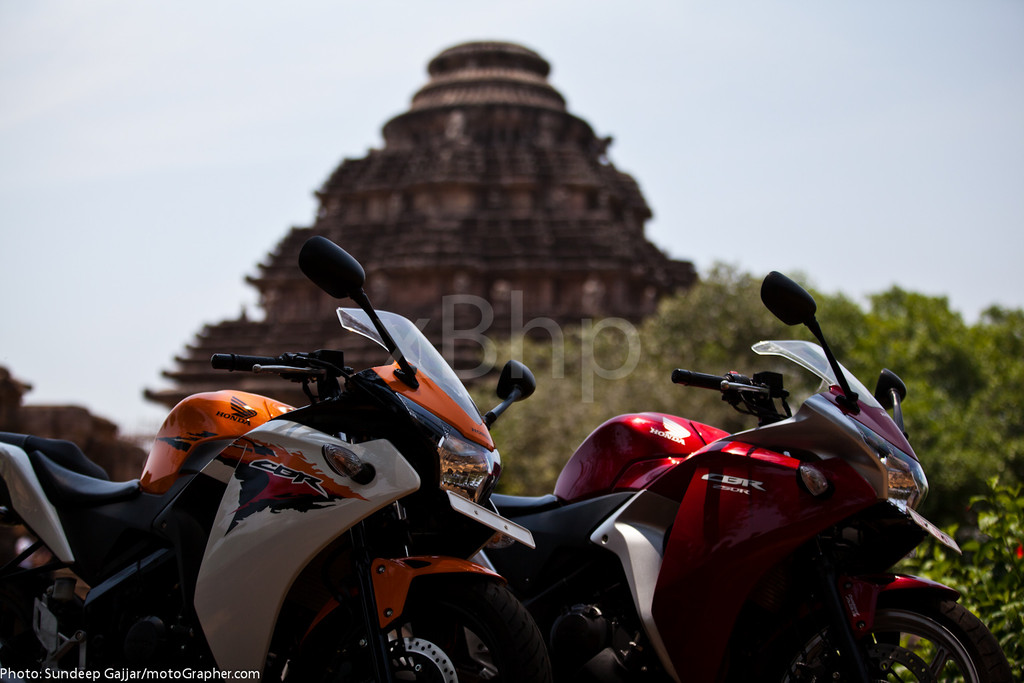
And while the xBhp GIR team was circumnavigating the country, they finally launched the CBR150 in the market. During our stay in Bhubaneshwar, we got our hands on this baby CBR, thanks to PGL Honda there. They gave us the machine for a full day to ride around on and it was good as we had a G2G ride to Konark and some 30 kms further towards Puri planned for the same morning. So we got a nice respectable distance to do on the bike and get to know it well enough to put up a reasonable first-ride review here for you all.
The bike looks more compact and proportionate than its 250cc elder and so appears more lithe and athletic. It is of course lighter than the 250 and almost the same weight as the R15 V2, its contemporary and a direct competitor. Comparisons with its elder sibling are inevitable and so seen externally the exhaust is a tad smaller and a closer inspection reveals a steel tube constructed twin spar frame in place of the Trellis type diamond frame on the 250. The plastic panels are again almost identical except for being slightly smaller and somewhat skinnier. The switchgear apparently comes off the Stunner sans the ‘engine kill switch’ and the ‘pass switch’ is a disappointment. The sitting posture is sporty and quite like the 250 with the pegs a trifle more rearset in the 150. Overall fit and finish is not absolute Honda but it is not that bad either. Paint quality is good and the overall touch and feel factor is appreciable. The 150 in fact looks a lot better aesthetically than the 250. But then ‘looks’ are very subjective and so not much stress can be laid on such individual opinions.


The engine has a now common layout of 4-valves, a double overhead cam and an under-square bore to stroke relation, makes for a quick revving and free breathing engine. And so it is with this little Honda motor. The 149cc engine produces almost 18 BHP but a very high 10500 rpm. The same story repeats itself for peak torque which at 12.66 Nm is again met at a high 8500 rpm. The 6-speed box, though slick and smooth, further adds to the pilot work levels here. This makes for a bike that needs to be revved hard and high to get to its promised performance levels. Not that the engine does not like to rev but then doing it say for an hour during a longish cross-city commute is stressful for the rider at least if not for the bike. The R15 peaks a couple of thousand rpm’s below this 150 from Honda and so apparently this 150 is a handful when used within city. The engine showed no signs of fatigue though and neither did it appear to heat up more than normal during the short stint we had the bike for. We cannot give any specific mileage figures after just a few hours of usage but somewhere between 30-35 kmpl seems relevant.
Handling is appreciable on all counts. Though not as flickable as the Duke or as razor sharp as the R15, this CBR manages pretty quick turn-ins and with good sense of security for the rider. On smooth tarmac the bike feels planted and requires just a nudge to change direction seamlessly. The suspension is just the right mix between plush and hard, a combination that one sorely misses on the 250 CBR. The stock tyres were MRF Zappers and yet the bike felt very poised during hard cornering. Cross wind stability is good, something we appreciated when riding next to the sea on the way to Puri from Bhubaneshwar. The seat felt good during the short 60 km run and we feel a little more firmness in the padding would make for more comfort during day long runs on the open road. Pillion comfort is a lot better than it is on both the R 15 and the KTM Duke 200. There’s a lot more of the ‘spaciousness’ element associated with the butt-perches on this 150.
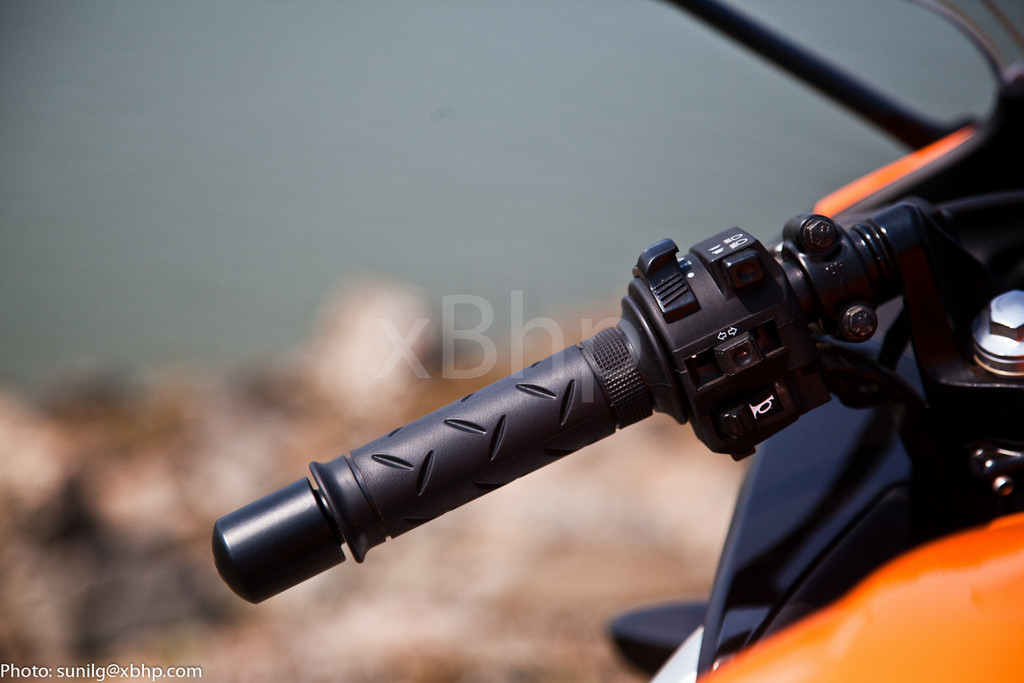


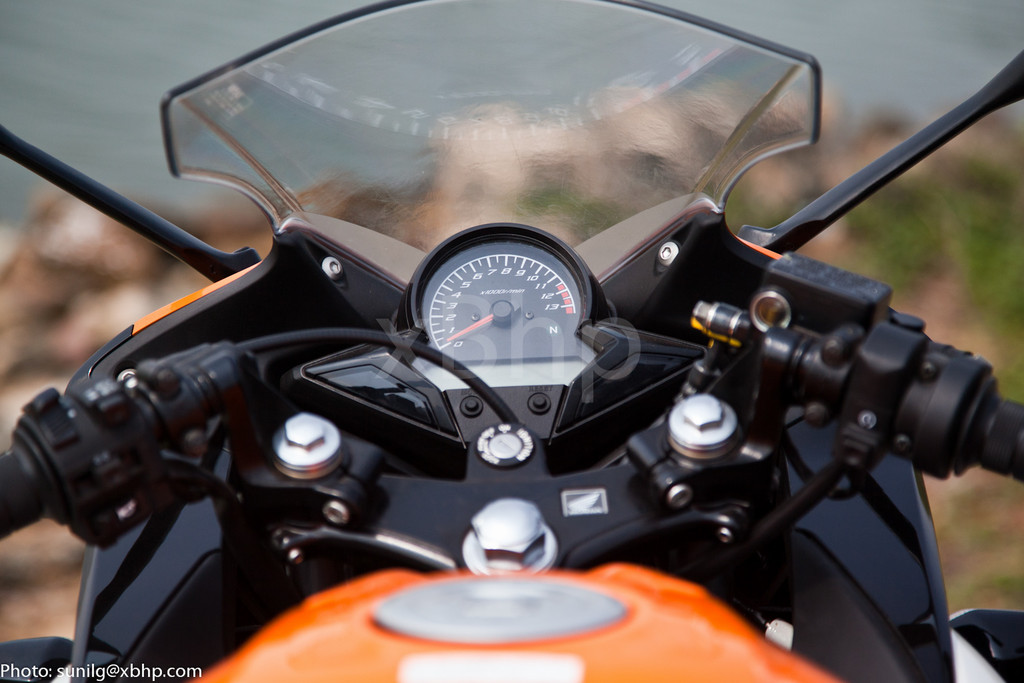


We did not use the bike after dark and so cannot comment on the headlight performance but seeing the size and shape of the reflector and inferring from the on-paper specs, this should be similar to its elder sister the 250. Instrument console looks a trifle down-market compared to the 250 as it comes without the silver edges and such frills. But it is functional and quite legible even in bright sunlight. Switchgear as told elsewhere comes from the Stunner and is functional but feels out of place on a premium product like this one. The brakes are sharp, give great feedback and did not fade despite repeated usage in hot weather.
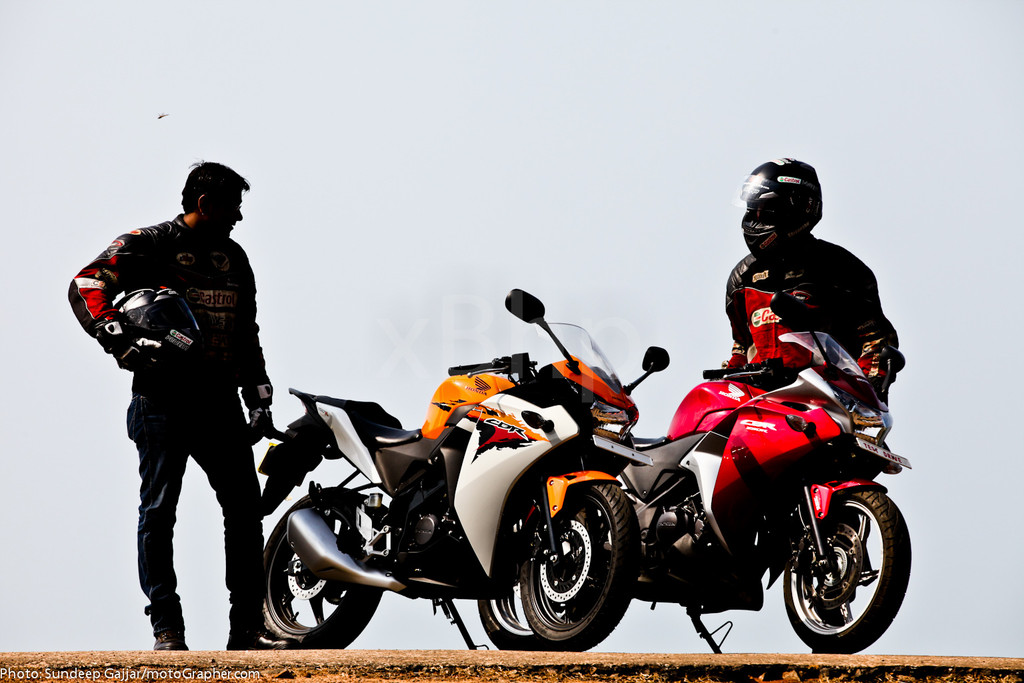
Pricing is one Achilles’ heel that this new entrant from the Honda stables has been burdened with. More expensive than both the Yamaha R 15 V2 and the KTM Duke 200 and with not any spectacular gains either in terms of performance or additional value for money, Honda will have a hard time convincing prospective buyers as to the additional premium in the price. The CBR150r does have that Honda racing DNA carousing through its insides and it shows in bright flashes when you push the bike through the paces. What remains to be seen is how the motorcyclist in India takes to this bike that comes forth as a mix of the commuter, tourer and a track machine.
KTM Duke 200 Detailed Review
 Dec 2011 Sunil Gupta
Bikes,KTM,Motorcycles
Dec 2011 Sunil Gupta
Bikes,KTM,MotorcyclesText & Photos: Sundeep Gajjar/ Sunny and Gourab Das/ MG
Sunny, Sunny.
Yes Officer.
Scraping Your Knee?
No Officer.
Show me your knee.
Ha, Ha, Ha.

Please bow down for the First Duke of India…
Honestly, how can you resist after seeing all the wonderful photos that you will below, with all the orange, and then connect it with the specs on paper and then connect the final two dots which say ‘KTM’ and ‘Bajaj’. The former being one of the most respected performance motorcycle manufacturers in the world, and the latter having one of the best reputations to deliver what they promise in the Indian market.
I have already got what a rider could want – riding what could be the best two hundred CC motorcycle ever mass produced on this planet – on a track, and being amongst the first to do it. I may add four stroke before the purists come out hollering. Both riding and shooting the bike was a sensory delight, something that you would be able to make out from this review, alright!
What is KTM?

Most of you here will know what KTM is – it is the name of a manufacturer based in the Austrian town of Mattighofen, near Salzburg in Europe. It’s official color is orange. KTM is an acronym for Kraftfahrzeuge Trunkenpolz Mattighofen. Kraftfahrzeuge means ‘motor vehicles’. Trunkenpolz comes from its founder Hans Trunkenpolz who founded it in the town of Mattighofen in 1934.
It has had its share of ups and down, in 1992 it almost faced closure before leaping back and selling a record 80000+ motorcycles in 2005. Who would have thought Orange could be so good for wealth too!
KTM is best known for its motocross racing pedigree. Only relatively recently did it start making road bikes like the Adventure 990 and the RC8 Superbike.
Our own Bajaj has a stake of 39.26% in KTM and that began to show when the KTM 125 started production here in Pune six odd months ago. That was 125 CC and 15 Bhp, not bad.
Both the 125 and 200 are produced at the Chakan plant here in Pune, India. The 125 is exported to Matighoffen where it is put through QA again and then re exported to other markets. Please go here to read about our visit to the KTM factory in Mattighofen. ( KTM Factory Visit : Austria – xBhp.com : The Global Indian Biking Community ).
Racing Pedigree…
Is evident…
Racing achievements: 188 World Championship Titles
• Endurance 1:
Winner – 2005, 2006, 2007
• Endurance 2:
Winner – 2004 to 2009
• Endurance 3:
Winner – 2004 to 2010
• MX 1:
o 2010 – Winner
o 2009 – 2nd
• MX2
2010 – Winner
2009 – Winner and 2nd
2008 – Winner and 2nd
Dakar from 2001 to 2010
The KTM 200 (or the Duke 200)
But the real kicker came with the news of the KTM 200. Two hundred may not sound groundbreaking but like the old adage goes – Winners Don’t Do Different Things, They Do Things Differently – this is the secret of our hero today – the KTM 200. Yes, this is a winner, I won’t wait till the end of my review to declare the obvious.
Why the name ‘Duke’?
As answered by Thomas Kuttruf, KTM Press Manager
“It was already end of 1993 in preparation of the first real KTM street sportbike. It was presented in Cologne in 1994, but there was no name! Project leader Wolfgang Felber wrote 20 different names on a paper and showed it to former Sales and Marketing Boss Mr. Calman Cseh. He ran with his finger down the list, stopped at “DUKE” and said: This one I like!”. From those days the “Duke” became a key word for the thinking of a pure KTM street motorcycle – and it remains until today!”
So the street sportsbike range name has percolated from the marketing room to the 990, 690, 125 and now the Duke 200.
Ok, so now let’s peel off the orange slowly, shall we!
READY TO RACE?

Prologue
I rode through to Slovenia from the open and single manned border post at the Austria-Slovenia border on the Adventure 990. A couple of hundred kilometres later I was standing inside the small town of Radenci. The home of Rok Bagoros, an upcoming stunter sponsored by KTM. The first time I had a look at the KTM 125, which he stunts on, I could not believe it was, well, a 125. Instantly I knew that this bike would be a hit in India, but only if it was just a tad more powerful and affordable…
(You can buy the single copy of the xBhp Magazine Aug-Sept 2011 Issue from mag.xBhp.com, this was a KTM special issue).
Present
I held my breath as I sat pillion, hunched under the weight of all the cameras on my back in the rucksack, over my Alpinestars jacket. This was no mean feat considering that none other than our very own flamboyant Gourab (MG) was maneuvering hard through the Pune traffic and inching closer to Chakan, the place where Bajaj would finally showcase us the KTM 200.
Thanks, both to my luck and to Gourab’s riding skills, we finally arrived at the destination without testing our riding gear.
First Impression: The Looks of it
Three bikes were shod with red cloth on a red carpet against a couple of big orange KTM boards. It was anybody’s guess what was beneath them. Finally after years, not months, of speculation, hunting down KTMs on Pune highway and putting up with all kind of rumors, the time had come for the Indian bikers to swing there leg over for the First Duke of India.
Soon enough, without any more drama, the covers were slid off the bikes and there they were – three Duke 200s, orange, naked and handsome.
The bike looks like a Greek god, conceived in Austria but born in India. Need say anything more?
Curiously organic, resembling an insect crouched and ready for action. Place a headlight assembly like this on any other bike and it would look downright ugly, but here it was a piece of art – mated with the right proportions with the rest of the bike. The wide tank also doubles up as a bikini fairing, the under-engine scoop which perfectly rejoins the visual line with the rear tail assembly. The wheelbase extends beyond the tail end of the bike, giving it a true street-fighter look. The white mono also attracts the eyes to where they should be – exactly where the center of gravity is located. Just when your eyes travel to the rear monoshock, they notice something is amiss – where is the exhaust? Look closely, its tucked away below the engine neatly. This is some serious mass centralization that, as we later experienced, would result in some fantastic corner carving. It is unprecedented to see such level of attention to detail in both function and form in such a small capacity bike targeted within such a price bracket and that too in India.
The rear tyre hugger actually makes the bike look even better, and bigger!


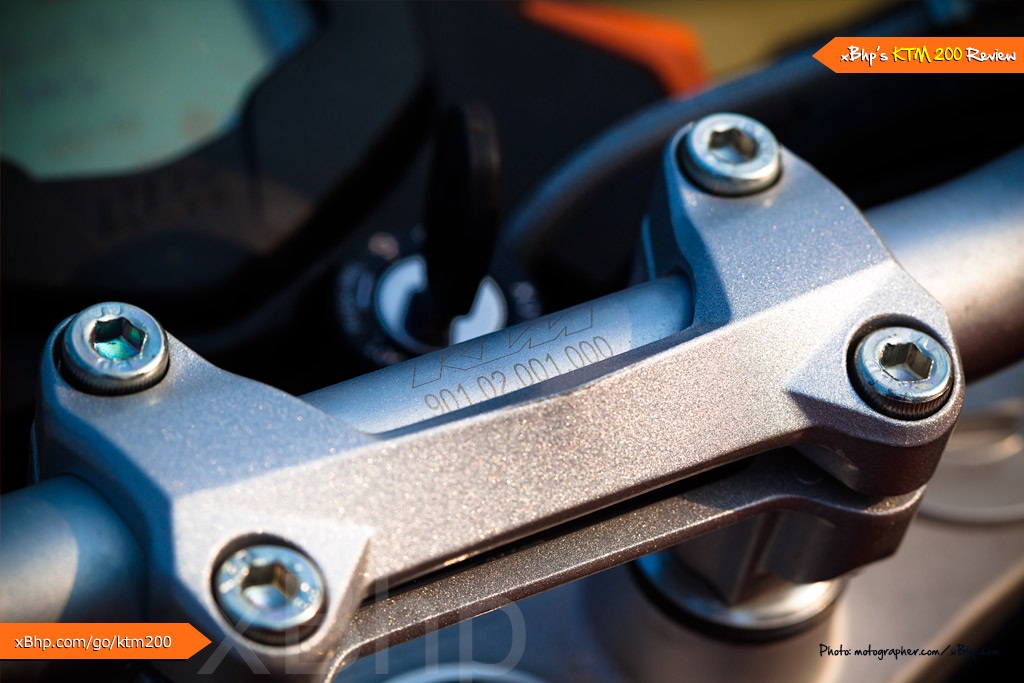

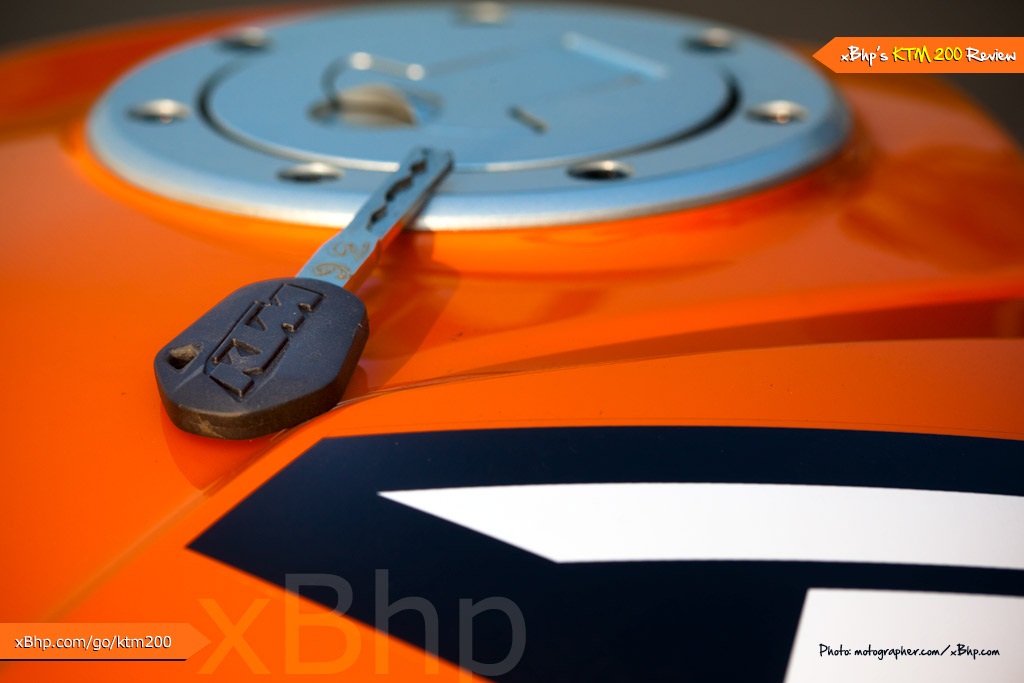

The one thing that I was intrigued about was the black color of the trellis frame, until someone told me that the orange trellis frame comes in ‘R’ bikes only, something that I didn’t buy into though! However have a look below to see how an orange trellis frame would look on the K200, I think it will look better! This is one thing to be done aftermarket on the bike.

^Wish the standard Duke 200 came with the orange trellis frame as well!
Taking about aftermarket stuff, KTM (I would stop using Bajaj now) would provide the Indian buyer with a series of original KTM branded accessories to personalize their Dukes, here is a list of a few below:
KTM Merchandise – India

***Prices tentative, may change later
Power Parts:
• Sticker Kit: Rs. 4500 – 5500
• Tank Cap : Rs. 1500 -2000
• Tank Pad: Rs. 1500-2000
• Seat Cowl: Rs. 10,000 – 11,000
• Alarm System: Rs. 18,000
• Illumination set: Rs. 7000-8000
• Sprocket: Rs. 3500-4500
• Chain: Rs. 6000-7000
• Handle Guard: Rs. 4000-5000
Power Wear:
Orange Tee: Rs. 1500-2000
Black Tee: Rs. 1500-2000
Vented Jacket: Rs. 14,000 – 15,000
R Boots: Rs. 20,000 -22,0000
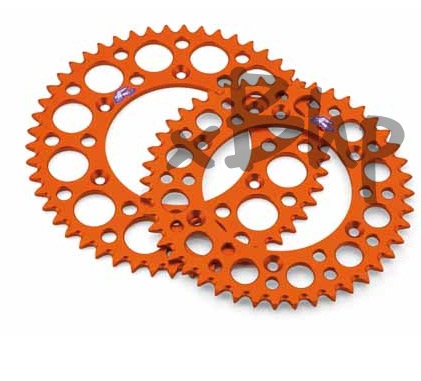


For me one of the best accessories was the stick on tank LED array that was just fantastic and inconspicuously tucked away in the fine recesses of the tank. The LEDs were quite bright and visible in the day as well
And here is a photo of the ‘tricked’ out KTM:


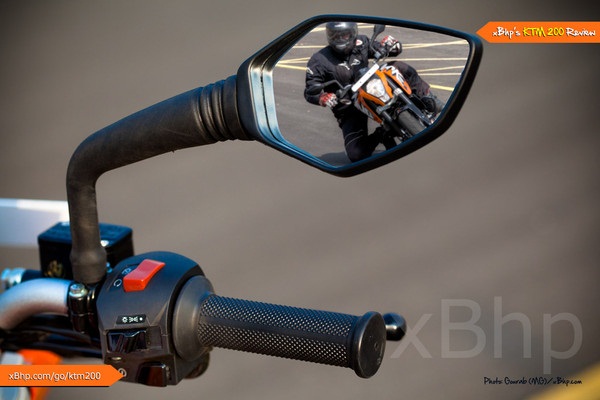


There is no doubt that its visual cues are borrowed from the big Duke – 990, making that connection with fun and speed even more immediate.

The saree guard that comes stock with the bike is also integrated well, but obviously the first thing that you will do is to take it off, which is also very easy to do and just a two screw job. Sigh for our archaic laws.
The mirrors were also quite functional, at least on the track I did not detect any considerable vibrations.
The Console
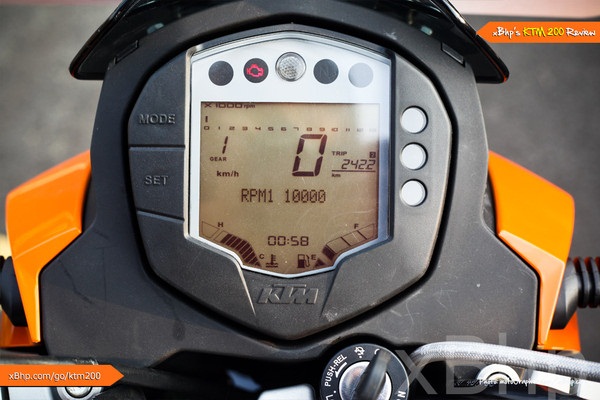
A beautiful console complimenting the bike’s aggressive and futuristic styling, everything is digital in this and it reads like a computer.
- Multifunction (MFD) cockpit:
- Digital Speedo/Odo/Gear indicator
- Two Trip meters with additional F mode.
- Dot matrix messages
- Ready to race.
- Side Stand on.
- Low fuel level.
- Distance to service.
- Distance to empty.
- Average speed during trip.
- Average fuel consumption.
- Shift RPM alarm for driver.
- Light dependent console display.
- Digital watch.
- Indicator display
- Eng Temp.
- Fuel Level.
- Tachometer.
- Turn signal.
- MIL.
- Neutral & High Beam.


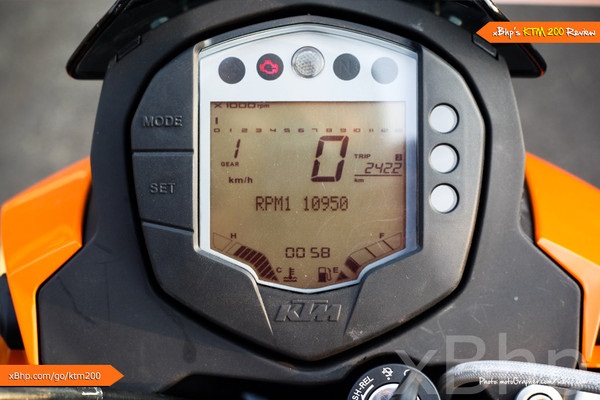


This is one bike that gets a thumbs up from me in the looks department straight away! But just one more thing – it would have been great if it had projector lamps instead of the reflectors ala Duke 690. I guess that would be in the K200 V2.0!
Style: 5/5
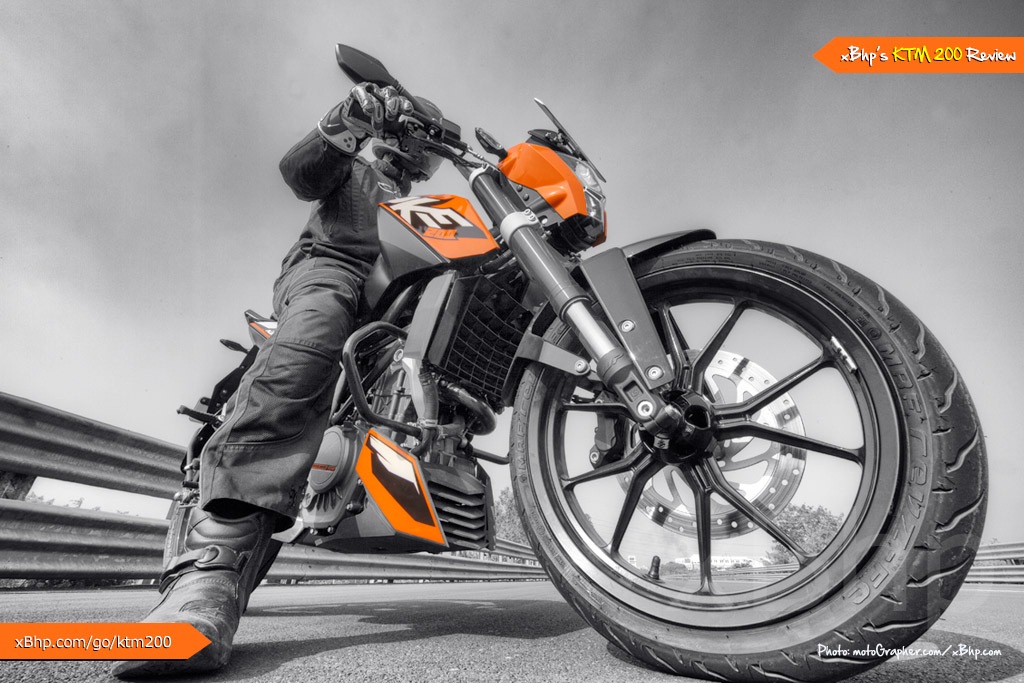
For: The insane street-fighter styling and world class finishing quality
Against: The rear is 150, but the narrow alloys don’t take advantage of that, visually that is. In the performance department it helps as you have more rubber on the edges to play around with. The trellis could have been orange.
Performance and Handling

On Paper
What can you expect from a bike whose power to weight ratio is 184 PS/Ton?
Another cue for you to try and gauge its performance from your chair is it’s kerb weight – 136 Kg. This means that with 10.5 litres of fuel in it (which is it’s tank capacity) and the engine oil (which should be around 1.5 litres) and the coolant it weighs this, which is astounding considering that the Honda CBR 250R is 161 Kgs (non ABS) with the same power output of 25 Bhp!
You can now but imagine how the Duke takes off. The first gear is relatively taller (upto 40kmph) than the higher gears.
Ergonomics and Comfort
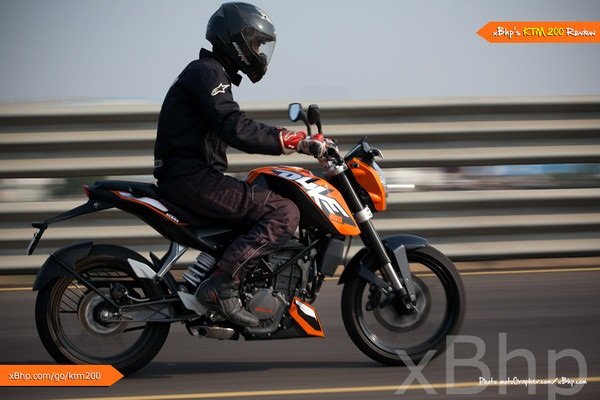
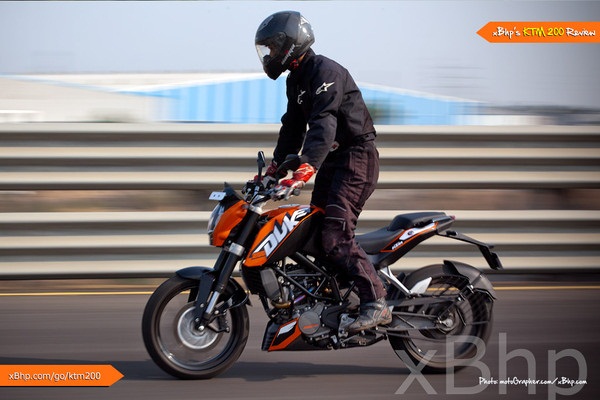
Once you sit on the Duke you realize how aggressive and yet comfortable it is. The view in front of you is wide and clear, no obstructions, no windscreens. The tube type handlebar was perfect, with all the controls being at hand without much thumb shifting. The controls are backlit (as with the Pulsars), and that certainly add a lot of techno-charm to it.
The Pillion seat looks small but surprisingly accommodated me sitting behind Gourab with all my camera gear at speeds over 100kmph. The split grab rails helped.
Speed

With the top speed of 138 kmph on the speedo (crouching), no luggage, you will hardly need a windscreen. I suspect the bike can do a little more at the top, but to improve reliability it has been geared as such. The rev limiter even kicks-in while even in the top gear sometimes, which is a little unsettling. The rev limiter kicks in around the 10000 rpm, you can feel the bike wants to rev more though. This again has to be related to its reliability concerns than anything else.
The gear box is smooth and the gear shifts precise, although I experienced some niggles finding the neutral, but that must be a rough test usage issue here.
I could literally feel the bike would do a power wheelie very easily in the first, but given the instructions from Bajaj, I didn’t try it. The lightness of the bike really shines when you drag it from a stop, which should make red light GPs fun. You sometimes will feel you are riding a more powerful bike than it really is, but sometimes, especially going by the looks of the bike, people may be disappointed it is just ‘200CC’.
The big console gave a good reading of the rapidly climbing numbers as I approached 100 quickly. From 100 to 120 it was pretty effortless, but beyond that the bike took a while to reach 130. And the console got stuck 138 kmph.
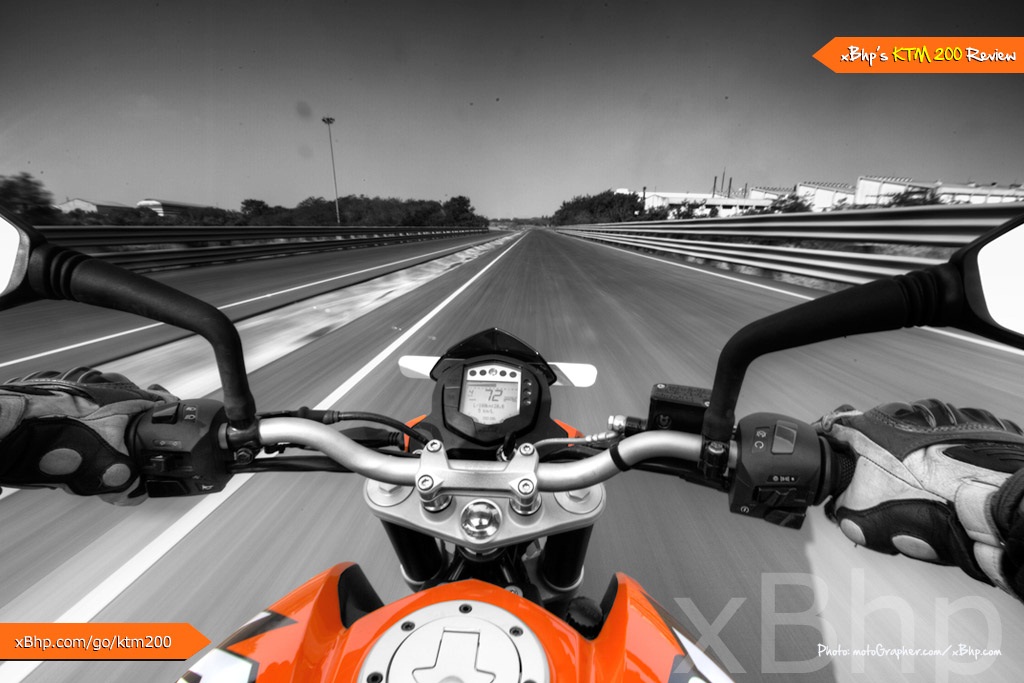
Max speeds in each gear
(as noticed while testing – all approx)
1st gear – 40km/h
2nd gear-60km/h
3rd gear-80km/h
4th gear-100km/h
5th gear-116km/h
6th gear-136km/h
All the above figures are at 10000rpm where it hits the red line
100km in 6th gear @ 7000rpm
Roll on figures (approximate):
0-60km/hr (in sec)
KTM200 – 3.33
CBR250 – 3.67
R15 – 5.41
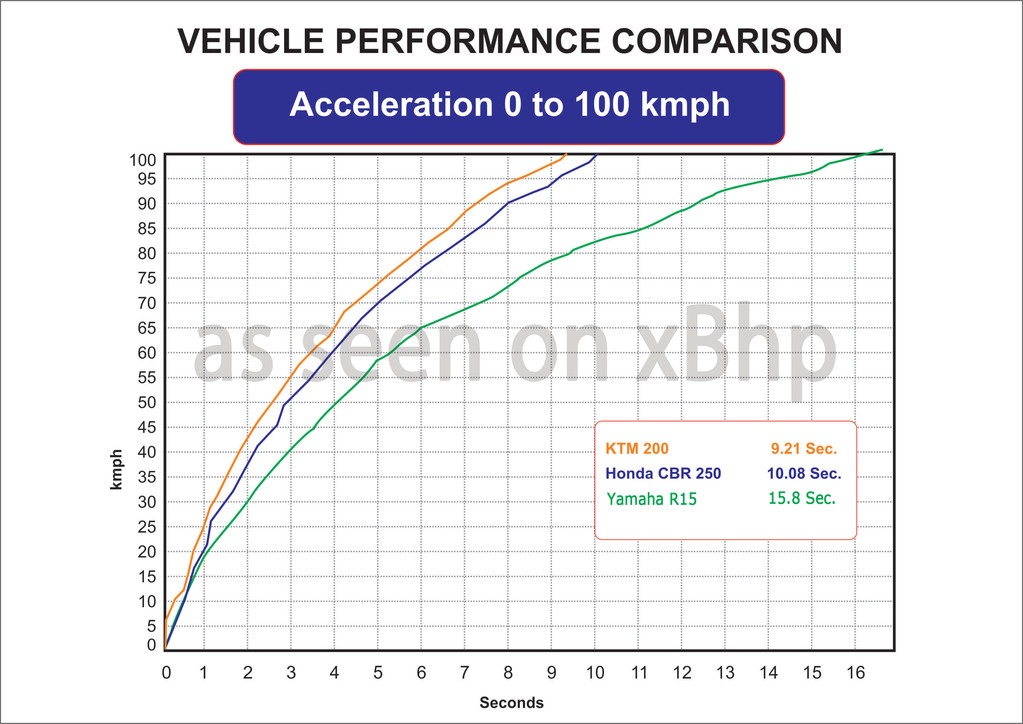
0-100km/hr (in sec)
KTM200 – 9.21
CBR250 – 10.09
R15 – 14.14
Roll –on 30-70km/hr (in sec)
5th gear 6th gear
KTM 200 7.66 9.76
CBR250 10.20 12.94
R15 13.20 15.60
Here are all the top speed figures by different publications take your pick. We tested the KTM 200 top end at 138 Kmph speedo indicated.
R15 V1
ACI0-60 – 5.020-100 – 14.14Top Speed – 124
Zigwheels0-60 – 4.50-100 –*Top Speed – 130
BI0-60 – 5.120-100 – 14.17Top Speed – 130
OD0-60 – 4.90-100 – 13.2Top Speed – 124.5
ZMR
BI0-60 – 4.70-100 – 13.8Top Speed – 127
OD0-60 – 4.50-100 – 14.05Top Speed – 124.6
ACI0-60 – 4.560-100 – 13.63Top Speed – 126
P220 DTSi
BI0-60 – 4.70-100 – 13.1Top Speed – 132.5
OD0-60 – 40-100 – 11.1Top Speed – 133.3
ACI0-60 – 3.770-100 – 12.15Top Speed – 133
I am yet to gather info for CBR250R.
Handling and Braking
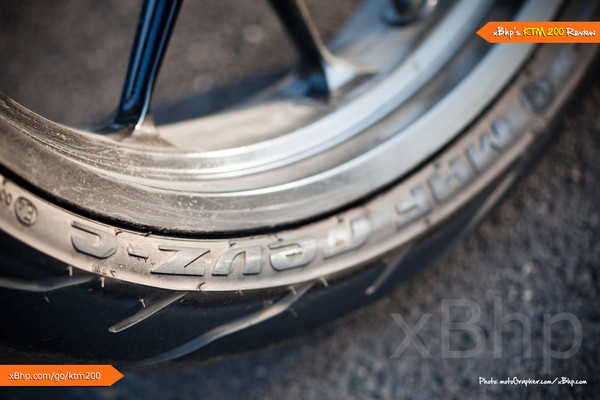
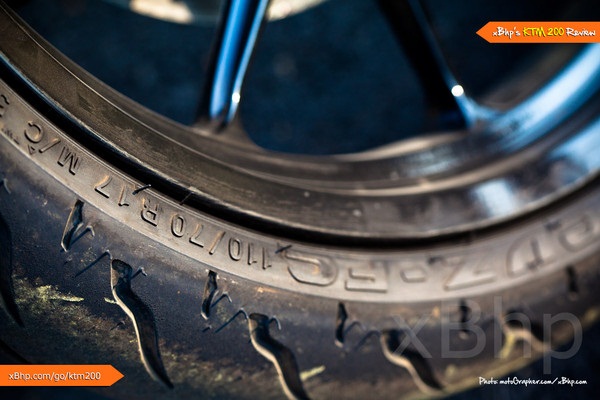
One place where it really shone was the corners. This was my first time at the Chakan track and only my third time ever on any track – and I got my knee down in my fourth attempt. The only other bike, which had inspired so much confidence in me, was the Ninja 250. Again this bike will surprise you, street-fighters are not usually meant for the track, but this one had no qualms about dispelling that myth. The MRF REVZ-C tyres served it well.


Braking was very good. But not good enough. I say this because it intrigues me why there is no ABS option? Just over here the CBR250 might score a little over this bike, but not enough to outshine it. If you are a good rider then you will rarely need ABS, but when the bike is loaded with so much it could have been as well be there. Hopefully in the next version. The K200 is equipped with front and rear discs powered by BYBRE, a sister brand of the bigger BREMBO for smaller and more economical bikes.
The bike that we got stalled a couple of times while taking a u-turn. This could be an issue with the way it was being treated by all of us at the track non stop rather than anything else though.

The Game
To see how nimble and flickable the bike really was, I took inspiration for the Ducati Panigale video and planned a few knee knockdowns myself.
Here is the setup:

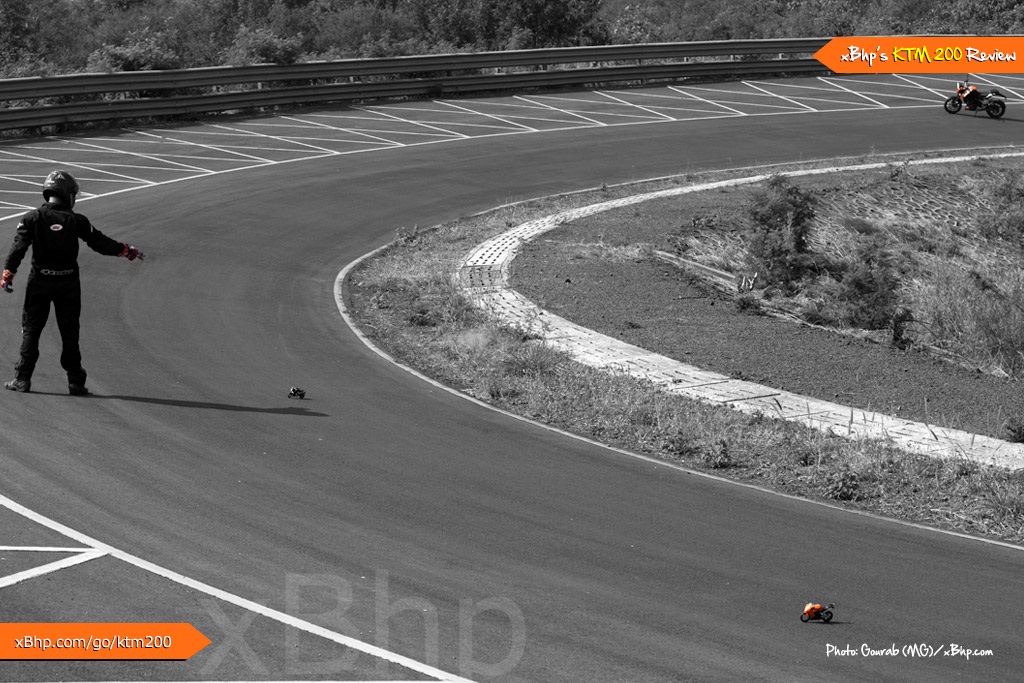
And here is the first victim:

and the second…

Fuel?
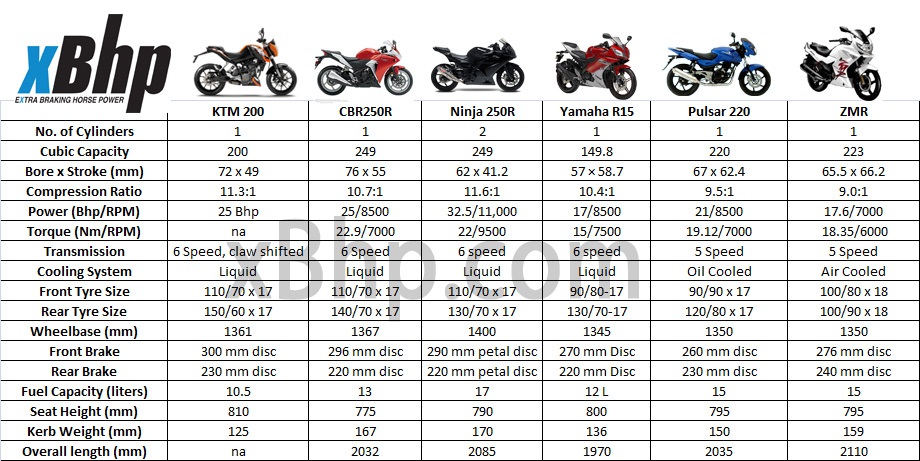
The compression ratio of the Duke 200 is 11.3:1. Now whether that means it will not behave itself when fed with anything less than 95 octane remains to be seen. That is something we need to find out on a long ride. In comparison the compression ratios of some popular bikes are:
Ninja 250R: 11.6
KTM 200 : 11.3
CBR 250R: 10.7
Yamaha R15: 10.4
Pulsar 220: 9.5
ZMR: 9
Going by the above it seems that the KTM200 should have no problems in running on any standard Unleaded fuel if required. However we would recommend at least brands like xTra Premium and Speed that fall within 91 – 93 octane.
The European spec KTM 200 has 95 Octane recommendations, but for India they apparently did some fuel mapping changes, and that was a wise move considering the vast expanse of our nation and their dubious quality controls over fuel (amongst other things).

PLEASE NOTE: We forgot to add this initially but all the graphs and figures you see below are taken from Bajaj presentations given at the preview. They were redrawn partly from rough sketches and partly from memory. Hence there could be some errors, so please do not eat us up for that,w eare going our best! We would urge people to post more reliable info on figures from a reliable publication here and we will update the figures accordingly.
Specific Power Output Comparison


Performance: 4.5/5
For: Stupendous acceleration and control.
Against: No ABS?
Tyres


For who is this bike suitable for?
If this is your first motorcycle?
Yes, if you have the money. Most learner legal motorcycles in the west have a 33 bhp limit and this is lower than that. However, when I say your first ‘motorcycle’ I don’t mean your first two wheeler. This bike is so light and forgiving on the wallet (if it falls) that learning on it and then making it your primary bike for the next many years would be easy than buying a new bike altogether after learning on something else. But its bigger dimensions will get you acquainted with bigger capacity bikes that you might own in the years to come.
If I am a student or in college?
Is that even a question? If this bike was available when I was your age and I had the money I would not think twice before buying it. But I would definitely think if I had bullies in my college…
If I am over 40 and have a farm house and a big bike and am well settled?
This must be change for you then, the monetary kind. On a serious note, as a second bike which you can take to any terrain across the country while looking good and going fairly fast, this one fits the bill. And you will not find it a problem sharing with your counterparts in the west that you ride a small KTM, and not a desi sounding something…
If I like to tour a lot, and abuse my bikes?
I am not sure on how you abuse your bikes, but I hope it’s not the gross type. On a serious note I feel that the bike can be an amazing tourer, its light and fast and so much fun around corners. PLUS the ground clearance is a massive 165mm, 15m more than the Karizma! Getting Lehd on this would never be the same.
If I am a narcissist?
Then you should not get this one. It will make you look outdated, unless you are a Transformer or a Robocop.
If I am a cop?
Definitely Not. It’s engine shuts down as soon as it detects a cop is sitting on it.
A Thug?
If you are in India, even a CD100 would do, but if you plan to make a getaway on the autobahn then perhaps the SuperDuke 990 would be better.
If I was going to buy a CBR250 or a Ninja 250 or any bike around the 1 lakh mark?
Look, I don’t want to spoil my relations with other manufacturers here, you know…So take the hint pls!
Last Word
I will be what you want me to be.
URBAN WARRIOR:

a BIG YES! This is the ultimate street-fighter availaible today (don’t take it literally, the other motorcycle from a red (and my favourite) brand using this very name is worth more than 12 times the Duke 200!). This is a motorcycle that I would like to go to my office on – in traffic! The only other bike that was as fun as this is my Ninja 250 with the Two Brothers exhaust! Nothing will feel better than demolishing the traffic with a bike as light and nimble as this. Bring it on Delhi rush hour, show what you got! Show me! Ha hahahaha!
TRACK JUNKIE

Above you can see a track novice scraping his knee and annihilating small objects on kept on the track with precision. So you know what this bike can do on the track. Plus it’s got minimal stuff to break and no fairings and plastics to be taken off before your track day. BRING IT ON!
TOURER
25bhp, 135 kgs. I don’t think any bike can compare this in India. And definitely not the heavy and bulky ones like CBR 250, or the underpowered ones like . Believe me, I pulled the bike up from an angle so close to the ground where other motorcycles would have refused to budge. Lightness! Supppper – Legerra – this is how an Italian who rides a KTM 200 would exclaim! Shod it with sport panniers and a tank bag and you can ride the world.
The only issue might be its small tank capacity of 10.5 litres which with an average of 30kmpl, will give you a striking distance of 300 kms, which is not that bad…
STUNTER
See Rok Bagoros on a KTM 125 and there will be no doubts on the capabilities of the insanely hooliganistic nature of the 200. It will be for sure the kind of stunt bikes in India. A problem for its sister here in Bajaj (Pulsar you hiding somewhere, eh?)

The World is getting younger, and the power is shifting to Asia . This bike is proof of that. The bike is built for youngsters and also the veteran population who want a second bike. The bike is built for the super economies of the future that have immense disposable income distributed in its middle classes.
The bike is for the future super-biker who wants a bike which looks good and goes TODAY without breaking the bank.
The future is orange and the other companies like Ducati and BMW have no option but to get into this game if they have to earn big money.
Perhaps soon we shall see a Ducati Monster 250 and a BMW S250R, soon!
Now how do I book an appointment with you Mr.Duke?
Epilogue
It’s 4 AM. The first sun rays are already reflecting off dew settled over the Duke parked outside the tent nestled somewhere in the Himalayas. From here to our final destination for today are thousands of turns, but I don’t care, I have the perfect machine to seduce them into loving the Duke as it caresses them effortlessly. This is it. I have been empowered.
PRICE?
We dont know, but it would be max 1.5 lacs on road.
LAUNCH AND BOOKING DATE
We guess it to be on 3rd January 2012.
KTM 200 : Summarized
200 CC . 25 Bhp . 19Nm . 136 KG (Wet)
Pros
- Naked styling matching the bigger KTM dukes
- Stupendous Power to Weight Ratio
- Lovely Console
- Made in India
Cons
- No ABS
- Rear end does not look meaty enough from some angles
- The sound of the bike is on the timid side
- The bike that we tested seemed to cut off too soon
- No orange trellis frame
- Top end might not meet the expectations of many people because it is easy to forget it is ‘just’ 200 CC after all
- The tank capacity might be a tad small at 10.5 Litres
- The rear seat might prove to be a tad small for a pillion on long rides, but we havent tested that
In the end a lot will depend on the cost which will be announced in January.
KTM 200 Duke Specifications
The Standard Crap
No. of Cylinders: 1
Cubic Capacity: 199.50
Bore x Stroke (mm): 72 x 49
Compression Ratio: 11.3:1
Valve and Cooling: DOHC 4V, Liquid Cooled, Fuel Injection
Power (Bhp/RPM): 25 Ps @ 10000rpm
Torque (Nm/RPM): 19 Nm @ 8000 rpm
Transmission: 6 Speed, claw shifted
Cooling System: Liquid
Front Tyre Size: 110/70 x 17
Rear Tyre Size: 150/60 x 17
Wheelbase (mm): 1367
Front Brake: 280 mm disc
Rear Brake: 230 mm disc
Fuel Capacity (liters): 10.5
Seat Height (mm): 810
Kerb Weight (kg): 136
Front suspension: USD, Telescopic fork, 43mm dia
Rear Suspension: Monoshock
Front fork travel (mm): 140mm
Real wheel travel(mm): 150mm
Headlamp: 12V 60/55W H4
Battery: 12V 8AH VRLA
Vehicle Features:
- Trellis Frame.
- Shortest possible connection of swing arm pivot to steering head.
- Well triangulated structure giving high rigidity.
- Aluminum swing arm.
- Upside down fork.
- Rear Mono-shock.
- Wide and radial tires.
- Front radial and rear floating caliper brakes.
- Cute looking all LED blinkers.
- KTM’s trademark orange color.
- Superbly finished AL die cast swing arm.
- Solid muscular chassis tubes on display.
- Backlit control switches.
- 5 spoke & shaped wheels.
- AL – cast rider and pillion footsteps.
- Headlamp roll ON during rolling downgrade: This means there is a vertical compensation for the angle created on an incline or decline, something like the adaptive headlight in the K1600, but way less advanced than that since the one on the KTM will not compensate for the lean.
- Zero maintenance 8 AH VRLA battery.
- Hydroformed handlebars : Better strength at clamping location.
- Finger rockers with hard carbon coating to reduce friction.
- Radial mounted front brake caliper.
- One piece forged crankshaft.
Aluminum Swing Arm
- The light alloy swingarm with directly linked WP shock absorber excels with extreme cornering stiffness and outstanding tracking stability.
- Aluminum swingarm excels in high strength to weight ratio with low unsprung mass.
- Shape and sections designed to maximize strength and reduce deflections under loads.
Suspension
- Flex resistant and high rigidity upside down forks with WP technology ensure stable and precise performance under extreme handling.
- Larger section module near the clamping with frame for better rigidity.
- Increased inner tube guide length improves rigidity
- About WP: WP means White Power. For more then 30 years now, ever since it was founded in Netherlands (but now that facility is closed) WP Suspension is developing advanced suspension products to satisfy the high demands of motorcyclists, world wide. Various motorcycle manufacturers, such as BMW, Husaberg and KTM use WP Suspension products in the production of their motorcycles. In 1999 it was taken over 100% by KTM. Today it produces OEMS and aftermarkets for BMW as well as KTM at the Munderfing facility in Europe.
This what I attained after riding the K200 on the track..

And thats me below..
thanks to Dream Sporting Gear for providing us with all the awesome riding gear that you see in this photoshoot!
The Hooligan is here!

KTM designs are always distinct and this one is no different. One look at the bike and you know that this bike has the best fit and finish that Indian market had even seen. R15 V2 is the only product which comes close to it. The bike has a very mechanical look and it’s criminal not to notice and appreciate it. Couple of months back when I saw the smaller avatar I jokingly said that this will be the only Indian bike where you can appreciate the mechanical elements more than the body panels. USD forks, trellis frame, aluminium swingarm, monoshock, 5 spoke Y shaped alloys, underbelly exhaust are all very tastefully done. Even the rear mud flap is nicely done with the KTM name engraved in it. Not to undermine the bodywork, the tank and the rest of body panels are very neatly done with high quality plastics being used everywhere. It has that radical KTM lines written all over it. The aftermarket bodykit which will be made available will make it even more appealing.
There are bikes which we buy just to fulfill our need by making certain compromises on the styling front and then there are bikes where the desire quotient is so high that you want to go and buy it the next day. KTM falls in the second category. Unless you have a fascination for full fairing or you are a complete cruiser guy there is no reason why you should not like this bike. The only negative that I can find is that the vehicle would have definitely looked sportier if the trellis were painted orange.
The Best Street bike ever?
Still early days but going by the first ride I have a strong feeling that it will be the new king of road. The riding position is spot on true to a street rider, i.e neither too relaxed nor too forward biased. There is ample power and torque as soon you engage the first gear which goes all the way till 130 after which it takes little time to hit the top whack. The bike is a treat to ride and there is a lot of punch in all the gears. With the street riding position I was not very sure about its handling prowess around the corners but that inhibition went away as soon I took the first corner. The light weight and the centralized CG makes it ultra flickable. There was an occasion when Sunny was sitting behind as pillion and we were discussing something while we entered the trickiest corner of the whole circuit and this we realized after we finished the corner at speeds over 60km/h. Even after all this madness the bike is easily rideable in 6th gear from speeds as low as 30km/hr
This bike will make you go wild, slide around, tearing across an open road, inspire some law breaking, or make you feel like law breaking is in your near future (No I’m not asking anyone to do so).The bike make me remember the famous game Road Rash which I played couple of years back. Even with a 200cc heart it is true to its core i.e Ready to Race!
This bike can surely do much more than being a street hooligan. From whatever riding feel I got I have strong feeling that it can be a good tourer and excel in off-road conditions with just change of tyres.
It took three long years for the first KTM to land our shores but this is definitely the best product to start the KTM innings in India.
For the wholesome ride report wait for the full test ride review from xBhp in the next couple of months.
Information that will be displayed on the Digital Speedo
- Digital Speedo/ Odo/ Gear Indicator
- Two trip meter with additional F meter
- Dot matrix messages
- Ready to race
- Side stand on
- Low fuel level
- Distance to service
- Distance to empty
- Average speed during trip
- Average fuel consumption
- Shift alarm driver for driver
- Light dependant console display
- Digital watch
- Indicator display
- Eng Temp
- Fuel level
- Tachometer
- Turn signal
- MIL
- Neutral & Hi beam
Mahindra Duro 125DX Review
 Dec 2011 Sunil Gupta
Mahindra,Scooters
Dec 2011 Sunil Gupta
Mahindra,Scooters
After taking over the reign from Kinetic, Mahindra’s foray into the two-wheeler industry, particularly in the scooters segment, has been quite positive thanks to its two products, Rodeo and Duro.
The 2-wheeler arm of the makers of the heavy-duty commercial and private vehicles, Mahindra 2 Wheelers, recently unveiled the facelifted version of its 125 cc scooter – Duro 125DX, in Lavasa, Pune.
Text: Sunil Gupta
Photos: Sunil Gupta (unless mentioned otherwise)
xBhp was there during the unveiling (and you thought we didn’t cover anything less than 1000CC ), and here is a quick summary of what we could gather of it during our very brief rendezvous with the Duro.
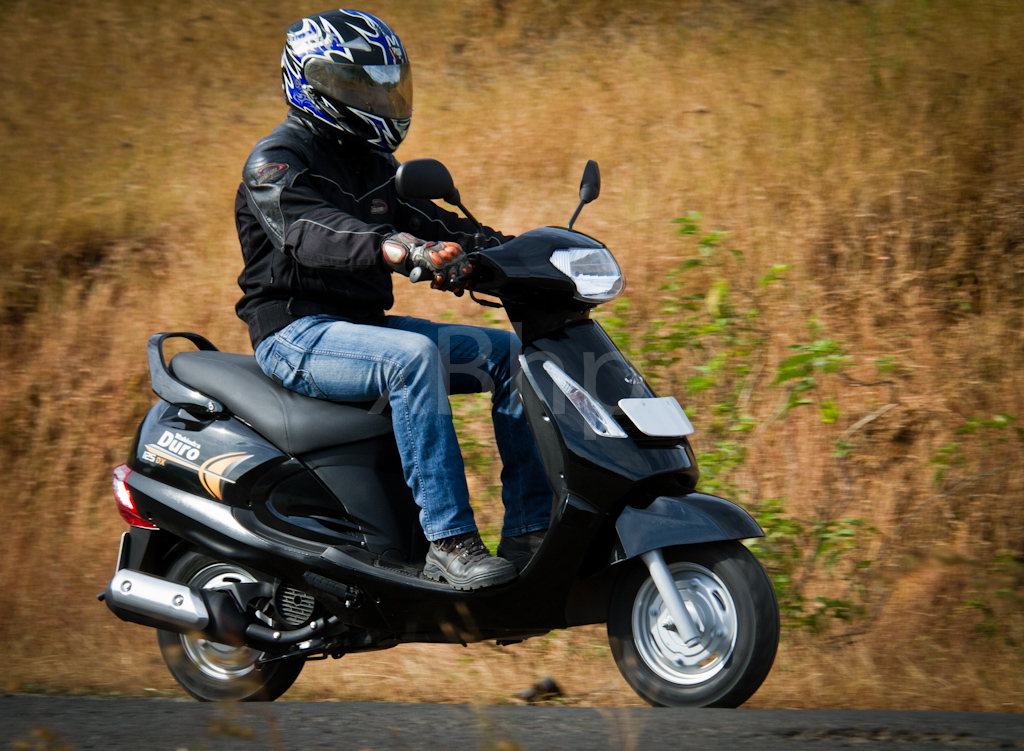
What’s new? Overall, the Duro remains pretty much the same without any ground-breaking change in terms of its looks or performance, yet the guys at Mahindra have incorporated some subtle and not so subtle cosmetic, performance related, and ergonomically focused changes to make it a better overall package to take on the competition. Mahindra says that they have implemented these changes after extensive research and feedback from a selected group of customers from across the country.
So, here is a list of the changes (cosmetic, ergonomics, and performance) that you can see in the new Duro:
1. Digital dual-curve ignition.
2. New suspension setup.
3. Longer wheelbase.
4. More ground clearance.
5. Larger headlamp.
6. Larger RVMs
7. Brake lever lock (what?)
8. Raised handlebar.
9. Better seat profile.
There have been some more tweaks other than the listed above; however, the most significant and anticipated of these is the change in the suspension system. The hydraulic shock absorbers in the earlier version have given way to the advanced telescopic forks in the new Duro, with some tweaks also in the spring setup in the rear ones, making the new Duro a delight to ride on the rough roads. The ground clearance has also been increased slightly to make it even more potent tool to fight the bad roads. And this ground clearance remains significantly high even with the maximum weight on the saddle. The handlebar height has also been raised a bit to make it tall-rider-friendly. Though the wheelbase has been reduced from 1290 mm earlier to 1270 mm, yet it remains significantly longer than the immediate competition (Suzuki Access 1250 mm).


The one thing that you are going to like about the Mahindra Duro 125DXc most is the new brake lock lever on the left side. When engaged, it would prevent the vehicle from rolling down even when parked on a steep incline. Mahindra says that they incorporated this change based on the feedback from their customers.


Then, there are larger RVMs, which give a very clear picture to the rider (even with a large guy on the rider seat) of what’s going on behind his back, perhaps help him identify a crotch rocket approaching in stealth mode!
The previous headlamp unit has also been done away with, making way for a bigger, completely changed unit in the 125DX which claims to be giving a larger and wider beam, though we were unable to cross-check this claim during the day.

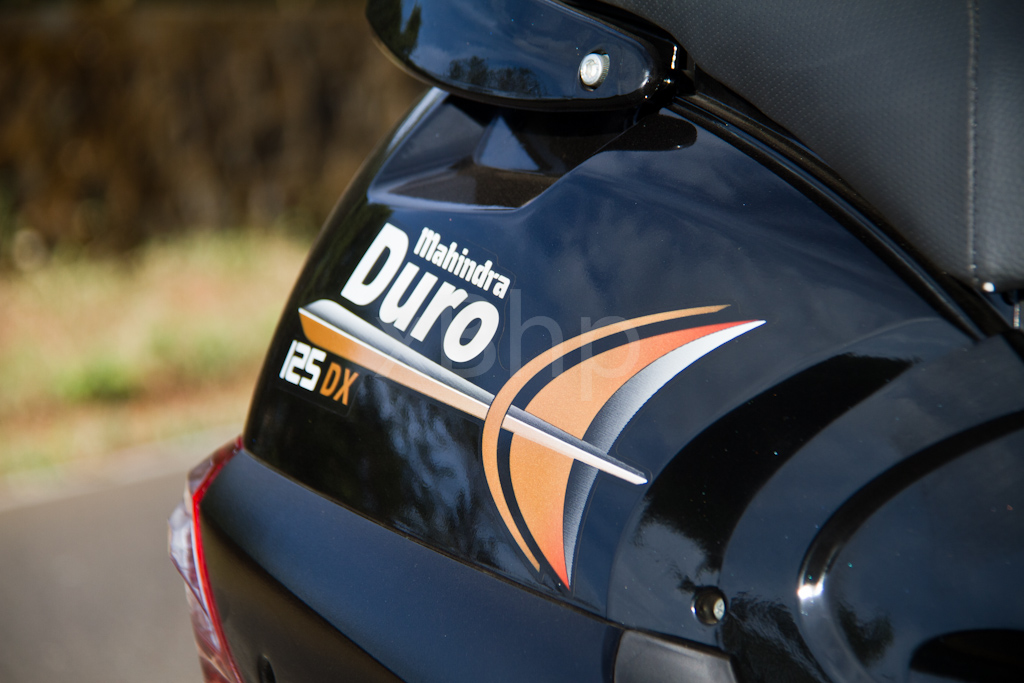
Looks and Styling: The new Duro has been given a completely new, bigger headlamp assembly that not only gives it wider beam, but also gives sharper looks to the scooter. The speedo console has also been changed and the new unit has an analog speedometer, odometer, and a fuel gauge which looks pretty clean and the numbers should be visible even during the bad light conditions. Overall, looks wise, Duro hasn’t really been head-turner, though it doesn’t look bad either. I would’ve personally liked it if they had given the Duro some styling tweaks to make it look ‘bigger’ and robust.


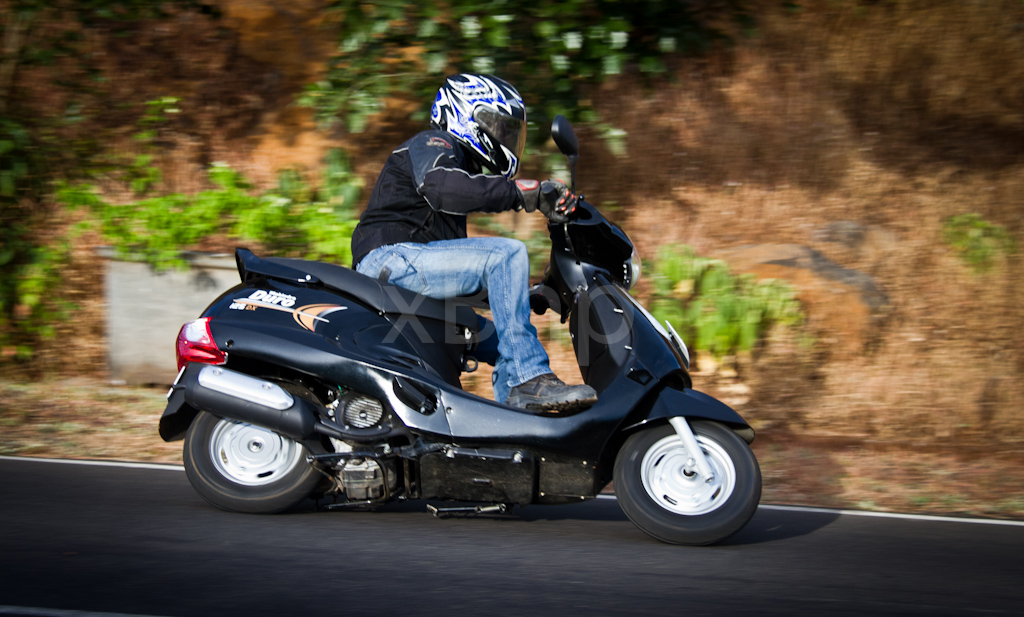
Ride quality and handling: During our ride that lasted a little over 45 minutes on the roads of Lavasa, the new suspension setup behaved very well and remained well balanced and planted on all kinds of roads, particularly the stretches heavily infested with potholes. Weighing a little over 100 kg, the Duro was quite amenable to some quick maneuvering and sudden sharp turns with ease. The increased ground clearance does help a lot in taking care of the bad roads; however, the center stand was quite regularly scraping the road on the left side whenever we pressed it a little hard on the corners. But keeping in mind that this scooter will be mostly ridden in normal city conditions without someone pushing it real hard on the tracks or ghats, this shouldn’t be much of a problem.
On the braking front, the new Duro comes fitted with drum brakes, both front and rear, which were just good enough to stop this vehicle producing 8 bhp max.

Engine/performance: There have been no changes in the engine or the performance figures; however, Duro 125DX comes equipped with digital dual-curve ignition, which Mahindra claims will make it more fuel efficient and will also give better throttle response. We couldn’t test the fuel economy; however, the engine felt quite smooth even during the high revs. The low end torque wasn’t that great; however, the mid range was quite satisfactory and we were able to reach up to 80 kmph quite quickly and regularly on the serpentine roads of Lavasa, which generally don’t give you many stretches of straight road where you can open the throttle. Mahindra says that you can expect more scooters in the future from other manufacturers to feature this gizmodry (dual curve ignition).
Overall, Mahindra has given the Duro 125DX some very well thought out and appreciable tweaks rather than working only on graphics and visual elements. These changes should make it a more value-for-money machine provided that Mahindra keeps the pricing right and market it well.

Yamaha R15 V 2.0 Reviewed: xBhp’s Ride Report
 Oct 2011 Sunil Gupta
Bikes,Motorcycles,Yamaha
Oct 2011 Sunil Gupta
Bikes,Motorcycles,Yamaha
Text: Sandeep Goswami/Old Fox
Photos: Sundeep Gajjar/motoGrapher.com
I remember the Yamaha R15 (V1) creating quite a flutter when it was launched in mid-2008. I rode one extensively during our pan-India ride in beginning-2009, accompanied by 2 examples of its biggest brethren – the YZF R1. The R15 then was a very different product from what the typical Indian motorcyclist had been used to. It not only looked like a serious sports bike but also handled and braked like one. Incidentally the ‘go’ was actually missing to a large extent, at least in accordance to what the rest of the bike promised and one rode it more on the inertia than power or torque. Riding it on the Golden Quadrilateral was fun as you could build up speed there and hold it. But hit a city and throttle wringing was the order of the day. We also experimented with wider tyres than stock with a different tread to give it better off-road capability but made an embarrassed reversion back to the original rubber. The bike was pretty well sorted out in all quarters of situational and directional control and meddling with the basics was not warranted. Of course the low ‘low end torque’ made riding in traffic quite a pain even though the 6-speed box was impeccable in up and down shifts. Subjectively, the anemic-looking rear end was sort of an eyesore and the thin-section rear tyre subtracted from the visual strength of the bike.

Yamaha apparently did some extensive bit of observing and analysis of inputs from various discussion forums and through direct customer feed-back and devised a strategy to upgrade its flagship product in India. Unofficial ‘scoop’ pictures of the new version undergoing road-tests were flashed on the net and caused quite a furor, sparking speculation about an imminent increase in engine power and performance. That the new bike would have a differently treated rear end was pretty certain but the rest was speculation. Yamaha finally launched the bike in New Delhi on the 6th of September 2011 and lay to rest all further conjecture. The new bike was primarily an upgrade on the structural and visual front with minor tweaks in the engine department aimed at making it more ‘rider friendly’. An increase in power was warranted but people at Yamaha apparently thought it better to leave the proven and reliable motor alone albeit with a few minor changes to improve its usability. xBhp rode this all-new R15 V2 and brings this exclusive review to its readers.
The looks: Having had a real up-close look at the bike at its Le Meridien launch a couple of weeks ago, I was keen on getting to ride an actual example and that too in typical urban riding conditions, where the majority of these bikes would spend their working life. Even though ‘looks’ are the most subjective of all attributes, the Version 2 does carry an almost universally positive visual appeal. It looks a lot more purposeful and proportionate now compared to the V-1. With motorcycles, the rider is a very important element not just for its functionality but also as far as its looks go. Meaning that if we call a bike a good looker, then it should look good both with and without the rider. Standing still sans the rider, the V2 gives a decidedly purposeful bearing. It projects the image of an outright serious sports-bike that means business on tarmac. The tail-high nose down stance adds to a sense of speed as does the front fairing even though it’s been carried over intact from V1. The new split seat carries the DNA transplant from the R1 to an extreme but then why not? Whatever’s inside should also show on the outside eh! And as with the R1, the pillion is surely in for a hard time. Though this design, apparently aimed at sort of ‘discouraging’ the pillion, is another indicator of its ‘true to the track’ credentials. That the new rear seat set-up is high is testified by the fact that I had to be consciously careful while swinging my leg over the saddle to avoid hitting the top cowl. The 130 section rear tyre adds visual weight to the derrière and in conjunction with the sharper ‘waspish’ tail piece allied with that angular LED tail-light, the R15 V2 posterior sure is alluring and carries a sting. The new ‘silencer protector’ with that carbon fiber look as is the mid-cowling treatment are a good touch. The new tyre hugger adds to the purposefulness and the plastic quality overall is as good as it was with V 1. The overall build of the bike feels robust enough to last and will wear quite well.


Sit and feel: The seat-footpeg-clip-on relationship feels a trifle altered, for the better I believe for taller riders as my almost 6 ft tall and equally ‘wide’ frame could easily fit between the three without feeling cramped or needing any contortion. The controls fall into hands naturally without a need to search for them as do the gear shift and rear brake levers underfoot. There is no great difference in the dimensions of the bike, the kind that would become apparent just by sitting on it. The seat height remains unaltered and even short people will have no issues flat-footing while astride this bike. The clip-on end grips feel softer and more slip resistant.
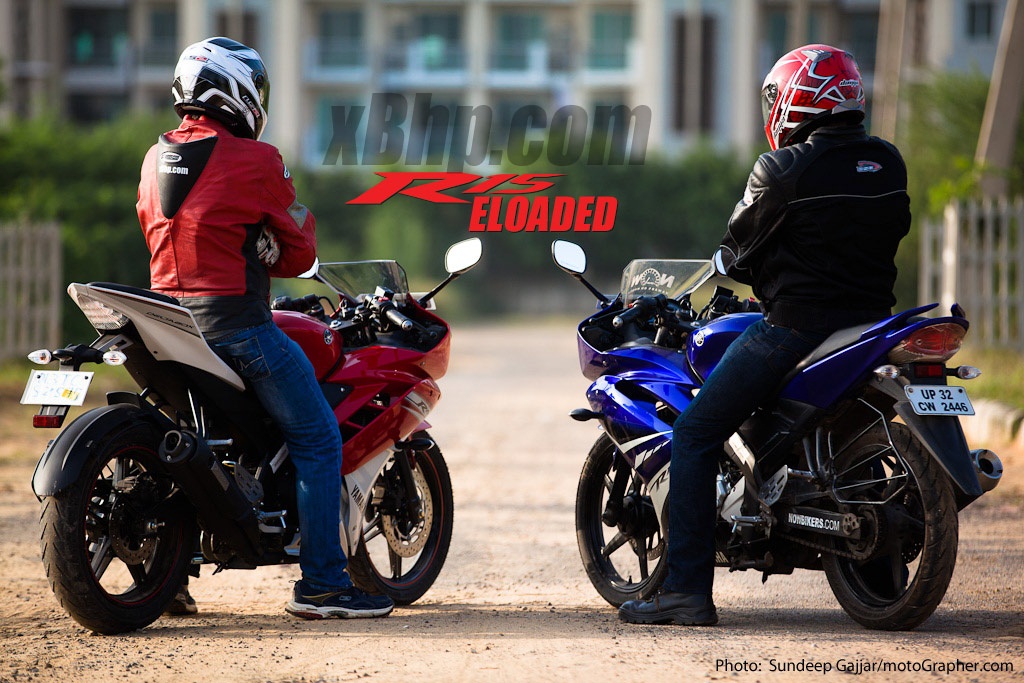

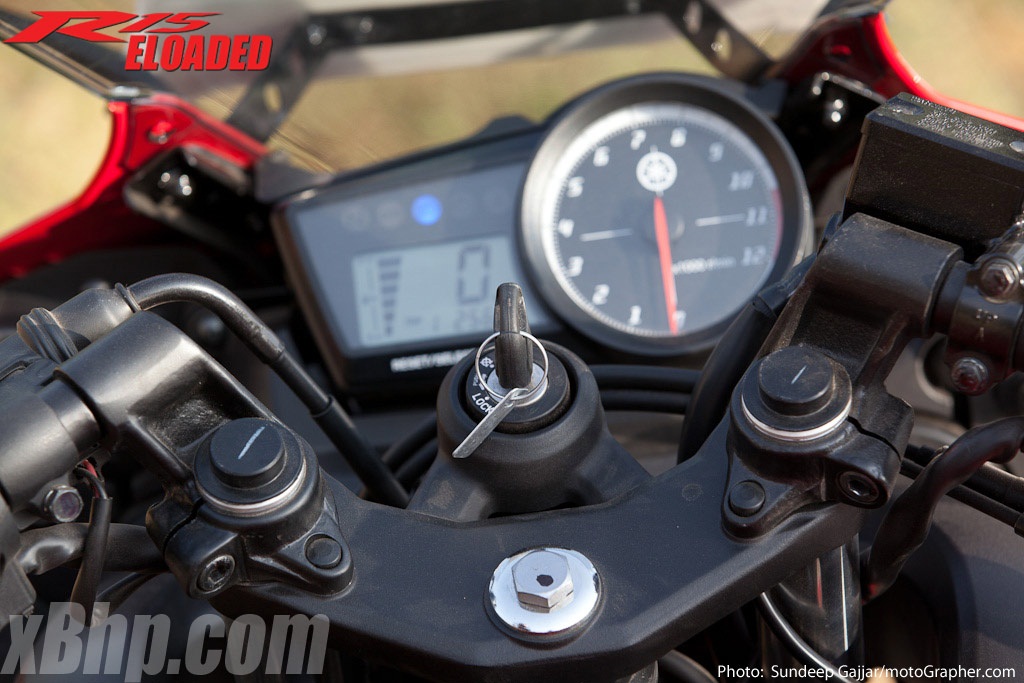
The engine: Yamaha states that they have tweaked the ECU and drive-train specifications of the engine to improve the one Achilles’ heel V-1 had vis a vis its anemically poor low-end torque and the resultant slow acceleration off the line. The changes to the ECU mapping, a more rigid clutch axle shaft and a better throttle pulley result in a decided difference in the way the bike pulls from stand-still and while in motion. The off-the-line acceleration feels a lot better compared to V1. You don’t really need to wring the throttle on this one to get some semblance of a pull while getting off the blocks. Even high-gear low RPM response is notably improved. For instance, the bike pulls cleanly from 3.5-4k RPM in 4th gear during a turn, something that the V1 never did. The clutch felt lighter but it could have been just me. Gear shifts were impeccable as ever and the six-speed box shifts positively and cleanly. The bike pulls cleanly from any RPM without a hint of snatch or judder. I did feel a semblance of a flat spot somewhere around the 5k RPM mark as there was a reduction in the initial thrust before the pull reasserted itself beyond 6000 RPM. It was almost like a transition overlap between the changes done for improving the low-end to maintaining the top end performance. The engine sounds great though, solid, throaty and vibration free. The heat from the radiator does hit the calves but whether in singes the legs will only become apparent in peak summers. The weather is getting better here. I did not have the opportunity to measure the fuel efficiency of
the bike but see no reason for it to be any worse than what the V 1 returned.

The ride experience: Press the starter button and the engine starts with the promptness of a well-designed mill. The idling RPM rises a bit initially before settling down as the engine warms up and throttle blips there-on produce unhesitant response. The clutch is light and smooth and the first gear engages with a soft thud. Pulling off from stand-still is a breeze now and the bike accelerates through the gears briskly. There’s an eagerness in the way the engine produces power and even early up-shifts through the box don’t result in any perceptible drop in the thrust. I couldn’t really push the bike into higher RPM’s anywhere close to the red-line as it was new and owned by a trusting friend. Straight line stability is amazing as ever and turn-ins have no perceptible sluggishness compared to V-1. This was a crucial comparative parameter considering the wider tyres were expected to adversely affect the roll-in. But V2 remains as flickable as and planted through the curves as its predecessor. The all new Aluminum swing-arm apparently is a major contributor towards this unchanged handling. This new swing-arm is lighter and more rigid that that used in V 1 and also adds visual value to the frame. Braking is again great as before though the rear did feel more effective. Have always felt that with the R15, the front dives a little more than it should, possibly because I am a ‘heavy’ rider but then a bike is not designed solely for 60 kilo slim fits, is it? A stiffer front suspension would go a long way in enhancing rider confidence during hard braking. The rear suspension of the R15 (both V 1 and V2) has been an amazingly judicious mix of softness and stiffness and feels just wonderful. Even prominent road irregularities are dispatched with disdain and the bike remains planted as if glued to the tarmac. The horn sounded better and louder and the head-lights looked bright. Cannot comment on beam spread and illumination as I rode the bike in broad daylight. The rear LED shod tail-light is bright and clean looking. A definite improvement over the incandescent lamp.


Verdict: Costing an additional Rs. 7000/- over and above the price at which V1 was selling, the R15 V2 makes this flagship Yamaha motorcycle even better value for money. The 150cc liquid cooled mill is a real workhorse, taking even the worst abuse and grossly unsympathetic usage in its stride and keeps going strong. It’s proven itself many times over in the past three years and has an enviable following of its own. And it gets even better with the tweaks improving upon its user friendliness. The bike looks wholesome now and satisfies the majority vote in the looks department too. The larger rear disc, wider tyres, a new aluminum swing arm, a decidedly sportier stance and those utilitarian engine tweaks make the Yamaha R15 V2 a real pleasure to buy, own and ride around.

The xBhp Kawasaki Ninja 650R Review
 Jun 2011 Sunil Gupta
Bikes,Kawasaki,Motorcycles
Jun 2011 Sunil Gupta
Bikes,Kawasaki,MotorcyclesxBhp Rides and Reviews the Kawasaki Ninja 650R.
Chlorophyll Inorganica + HomoSapien = (C9H13NO3) *∞
Text & Photos: Sundeep Gajjar / motoGrapher.com
Today’s launch of the Ninja 650R will be remembered as an important checkpoint for Indian motorcycling . It marks the start of a new war involving the 600s in India. The first battle will be between the, you guessed it, Garware Hyosung GT650R and the new born Ninja 650R. However, this is not the topic for now.


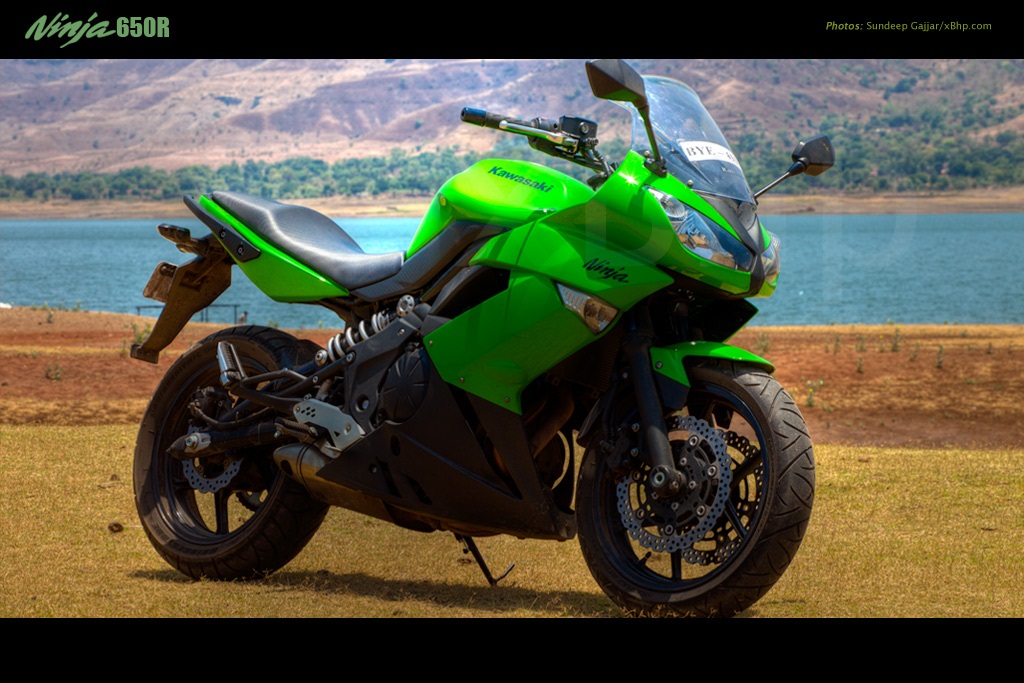
I will start from the most important attribute that anyone factors while choosing their dream machine – the dough.
You will have to cough up 4.57 Lakh ex-showroom Delhi (which will be less than 5 Lakh INR!@ on road!). This is an extremely competitive pricing.
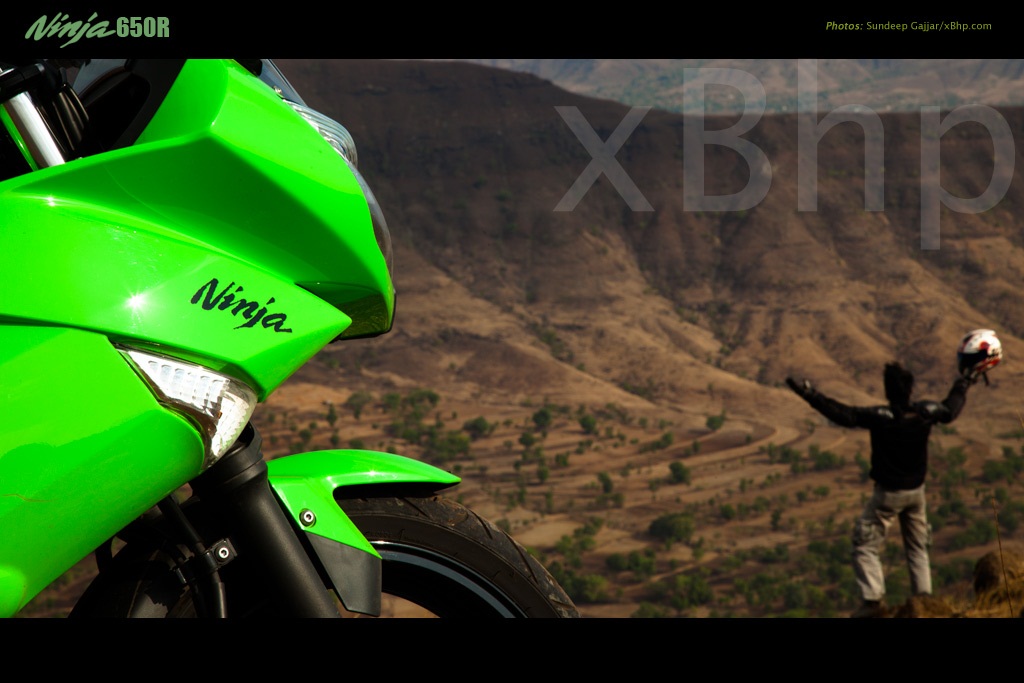

The next is the brand equity and its legacy. The Ninja brand name is pretty darn strong. Say Ninja in a biker’s meetup and everyone sees green and fast bikes. In retrospect, It’s unbelievable how bold a move it must have been to give a bike named Ninja the flagship color of lime green. I am sure it wasn’t by design, but destiny. Much like the success of our own Pulsar here. Kawasaki is also a reputed company, plus Ninja 250R has been there for a long enough time and has proved its mettle in India.

Then come the looks. No matter how good the engine is, it is the looks that make machines like these a commercial success. And with a country like India which just has a handful of options and an infatuation with faired bikes, this is again goes positively for the Ninja. My first look impressions involved me getting in love with that green again. It reminded me of my green Ninja 250 which I acquired an year ago. Coming to that, I felt a little confused, the N650R did not look as BIG as compared to its younger sibling. Now, before you get me wrong – discerning and informed motorcyclists like you and me know that they are two very different machines – but for many who will buy the N650R will be not be comfortable with a Ninja 250R standing besides it and getting equal if not more gazes from the curious onlookers. I have been around enough to be able to vouch for this predicament that will be inevitable for every N650R owner. However equally frustrated will be the N250R owners, when they will compare the price difference between the two Ninjas. This is for laters though.
The N650Rs most impressive design element has to be the side mounted monoshock which lends it a radical look. Following this are the broad dual headlights (again compare it with the R15 and the FZ16 and many might come to a conclusion that its not that radical or ‘big’ for a bike which is four times the capacity, but again this is India and lots of people think on these lines, ‘un’fortunately many of them also are probable customers).
Your eyes then track to the rather broad and tall windshield, which doesn’t look out of place but doesn’t aid its look as well, really. However, go past this paltry issue and you realize that almost everything about this bike oozes practicality. The good windscreen, the BIG LCD backlit console which has every thing digital – from a tacho to a very handy clock (which has CLOCK written below it just in case some over smart number crunchers might think of the numbers as something else ?).


The tube type raised handle bar along with the switchgear feels top notch, again putting function before form. The fuel tank is sleek and rotund at the same time, a little bulged up that the N250R’s but enough to carry 18 litres of gas. The seat looks svelte with the pattern grooved on to lending it a premium feel, however is it comfortable? Lets find out ahead in the long ride report. The mirrors are borrowed from the ZX6R, they are good but not great while the front set of fairing integrated indicators lend it a more contemporary and clean look.

The rear end is pretty sleek and rather simple. But before your eyes reach there you will stop and stare at the side-mounted monoshock. It definitely looks different. But beyond that I was forced to think what purpose could it have served on a bike, which had a relatively simple styling. Some research and pondering minutes later it boiled down to a m being a clever packaging solution (placement of ultra stubby exhaust, battery etc) plus maybe a distinguishing design element which is also found on the bigger Versys from the Kawasaki stable.
Track further down and you have the under engine exhaust which probably not only lends it a tricked out look but also better CoG (Center of Gravity) in terms of mass centralization and low CoG. However, in my opinion that definitely didn’t help it a lot when compared to the N250R, despite the younger sibling having a standard exhaust. Goes a long way to say perfection is achieved by a lot of interdependent components rather than a single component fixed in for a specific purpose.
The bike ends with a rather simple and sleek rear. No dramas there. A standard LED cluster tail lamp with practical longish grab rails greet the trailer.
The tyres (rear 160 and front 120) on the N650R are good enough, but could have been thicker to make the bike look, once again by popular demand, bigger.
The best view of the bike is rear 3/4th, the biggest from front 3/4th, most radical is the right side profile, the least impressive is the direct rear.
Zoom out and see the bike’s profile in totality. Something will strike you. The bike looks small than it is supposed to be, and that it sometimes looks like a semi faired bike. One of the reasons is because the lower fairing is matte black which merges it with the similarly treated engine casing. I fail to understand why it didn’t have the standard green all over it.
Overall, I would have preferred if the styling of the bike would have one justice to the R appended to it. The N650R doesn’t look off the charts but it isn’t a bad looker either. That’s about it for the styling part, now lets move on to how it moves.
X = 72 Bhp. 650 CC rounded off. The most important figures are these. Or are they? Sit on the bike, flick up the side stand (no main stand) and it feels light (unlike the Bandit 1250 which needs to start moving for its weight to disappear). With 203 Kgs of curb weight the bike is no feather light, but its no slouch either. The peak figures of Bhp (72) and Torque (66Nm) are achieved at 8500 and 700 respectively , keeping the engine relatively relaxed (compared to the N250R). This means that it will be easy touring on this and easier in traffic. And sure enough it was. I rode the bike intermittently over 200 kays and it was a delight, however not exciting as a Ninja 250R, especially in the hills. Maybe I am used to revving the N250 high, soaking in the delightful inline twin sound. Plus the 650R handles nowhere as sweet as the N250 but this doesn’t mean it’s bad at all! I am just trying to justify the R tag after the 650 like in the 250R, which needs no justifications.
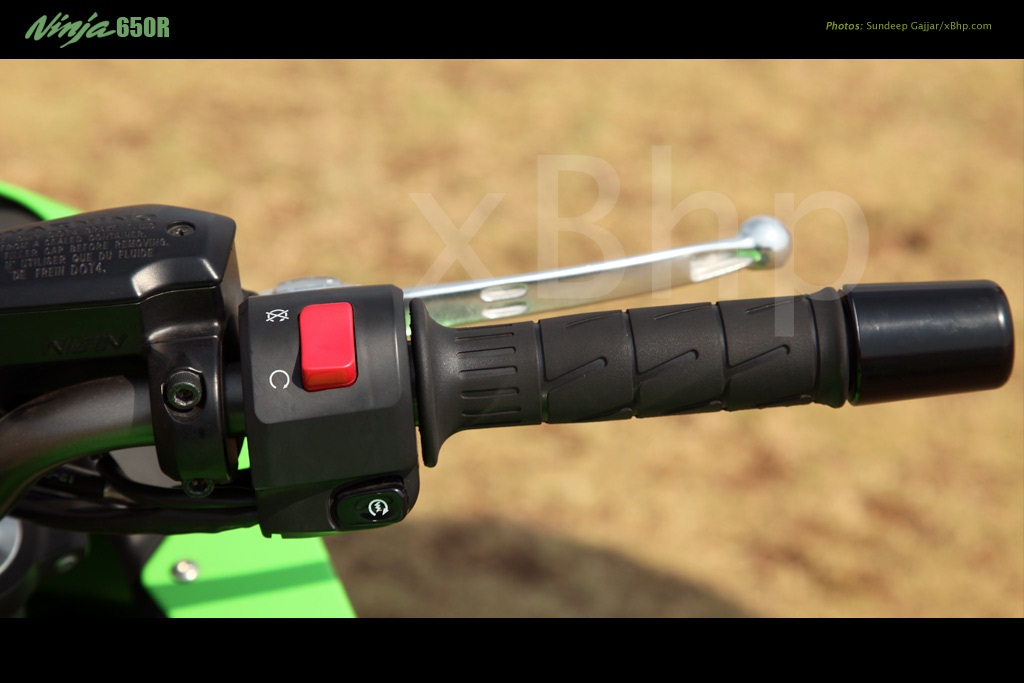
Turn the key and you are greeted with pre ride checks, lots of characters flashing and running up and across. Makes for a delightful high tech experience. It was one of the biggest consoles I had seen after the Ducati 1198’s. At night the orange backlight looks very chic.


Thumb the starter and the two cylinders come life without dramas. In fact its little too simple. The exhaust note is totally uninspiring. You can expect the N250R to sound like this, but definitely not a middle weight class bike. I am sure one of the first thing many will be looking to do is get that sound to match the go and the show. However at high revs, especially around 7000, it does sound decent, but again, it wont touch your hear. To me, the sound of the machine is one of the most important experiential factors to make for a great ride.

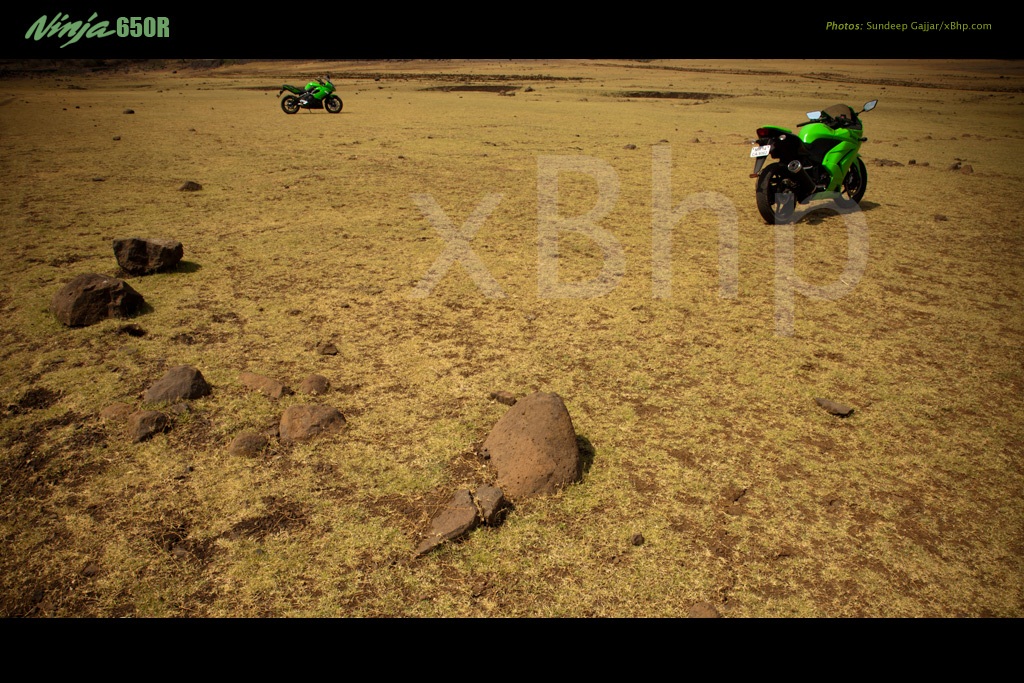

Twist the throttle and the bike surges forward, hard, but not pull-your-arms-out-of-your-sockets-hard. 72 HP is enough power to propel you ahead of anything on four wheels (for a while at least) and will keep in the rear view mirrors of most superbikes being ridden sanely. Thought the acceleration and the adrenaline rush is nowhere near that of a 1000CC bike (of course, it cannot be!). Neither it can match the stupendous rush lent by its fitter sibling – the Ninja ZX6R.


The bike can cruise comfortably at 120 oddish for long hours. One of the best bikes to do a Saddlesore in India today!
The gear shifts are precise and you will find the green dot on your console with ease. The bike can be ridden pretty hard without the rider losing confidence. However, the bike which we got had braking issues. The brakes worked alright, but the kind of brakes that I was expecting after owning a N250R over 11,000 kays were missing. And that was a big deterrent for me to have real fun with the bike, especially on the ghats. However it could be an issue with the particular model given to us only.
I tried to lean the bike, it did well, and however it didn’t inspire confidence in me as the N250R does. This plus the N250R is also a very capable touring bike, as our own BlueVolt (Rahul) (http://www.xbhp.com/talkies/xbhp-roa…ete-blogs.html) had proved from his ride around India on the GQ early last year.
At this stage such comparisons are but inevitable.
At night the light of the Ninja on low (single side) is biased towards the right, however once you switch in the high beam things get much brighter (and uncomfortable for the people coming from the opposite side).
Thumbs up on the bike from me for the following:
• No side flanked exhaust and sleek rear means great space for putting soft panniers
• Metal tank means you can put a tank bag too! (like I did along with my camera)
• Green! Green! GREEN!
• Looks good
• PRICE! PRICE! PRICE! PRICE! Total VFM!
• The Kawasaki and Ninja badge under Bajaj’s aegis
• Hints of supersports styling
• Flickablity
Thumbs down:
• Not BIG enough
• Not GREEN enough, why is the lower fairing black!
• The exhaust note
• Just hints at supersports styling, looks confused
• Not ultra flickable like the N250, depite the R tag
Overall the bike is great value for money, and simply great for long distance touring as well as off roading! And at 4.57 Lacs ex, this will make lots of dream come true and green!

BUT, the big question, what happens to the Ninja 250R?
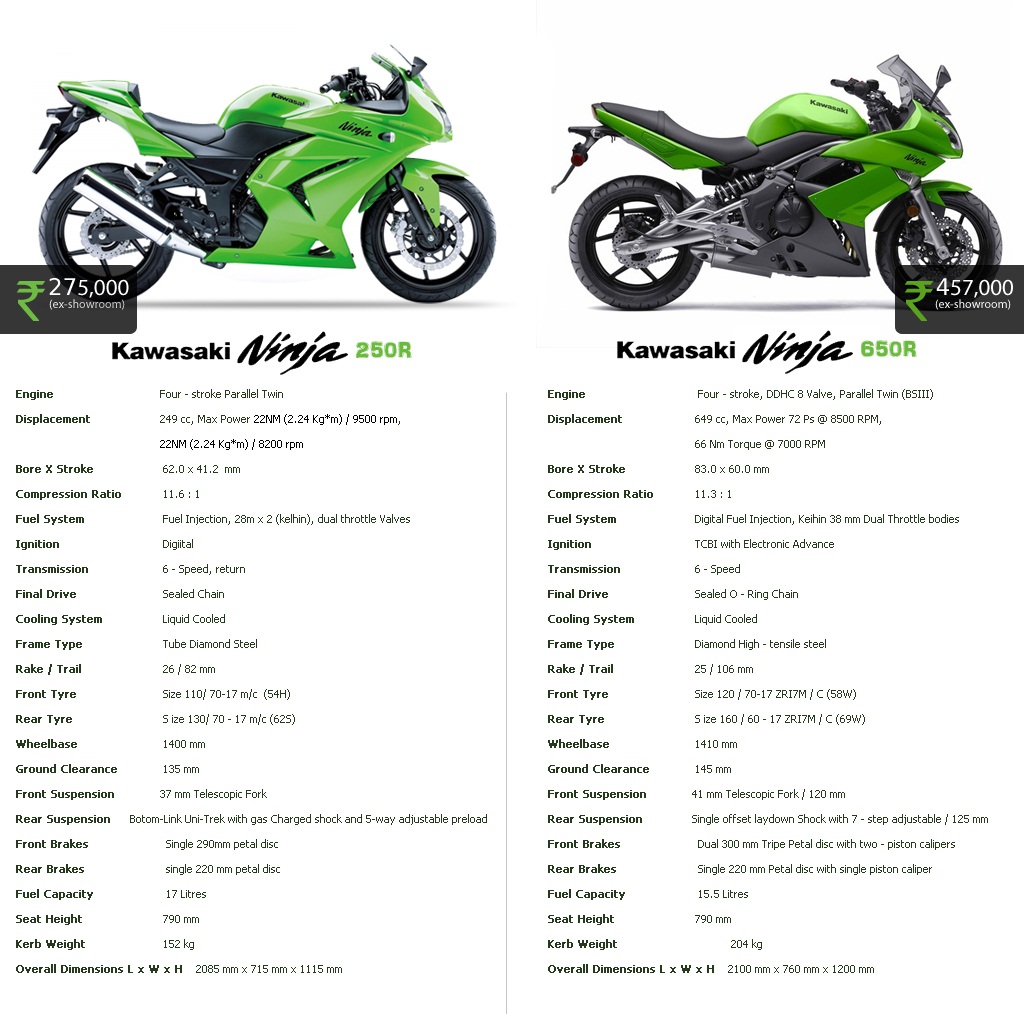
Kawasaki India has clearly stated that the price of the N250R will remain unchanged for some time to come. However the price difference is not too narrow to warrant ay possibilities of cannibalization , however, like I said, comparisons will be inevitable. Below is a chart comparing the two green machines from the Kawasaki stable available as of June 2011 in India:
Satadal Payeng’s Review
Ninja 650R First Ride Impression
Foreword: “I am not someone who regularly rides the so called exotic “big bikes”.
This review therefore is basically from the point of view of an Indian “Biker Next Door”. Someone who has been so far limited to riding the basically so called “sporty” commuter bikes”.
Likes
(+) “Neck jerking” Torque
(+) Refined engine
(+) Top notch Quality
(+) Comfortable ergonomics
(+) Low seat height
(+) Value for Money
Dislikes
(-) Scope for improvement in styling
(-) High speed handling
(-) Bit too powerful and heavy for me
(-) Still can’t afford it
How did it all start?
Couple of day’s back, just before the Kawasaki Ninja 650R was being launched in India; I received an invitation to ride the bike. Unfortunately I could not match my schedule with the ride experience that Bajaj was providing to a couple of prominent Indian auto related sites. However on the day of its official launch, I did get the opportunity to take a couple of laps on the Ninja 650R at the Test Track of Bajaj Auto at Chakan, Pune.
I’d like to thank MG_Biker for taking a couple of snaps (posted here) as I rode the bike around the track.
Styling/Looks: “Sharp, Edgy, Aggressive from the front & sides, bit incomplete at the rear“
Usually the styling of a motorcycle gives away what kind/category it belongs to. A glimpse of the Ninja 650R in the flesh will clear all doubts that it is not another bike in the Super Sports mould. Unlike the crouching stance of a Super Sports motorcycle, the stance of the Ninja 650R is relatively upright.
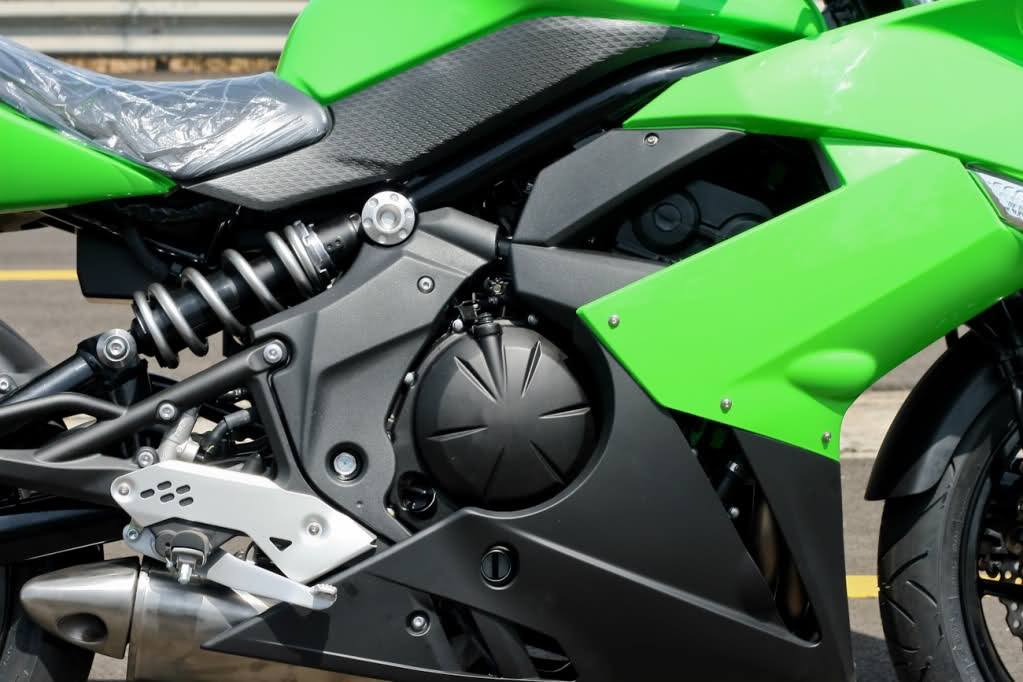
The Ninja 650R (or ER-6F as it is branded in a few countries) is basically a fast street bike which can also be used for long highway rides and therefore the upright stance. The Ninja 650R is a decent sized bike. Bigger than our “desi” Karizma ZMR in terms of bulk. The front end is impressive with sharp edges and lines and aggressive looking twin headlamps.
The distinctive styling continues to the sides which features a prominent horizontally laid exposed monoshock that adds to the funky appeal of this motorcycle.
It is just the rear portion where the styling loses its flow. Compared to the front of the bike, the seat and the tail piece can be said to be relatively bland. With a slight redesign of the rear, Kawasaki can create a bike would be perfect from all angles.
The Ninja 650R would not attract glares at a traffic signal like Super Sports bike would, but for a biker who is more interested in riding his vehicle rather than posing on it, it is not a bad thing. For he can peacefully park his bike at a public place and be rest assured that it won’t be molested in his absence.
Top Notch Quality: “Looks and feels like a premium product“
The quality of the material used on the Ninja 650R is top notch. The tactile feel of the switches, the fit and finish of the body panels, the quality and texture of the plastic used, the paint quality, the weld joints..
Everything on the Ninja 650R that you can see and touch exude a plush feel.. which is naturally expected from a vehicle which costs almost at par a B+ segment hatch in India.

The LED Tail light of the Ninja 650R even though not that aggressive in shape is quite bright and does its job quite well. The speedometer console is all digital including the tachometer. Most would love the all digital display but I somehow still prefer the old school needle for the tachometer.

The rear gets a welcome grab rail which is handy for the pillion to grab on and also to strap on any luggage meant for touring.
Riding Stance/Ergonomics: “Ideal for Street riding as well as for long hours on the saddle“
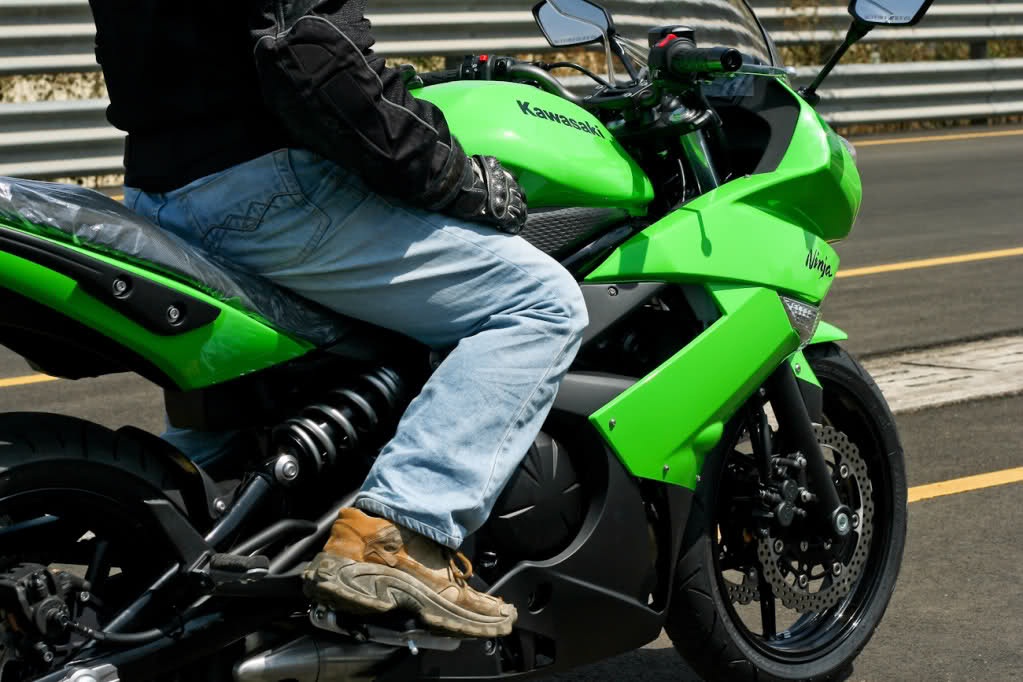
Similar to the stance of the Ninja 650R even the rider sits on the bike in a comfortable upright stance. As clear from the photos, the stance on the Ninja 650R is comfortable yet sporty due to the rear set foot pegs.

The Ninja 650R is a generous sized motorcycle, much bigger and bulkier than the Karizma ZMR (the current desi benchmark for bulk). But even then thanks to a sub 800 mm seat height and a seat which narrows at the front, a 5 ft 5 inch small guy like me was still comfortable on it.
The only issue for me was the 200 Plus Kg of kerb weight of the bike. I had to be specially careful while taking slow corners with one foot down.
Engine Performance: “Truly Super Refined Aggression“
Boy o Boy..!! The moment I cracked opened the throttle of the Ninja 650R I was in for a big surprise. The acceleration was neck jerking. The low and mid range performance of the Ninja 650R is very strong. Most of the 66 Nm of torque seems to be spread thickly at the low and mid rpm range.

Only on a Boeing or on an Airbus have I experienced better acceleration from standstill. Despite the 200 plus Kgs of Kerb weight, the 72 Ps of Peak Power and 66 Nm of Torque is overwhelming for a “Biker Next Door” like me. I am sure that the Ninja 650R will be easily able to out accelerate most C-D segment Indian cars in the initial 0-100 kmph dash.
The 1.5 km long straight at the Chakan test track provided the opportunity to test the top whack of the Ninja 650R. I could see around 180 Kmph on the speedo just before the straight ended. With a longer stretch and someone with guts I am sure that clocking 200 kmph on the bike isn’t impossible. Now this is seriously fast by Indian standards.
Unlike the Ninja 250R where the power and torque is evenly spread across the entire rev range in a linear manner, the Ninja 650R is tuned like a torque monster. With generous amount of torque available from low rpm, the bike would definitely be a breeze to ride on our streets and for long distance touring as well.
Another aspect of the Ninja 650R’s engine was the refinement with which it goes about doing it job. Even when revved to its redline, vibrations are hardly felt.
There would be a few who would not like the throbbing exhaust note of the Ninja 650R. But once on the move, the note hardly makes a difference to the ride experience.
Handling: “Not exactly a track bike, but adequate for every where else“
Having ridden on the test track, it became clear that the race track is not the natural habitat for the Ninja 650R. The Ninja 650R would handle decently under normal riding but it is not the ideal tool to go knee scraping on the race track. Confidence while taking fast corners on the Ninja 650R is not in the same league as on the Ninja 250R.
The front brakes of the Ninja 650R also seemed to lack the kind of bite which the Ninja 250R and even my Pulsar 220 possess. Maybe it was just an issue with the particular model that I was riding. The higher seating and relatively softer (compared to the Ninja 250R) suspension setting makes the Ninja 650R clearly a highway tourer more than a track tool.
Final impression:
For someone like me the Ninja 650R is a bit too much power to handle, plus at 200 kgs it will be difficult for me to lift up the bike without any assistance in case of a spill. Also my better half would be scared to death at the kind of low and mid range acceleration that the Ninja 650R has.
Most importantly, I can’t afford it. But for those can cough up the Rs. 5 lakh (+), and plan to really use the motorcycle and not just limit it to a posing tool, the Ninja 650R is a very sensible option.
Your Own Diavel From Hell: xBhp First Review!
 Apr 2011 Sunil Gupta
Bikes,Ducati,Motorcycles
Apr 2011 Sunil Gupta
Bikes,Ducati,MotorcyclesxBhp Rides and Reviews the Ducati Diavel in China.

Text & Photos: Sundeep Gajjar/ Sunny
Almost every two wheeler company that is out there for serious business has at least one cruiser in it’s product lineup. And the weight is almost always inevitably hovering around quarter ton mark with all that steel and chrome and yes of course the fat rubbers. It is in these times when Ducati decided to actually work on a motorcycle form which is traditionally seen as slow and relaxed, far removed from what Ducatis are supposed to be. Amidst terrified gasps from Ducatistas across the world and in some cases industry experts like the former Confederate Motorcycles designer – JT Nesbitt who shunned the Diavel as “a monumental breach of brand trust and honesty,” citing the 240mm-wide rear tire as the first time Ducati had ever specified a component that “objectively compromised the performance of their motorcycle.” ( source : Motorcyclist magazine and hell for leather ).
In the middle of this storm Ducati held it’s belief in the Bart Janssen-Groesbeek (Ducati Style Center Senior Designer) led project, and when it finally made it to the road, it blew almost everyone away across the globe, however almost everyone were left scratching their heads trying to figure out what in the world can it be classified as, and that’s what we will try and do here…
First impression: It’s a Cruiser!
With the new Diavel, the comparisons will be inevitable. The most obvious one being with the cruisers of the world, – the Intruders, the Harleys and the alike. This primarily stems from Diavel’s visual profile – the low slung seat and the relatively relaxed position coupled with the behemoth 240mm rear, which is only to be found on big power cruisers like the Intruder and the Rocket III.
Second reckoning : It’s a muscle bike!
What is exciting is once you see the specification sheet some mildly unexpected comparisons begin – with the muscle cruisers like the Harley Nightrod and the legendary vMax.
Hell no, It’s a Streetfighter!
The wake up punch doesn’t end here. Once you sit on it you will realize its seating position is unlike any cruiser, more like falling between the Monster 1100 and the Hypermotard, taking models from only the Ducati lineup.
Take it off the stand, try and move it. The bike will move a lot more faster and way lot easier than you expected after just looking at it and knowing it sports a 240mm rear. That’s another punch there in the stomach. After all it is just 222 kg kerb ( propelled by 162 horsepower) which is just 16 kgs more than your Yamaha R1 superbike at 206 kg kerb ( propelled by 179 horsepower)! And I think that’s just astounding for a bike which looks as massive as the Diavel and is supposed to be weighing on the other side of 300 kgs!
You know what they have built a damn superbike, which doesn’t look like one!
The final realization dawns upon you once you take it around the parking lot and then a road track ( which is where I rode it). This thing accelerates like a devil with his horns on fire, it turns like it ain’t got the 240 mm up rear ( which is expected since Pirelli specially developed those beautiful Pirelli Diablo Rosso IIs enabling the bike to give a complex or two to the full specced superbikes on a track day.
Last but the least, the way it looks…
It looks like a creature conjured up from the darkest pits of hell, bad mouthed, loud and with raw power controlled only by a plethora of electronics stashed away in almost hidden nook and crannies of the frame. Many people will not see it that way and will perhaps detest it by calling it an ugly thing with no certain design character. But once they own it they will like to call it their hell hound, and will probably dress to match it’s character as well. Tight leathers, a full face (yes, not a half face, thats for true blue cruisers!) carbon helmet ( the Daijya G-Fit Carbon helmet which i was wearing would be a good choice!).
I personally love the styling of the bike, it exudes a lot of attitude, reminds me of mad max and resident evil combined into one!
I also have yet to see a bike so well finished, the brushed aluminum radiator hoods, the seamless integration of pillion foot pegs, the dual display ( one TFT + one LCD ) gives it a whole lot of extra premium feel.
To me this one bike on which you mix with those Harley guys and give them a serious complex, or go for that mountain run with one piece leather clad knee scraping buddies and give them a complex too, or take it to to your office party and park it right along side that Royce making it look right at home.
This is one bike which defies classification, has got that Ducati badge and will poke you everyday to ditch your car to work…
This is one bike which I gotta have, RIGHT F NOW!


With Gabriel Del Torchio, World CEO Ducati


Honda CB1000R Review
 Feb 2011 Sunil Gupta
Bikes,Honda,Motorcycles
Feb 2011 Sunil Gupta
Bikes,Honda,MotorcyclesStreet-nakeds tend to be the closest to the motorcycles we usually start riding on. Way more powerful, heavier and expensive but the body-bike relationship is pretty close. And that’s the first impression one gets on sitting astride a Honda CB1000R. We review the beauty and the beast in it…
Photos: Sundeep Gajjar / motoGrapher.com & Sandeep Goswami
Text: Sandeep Goswami
The riding stance is so generically motorcycle-like. Slightly rear-set foot pegs, a tank that the knees can easily grip, handlebars that need a slight forward rotation of the torso to reach comfortably with slightly flexed arms and the general feel of ‘riding’ astride a bike, neither on top of it nor ‘inside’ it.

This feeling of easy familiarity and the unhurried intimacy it encourages between the rider and machine is carried forward by the engine and drive-train. This is a high-performance bike, no two thoughts about that, but not one that necessarily imposes itself on the rider. He can choose the facet he wants to reveal, the devil or the saint. And a simple flick of the wrist can transform it from one to the other. The ’07 Fireblade derived 998cc in-line 4, though supposedly de-tuned for a flatter torque curve, still remains potent enough to take the bike from stand-still to a 100 kmph in less than 3 seconds. Yet the engine with its spot-on fuelling and the right gearing allows the same bike to trundle at


The street-naked, looking good is not just about good looks. It has to exude an attitude, ooze raw excitement and a perfect test for this is when it excites impromptu comments about its looks from the most poker-faced of onlookers. The CB1000R does all that and the comments keep flowing even if it passes by at a fair clip. Made by a company known more for perfection in its machines, they being perfect to the point of blandness and emanating those ‘good-boy’ vibes by the truckloads, the CB1000R sure is a pretty radical shift in Honda’s motorcycle design paradigm. The ‘crouching cat’ stance, the brilliantly effective triangular head-lamp with the underslung circular LED cluster, the massive single-sided swing-arm, those ‘sweeping’ spoked die-cast wheels and the unusual low-slung exhaust that comes from the ‘Blade are all strong visual elements that make for a pretty aggressive yet well-wrapped up look. Sit on it, especially after dark and see the instrument cluster glow a beautiful soft blue. A digital ‘strip’ tacho in the middle flanked by a digital speedo on the left and the tell-tale info stuff in the right display. Adding to this hi-tech impression is the Honda Ignition Security System (HISS) that allows access to the bike only through either of its two original chip-embedded keys, the system disabling the ignition in a manner that cannot be bypassed by hot-wiring in any way. In its entirety, the visual, aural, technological and tactile feel of the bike is a definite and firm intrusion into the established street-naked category ruled by the Triumph Triples and Ducati Monsters.
A good motorcycle is of course a lot more than mere looks and an engine between two wheels. A strong engine results in high potential speeds and so makes controlling the bike paramount. And the CB1000R shines here. A very rigid gravity-die-cast single sided swing arm in conjunction with an adjustable mono-shock does duty for the rear while an equally rigid inverted cartridge-type fork with 43mm thick stanchions anchors the front. The front is fully adjustable for pre-load, compression and rebound damping. The suspension set-up felt spot-on and the bike felt amazingly planted through any and every maneuver. Even though the swing-arm is a lot heavier than the set-up the Fireblade uses, the benefits, both in performance and aesthetics far outweigh the penalty imposed by weight. All this tech results in a bike that steers to perfection, right from a crawl to 200+ kph. Be it a blast through the twisties or a swift commute on the straights, the CB1000R does the job with almost boring exactitude.
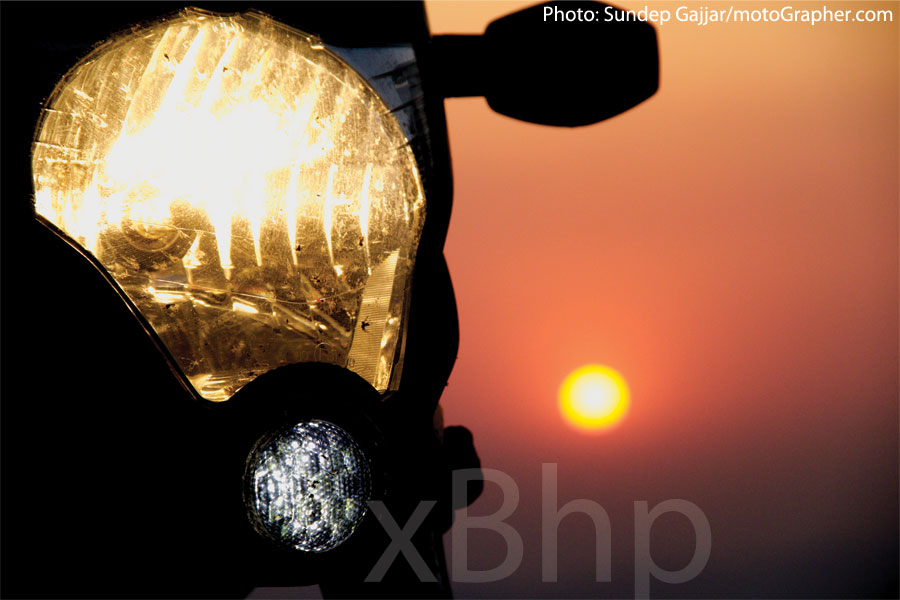
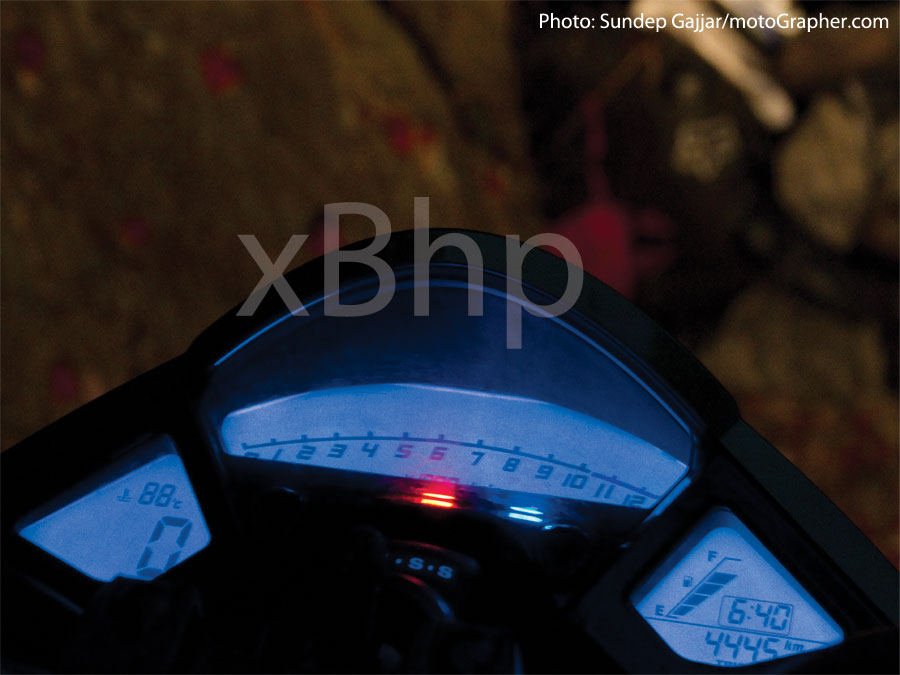
The brakes, like the engine, are a straight derivative of those on the Fireblade but with slightly smaller discs. This and the fact that the CB is substantially heavier than the ‘Blade make the brakes feel just right for the bike’s purpose. Any supersports’ brakes, like its performance, can be intimidating and takes skills better than the ordinary to master. No such issues with the CB’s anchors and it goes for both front and rear. As a matter of fact, the rear has a better bite and gives enough feedback for the rider to use it with confidence, something that even most race-track bred ones cannot lay a claim on. The bike I rode had a slightly loose steering head bearing and so the front juddered a little under panic braking but I firmly believe it was more a case of an incidental and rectifiable fault than a design issue.
Handling the CB1000R is like handling a very powerful and somewhat heavy Karizma. Pretty neutral in its turn-ins, the bike leans just so much as the rider wants and feedback is virtually telepathic.
The low-slung engine results in a low center of mass and the fact that the addition of the rider into the equation does not result in a major shift in it makes the bike very flickable. And yet there was no discernible steering nod when riding at appreciable speeds through twisties that had a rippled surface, even without a steering damper. The rigid swing-arm of course takes most of the credit for this and so does the linear power delivery.
That the CB is unequivocally a street-fighter that cares primarily for the rider, the pillion being almost an appendage, is apparent from the seat design. The perch for the rider, though minimalist, is well designed and acceptably comfortable. But the same can definitely not be attributed to that for the pillion which gets the step-motherly treatment reducing it to a mere slip of a cushion that would make even the slimmest and shapeliest of the human rear-ends writhe in discomfort after some time on the road. But then this bike is not a tourer as such anyway. True, the torquey engine, splendid ergonomics, great handling and secure braking are all the ingredients needed to make a tourer but the lack of wind-protection and a relatively small-capacity fuel tank precludes its effective use as a real mile muncher. The low gearing penalizes fuel consumption further reducing range but then one wouldn’t really want to do 150 kph in first on a naked bike.
The CB1000R has been the most ‘rider-friendly’ litre-class bike I have ridden and also the most ‘natural’ to ride on. Not intimidating at all despite those aggressive looks (though a hard twist of that throttle does make ‘not intimidating’ a misnomer), it endears itself to the rider by becoming just what he/she wants it to be. It responds to its master like a superbly trained horse, switching between a leisurely canter and fast gallop with unimaginable ease and seamless fluidity. This is one bike that can befriend a rider quicker than any and keep that trust for as long as the rider desires. And yes, the Hornet finally has the sting, the wings and the looks to buzz terra-firma big time.
Technical specifications
* Engine Liquid- cooled 4-Stroke 16-Value DOHC inline 4
* Displacement 998 cm3
* Bore X Stroke 75 X 56.5 mm
* Compression Ratio 11.2:1
* Max. Power Output 92 kW/10,000 min-1 (95/1/EC)
* Max.Torque 100 Nm/ 8,000 min-1 (95/1/EC)
* Carburation PGM – FI electronic fuel injection
* Ignition System Computer – Controlled digital transistorized with electronic advance.
* Starter Electric
* Transmission 6-Speed
* Final Drive # 530 O-ring Sealed chain
* Dimension (LxWxH) 2,105 x 785 x 1,095 mm
* Wheelbase 1,445 mm
* Seat Height 825 mm
* Ground Clearance 130 mm
* Fuel Tank Capacity 17 Litres (including 4-litre LCD –indicated reserve)
* Suspension Front 43 mm inverted HMAS cartridge –type telescopic fork with step less preload, compression and rebound damping adjustment, 120 mm cushion stroke.
* Suspension Rear Monoshock with gas -charged HMAS damper featuring 10 – step preload, compression and rebound damping adjustment, 128 mm axle travel
* Wheel Front Closed –section 4 –spoke cast aluminium
* Wheel Rear Closed –section 4 –spoke cast aluminium
* Tyres Front 120/70 – ZR17M/C (58 W)
* Tyres Rear 180/55 – ZR17M/C (73 W)
* Brakes Front 310 x 4.5 mm dual hydraulic disc with 4-piston caliper, floating rotors and sintered metal pads
* Brakes Rear 256 x 5 mm dual hydraulic disc with dual-piston caliper and sintered metal pads
* Frame Mono – backbone ;cast aluminium
* Caster Angle 25
* Trial 99 mm
* Kerb weight 217 kg (F: 106 kg; R: 111 kg)
Discuss this review on xBhp forums
And don’t forget to check out the video when we took the Honda CB1000R to one of the world’s densely populated areas
Check out some more photos of the Honda CB1000R
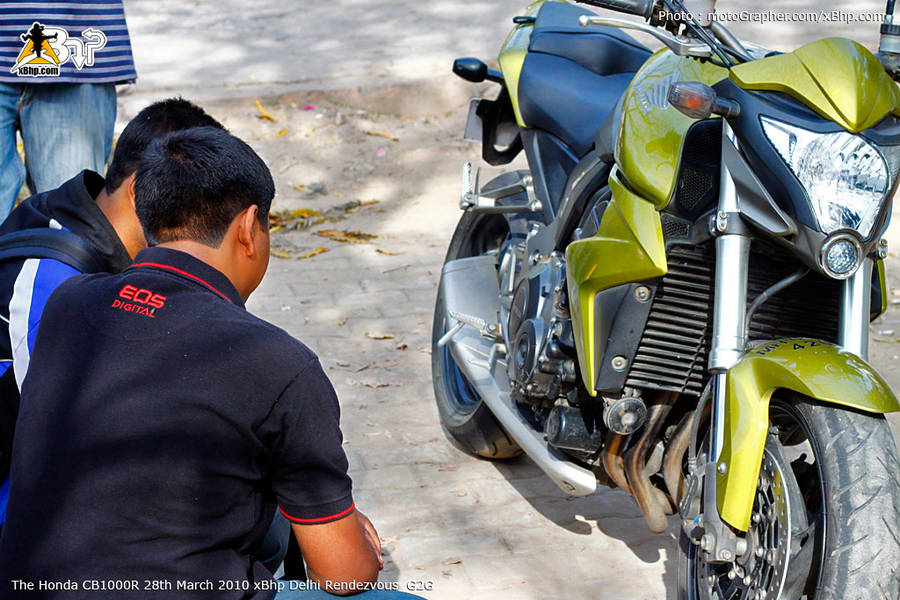


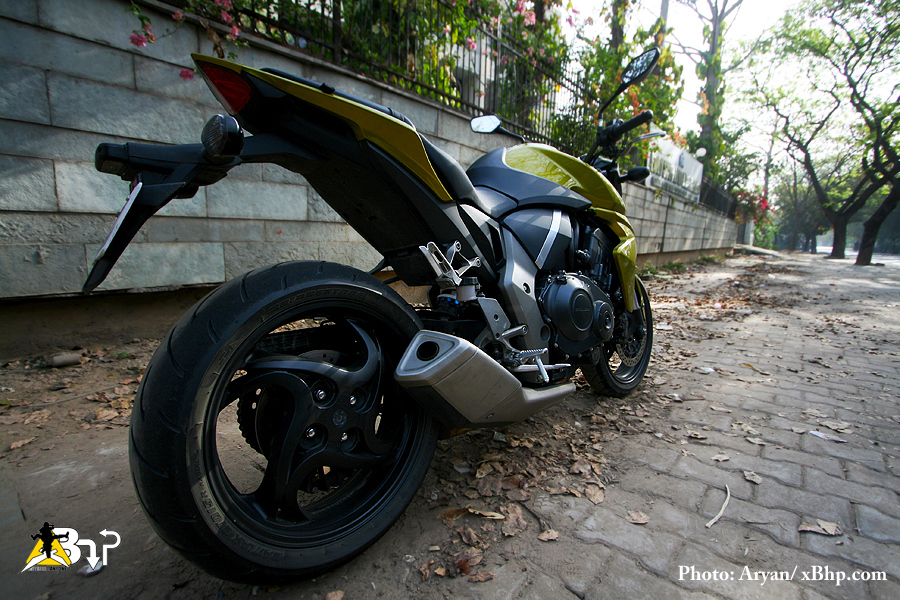


Vespa GTS300 Ridden
 Feb 2011 Sunil Gupta
Scooters,Vespa
Feb 2011 Sunil Gupta
Scooters,VespaManga le Mele
Text & Photos: Sundeep Gajjar / motoGrapher.com
It has been wisely said that fashions and seasons always return. Something similar is stated by the idiom, ‘History repeats itself’. A new geared scooter with Vespa lineage, if introduced in the Indian market, would justify both the above quotes. And the Vespa GTS300, a Vespa with the largest engine capacity ever made, can carry the weight of both history and fashion on its capable shoulders. The scooter once dominated the Indian two-wheeler market and some forty years ago, Bajaj Auto was building the Vespa scooter under license from Piaggio. A split with Piaggio around 1970 saw Bajaj Auto go independent on both the design and engineering. But even then their design retained the monocoque chassis, a Vespa hallmark.



Vespa is to scooters what Ducati is to motorcycles and Ferrari is to sportscars. It is an iconic brand and for well more than half a century, people the world over have been riding Vespa scooters and been happy doing so. The current crop of Vespa GT series traces its origins to the GT 125 that came up when the previous PX series was killed off by stringent emission norms across most of the globe. The GT series is characterized by liquid-cooled 4-stroke engines with CVT drives but with the characteristic monocoque chassis intact. The Vespa GTS300 is a recent upgrade of the GTS250 that has been selling well for quite a while. 278cc liquid cooled 4-stroke with electronic fuel injection developing 22 bhp and 22 Nm of torque at 5000 rpm. This scooter’s engine specs beat most of the motorcycles being made and sold in our country. It is actually capable of displaying 130kph plus on its clear analog speedometer, can sprint from standstill to 100 kph in 14 secs, can effortlessly cruise all day long at above 100 kph and do this for 25 kms using just 1 ltr of petrol. Tempting eh!
The Vespa’s have always looked like …well…Vespas. Pretty, retro and yet fetching. And so does the GTS300. Round headlamps, straight handlebars with instrument console, switchgear and headlamp integrated into it. The rounded ‘duck-wing’ side cowls that cover the sides and the usual single-piece seat with the fuel-filling point underneath. Scooters have evolved equally well as motorcycles on the handling and braking front and this is quite evident when you ride the Vespa GTS300. Its single sided front suspension and dual shocks at the rear (adjustable for pre-load) when allied with 12-inch wheels makes for a pretty sure-footed scoot. Hustle it through the twisties and its only the ground-clearance limits announced by the floor-board grinding away that stops you from leaning further. Bumps or tarmac ripples, even in the middle of a turn, cannot upset its line and it tracks true to the riders inputs.


Braking is great, what with discs both up front and at the rear and their amazing feedback. The 130 section rear tyre provides a wide enough contact patch to handle traction loads on a rear-engined scooter. And the front 120 section is the perfect choice for light steering, great grip and wonderful braking. The wheelbase, at 1370mm, is about 20mm more than our homegrown Bajaj P220 DTSi, promising swell straight-line stability, even in strong cross-winds. The torque engine allied with low gearing (typical of scooters and CVT’s) makes for very peppy pick-ups and the rider can outpace virtually any and every element of traffic from stop-lights. And the high top speed, good stability, powerful brakes and comfortable ergos make the Vespa GTS300 a very strong contender for highway runs. Storage space is good, with enough space under-seat for a small bag (maybe a camera kit or something) and a smallish glove compartment up front. The seats are comfortable with the pillion being even better off than the rider. Lights are about adequate though the horn is weak, as is the case with even far larger bikes.
The Vespa GTS3000 would make for a very attractive scooter if introduced into the Indian market. And it would make a lot of sense too with lots of power, great handling, tubeless tyres, wonderful braking and those aesthetically pleasing ‘traditionally Vespa’ lines that define its shape. We still have scooters in our blood. It is just that we are waiting for something that bridges the retro and the modern the way the Vespa GTS300 does. Bring it on…..one in Montebianco white for me please!
The 300CC provided for a surprising amount of punch despite the gearless arrangement. I did half of the Great Ocean Road on the Vespa and back to Melbourne with a pillion managing to hit speeds of 100+ with extreme ease. The CoG was also good for a scooter and at speeds like those, and good braking was a boon. I was initially a little uncomfortable on bends but that gave way confidence a few turns later. There is hardly anything to say about the looks, it is an all time classic!
Specifications
ENGINE TYPE: Single cylinder, four-stroke, four-valve, electronic injection, catalytic QUASAR
CYLINDER CAPACITY: 278cc
BORE x STROKE: 2.95″ x 2.48″ (75 mm x 63 mm)
MAX POWER AT SHAFT: 15.8 Kw (22 hp) at 7,500 rpm
MAX TORQUE: 22.3 Nm at 5,000 rpm
MAX SPEED: 129 km/h
FUEL / TANK CAPACITY: Unleaded (9 litres)
MILEAGE: 24-26 kpl
COOLING SYSTEM: Liquid
LUBRICATION: Wet sump and chain-driven lobe pump; intake and delivery filters
IGNITION: Electronic (with inductive discharge, variable spark advance and three-dimensional mapping)
GEARS: CVT (Continuously Variable Transmission) with torque server
CLUTCH: Automatic centrifugal dry clutch with dampers
CHASSIS: Load-bearing sheet steel chassis with welded structural supports
FRONT SUSPENSION: Single arm, dual chamber hydraulic shock absorber with coaxial spring
REAR SUSPENSION: Two dual effect shock absorbers with adjustable preload
FRONT BRAKE: 220 mm disc
REAR BRAKE: 220 mm disc
FRONT TYRE: Tubeless 120 / 70, 12″
REAR TYRE: Tubeless 130 / 70, 12″
LENGTH: 1941 mm
WIDTH: 755 mm
WHEELBASE: 1369 mm
SEAT HEIGHT: 790 mm
DRY WEIGHT: 148 kg
AVAILABLE COLORS: Shiny Black, Dragon Red, Montebianco White, Titanium
Aprilia RSV Factory in India: Photo Feature and First Impression
 Jan 2011 Sunil Gupta
Aprilia,Bikes,Motorcycles
Jan 2011 Sunil Gupta
Aprilia,Bikes,MotorcyclesText & Photos: Sundeep Gajjar/ Sunny

Its an even more exotic and ‘under exposed’ brand for the Indian motorcyclist. April –what?, Its January, duh! is the underlining reaction of an average motorcycling enthusiast.
But of course, don’t we know better? If Ducatis were supposed to be the exotic ones, then this one’s right from Timbuktu, this one being located in Italy though.
To be frank most of us have had the maximum experience with Japanese bikes, then British (if you consider RE as one!) and then something else like a Ducati. But with 33 championships, 254 MotoGP World Championship wins and 8 Superbike victories, this is no new kid on the block, but in the Indian context, it very much is.
With price ranging for 14-18 Lacs (ex, for the highest specced Aprilia RSV F), I must say its priced rather ‘economically viably’, if I may use this phrase at all, as compared the initially exorbitantly priced 1098R at close to 50 Lacs!
The RSV Factory was only launched last year by Aprilia by ending a long contract with Rotax for their engines thus allowing them to build the V4 (yes not like the earlier V2) in a super compact form.
My first impression of looking the bike was – it doesn’t entirely look Italian, the rear part yes, but the front somehow reminded me of the CBR600S of 2009 -2010.
The tricolor of Italy was proudly sitting on the forehead of the bike The most striking part of the bike is the tail, after the BMW S1000R, I think this must be the pointiest and most stylized tailends on a superbike ever.
The whole package came across to be ultra compact. The LCD console was big but didn’t evoke that gasp from me which the 1198R’s did.
This was a strictly ‘view-feel-only’ session but I did manage to hear the sounds of it, and it sounded unlike what I heard before (I was hearing the grunt of a V4, which was a first for me I think after the Vmax). But this definitely sounded close the MotoGP bikes, wish I could have heard the music at higher Rpms. I wonder how can such a bike with high decibels be approved by most RAs in the western countries! But all the better for us music lovers here!
I think the price of the two bikes (RSV R and the RSV Factory, which is the highest specced one) will be decided in the coming week. The RSV R should be priced around 154 ex, and the Factory around 18.
To end quickly and leave the detailing to the press release below I would says it’s a very tough call between the Ducati 1198R and the RSV here, but in the end the red might prove to be a little more alluring than the other black red Italian marque.




Read the Official PRESS RELEASE
A revolutionary project and a unique history of victories on the racetrack have come together to create the RSV4. A supersport with absolutely exclusive racing technology, developed around the 4 narrow V cylinder engine developed from the technical know-how that has led Aprilia to victory on racetracks all over the world. Aprilia RSV4 hits the racetrack and the roads with one goal only: to win.
33 championships, 254 MotoGP World Championship wins and 8 Superbike victories : over the last two decades Aprilia has become a modern motorcycling legend. The bikes from Noale have dominated tracks the world over thanks to the genial design, courage and extraordinary abilities of the technicians who pursued innovative solutions by experimenting, innovating and sometimes revolutionising technical schemes that seemed to be unchangeable. Aprilia RSV4 Factory, the bike that brings Aprilia back into the 2009 Superbike World Championship, is the product of this immense technical know-how. It is a highly technologically advanced motorcycle, conceived for racing and for this purpose designed and developed by Aprilia together with the marque’s Race Division, the largest and most advanced of its kind in Europe and one of the most important in the world.
Aprilia RSV4 Factory is a racing machine that, in line with the Aprilia tradition, follows a completely innovative approach in its design and construction. Its narrow V engine, the use of state-of-the-art electronics,plus its lightness and extreme compactness are only a few of the features that make it unique in the world. Aprilia RSV4 Factory is designed and built with the same philosophy adopted by the Aprilia race division. This is why RSV4 Factory is the most “complete” Superbike racing replica, ready for those who want to venture onto the track with a class leading motorcycle.
The engine of the RSV4 Factory is the most innovative and powerful Aprilia has ever built. It is a super compact 999.6 cc 65° V-four cylinder engine designed for maximum power (180 CV), where powerplant engineering comes together with the finest materials and the most advanced electronic control solutions. Aprilia’s engine, in fact, uses a Ride by Wire multimap technology, a solution that opens up new frontiers for engine management, with practically infinite possibilities for further development.
Besides the triple map Ride by Wire system, a sophisticated electronic injection system with two injectors and adjustable height ducts are fitted.
Aprilia RSV4 Factory is an absolute supersport motorcycle, the most complete bike available on the market for bike fans, and its chassis confirms this: designed for the racetrack, it has adjustment features that are typical of racing motorcycles. The adjustable geometry chassis allows parameters such as the position and inclination of the headstock, the height of the swingarm pin and even that of the engine to be changed. The construction technology is also motorsports-derived: the RSV4 Factory chassis and swingarm are made of aluminium with variable section castings and pressings.
The components are the state-of-the-art in motorcycling technology: Öhlins Racing fork, rear monoshock and steering damper, Brembo monobloc callipers, forged aluminium rims.
Aprilia RSV4 Factory is the new benchmark in the street legal superbike sector. The unique characteristics of the bike are listed as follows:
– Compact, innovative design
– New – and unique – 65° V-four cylinder engine
– Multi-adjustable perimetral aluminium alloy frame
– Adjustable engine position relative within frame
– Asymmetric aluminium swingarm
– Öhlins Racing full adjustable fork and rear monoshock.
DESIGN. The quest for ultimate compactness
Creating the most compact, innovative and gorgeous supersport bike on the market: a tough and intriguing challenge for Aprilia’s style department! This is how RSV4 Factory was created, a motorcycle that sets new performance and riding standards while opening new horizons in ultra-sports motorcycle design. Just a few simple and distinctive styling elements highlight rather than conceal the specific technical features of the Aprilia RSV4 Factory. Its frame and engine stand out as fundamental elements of the motorbike’s design.
In line with Aprilia traditions, the design of RSV4 Factory does not focus merely on looks but it serves technology and performance. Every detail has been conceived not just to be unique and beautiful, but also and above all to be efficient.
The needs of the optimised dynamic intake system feeding the V4 defined the strong-charactered front, with extra-large air intakes that not only develop considerable overpressure in the airbox (approx. 35 mb @ 280 km/h), but also completely separate the headlamps from the bottom of the fairing. This results in an absolutely unique style, never seen before on a sports motorcycle. The look of the RSV4 Factory is absolutely original, technological and definitely aggressive. The triple headlamp cites the original Aprilia maxi sportsbike, that RSV that set new standards for sports twins in 1998.
Smaller, lower and narrower than any 4 cylinder bike before,the RSV4 Factory’s extreme compactness is its strength, together with an almost obsessive pursuit of perfect ergonomics (crucial for perfect riding control), which has always distinguished Aprilia’s road and World Championship dominating motorcycles.
In depth aerodynamic studies minimised surfaces without compromising the bike’s class-leading aerodynamics. The spectacular, ultra-compact tail fairing is one of the most distinctive features of this motorcycle. The LED taillight merges stunningly into the tail, offering excellent luminosity. Even the rear of the RSV4 Factory is absolutely unmistakable.
ENGINE. An exclusive 65° V4
The pursuit of maximum engine performance in a supersport motorcycle must be accompanied by a perfectly positioned engine in the frame. Mass centralisation, swingarm length and optimum weight distribution are ingredients for achieving the most competitive bike, together with the pursuit of maximum power and perfect power delivery.
Aprilia engineers have known for years that a narrow V engine layout is the ideal technical solution for obtaining a class-beating chassis architecture that emphasises the performance of the engine. It is no coincidence that the RSV 1000 twin, launched in 1998, is still universally acknowledged as the sports motorcycle with the best chassis ever. Even the multiple race-winning RSA 250 GP motorcycles (5 world championship victories in the last three seasons) produced by Aprilia’s race division have a V engine. Aprilia was able to draw from its extensive expertise gained in years of unrivalled supremacy in the Motorcycle World Championship; hence, when the time for defining the new Superbike came, after evaluating all possible solutions, a narrow V engine was chosen. A 65° V-4 cylinder engine, the only solution that could ensure unparalleled performance, enabling the outstanding chassis architecture that has defined all Aprilia racing motorcycles for the past twenty years.
Besides the exclusive configuration that makes the 65° V4 unique around the world, the technical advantages of the Aprilia four-cylinder engine can be summarised as follows:
– Perfectly integrated into the frame, with optimal mass centralisation and minimised inertia for benchmark agility.
– Absolute slimness, its overall width is comparable to that of a twin cylinder motorcycle, with huge benefits in terms of ergonomics and aerodynamics.
– The compactness of the engine makes a very oversquare cylinder layout possible, using large bores and subsequently larger valves, helping the engine breathe more freely and achieve higher engine speeds (14,000 usable rpm).
The engine was entirely developed by Aprilia’s Research and Development Division, aiming at offering record performance and ridability in compliance with the strictest reliability and quality standards.
Aprilia’s V4 design exploited the most powerful calculation programmes currently available on the market, resulting in a highly optimised engine layout. By slightly opening the angle of the V (with respect to a 60° V engine), the designers could make use of the larger space to optimise the inlet ducts and maximise engine efficiency. The RSV4 engine has class-leading fluid dynamics attributes that no narrow V engine can match.
The unique timing system makes extremely compact heads possible (measuring only 250 mm high at the rear), especially in the area beneath the frame spars, which are thus much narrower than would otherwise be possible. The lateral timing chain drives the intake camshaft only and follows an optimised path for improved timing precision and chain durability.
A gear pair at the centre of the cylinder bank transmits drive to the exhaust camshaft. This solution made it possible to obtain an extremely compact head in the exhaust area. The V4 is even more compact than the V60 Magnesium twin mounted on the RSV 1000 R.
A countershaft dampens vibrations even more than in a 90° V engine. The crankcase is a monobloc configuration with integrated cylinder liners for maximum rigidity and consistent performance.
Electronics of the Future
Aprilia’s RSV4 Factory engine features full Ride by Wire technology. There is no direct connection between throttle grip and the throttle valves, which are completely controlled by a latest generation Marelli control unit.
Each bank has a dedicated servo unit actuating the two relevant throttle bodies only. Hence the two banks, and subsequently the quantity of fuel injected, can be managed independently. While this solution has been tried and tested by Aprilia, it has never been applied before on such a powerful engine, thus opening up practically infinite possibilities for power delivery control. This technology immediately benefits the rider who, thanks to the triple mapping that can be controlled directly from the handlebar, can change the engine delivery mode and thus the motorcycle’s temperament at any time.
The fuel supply uses two injectors per cylinder ne injector is placed downstream of the throttle valve and a “shower” injector is placed in the airbox and starts working at high loads and revs. The technological excellence of the V4 engine is complemented by electronically controlled variable length intake ducts. At low revs and loads, the long duct favours torque and smooth power delivery. When top performance is required, the upper part of the intake duct raises, thus shortening the duct and leaving the engine free to express its full power potential. A butterfly valve in the exhaust further optimises power delivery.
The transmission was also designed according to the most advanced criteria. To underscore the racing soul of the V4 engine, a cassette gearbox is used, with a multiplate wet clutch disc equipped with a mechanical slipper system to optimise engine braking torque and ensure stability under hard braking.
Lastly, in order to minimise weight, Aprilia’s new engine makes large use of ultralight materials; all valve covers and external housings are made from magnesium.
The V4 engine in short:
Engine capacity: 999.6 cc
Architecture: 65° V4
Power: 180 HP (132.4 kW) at 12,500 rpm
Crankcase: monobloc with integrated cylinder liners
Timing system: 4 valves per cylinder (Titanium and Nymonic) operated directly by a camshaft driven by a mixed chain/gear system (lateral timing chain, central gear train)
Fuel system: Magneti Marelli electronic injection with 2 injectors per cylinder and integrated independent Ride by Wire system for each bank. Three mappings selectable from handlebar. Electronically controlled variable length intake ducts
Antivibration countershaft
Maximum rpm: 14,100 rpm
Compression ratio: 13:1
Transmission: 6-speed direct-control cassette gearbox
Clutch: multiplate wet clutch with mechanical slipper system
Exhaust system: 4 into 2 into 1 headers with oxygen sensor and single silencer with integrated catalytic converter and butterfly valve.
CHASSIS. Aprilia’s entire racing know-how
A unique engine like Aprilia V4 could be nothing but combined with an extraordinary chassis that stresses the uniqueness of this motorcycle. Years of races and victories at the top level melts into a racing chassis implemented by Aprilia’s research and development department, with construction solutions and adjustments that only racing prototypes can boast. RSV4 Factory reaps the rewards of Aprilia’s entire racing experience.
Perfect mass centralisation was a must when the RSV4 Factory frame was being developed. Everything was designed in order to achieve the best possible result, starting from the tank position (crucial for riding) with most of the fuel under the saddle in order to optimise motorcycle balance and eliminate any riding differences between full and empty tank.
There is no doubt: Aprilia RSV4 Factory is a true track-ready motorcycle, and a front/rear weight distribution of 52/48 confirms this.
Frame
In line with Aprilia race division traditions, the RSV4 structure uses castings and aluminium pressings that are welded to create a far more rigid frame than that of the RSV 1000 twin, which was already a benchmark. In particular, torsional and flexural rigidities were optimised in order to offer perfect feeling and control as well as the ability to handle high power outputs such as those of the Superbike version.
Notwithstanding the higher performance, the RSV4 Factory frame weighs almost the same as the RSV, at only 10.1 kg, a lightness matched only by racing frames. The special construction technology also allows both the frame and the swingarm to show the natural and shining colour of the aluminium, which makes the appearance of the RSV4 Factory very similar to that of a racing prototype.
Designed using the knowledge acquired during GP racing, the spectacular swingarm of the RSV4 Factory, like its frame, is made by combining castings (the internal part and the swingarm pin/wheel connection areas) with aluminium bent sheet elements (the external part) to form a very rigid but super light box section capable of minimising the moving masses, exalting the reactivity and sensibility of the motorcycle to the suspension adjustments. The asymmetric conformation, with an arch section on the right side and a reinforcing arch on the left, made it possible to implement an exhaust system with optimised internal volumes without penalising the rigidity of the swingarm. Here too, FEM modelling was used in the design process to optimise cross sections and thicknesses. The swingarm of the RSV4 Factory weighs only 5,100 grams, close to the absolute standard threshold for this technical element.
The desire to offer the first four V cylinder “race ready” superbike in the world led Aprilia to find unique solutions that will hardly be found on competitors’ bikes even in the years to come.
In order to boost chassis performance and make it match the rider’s style and wishes, or features of the track, Aprilia RSV4 Factory ensures a combination of adjustments that are pretty much infinite. The multi-adjustable suspensions, taken for granted on a motorcycle of this level, are combined with adjustments of the headstock position and rake (through interchangeable bushings), the rear end height, the swingarm pin height and – introducing a new capability exclusive to this bike – the engine position in the frame.
Aprilia RSV4 Factory is the most highly adjustable production motorcycle in the world, just like a real race bike.
Suspension
The Öhlins Racing upside-down fork has 43-mm stanchions and is titanium nitride coated to minimise friction. The wheel travel is 120 mm. Like in race motorcycles, the fork allows precision adjustment for hydraulic compression and rebound damping and spring preload.
The Öhlins Racing rear shock absorber is equipped with a “Piggy Back” nitrogen canister and can be adjusted for spring preload, compression and rebound damping and length, thus allowing the height of the rear end of the bike to be changed to adjust the set-up to the different riding styles and tracks. The wheel travel is 130 mm.
The motorcycle is also equipped with an Öhlins Racing adjustable steering damper.
Brakes
The front system is without a shadow of a doubt the best system available on the market. Brembo monobloc radial callipers are the state-of-the-art in racing braking systems thanks to their power, high modulability and fatigue resistance.
The dual 320-mm diameter stainless steel floating discs are completely new and were developed by Aprilia specifically for this motorcycle. A rotor with reduced height and asymmetric perforation were used, allowing the braking power to be improved and the front wheel to be lightened by approximately 500 grams. The floating retainer is fastened to the flange with 6 pins only in order to minimise inertia and weight.
The brake pump is the radial type to improve lever feel and response accuracy. The rear braking system is Brembo “Serie Oro” with 220-mm diameter stainless steel disc and two-piston caliper, with racing-type pump and integrated tank.
Rims
The search for greater lightness led to implementation of new forged aluminium rims. The original design further decreases the weight (approximately 1 kg less than the RSV 1000 twin) which, together with the new brake discs, minimises unsprung mass and rotating mass inertia, benefiting motorcycle responsiveness.
Components
A real Superbike is special not only as far as performance is concerned but also for the care it is built with. With regard to the RSV4 Factory, the details say it all: no other “race ready” motorcycle has ever been built with such care. The attention paid to its construction not only satisfies the desire for beauty (a motorbike built like RSV4 Factory is in any case gorgeous), but most of all aims at achieving the goal: to win. This is why every detail was thought out to increase performance and functionality, reducing the weight and considerably increasing the product’s quality and finish.
The following components are worth pointing out:
– Instrument panel: the mixed type (digital-analogue), it receives all the information from the CAN line and becomes an integral and crucial part of the self-diagnosis system as it is fitted with memory. It is a real onboard computer, fitted with a dot matrix display inserted in a minimal, extremely modern and compact design that provides all the information relating to the use of the motorcycle, including: shift light, engaged gear indication, indication of the engine map being used and chronometer with time storing memory. Its functionality was improved to reach a level that is even better than that of the best products available on the market, all use modes are controlled from the left hand switchgear unit so the hands can always remain on the handlebar.
– The front headlamp uses three elements that call to mind of the first RSV 1000 twin, proving to be perfectly integrated, even from the structural point of view, with the top fairing and creating a very distinctive front. The parabolic mirror was designed with modern calculation systems that led to an excellent result: maximum visibility at night with reduced weight and size.
– The electrical system was designed in order to achieve maximum functionality, rationality and minimum weight: the result is an extremely clean and compact layout that makes maintenance operations easier and is preset for use on the racetrack as the parts dedicated to the headlamps can be easily removed. Even the turn indicators – with the front indicators incorporated in the rear view mirrors and the rear indicators in the license plate holder – can be removed quickly for use on the track, the real hunting ground of Aprilia RSV4 Factory.
ACCESSORIES
A complete range of accessories is available for Aprilia RSV4 fans:
– Akrapovic racing exhaust system
– Öhlins TTX36 rear shock absorber
– adjustable footpegs
– racing half-handlebars
– fairing protection pads
– high top fairing
– fairing caps for rear mirrors
– rear stand pins
– license plate retainer cover
– motorcycle cover
– dedicated stand
– carbon heelrests
– tank cover with backpack
– tail fairing bag
– carbon exhaust system protection
– carbon fairing pullers.
Then there is a series of options – many of which designed and manufactured specifically for racetrack use. Complementing these options are a dedicated suit and helmet.
xBhp First Impression: Suzuki SlingShot 125
 Oct 2010 Sunil Gupta
Bikes,Motorcycles,Suzuki
Oct 2010 Sunil Gupta
Bikes,Motorcycles,SuzukiText: Sunil Gupta/ Sunilg
Photos: Sandeep Goswami/ Old Fox and Sunil Gupta/ Sunilg
It has been a while since Suzuki entered the ever-growing Indian two-wheeler market and they have been a silent player till sometime back, seemingly content with a very short product line-up that included Zeus’s and Heat’s. But it seems they no longer want to sit on the fence now and are all geared up to get a bigger pie of this market. There has been a slew of launches from the Suzuki stable, like Bandit, Gixxer, and Hayabusa, mostly catering to the superbike segment only. But with GSR150 and Access 125 sales figures bringing smile to their faces, Suzuki seems to have understood the importance of the commuter segment that has been bread and butter for the Indian manufacturers. And, to serve to that very segment, they have launched a brand new bike, the Suzuki SlingShot 125.
We recently got our hands on this machine for 3-4 days and we decided to make full use of it. Given below is an attempt to convert our experience in to black and white.

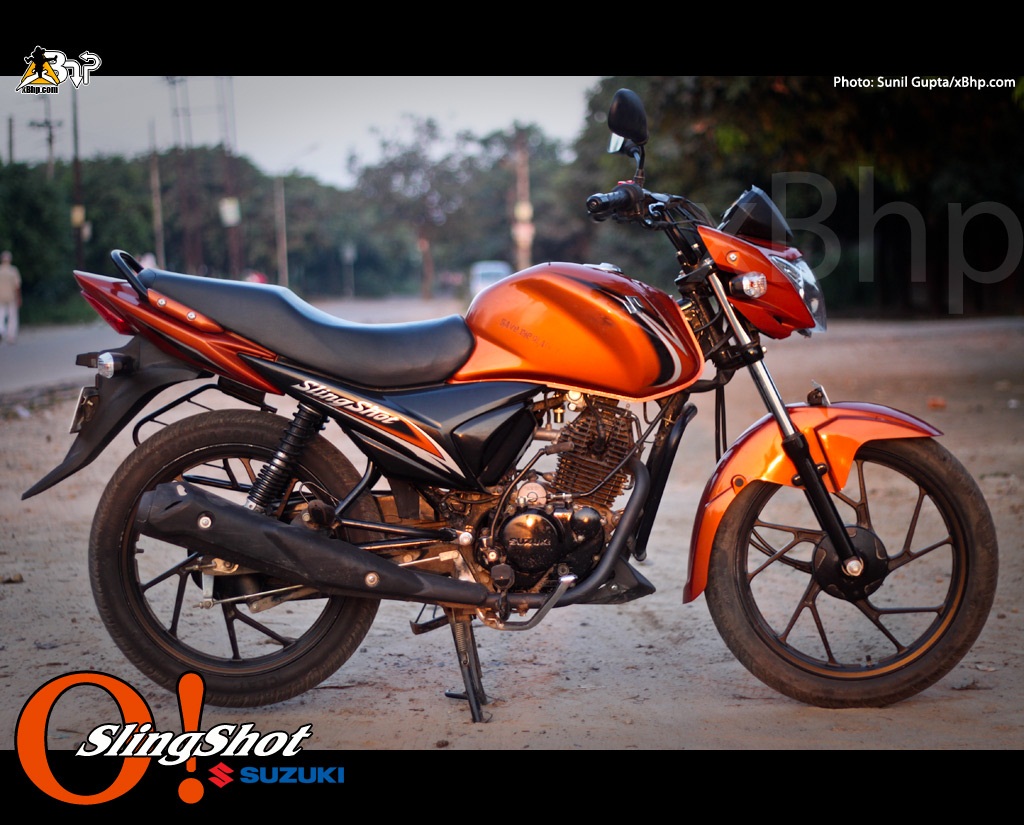
The Looks and features
Though we found the Suzuki SlingShot design to be minimalistic in nature, when we were riding this bike on the streets of Delhi, it managed to get a few heads to turn and inquiries from petrol pump operators and general road users, so there seems to be a slight element of freshness in it, be it the bikini fairing with sharp headlight design or the new alloy wheels. This windshield-less headlight design is highly responsible for the peculiar looks this bike has. It gives the bike a very ‘edgy’ feel. Theheadlight assembly hosts a 12V/35W bulb. Also fitted in this fairing/headlight assembly are turn-indicators with clear glass and orange bulbs inside.


The instrument console as we said is ‘minimalistic’ or slightly over-minimalistic we should say. The console houses a large analog speedometer on the left with its dial in blue-white color combination and the needle in orange. The odometer is also located on the upper part of it. The fuel gauge finds its position on the extreme right of the console. Sandwiched between the speedometer and the fuel gauge are the neutral position indicator on the bottom, the high- beam indicator on its top, and then the turn indicator light on top of it. Sitting on top of everything is the ever-so-useful gear position indicator, which is a very handy feature while riding a motorcycle. But, there is no tachometer, even the trip-meter failed to find a place in the instrument panel.

Moving rearwards, the upright handlebar gives way to a muscular looking petrol tank. The tank has a 12 liter capacity with 2.1 liter reserve. The contrasting black color side panels improve the overall visual appeal of the bike. This is followed by the body-color rear panels and a single unit tail lamp.
The bike has been given an all-black look, which is the most common thing in most of the Indian bikes nowadays. The heat-shield on the exhaust pipe has also been painted black.
Apart from the headlight assembly, the most distinct feature of this bike are the split-end 5-spoke all black alloy wheels, which have the love-it or hate-it factor in them. The Sling-Shot also comes with spoke version.
The Suzuki Sling-Shot is available in four colors – Metallic Mustard Yellow, Metallic Fox Orange, Candy Antares Red, and Pearl Nebular Black. The one that we rode was Metallic Fox Orange.
Electric start comes as a standard in both the versions, alloy and spoke wheel.

Engine and Performance
Powering the Suzuki SlingShot is a 125 cc 4-stroke SOHC mill that is capable of producing around 8.5 Bhp at 7500 RPM, which is not something that you can brag about since the other bikes in the same category are pumping out more power. However coming to Suzuki’s rescue here is the sufficient amount of torque that SlingShot manages to produce. At 3500 rpm, you have 10 Nm of torque at your disposal which makes it quite comfortable in city riding conditions, especially for those who are not very comfortable with the idea of changing gears quickly. The bike easily picks up from as low as 30 KM/H in fifth gear without any hiccups at all. The bike does 0-60 with relative ease, even the 0-80 didn’t seem like a tough job; however, it takes its own sweet time to move beyond that figure and would tell you that it is not made to do high-speed runs. It is made for comfortable commuting in city and it does just that.
Doing the job of transmitting power from the engine to the wheel is a 5-speed gearbox, which we found to be of top quality. Throughout the test period, the gear shifts were positive and smooth with hardly any glitches or false-neutrals. The universally-adopted 1-down 4-up pattern finds its way in this gearbox also.


Ride Quality, Comfort, and Handling
When we rode it, the traffic condition in Delhi was at its worst due to the Commonwealth Games and stuff and for us, this seemed like the perfect condition to test this bike.
The bike performed like a charm in the stop-go-stop traffic that it faced, requiring minimal effort from the rider and this is what SlingShot is made to do. The upright sitting position and the comfortable seat also add to the small list of goodies it offers. The vibrations were minimal throughout the rev range during our test period.
One of the key features of SlingShot is the way it handles in the day to day riding condition. A very short turning radius makes it a good traffic cutter and the response to the quick maneuvering inputs from the rider is also impressive. This bike comes fitted with a 2.75 x 18 tire on the front and 3.00 x 18 tire on the rear, which is neither-too-skinny-nor-too-fat a set of rubber.
It is okay as long as you are ‘riding’ it; however, braking is a different story all together. SlingShot has drum brakes at both the front and rear. With disk brake feature is not available even as an option and so braking is a sad story here.
Fuel Economy and Price
If we say that these two factors will be the most crucial in determining the fate of Suzuki SlingShot, or any other bike in this segment, it won’t be wrong. When they launched SlingShot, Suzuki promised to provide the fuel economy and pricing comparable to a 100 cc bike with looks to match a 150 cc premium bike. While the looks are subjective, Suzuki cannot afford to produce a bike that gives anything less than what they promised. SlingShot claims to return a FE of 70+ KMPL and comes with a price tag of Rs. 45,911 for the alloy version and Rs. 43,945 for the spoke wheel one (Ex-Showroom).
Build Quality
Quality has always been Suzuki’s USP in India and this is quite visible in SlingShot too. The fit and finish of every part is at par with industry standards.
Verdict
At this price tag and for its ride quality, and if you are not a BHP-sensitive soul, the bike seems to be a competent contender in 125 cc commuter segment. The things that work in SlingShot’s favor are the good torque range, comfortable ride, build quality, and the claimed fuel economy. But, there are some glaring omissions of certain goodies like disc brake, tachometer, and trip meter that some of its competitors offer. If Suzuki manages to address these issues, then they surely have a winner on their hands.
For:
1. Good Torque.
2. Good claimed fuel economy.
3. Build Quality.
4. Comfortable seat.
5. Gear position indicator.
6. The most practical grab rail.
Against:
1. Lack of disc brake.
2. No tachometer or trip meter.
3. Less BHP figure.


