







 Tweet
Tweet
Wonderful to read about the steam locomotives, if I'm not wrong had traveled hardly few times when I was a kid. Subscribed!
-
RX100 1996 | Karizma 2004 | Karizma-R 2011 | RXZ 1999 | RX 135 1998 | RX 100 1993 | CBF150 2005 - 2011
2012 - Meghamalai | Kuttralam | 2011 Ooty | Munnar | 2010 Point Calimere | Horsley Hills | Yercaud -
The Steam Loco Cross section is now visible...Originally posted by Saerius View Post
In the Mallet type articulation the pinion gives horizontal flexibility to follow the rails through the curves without destroying them.The Pinions are routine,repeat maintenance item..
First off the Big Boy is not a true Mallet type Steam Configuration...
The first compound-compression locomotive with an articulated pair of drive wheel assemblies was designed by Swiss engineer Anatole Mallet (pronounced "Malley") in France. The front driver assembly included two low-pressure cylinders. The rear driver assembly included two high-pressure cylinders. The single boiler was rigidly attached to the rear driver assembly. Mallet locomotives in the USA followed the design created by Anatole Mallet and were called Mallet locomotives as a result. Like Anatole's original design, these locomotives used compound expansion where steam was first used the the two high-pressures cylinders and then exhausted to be used a second time in the two larger low-pressure cylinders in the front of the locomotive.
The USA later experimented with the same basic design but with four high-pressure cylinders. These were still articulated locomotives but were no longer true "Mallets" because they used simple expansion instead of compound expansion. Unfortunately, no good name for this design ever emerged, and they tended to be loosely called 'Mallets' as well.
Anatole Mallet designed a steam locomotive with two important characteristics. His design of locomotive,...was articulated, and,used compound expansion (high and low pressure cylinders)
The Big Boys,as well as many other articulated steam locomotives, used simple expansion (high pressure cylinders all around), and thus, according to the strictest definition of the term, are not true mallets.
Here are some images of fire less locomotives..
Excepting for the fact that there is no fire box,and less power, the Fireless locomotive was almost the same as the regular Steam LocoLast edited by psr; 06-01-2012, 08:17 AM.When Was The Last Time,You Did Something For The First Time.Comment
-
Thank you so much for this vast information psr sir...
Subscribed...Originality is the art of hiding your sources...Comment
-
Originally posted by SriramEfunds View PostThanks for the appreciative words..Originally posted by Rahul.Gvli View Post
My first exposure to steam came ,when i was 6 yrs old... My Father took me to the station,and to a Steam Loco standing on the siding.The Fire man and Driver lifted me into the Loco..I was trembling with excitement and looking with wide eyes at all the gauges,levers etc..Like any kid The first thing I did was Blow The whistle, and then tried to feed coal into firebox with a shovel...I couldn't even lift the shovel and the driver and fireman kept laughing...I picked up two large coal pieces in each hand and demanded the firebox be opened,which they did...I threw the coal inside and got a blast of heat on my face..I was petrified with fear at the sight of fire and heat and at the same time felt 10 feet tall ,having done my job as a fireman. ....the infatuation with Locos continue till to-day.
Last edited by psr; 06-01-2012, 12:02 PM.When Was The Last Time,You Did Something For The First Time.
....the infatuation with Locos continue till to-day.
Last edited by psr; 06-01-2012, 12:02 PM.When Was The Last Time,You Did Something For The First Time.Comment
-
Your query actually deserves a lengthy explanation on different mechanism involved in Articulation, steam distribution between cylinders,and flexible joints....I am giving a link which explains all in detail...go through the contents carefully,and you will be happy you did..Originally posted by Saerius View Post
Mallet Articulated LocomotivesWhen Was The Last Time,You Did Something For The First Time.Comment
-
Ah, Such beautiful information - I do not have any valuable query or inputs to add - Just popped in to say "Thanks for all the efforts & valuable information"
Photo Gallery[/B]Comment
-
Thanks for your kind words of appreciation..after clarifying all Steam doubts...we will soon be starting with the Diesel Electric Locos....Originally posted by Ananth View PostWhen Was The Last Time,You Did Something For The First Time.Comment
-
Here is a pictorial representation of the steam loco wheels,eccentrics, and components involved in forward and reverse movement of loco.

1. Eccentric Crank 8. Radius Bar
2. Eccentric Rod 9. Crosshead Arm
3. Reach Rod 10. Valve Stem Guide
4. Lifting Link 11. Union Link
5. Lifting Arm 12. Combination Lever
6. Reverse Arm & Shaft 13. Valve Stem
7. Link (Expansion Link)14. Valve Spindle
 When Was The Last Time,You Did Something For The First Time.
Comment
-
Each of the drive/power wheel has a counter balance integrated into it's design...This is to off set the ,Off center crank assembly,pin and drive to some extent...This counter balance is present on wheels of both sides with a 90 degree offset difference...

As one crank is on dead center, the other is at the position of maximum torque, and the power strokes are evenly spaced throughout the driver rotation. What may not be obvious is that the counterbalances are doing more than simply statically balancing the crank pin, side rods, main rod, and eccentric crank on their respective sides. The main driver counterbalances are "tipped" to provide a force component on one side (eg: left) to cross-balance a rocking couple caused by the opposite (eg: right) side rods and eccentric crank about their own counterbalance weight. This cross balancing renders the axle/driver assembly in dynamic balance as well as static balance. This concept is applicable for all axles, but apparently was done only for the main axle where the additional mass and larger moment arm of the main rod and eccentric crank is much more significant. In the context of balance, it should be mentioned also that for this type of two cylinder (single cylinder per side) locomotive, the counterbalance weights balance all of the rotating mass per the above, but balance only a portion of the reciprocating mass.
The wheels have robust ,leaf type springs for taking care of the suspension .

Last edited by psr; 08-13-2012, 11:24 AM.When Was The Last Time,You Did Something For The First Time.Comment
-
I had shared and explained the basics of the Steam Locomotives,till now..I will wait for the next 2 days for queries and clarifications,after which we will move on to Diesel Electric Locomotives.
When Was The Last Time,You Did Something For The First Time.Comment
-
^^^ excellent. My physics teacher always told us that had IC engine been invented 20 years later, the development of steam engines would have reached a zenith that IC engines would never have been able to match. Waiting for the next part.Only a biker knows why a dog sticks his head out of a car window.
Multum in Parvo - Much in Little
"Yes, it is FAST! No, you CAN'T ride it!" - http://www.xbhp.com/talkies/general-...a-300-san.htmlComment
-
We will have a brief look at the Rails which enables the Locomotive and wagons to roll on ,on their journey.The Rails are made of Steel Alloy and have special properties.They have to be malleable without being soft and bend with load, have to be stiff without breaking under load and stress ,...of varying on/off loading when the wheels pass over them,and should have good temperature coefficient of not contracting much,or expanding under different temperatures. The most popular Profile for the rail is the "I" section girder with the bottom portion flared wide for support and load bearing. A bull head type was also used ,but with the advent of the flared flat bottom type,it was phased out.

They are widely grouped as Broad gauge,medium etc., depending on the distance between the rails...and varies from country to country
Broad Gauge Breitspurbahn 3,000 mm (118.1 in) Brunel 2,140 mm (84.3 in) Indian 1,676 mm (66.0 in) Iberian 1,668 mm (65.7 in) Irish 1,600 mm (63.0 in) Russian 1,520 mm (59.8 in) Standard
(Stephenson) 1,435 mm (56.5 in) Medium Gauge Railway Scotch 1,372 mm (54.0 in) Cape 1,067 mm (42.0 in) Metre 1,000 mm (39.4 in) Narrow Gauge Railway Three foot 914 mm (36.0 in) Bosnian 760 mm (29.9
These rails are mounted on what is called " Sleepers " to support them,and to take the load and distribute it. The sleepers are laid down on the ground with buffers to give strength,and at at the same time holding the rails in place without causing distortion under heat and load stress. This buffer is made of gravel and called "ballast"...
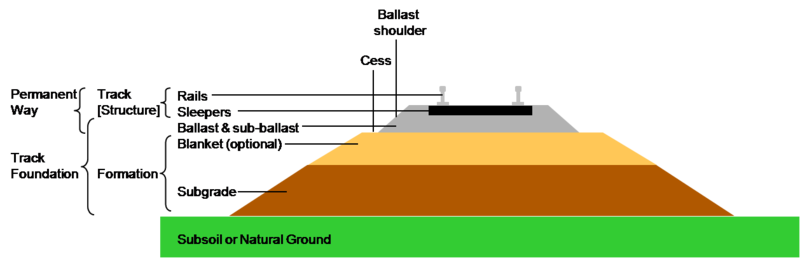
Depending on the country,it's temperature, seismographic record, speed and load of the passing traffic this design varies.
here are some pictures of various types of support..
The older ,and now obsolete Wooden sleeper type

The High speed Matt support type used in Japan..concrete sleepers
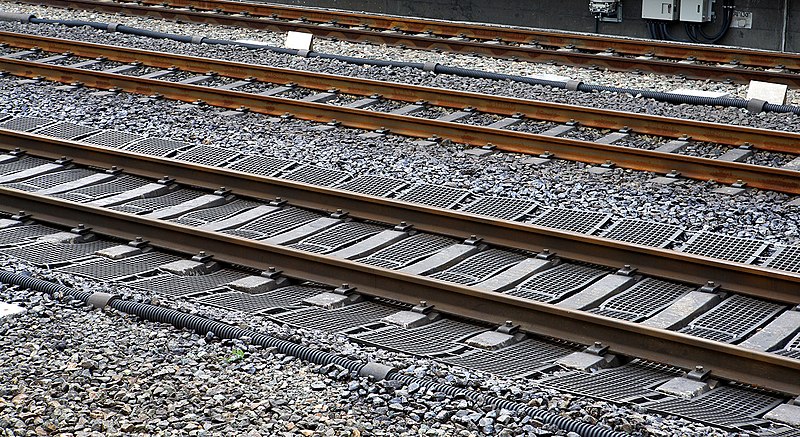
The Ballast less full concrete type used for high speed train in CHINA.
 Last edited by psr; 08-13-2012, 11:25 AM.When Was The Last Time,You Did Something For The First Time.
Comment
-
Let us look at the Rail Joints which serve to connect the lengths of rail to make a continuous path for the train to move on...Broadly categorizing there are three types.. The Normal joint with Fish plate on both side and securing Nuts and Bolts, the second The Welded Joint, and the third the Isolated Joint for Signalling and track and train movement monitoring.
The normal joints are made for Every length of the rail and leads to track creep and wear on loco and wagon wheels . The solution to this was found to be the Welded joint. This necessitated use of superior steel for the rails ,which had negligible heat expansion and contraction, and good load carrying capacity.
Here is a picture of the common joint...

here is a Picture of welded joint.
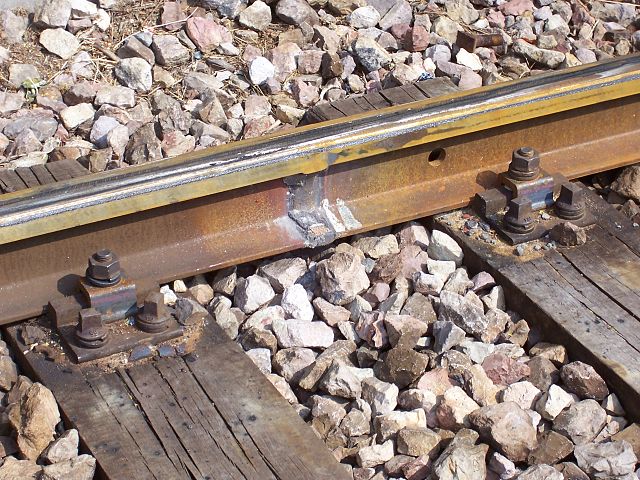
here is a picture of the Insulated and glued joint...
 Last edited by psr; 08-13-2012, 11:29 AM.When Was The Last Time,You Did Something For The First Time.
Comment
-
i missed this wonderful thread, will read in detail later, but nice thread.Comment
-
Psr sir,
The section pic of the superheat did help in clearing my doubt.
So did link about the mallet articulated compound locomotive (i have yet to finish reading up the entire article though, preparing for an exam of Industrial Electronics ) I have a question, so the US mallets have simple expansion cylinders, woudnt that give them benefit over the compound expansion cylinder locomotives when they both breakdown? if one set of US Mallet cyl units fail, then the locomotive can chug back to the depot on the other pair, but what happens when the high pressure expansion units fail in the compound cyl setup. I feel that the answer to my question might be hidden in the link that you gave me, but still what do you say?
I had no idea about the driver wheels also being dynamically balanced apart from just statical balance. In the back of my head i always thought that the cranks were 180 degrees apart, even before that i thought that they didnt have any offset. I blame Improperly designed toy trains.
Ok now about rails, the Ballast is there to absorb the loads of the train in motion , to distribute it to the ground and in turn also give a softer uhm ride (for lack of words) ? Or does it do no such work of softening the load on the rail ,by allowing it to flex within elastic limits? If yes then how is rail life affected in ballast less full concrete sleepers?
Glued joints or alumino thermic welded joints are still given expansion joints at certain distances too, right?When I die, I want to go peacefully like my Grandfather did, in his sleep -- not screaming, like the passengers in his carComment




Comment