

Since '02 xBhp is different things to different people. From a close knit national community of bikers to India's only motorcycling lifestyle magazine and a place to make like-minded biker friends. Join us

Castrol Power 1

Fatigue, sleepiness, & alcohol are the same.

Our Partner

Announcement

Collapse
No announcement yet.

An INTRO to Locomotives..Steam /Diesel Electric / Electric.

Collapse
This is a sticky topic.
X
X
 
  • Filter
  • Time
  • Show
Clear All
new posts

  • #61
    Well I have one doubt to clarify.

    I heard like this somewhere don't remember exactly

    The present day diesel engines used by Indian railways do they convert the mechanical power to electric power and then drive the wheels using a motor? .

    Similarly during breaking a load is applied on the wheels so it reduces speed. .
    Cheetahs are faster but the lion is still the KING

    Being In Love with a Girl is like being a superbike fitted with SPEED LIMITER

    Comment


    • #62
      Originally posted by psr View Post
      Each coach of any train is certified for a specific speed based on its construction ...A wording "Fit to run 160 Kmph" means the coach can do 160 Kmph Max....but what about the tracks ? and the train scheduling ? if you have to travel 400 Kms non stop and running time is 5 hrs, then the train will not be run at the rated speed ,but adjusted to "Running Time".
      Happy to know you have noted the Coach rated speeds,and learning....if possible try to see which engine Electric or diesel is pulling the train...Diesels have WDM written near the crash buffers, and Electric Locos are WAP...both will have a number suffix to the ID..ie.,for diesel 2, 3a,3c etc, and 4 ,5 , 7, for the electric
      Sir it was an electric one, which they changed to another at Kanpur.
      But Sir on the same tracks if Shatabdi can run over 150kmph then... are the coaches of Shatabdi fit to run at more than 160?
      At Howrah once I went to drop my cousin, then an empty loco was moving after the train departed, then I requested the driver to let me come over there I wanted to see the mechanism and he scolded me to get away...

      Originally posted by psr View Post
      The Delhi Metro is powered by Electric Locomotion ...more or less like the EMUs of other metros,and if you notice, there is a overhead line for this..This line carries 25,000 Volts AC at 50 Hz..so like all Electric locos the acceleration will be immense because of the efficiency of nearly 95 % and the instant power available from the 25 Kv line.
      You have both Broad gauge (1,676 mm) and Standard gauge (1,435 mm) rail forms in Delhi Metro...
      The Phase I of broad gauge coaches were built by the consortium of Hyundai Rotem, Mitsubishi Corporation, and MELCo.
      Initially the coaches were built in South Korea and after Technology transfer at BEML Bangalore....The Standard Gauge coaches are built by BEML Bangalore. In Phase II Bombardier was the supplier and ,now Bombardier Corp., is doing the same through their Vadodara factory.

      The reason for the smooth ride is because of the Secondary Air Suspension in all these coaches and the Braking is Microprocessor controlled to give the best braking.
      Hope I have clarified your query.

      Get ready to levitate....since Govt., had proposed to Introduce Mag Lev in Delhi Metro
      Thats a good news about magnetic lev, I have had just heard about it being used since a long time in Japan etc. If you start discussing about the mag lev trains then I have a lot of things to clear about, will ask then only. After diesel are you moving to electric locos? Then please do come at the magnetic part later for sure.

      And, in Kolkata metro, since they are quite old I doubt about their performance in comparison to Delhi metro. Plus, I dont know if they are using microprocessors controlled braking or not, but they are pretty aggressive..don't know whether poor suspension is also contributing in that


      Edit: In your rough diagram of a diesel engine I saw "air intake" and "air compressor", how do they differ from each other?
      Also, from the side view I see when a train is standing then a part of piston/hydraulic system like is in the relaxed state but just before they start to move then that thing gets inside (I guess it happens because driver releases the brakes?)
      Also, what is that sound produced like compressed air is released for few seconds (even when the train is standing)
      Last edited by sunny_; 06-16-2012, 01:54 AM.

      Comment


      • #63
        Originally posted by Vishakh View Post
        Well I have one doubt to clarify.
        I heard like this somewhere don't remember exactly
        The present day diesel engines used by Indian railways do they convert the mechanical power to electric power and then drive the wheels using a motor? .
        Similarly during breaking a load is applied on the wheels so it reduces speed. .
        In Diesel Electric as the name implies the diesel engine is used to drive an Alternator which in turn provides the power for the motors attached to the wheels through gear system...Please go through previous pages for further clarifications...
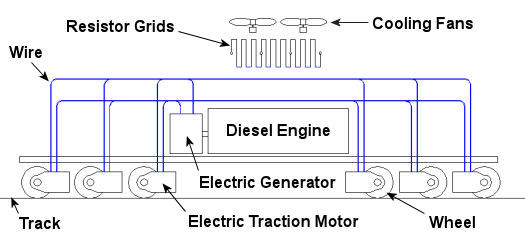
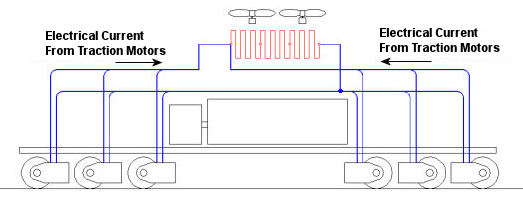
        In later models of Diesel Electric Locos, apart from the physical braking another form known as regenerative / Dynamic braking is also used. What is done is the Input to motor is totally disconnected ,and the motor is connected to a series of high power Resistors. The motor when not receiving input, and is also turning ,becomes a generator of electricity,and by putting resistors in it's output we are effectively loading the motor ,which in turns offers resistance to it's rotary movement.

        Here is a Pictorial representation of Normal Traction,when the Axle motors are receiving power.


        Here is what happens under Dynamic braking when the Motors are turned into generators and Resistors are used to load on the power from the motors to have Dynamic braking.

        Last edited by psr; 06-16-2012, 05:21 PM.
        When Was The Last Time,You Did Something For The First Time.

        Comment


        • #64
          Originally posted by sunny_ View Post
          Sir it was an electric one, which they changed to another at Kanpur.
          Did you note the model of the LOCO ?
          But Sir on the same tracks if Shatabdi can run over 150kmph then... are the coaches of Shatabdi fit to run at more than 160?
          YES.
          At Howrah once I went to drop my cousin, then an empty loco was moving after the train departed, then I requested the driver to let me come over there I wanted to see the mechanism and he scolded me to get away...
          NO Civilian other than the Driver and Assistant Drivers are allowed in the Leading Cab.
          Thats a good news about magnetic lev, I have had just heard about it being used since a long time in Japan etc. If you start discussing about the mag lev trains then I have a lot of things to clear about, will ask then only. After diesel are you moving to electric locos? Then please do come at the magnetic part later for sure.
          YES I will touch upon it AFTER Electric Loco.

          And, in Kolkata metro, since they are quite old I doubt about their performance in comparison to Delhi metro. Plus, I dont know if they are using microprocessors controlled braking or not, but they are pretty aggressive..don't know whether poor suspension is also contributing in that
          Kolkatta Metro is the older version and Delhi uses the later version of coaches...in Chennai also it is supposed to be mixed..But in chennai Metro the rails are WITHOUT Ballast..full concrete type.
          Edit: In your rough diagram of a diesel engine I saw "air intake" and "air compressor", how do they differ from each other?
          Intake is for the air to come in(has a Paper Air Filter) and compressor is one that compresses it.Since different age of coach have different type of braking, the Locos have EXPRESSOR, which contains both compressor and Vacuum lines...please go back and see earlier posts
          Also, from the side view I see when a train is standing then a part of piston/hydraulic system like is in the relaxed state but just before they start to move then that thing gets inside (I guess it happens because driver releases the brakes?)
          Yes. If there is a change of Locomotive and train stands for some time, you can see a person walking up to each coach,with a long steel rod, and manually actuating the brakes...
          Also, what is that sound produced like compressed air is released for few seconds (even when the train is standing)
          Like I said before older coaches had Vacuum brake and newer coaches have Compressed Air Brakes...The Diesel loco generates both Vacuum and Compressed Air for braking ,through the Expressor...when ever the air pressure exceeds the required safe level , there is venting of excess pressure to keep pressure at safe level.
          replies in bold.
          Last edited by psr; 06-16-2012, 11:36 AM.
          When Was The Last Time,You Did Something For The First Time.

          Comment


          • #65
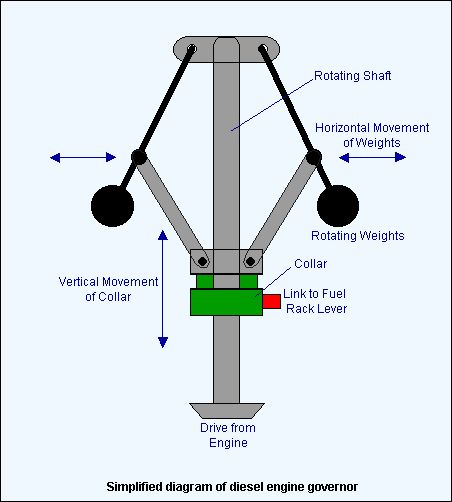
            Till a few years back, the max RPM of the Diesel Loco Engine was Limited by a Mechanical regulator.
            The idling RPM was around 400 and the max was 1,000.These are called Speed Governors..... Here is a pic of the mechanical limiter ..


            To accelerate the engine in tune with required Voltage ,current and hence Power from the Alternator, a throttle control was used...Here is a pic of the mechanism of the Throttle Control..


            These two types of RPM and Throttle Control were widely used in the ALCO Diesel engines belonging to the WDM 2,and 3 class of engines.
            Last edited by psr; 08-13-2012, 01:22 PM.
            When Was The Last Time,You Did Something For The First Time.

            Comment


            • #66
              Here are some Links to Indian Railways diesel Locomotives including information about the Diesel engine,type of drive(AC/DC) wheel configuration used,tractive effort etc.,....A MUST READ for getting in-depth Knowledge about the Diesel Traction in India...


              Here is a link to most frequently asked question and Answers


              And here is how the Indian railways system classifies it's Engines..

              • W = Broad Gauge
              • Y = Meter Gauge
              • Z = Narrow Gauge (2' 6")
              • N = Narrow Gauge (2')

              The second item, '[power]', is one or two letters identifying the power source:
              • D = Diesel
              • C = DC traction
              • A = AC traction
              • CA = Dual-power AC/DC traction
              • B = Battery electric(rare)

              The third item, '[load]', is a single letter identifying the kind of load the loco is normally used for:
              • M = Mixed Traffic
              • P = Passenger
              • G = Goods
              • S = Shunting
              • L = Light Duty (Light Passenger?) (no longer in use)
              • U = Multiple Unit (EMU / DEMU)
              • R = Railcar
              Last edited by psr; 06-19-2012, 11:19 AM.
              When Was The Last Time,You Did Something For The First Time.

              Comment


              • #67
                Why does diesel engine convert it to electric power and then transmit to wheels? . Wouldn't there be high energy losses associated with it?

                Or are the mechanical complexities too big to transmit power directly?

                I wonder how many Indian railway engines will pass pollution test .
                Cheetahs are faster but the lion is still the KING

                Being In Love with a Girl is like being a superbike fitted with SPEED LIMITER

                Comment


                • #68
                  Originally posted by Vishakh View Post
                  I wonder how many Indian railway engines will pass pollution test .
                  None of them bro...they have not even think about it, I must say...
                  KTM RC390 - Current
                  Yamaha R15 v2 - Sold
                  Hero Hunk - Sold
                  An IT Engineer by profession and a rider by soul.


                  Delhi to Sach Pass - http://www.xbhp.com/talkies/tourer/3...h-ka-darr.html
                  Delhi to Mana - http://www.xbhp.com/talkies/tourer/2...xperience.html
                  Delhi to Munsyari - http://www.xbhp.com/talkies/tourer/2...ttrakhand.html
                  Spiti circuit - http://www.xbhp.com/talkies/tourer/3...cuit-solo.html

                  Facebook

                  Comment


                  • #69
                    Originally posted by Vishakh View Post
                    Why does diesel engine convert it to electric power and then transmit to wheels? . Wouldn't there be high energy losses associated with it?

                    Or are the mechanical complexities too big to transmit power directly?

                    I wonder how many Indian railway engines will pass pollution test .
                    Originally posted by itsmevini123 View Post
                    None of them bro...they have not even think about it, I must say...
                    Just imagine transferring the diesel engine power to the wheels through a clutch system....It will be a huge clutch,and imagine clutch failure half way through journey,and it's replacements,gear box it's SIZE and it's oil, and gear shifters etc.,There is infact a huge loss of power through this kind of transmission than with the electric system,due to the mechanical linkages involved. Added to that is the smooth delivery of high torque(about 3,000 HP) needed to move about 3,500 tons of load(coaches/wagons)....Electric traction is the way to go.
                    The Old ALCO 251 series used in India were not confirming to the pollution control norms..In fact one of the reason ALCO sold the company and wound up operations in US.The present generation ALCO engines in India are being fitted with Micro processor based fuel Injection system ,along with it's sophisticated Technology,and have become more Fuel Efficient and less smoky.
                    But the winner here is the GM EMD made WDP 4 Diesel which gives higher power(4,000 HP) and is almost smokeless...It is a TWO STROKE DIESEL.....an injected Two stroke design which is superior to the 4 stroke design,of the ALCO engine.
                    Last edited by psr; 06-19-2012, 01:30 PM.
                    When Was The Last Time,You Did Something For The First Time.

                    Comment


                    • #70
                      So that justifies it, too much moving parts means increased failure chances .

                      And a two stroke diesel engine almost smokeless . Wow!.
                      I hope for production line bikes in India with pollution less two stroke petrol engine.
                      Cheetahs are faster but the lion is still the KING

                      Being In Love with a Girl is like being a superbike fitted with SPEED LIMITER

                      Comment


                      • #71
                        Originally posted by Vishakh View Post
                        So that justifies it, too much moving parts means increased failure chances .

                        And a two stroke diesel engine almost smokeless . Wow!.
                        I hope for production line bikes in India with pollution less two stroke petrol engine.
                        Yes and the GM EMD diesel has Tier 2 certification for pollution control..In USA the present norm is Tier 3...Indian Railways is set to get their Diesel Locos to Tier 3 and also increase WDP-4 power from 4,000 HP to 4,500 HP.
                        It had been proved that a Two stroke engine with Fuel injection technology is least polluting and gives better Power and FE...Already there are conversion kits available abroad for small gasoline engines
                        When Was The Last Time,You Did Something For The First Time.

                        Comment


                        • #72
                          Here is a video of the TWO stroke GM EMD Diesel starting...Notice any smoke ?

                          Cranking of a WDP4!! - YouTube

                          and here is a ALCO WDM 3A...4 stroke diesel..

                          Loco : ET WDM-3D #11316 & ET WDM-3a #16412RTrain : [2628] New Delhi-Bangalore, Karnataka ExpressKarnataka Express comes with a surprise - Orange Rebuilt WDM3...


                          and a IR modified WDM 3 C with Micro processor controlled Fuel injection,etc., spotted doing 115 Kmph...notice negligible smoke.....an example of Indian Railways at it's best innovation..
                          A rare capture of LDH WDM-3C# 18878 taking a sharp curve and rushing past silent Umroli station at above 115kph with mismatch Bandra Terminus Delhi Sarai Roh...
                          Last edited by psr; 06-20-2012, 12:59 PM.
                          When Was The Last Time,You Did Something For The First Time.

                          Comment


                          • #73
                            I think it is common for all diesels to emit black smoke under sudden acceleration.
                            Even my 1400cc IDI turbocharged diesel car does that.
                            May be due to rapid cooling of the cylinder by diesel as more diesel is injected than what it can burn ?

                            Comment


                            • #74
                              Originally posted by shoeb2015 View Post
                              I think it is common for all diesels to emit black smoke under sudden acceleration.
                              Even my 1400cc IDI turbocharged diesel car does that.
                              May be due to rapid cooling of the cylinder by diesel as more diesel is injected than what it can burn ?
                              What we see as black smoke is the partial/unburnt diesel coming out as smoke. If the engine is suddenly accelerated ,and the amount of Air breathed in the inlet is less then the AFR becomes rich leading to this. In Manual injection this is very pronounced, while in MPF Injected it is less because the injectors instantaneously reduce the amount of diesel injected, based on sensor's input to the ECM.
                              When Was The Last Time,You Did Something For The First Time.

                              Comment


                              • #75


                                Alco(?) V16 at Loco Workshop, Parel. Took the picture when we had a IV last year and when i was considerably nubile. I noted that the Turbo charger had its exhaust case connected in reverse, i.e the exhaust enters the casing from the lip (centre) and is thrown out from the side. Isnt the exhaust gases supposed to hit the impeller at an angle and then get thrown out from the centre?


                                ^This is how its supposed to be, and in that turbo the exhaust comes in from where it is supposed to come out, and flows out from where it is supposed to come in, (if you check the previous pic closely, then it will be clear sorry for lack of any better picture)

                                At that time i felt that the thing is driven by the crank (i.e is a supercharger) and the exhaust blower sucks air from the exhaust port of the engine, to scavenge it better.

                                Later on i thought that the impeller in the exhaust casing would have been designed differently keeping in mind exhaust flow rate and pressure.

                                So which thesis is right?

                                Have some more pics to show you, is it possible to share fb albums here?


                                Also How 'exactly' does this xpressor work? the top half does the compression work and the crank does the vacuum work?

                                PS: thats not me in the picture.
                                Last edited by Saerius; 06-20-2012, 06:14 PM.
                                When I die, I want to go peacefully like my Grandfather did, in his sleep -- not screaming, like the passengers in his car

                                Comment

                                Working...
                                X