


Since '02 xBhp is different things to different people. From a close knit national community of bikers to India's only motorcycling lifestyle magazine and a place to make like-minded biker friends. Join us

Castrol Power 1

Learn & practice evasive maneuvers.

Our Partner

Announcement

Collapse
No announcement yet.

An INTRO to Locomotives..Steam /Diesel Electric / Electric.

Collapse
This is a sticky topic.
X
X
 
  • Filter
  • Time
  • Show
Clear All
new posts

  • Several high capacity shock absorbers were assessed for possible application to Locomotive Crash Energy management(CEM).This led to the innovation of compact Shock Energy Absorbers(SEA) suitable for CEM systems in a Locomotive.
    The SEA makes use of Easily available plastic material--Ultra High Molecular Weight Polyethylene.(UHMWPE) as the core material
    From past test evaluation and results the new material was tested for a 27,000-lbs impact at 13 feet per second. The test impact on previous evaluation showed that the crash energy of 20 Million pound was exerted when a 200 ton Locomotive was lifted to 10 feet during an impact override.this Impact was of a 200 Ton Locomotive hitting a stationary rake at 30Mph(48Kmh).Therefore any CEM system must be designed to absorb such a High Energy impact.Hence the design requirement also meant that the crash buffers must be adequately sized and even distribution of the impact energy was essential....the Maximum allowable area for the crash buffers being approximately 3 feet, the amount of the crash buffer travel was estimated to be less than 2 feet.
    In view of the space constraints in the locomotive structure itself,distributive dissipation of the impact shock energy was paramount.
    To this end the Pneumatic crash buffer along with it's support plate were arranged to be at a lower level to allow buckling under impact and prevent Loco over ride.
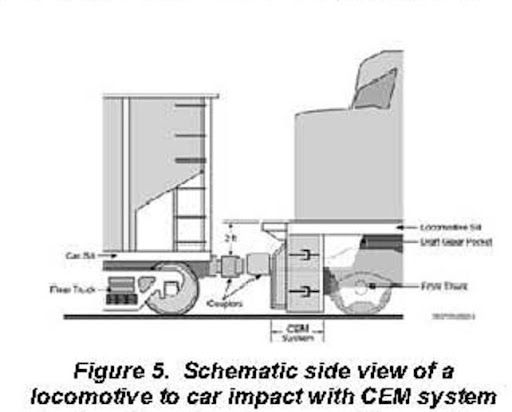
    The distribution of the impact energy was to be managed by increasing the number of Crash Buffers.

    Last edited by psr; 12-07-2012, 02:28 PM.
    When Was The Last Time,You Did Something For The First Time.

    Comment


    • Design Characteristics of SEA units Comprising of the CEM System.


      Results from FEA Simulation with CEM System :

      Simulation of the locomotive with CEM showed that the intended goal of preventing locomotive override is achieved and the crash energy is dissipated in the CEM system as well as by extensive fracture and large scale deformation of the impacted hopper car. A closer examination of the draft gear and the central SEA deformation reveals that the sequence of energy dissipation events such as the shear pin failure, the coupler/draft gear collapse, the sliding of draft gear pocket walls to activate the full plunger displacement of the central SEA behind draft gear took place as envisioned in the design of CEM system. In essence, the crash energy dissipation by the central SEA was fully effective and it performed in the simulation as per design.

      However,

      (a) other six SEA units fitted between the modified pilot plate and the reaction plate on either side of locomotive did not perform as effectively and contributed partially to the crash energy dissipation through part of the designed plunger travels for each of the six SEAs. But a significant achievement of these distributed SEAs in preventing the locomotive override is that together they increased the stiffness of the pilot plates which inhibited formation of a

      (b) ramp ahead of locomotive front truck. This resulted in the Figure 11. Post-collision configuration of SD70 inability of the locomotive to climb over the hopper car.

      Figure 11.


      (with CEM): (a) at T=300 ms, (b) at T = 500 ms Instead, it enabled extensive crushing of the impacted hopper car structure by the locomotive.

      Conclusions :

      In this simulation, a novel design of a new class of compact shock energy absorbers using low cost UHMWPE material is presented whose efficacy has been demonstrated through laboratory scale testing and also through prototype test and finite element analysis. From these design, testing and FEA simulation studies it can be concluded that it is possible to innovatively design crash energy management systems for railroad locomotives and other rolling stocks. However, this requires further focused investigations involving freight as well as passenger locomotives and coaches in order to optimize the low cost SEA/CEM system for improved crash worthiness.
      Last edited by psr; 12-12-2012, 09:16 PM.
      When Was The Last Time,You Did Something For The First Time.

      Comment


      • When I started reading this thread I understood a fair bit of the working principles of locos sir. But, after I visited the diesel loco shed at tondiarpet, things have become more complex sir! The Tondiarpet diesel loco shed handles the WDS4D, WDP/M 2,3A,C&7, Accident relief vehicle and crane service vehicle. Luckily I also got to see a completely ripped off engine(the V16) as one of the piston was damaged badly. Only after seeing these beasts in flesh to bones, I understood the various circuits(fuel,air,coolant etc.) It may be a little late to ask questions on disesel locos but better now than never.

        1. I see that the radiator fan is driven by the end of the crankshaft through a bevel pinion. And this is because the fan is located on the top horizontally. Since the radiators are placed vertically at the sides, how is the air directed to them?
        2. I did ask them about the multi-grade oil used. They did not know anything about it being 20W50 but they only gave me the name RR-606. What does it denote?
        3. I understand that the AC traction motor is preferred due to low maintenance but how is it possible to provide the immense torque for the initial movement using the same?
        4. When the loco moves initially(low speeds) with 5 or more notches up, is there a loss in power transmission? If yes, how?
        5. What is the counterpart for a differential unit in locos?
        6. And lastly why does the 6 cyl ALCO make hell of a noise??
        Last edited by harishkumarko; 12-15-2012, 03:49 PM.
        Tour De Thekkady

        The Return of the KB

        The Run-in Adventure

        150cc doing 100+ is great!
        100cc doing 100+ is awesome!!
        150cc cornering like hell is great!
        100cc cornering like hell is awesome!!
        THAT'S WHY I RIDE A RTZ!!

        Comment


        • Good that you have seen the Locos in Flesh, but sorry to note that you have been able to see only parts of it....

          1. Radiator fans on WDM and WDP series are run by eddy current from the generated 3 phase voltage....Only lesser powered Locos have fans run from the crank...these are few and not much in active service(shunters).You may see Radiators without fan,...these are the oil cooling ones, and are fitted where there was none before..so no additional fan cooling is required...The horizontal roof mounted fan with radiator is the actual engine Coolant radiator which cools the engine...if there is no radiator associated with the roof mounted fan then it is for cooling the engine cubicle...

          2. The end user..e., the maintenance engineers are given just part no so that confusion and Local duplication will not occur..the coolant and the oil are from the centralised store ,to maintain reliability factor for the engines...so the engineers on site may not know of the multigrade engine oil used...(See my post # 86 )

          3. The AC motor used is the common AC motor type known as the " Squirrel Cage Motor "....It has no brushes, and by the field excitation in outer coils, the laminated iron center core,will turn Electro magnetic power to rotational energy.

          Squirrel-cage rotor - Wikipedia, the free encyclopedia

          squirrel cage motor - Google Search

          4. At lower notches, the stator windings are made in to parallel to handle higher amps. simultaneously the Voltage supplied to the motor will be Low in Voltage , but high in current...for instance for calculating HP it is known that 746 watts= 1 HP.
          and watts is Voltage X Current..
          In Diesel Electric Locomotives the starting Voltage will be about 150~200 Volts and Ampere capability will be about 1,800 amps per motor.....as the speed is increased the winding are made into serial connection and the voltage is increased and amperes reduced...ie., 300 Volts at 900 amps....you will see that the power at lower RPM was almost the same ,as at higher RPM, BUT THE RPM of Motor rises as more winding are made into serial connection...In Dc Traction motors this power is connected through thick Copper brushes, while with a AC traction motor it is done by varying the excitation field strength and frequency.

          5. In Locomotives there are no differential required, because there are no sharp curves which would require the inner and outer wheels to rotate at different RPMs...if a track is so made the train will destroy it....Which is why if a sharp curve is made then the tracks will be banked to take care of the rigid wheel sets.

          6. Exhaust Noise from any engine is dependent on the exhaust design , and the internal design is responsible for engine noise...6 to 10 cylinder engines are very old designs which were never taken up for refinement as they are virtually useless in modern day Loco utilization... so they are still mechanical injectors with none of the refinements of the modern day diesel, and the added fact that a 6 cylinder engine is underpowered and may have to be revved hard to haul even minimalist load...
          To make a simple comparison, it is like comparing the old Matador diesel engine with the CRDis.

          Please read pages 5,6,and 7 ..
          Last edited by psr; 12-15-2012, 08:53 PM.
          When Was The Last Time,You Did Something For The First Time.

          Comment


          • Originally posted by psr View Post
            Good that you have seen the Locos in Flesh, but sorry to note that you have been able to see only parts of it....

            1. Radiator fans on WDM and WDP series are run by eddy current from the generated 3 phase voltage....Only lesser powered Locos have fans run from the crank...

            The personnel who explained me the radiator fan principle was referring to a WDM3A sir!! Now that you have mentioned eddy current I'm more confused. In that case wouldn't the fan keep running even at unnecessary conditions irrespective of the load(unless it is visco type)?


            3. The AC motor used is the common AC motor type known as the " Squirrel Cage Motor "....

            I'll get my basic electronics done before I venture any further sir!!

            4. At lower notches, the stator windings are made in to parallel to handle higher amps. simultaneously the Voltage supplied to the motor will be Low in Voltage , but high in current...

            Ah....they did brief something about series and parallel connections used for initial and running conditions.


            5. In Locomotives there are no differential required

            Which means there is a very little slipping?
            Such is the fate of WDS series. There were 20-30 of them like this.


            Thank you for clearing my childish doubts sir.
            Last edited by harishkumarko; 12-15-2012, 09:25 PM.
            Tour De Thekkady

            The Return of the KB

            The Run-in Adventure

            150cc doing 100+ is great!
            100cc doing 100+ is awesome!!
            150cc cornering like hell is great!
            100cc cornering like hell is awesome!!
            THAT'S WHY I RIDE A RTZ!!

            Comment


            • Originally posted by harishkumarko View Post
              Such is the fate of WDS series. There were 20-30 of them like this.


              Thank you for clearing my childish doubts sir.
              The WDS series are Broad gauge locos used for short haul or shunting...In fact the engines of the once Meter gauge Locos ..the YDM series were removed from the Locos and fitted into WDS 6 chasis ....If you listen to the Exhaust note of the WDS 6 loco you will immediately identify it as the YDM meter gauge engine....
              Only the smaller shunters used Crank driven fans for the radiator, while the WDM and WDP used Electrical fans that will switch on ,when the appropriate temperature is reached....much like the fans in our cars and LC bike.

              In the EARLY WDM2 ,which were converted to WDM 2 A, c etc., then named WDM 3A,B,C...The Radiator Cooling fan is operated by eddy current clutch, and prime power for the fan came from the diesel engine itself....So you have seen one of the early models,which had been converted, and what the person explained is true for the early engines..
              Later on the configuration changed....

              In all we have more than 4,200 Locos in the WDM3 series with various configuration, With conversion from WDM2 , to Locos manufactured as WDM 3 with A ,B ,and C nomenclature.
              One Loco was built with AC cab then dismantled...and some have Air Brake+Vacuum brake, and some with only air brake and some with vacuum only, apart from different Electronics, and cab configurations.......So it is difficult to predict the Actual configuration of a WDM3 series.....


              Eight Locos with hydraulic drive were imported ,manufactured by both Mercedes Benz,and Henschel, and were given Id of WDM3...
              the WDM3 is not in active service.

              Here is a useful link...


              Last edited by psr; 12-16-2012, 04:19 PM.
              When Was The Last Time,You Did Something For The First Time.

              Comment


              • Russian LNG-powered trains headed to India | Russia & India Report

                Sir its not the americans this time. Looks like we have the sukhoi people helping us out this time!!
                Last edited by harishkumarko; 12-17-2012, 07:22 PM.
                Tour De Thekkady

                The Return of the KB

                The Run-in Adventure

                150cc doing 100+ is great!
                100cc doing 100+ is awesome!!
                150cc cornering like hell is great!
                100cc cornering like hell is awesome!!
                THAT'S WHY I RIDE A RTZ!!

                Comment


                • Originally posted by harishkumarko View Post
                  Russian LNG-powered trains headed to India | Russia & India Report

                  Sir its not the americans this time. Looks like we have the sukhoi people helping us out this time!!
                  Ha ha ,..I am aware of this info since I had already read the RDSO's requirement tender,regarding the turbine powered Loco.
                  Though the Russian company is one of the biggest manufacturer, it's quality is despicable...I saw a documentary on the manufacturing of one of their Loco, and even a brand new casting of an undercarriage chasis was found to be having cracks just when it was about to be integrated into a Electric Loco....if it really comes, God help us...
                  When Was The Last Time,You Did Something For The First Time.

                  Comment


                  • Sir why does the light inside the cabin of WDP/WDM4 go off when the engine is cranking? And there is no mechanical governor in the 4 series right?
                    Tour De Thekkady

                    The Return of the KB

                    The Run-in Adventure

                    150cc doing 100+ is great!
                    100cc doing 100+ is awesome!!
                    150cc cornering like hell is great!
                    100cc cornering like hell is awesome!!
                    THAT'S WHY I RIDE A RTZ!!

                    Comment


                    • Originally posted by harishkumarko View Post
                      Sir why does the light inside the cabin of WDP/WDM4 go off when the engine is cranking? And there is no mechanical governor in the 4 series right?
                      Either due to load on the battery or may be by design the internal lights will go out..
                      Even the early WDP4 ,with B o-1 1-o B arrangement ,had wood ward Governor, like in the WDM series ....these are being slowly converted to electronic ones.....
                      Here is a pict., of the engine Governor in WDP4
                      When Was The Last Time,You Did Something For The First Time.

                      Comment


                      • Originally posted by psr View Post
                        Even the early WDP4 ,with B o-1 1-o B arrangement ,had wood ward Governor, like in the WDM series ....these are being slowly converted to electronic ones.....
                        Here is a pict., of the engine Governor in WDP4
                        Which means there are sensors for optimum temperature and also to cut off in case of overheating?
                        Tour De Thekkady

                        The Return of the KB

                        The Run-in Adventure

                        150cc doing 100+ is great!
                        100cc doing 100+ is awesome!!
                        150cc cornering like hell is great!
                        100cc cornering like hell is awesome!!
                        THAT'S WHY I RIDE A RTZ!!

                        Comment


                        • Originally posted by harishkumarko View Post
                          Which means there are sensors for optimum temperature and also to cut off in case of overheating?
                          There is nothing to heat and cause problem...the WDM engine ALCO 251 16 cylinder engine runs at max 1,050 RPM ..is with Steel cap piston, 1,050 liters of Coolant forced air cooled Coolant and engine oil etc.,
                          The WDP4 engine is still lower at 904 RPM max....and has a plethora of Cooling fans for everything including the electronics.....
                          The only place where there are no sensors, is the wheel...on many occasions hot axle condition had occurred, and to counter this problem,grade and quality, of the wheel bearing lube is being improved....
                          In WDP & WDG there is also a ABS sensor and control unit.....
                          Last edited by psr; 12-20-2012, 11:35 AM.
                          When Was The Last Time,You Did Something For The First Time.

                          Comment


                          • Originally posted by psr View Post

                            In WDP & WDG there is also a ABS sensor and control unit.....
                            Do you mean Anti Lock Braking system??
                            http://www.facebook.com/ateesh.kumar

                            Comment


                            • Originally posted by Honda_CBF View Post
                              Do you mean Anti Lock Braking system??
                              Yes it is there as standard OE fitting in all WDP4 and WDG4 GM EMD Locomotives...it uses a radar unit which is focused on the Loco wheel and detects lockup and moderates the brake...

                              When Was The Last Time,You Did Something For The First Time.

                              Comment


                              • Wishing all a Healthy and Happy New Year
                                When Was The Last Time,You Did Something For The First Time.

                                Comment

                                Working...
                                X
