








 Tweet
Tweet
I have a pic of the first prototype for WDG5 series loco which is rated at 5500 HP. I was looking for some info on this. I had some more pics of the same and trying to trace them. will post them here once i find it.
-
I have a pic of the first prototype for WDG5 series loco which is rated at 5500 HP. I was looking for some info on this. I had some more pics of the same and trying to trace them. will post them here once i find it. -
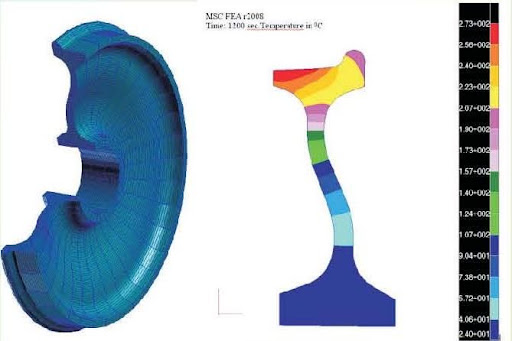
This Locomotive is jointly developed by DIesel locomotive Works Varanasi and GM EMD division under RDSO India. The initial MOU for this was done in 2009~2010, and RDSO had given the guidelines. It was first designed to be a 5,000 HP Loco, and during trial production Itself several re-engineering for improvement had been required by RDSO..the original trial started sometime in March~ April of 2012 and though it is seeing service in certain operational routes, there are certain aspect of the Loco yet to be finalised. It has some very unique and radical design feature like a " S " type wheels..which had been developed, put in use and approved.Right from the cattle guard to brakes , frame , the control desk ,and main motive power, Everything had been designed for higher efficiency and lower return time to shed....One of the main problem of restricting the per axle load to 22.3 tons had been achieved ,thanks to the RDSO and DLW expertise.Originally posted by s_hari View Post
Here is a picture of the " S " type wheel in design stage drawing....
 When Was The Last Time,You Did Something For The First Time.
Comment
-
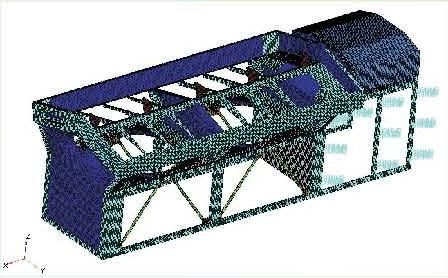
Here is another image of the WDG 5 loco, as analysed on Hyper mesh modal analyses for stress, heat, and resonant frequency .....

The final frame structure for light weight and strength, to keep the per axle load to 22.3 tons per axle...
 When Was The Last Time,You Did Something For The First Time.
Comment
-
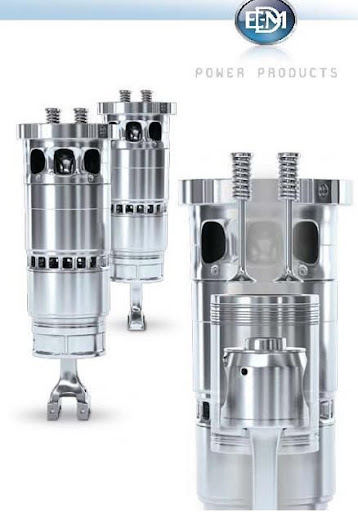
The WDG5 is a slightly modified EMD's SD 80 Loco's engine Model 20-710 originally designed for 5,000 HP.The EMD 20-710 engine is widely used in ships and tugs ,including US Navy ,and is supposed to be a very reliable Two Stroke diesel engine. The 5,000 HP is generated at a low 900 RPM .. here is a pic of the engine...
 Last edited by psr; 11-25-2012, 02:25 PM.When Was The Last Time,You Did Something For The First Time.
Comment
-
here is a cross sectional view of the emd 20-710 series engine

The main engine is made of many pieces welded to gether to form a 8 or 12 or 16 or 20 cylinder engine... the concept of making the engine out of preformed pieces being welded to-gether reduces weight, gives better flexibility in choice of number of cylinders, and aides is easy replacement.
Here is the many pre-formed sub assemblies which are welded to make an engine casing...

The Cylinder liners are hardened ,and formed with Laser for precision fitting. This again aides in easier replacement as and when required...The Pistons are Hard Tin Plated for long life.
 When Was The Last Time,You Did Something For The First Time.
Comment
-
The WDG 5 is a goods only Locomotive with top speed of 106 kmph...By changing the drive motor to wheel gear ratio it can be made into a higher speed Passenger train locomotive...But IR is more interested in developing Higher power goods haul locomotive ,since the prime earner for IR is the goods movement. The WDG 5 has only one Leading Cab and so must always be run on Short end..ie., the leading cab will always be facing the path, and Long head run is not allowed.
Due to this configuration extensive tests are done for Safety of Loco Pilots(Drivers), and crash test simulation and buffering is being improved. Hence the final design is not yet logically finalised and Prototype test Engines are being run to evaluate different parameters.
Due to unreliable operation of Siemens Electronics,in WDG /P 4 series engines, a local source had been developed who had already supplied the required Electronics and allied parts for the WDG/P 4 Locos.
M/s Medha Servo Drives private ltd., from Hyderabad is the certified supplier of the Electronics, and will continue to support the WDG 5 development and implementation programme in all allied Electronics and Electromechanical sub assemblies.Last edited by psr; 11-25-2012, 02:44 PM.When Was The Last Time,You Did Something For The First Time.Comment
-
Found few of the pics in my collection. WDG5 is the first Indian loco with
1) Aircondition Cabin
2) Loco with toilet
3) TFT only dashboard and no mechanical dialsComment
-
It also has heaters for cold condition,....twin 1kwatts heaters just above the drivers fore head....all these are under review,since the Locomotive has single Leading cabin head and must undergo rigorous crash test for certifications.Right now the front cab is more like the Maruti OMNI van where the driver faces the brunt of any collision..The Loco Driver sits right at the front with minimal protection, which IR and the unions are un comfortable with, which is why only Prototype Test engines are run.....Further up grading and testing are going on to get the Certification of Safety.Originally posted by s_hari View Post
The biggest worry will be the Diesel Engine itself, since in the US of A there have been reliability issues with 20-710 model of engineLast edited by psr; 11-29-2012, 12:29 PM.When Was The Last Time,You Did Something For The First Time.Comment
-
I am just wondering how a gigantic loco can be crash tested!Originally posted by psr View Post I am working in a field which involves crash testing for cars, which in its own way makes you go mad with its numerous sensors and algorithms. Does India has a lab where the loco's are tested or is it abroad?
Rx is a Phoenix!!! It always rise from ashes!!
I am working in a field which involves crash testing for cars, which in its own way makes you go mad with its numerous sensors and algorithms. Does India has a lab where the loco's are tested or is it abroad?
Rx is a Phoenix!!! It always rise from ashes!!Comment
-
Actual crash test are done abroad by GE on their Locos...First they are tried on their Simulator software, and 3 d projects, then are tried in actual real time, to know software simulation accuracy.... here are some pictures of simulation on PC and actuals....of a GE C39 type Loco...India has a software simulator..Originally posted by dpak89 View Post


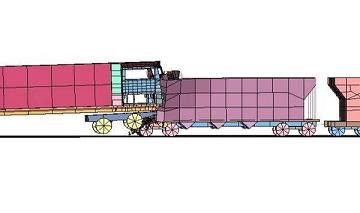


Here is the Link to the full test report....
 Last edited by psr; 11-30-2012, 10:23 PM.When Was The Last Time,You Did Something For The First Time.
Comment
-
We will now see some of the improvements RDSO had started implementing in the Locomotives....
" INTELLIGENT LOW IDLE " for Micro Processor and " E " electronic fuel injected Locos..
RDSO had designed an " INTELLIGENT LOW IDLE for microprocessor based injection engines in Locomotives...Nearly 300 Locos have been successfully upgraded with this. The fuel is considerably reduced during idle . The same feature was also planned to be introduced in non-Micro Processor "E" type control fitted locomotives.For this RDSO designed, developed and implemented a stand alone low idle controller which enabled reliable low 350 RPM idle after ensuring idle at 400 RPM and lube oil pressure of 1.7kg/cm2 for more than 5 minutes.
This innovative modification saves the Railways 2.5~3 Lakhs Rupees per Loco per Year.
The manual configuration of the WDG5 is as follows..
1. Roof mounted Radial Dynamic Grid
2. CCB(Computer controlled Braking) located at Radiator end
3. Toilet between electrical locker room and Alternator Room
4. Provision of Strong and robust cattle guard
The Locomotive Coupler had also been re-designed for the extra load and safe locking.RDSO had issued instruction to use "H" type Tight Lock Coupler and low pre-load draft gear on all Passenger Locomotives..
24 coach operation with fitment of tight lock CBCs, reduces longitudinal jerks of coaches..
Starting with WDP 4 and WDG 4 all the Locomotives are to be fitted with Computer Controlled Braking.Last edited by psr; 12-04-2012, 11:01 PM.When Was The Last Time,You Did Something For The First Time.Comment
-
A new Design of WDP4 with Cab at both ends had been designed and tested by RDSO... The Loco is identified as WDP 4 E.
Since the second cab is located at the Radiator end of the Loco, there was a chance of deficiency in cooling of the Radiators. For this the RDSO re-designed the Radiators placement and went in for Radial Cooling fans on top of Locos,(like in WDG5) and solved the problem.Last edited by psr; 12-05-2012, 12:34 AM.When Was The Last Time,You Did Something For The First Time.Comment
-
Improvements done to fight Rail Corrosion.....
Bangalore (IANS): A new alloy steel developed at the Indian Institute of Technology, Kanpur (IIT-K) has provided the answer to one of the major problems faced by the Indian railway system – corrosion of rails by toilet discharge.
Indian Railways is the second largest railroad in the world under a single management, running more than 11,000 trains every day, 7,000 of which are for passengers. The network comprises 108,706 km and ferries 14 million passengers daily from 6,853 stations across the length and breadth of the country.
The stuff leaving the toilets of speeding trains in the form of fine spray corrodes the rails, says R. Balasubramaniam, professor of materials science at IIT-K. “It is a unique problem faced in India where long distance trains are quite common. Longer travel times invariably result in greater use of toilets and, in turn, more corrosion.”
“Rail corrosion is a major problem especially along the salt-laden sea coasts,” admits H.S. Pannu, director-general of the railways’ Lucknow-based Research Designs and Standards Organisation (RDSO).
Environmental corrosion combined with “toilet corrosion” shortens the life of rails and according to the railways, nearly Rs.4.4 billion ($89 million) is spent annually on replacement of rails withdrawn prematurely due to corrosion.
The solution to the problem is now at hand thanks to the new corrosion resistant rail steel developed by a team led by Balasubramaniam of IIT-K in collaboration with RDSO and the Steel Authority of India (SAIL).
While atmospheric corrosion of rails may not endanger safety, “crevice corrosion”, taking place under the liners of the rail fastening system – and hence not visible from outside – is particularly worrisome, Balasubramaniam told IANS. “Crevice corrosion is accelerated in the presence of chloride ions near sea coasts as well as in discharge from the toilets of passenger trains.”
The rails currently in use are high carbon steels containing about 0.7 to 0.8 percent carbon and 1.0 percent manganese. “The presence of high amount of iron carbide also called ‘cementite’ renders these rails susceptible to corrosion,” he explained.
The railways’ own efforts to combat crevice corrosion by trying out different types of coatings in field trials failed to work. Extensive trials at a corrosion-prone location near Visakhapatnam showed that even four coats of epoxy could not stop crevice corrosion. Zinc coating was found effective but expensive. “So we decided to tackle this problem through alloy chemistry,” Balasubramaniam said.
A clue for developing the new rail steel came from Balasubramaniam’s earlier research with the 1,600-year-old Iron Pillar of Delhi. The research showed that the pillar’s excellent resistance to atmospheric corrosion was due to presence of traces of phosphorus in the iron that catalysed the formation of a “protective” layer on the steel surface.
Extrapolating the idea, the researchers reasoned that the corrosion rate in the rails could be markedly lowered by micro-alloying the steel with small amounts (0.1 to 1.0 percent) of copper, silicon, nickel and chromium in certain combinations. And they turned out to be right.
The IIT-K group was however not the first to think of alloy chemistry to attack rail corrosion. There were efforts earlier by SAIL to develop a corrosion-resistant rail that used copper and molybdenum as alloying additions. Again, the high cost of molybdenum was an issue.
The aim of IIT-K scientists was to reduce the cost of the rail. So, in their new rail chemistry, they deliberately kept higher levels of chromium and copper alloying elements that are relatively cheap. “We found the alloy containing copper and chromium along with a small amount of nickel gave the best results and this was recommended to the railways,” Balasubramaniam said.
The new rail’s superior corrosion resistance as compared to the standard carbon-manganese rails has been confirmed in laboratory trials. The evaluation was made using several different types of tests – long term and short term, from simple immersion to complex electrochemical tests, and testing in a simulated environment corrosion chamber. The chromium-copper-nickel rail composition has since been incorporated in the Indian Rail Standard specification.
“We are happy with the laboratory results of the new corrosion resistant rail,” Pannu told IANS. He said the railways have ordered a substantial number of the new rails from SAIL’s Bhilai Steel Plant for large-scale field trials along the coast. If these trials showed promise, he said, the railways may switch over to the new rails.When Was The Last Time,You Did Something For The First Time.Comment
-
Wonderful! An indigenous problem solved indigenously!
P.S: may be this is OT- heard that railways have proposed to build a bio-degradable closed type toilet in all the trains future!Rx is a Phoenix!!! It always rise from ashes!!Comment
-
The Bio toilet is already in use in some of the long distance trains on an experimental basis.The IR had earmarked about 400 Crores,overall for this.Trials for bio-toilets based on bio-degradable technology are being carried out in Bundelkhand Express between Gwalior and Varanasi. These bio-toilets are in use in Siachen.Originally posted by dpak89 View Post
At present,the technology being used in the coaches of Rajdhani, Shatabdi and Duranto trains is the controlled discharge toilet system (CDTS). In this, the toilet holds the contents until the train attains a speed of 30 kmph, after which the discharge takes place. The idea is to prevent the toilet from releasing contents at stations. So far, 5,300 CDTS units have been provided in 1,900 coaches, built under transfer of technology imported from Germany.
These newly designed bio-degradable lavatories are likely to be manufactured in Motibagh workshop in Nagpur under the South East Central Railway (SECR). The toilets do not allow the refuse to fall on the tracks. Instead, it would be collected in a tank fixed below the coach floor. The tank has a 900lt of capacity, twice the capacity of the overhead water tank. The prototype of this toilet was developed in 2000. The interiors are similar to the current train toilets. The retention tank is provided with a small vent at the top of the coach so that the gases generated in the tank escape into the atmosphere. The system also requires fitting of an underground drainage facility at stations to discharge the wastes.
The railways had signed a MoU with Defence Research and Development Organisation (DRDO) for development of bio-toilets for rail coaches. Rail tracks get corroded because of the discharge from toilets and the new design green toilets would prevent the damage to the tracks.
Indian Railways is also planning trials on vacuum toilets, similar to those used in aircraft. With this, the railways hope to offer an airline-like experience to commuters.
A total of 68 bio-toilets based on anaerobic bacteria, imported from the US, and 436 bio-toilets based on anaerobic bacteria and developed indigenously by DRDO are already in operation in nine trains.
In the bio-toilet system, anaerobic bacteria consume the waste material and convert it into water and gas. The water passes through a chlorine tank and is discharged as clean water, while the gas generated evaporates. The technology used has been developed by DRDO, and is not used in any other railway system in the world.
Based on the outcome of the trials, these bio-toilets will be fitted in the other trains. The timeframe for full implementation will depend on the outcome of the trials.
The technology is not without its share of problems. As the bacteria can only decompose human waste, throwing plastic, polythene and napkins in the bio-toilets could affect the working of the system.
A committee has been constituted to study the fitment of bio-toilets on existing coaches. The railways have an estimated 50,000 coaches. About 4,000 coaches are produced every year, which could be fitted with bio-toilets.Last edited by psr; 12-05-2012, 05:13 PM.When Was The Last Time,You Did Something For The First Time.Comment



Comment