










All posts by Sunil Gupta
H2O: Kawasaki Ninja H2 Review: First Impression

 Oct 2015
 Sunil Gupta
 Bikes,Kawasaki,Motorcycles
What do you exactly do when someone offers you to ride one of the most breathtaking motorcycles on the planet? It depends on what kind of person you are! This well could be taken as the new personality type test, especially for the petrol heads, and finally Dr. Freud could be given a backseat! I’ll tell you what I did – just managed to stop myself from acting like a neurotic and snatching the key from the owner and gulped all the saliva that I was drooling and in the most nonchalant way possible swung my leg over the Kawasaki Ninja H2 and thumbed the starter. Revved it a little and heard the supercharger flutter through the sweet inline four sound that we are used to.
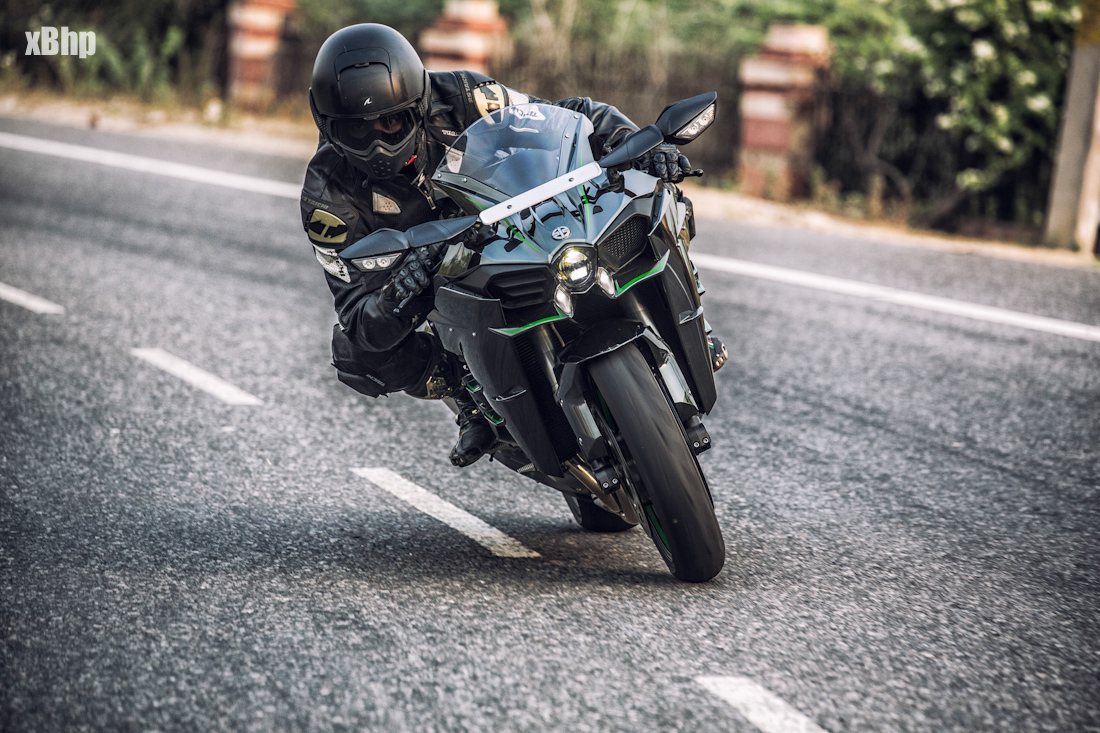
This was it. One of the most hyped motorcycles in recent times was now under me, right here in Delhi! The marketing, drama and buzz that was created around the launch of this bike, banked primarily on the social media and seeding videos, sound of the bike and image teasers. I tell you – it was worth it!
I first saw its demonic version, the H2R at INTERMOT 2014, and then finally the road legal angelic H2 at the EICMA later in 2014. The strange logo on the front intrigued the whole world, but now of course we know it to be the Kawasaki River Logo, the historic emblem of the Kawasaki Heavy Industries. This means that it’s one of the very rare times other divisions of KHI have any input in one of its smallest divisions – motorcycles.
The year 2015 looks like there is a renewed interest from the JapFours in building something extra ordinary, in this case building something beyond belief, or that’s how Kawasaki puts it. Suddenly the whole spectrum is alive again: the low capacity yet very important 250 CC segment, the middle weight 300-650 CC and the superbikes for the Japanese manufacturers.
Coming back to the main subject at hand, the H2 looks astonishing, and the finish of the bike is beyond anything I have seen – right from the immaculately laser-cut frame tubes in the green trellis frame down to the last nut and bolt. The major contributor to the aura of the bike is the paint job that almost has a mirror finish, thanks to a layer of actual silver(!) over the base black coat. The intense looking headlight assembly also contributes to the overall futuristic and bold styling. It is not a typical Kawasaki design. This might be the only Ninja as well which doesn’t come in the trademark green, and I think even they know it Batman and Darth Vader like black.
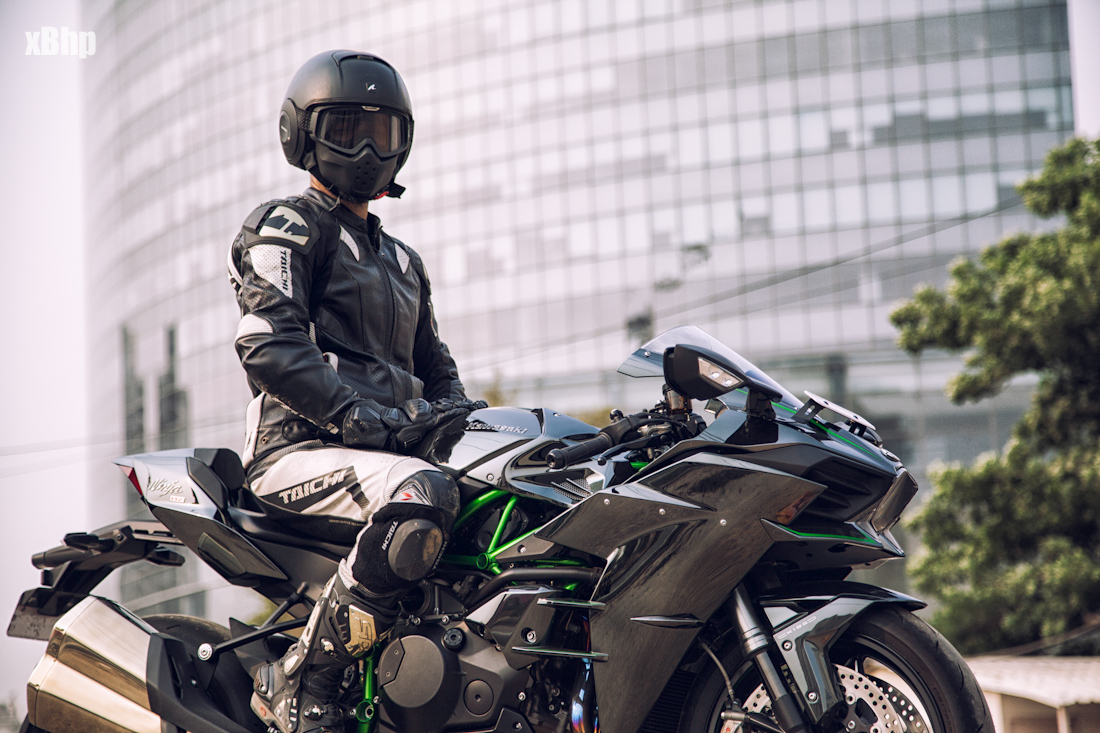
The bike itself is not as compact as the modern superbikes that are meant to be track tools, nor is it as big as a supertourer like the Hayabusa or ZX14. It sits somewhere in between and it definitely looks bigger than it is thanks to the generous use of bodywork.
And of course the biggest thing that makes the H2 unique is that there is no other supercharged production bike in the market.
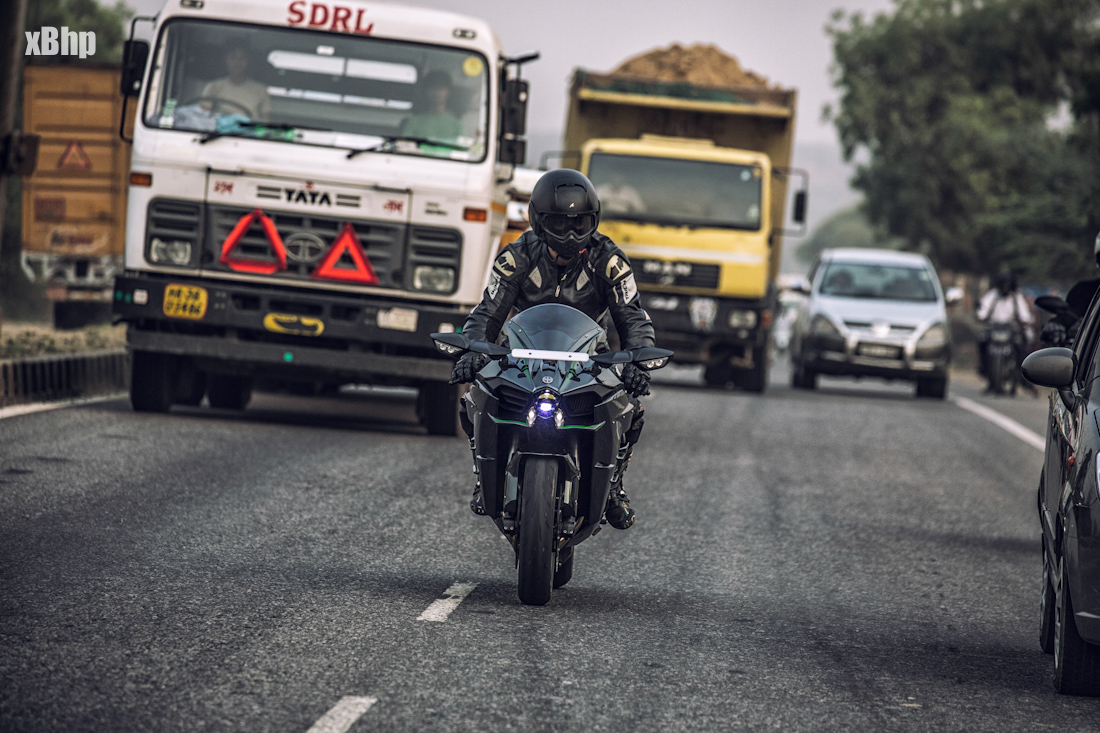

Riding the H2 on Delhi roads is not exactly what you would term as ‘reviewing’ such a motorcycle or even getting the right impression. But let me tell you, we all know it’s bloody fast and it’s got host of technology stuffed into it. It is a landmark motorcycle and no matter what flowery language I put down to say this, this bikes needs no reviews, it needs to be bought (if you have the money) and ridden.

There is a lot of tech inside the bike too, along with the engine which has been developed from ground up to accommodate the supercharger without an intercooler to keep things cool. To achieve this, Kawasaki took help from its aerospace division, much like you probably take help from your colleague to put together that presentation – “Hey, guys, can you leave designing the planes, jets and whatever useless stuff and work on something actually exciting that can be used on planet Earth?” ”Yea, sure” どうも有難う(thanks!).
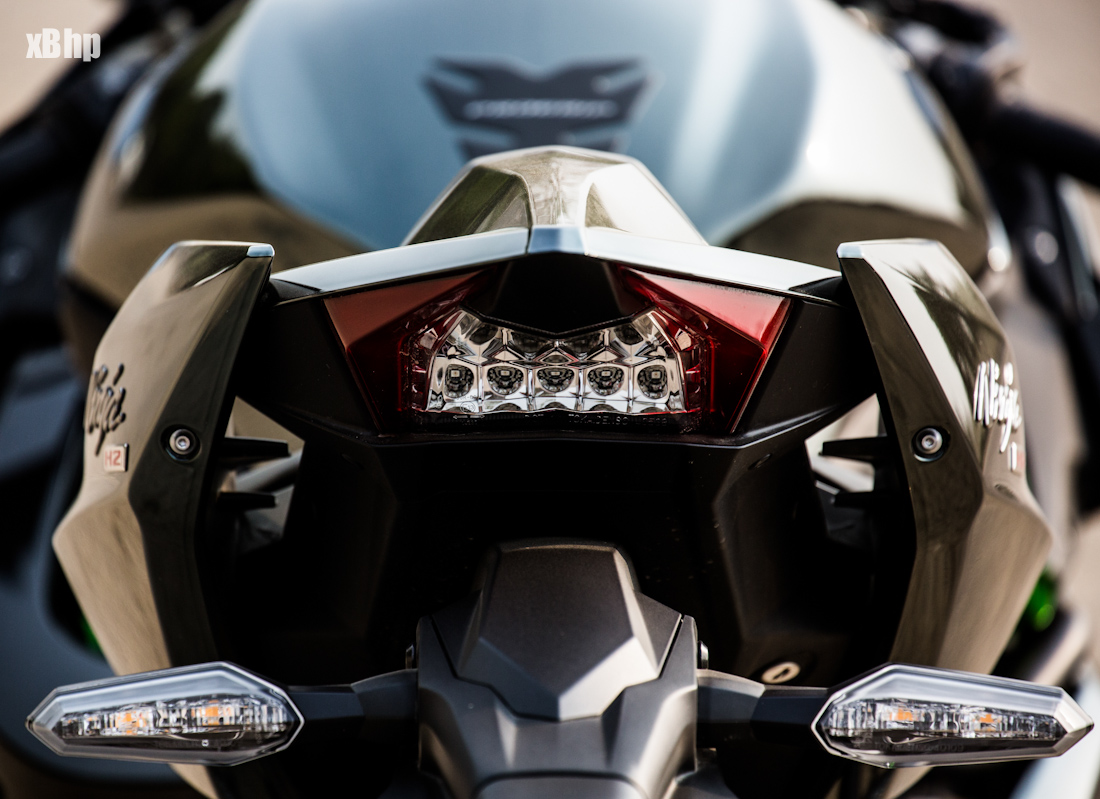

That was it. This is how big Kawasaki’s prowess is. Motorcycles are but a hobby for them. Delving into how they managed to keep things cool despite adding the supercharger without an intercooler actually makes riding the bike more interesting, especially in a hot country like India. From using a heat dissipating superalloy named Inconel to using 35% more oil (4.9 litres) than standard litre-class bikes to get rid of that heat, it’s an engineering marvel in itself.
I pushed the bike while being a gentleman and remembering not to drop it or let any elephant, cow, dog, man, cycle, plane, tree, etcetera objects which so widely populate the Indian roads crash into it.
Fifty odd kilometres later I came down the bike, carefully swinging my legs over the rear cowl unit as not to scratch it and handed the keys back over to the humble owner. We needed something exciting and affordable like this to stir things up, I am not sure for how long I have to wait for another landmark moment like this, but I hope it’s soon, both for the motorcycling industry and as a motorcyclist.
While the 200 odd horsepower seemed enough for the H2, I cannot even begin to imagine what the H2 R will be like with an additional 125 horse power and 15 odd kgs off it.


Kawasaki Ninja 250R Review
 Feb 2015 Sunil Gupta
Bikes,Kawasaki,Motorcycles
Feb 2015 Sunil Gupta
Bikes,Kawasaki,MotorcyclesThe Kawasaki Ninja 250R Review and Ride Report by xBhp.
Text: Sunil Gupta/ Sunilg
Photos: Sunil Gupta/ Sunilg & Sundeep Gajjar/motoGrapher
with Special Thanks to: Castrol Power 1, Kawasaki Philippines, & Motorcycle Magazine Philippines

They say perfection is difficult to improve upon. Difficult, but not impossible! The Kawasaki Ninja 250R was one such perfect (well, almost!) bike that everyone thought was too good to improve. To its owners, it gave everything that they could expect from a quarter-liter machine, sometimes more than their expectations – case in hand, the brakes that are among the best that your money can buy.
The Ninja 250R though didn’t stir a storm in the Indian market, thanks to its steep price tag and our price sensitive market, but it did make its mark and the Indian bikers had a real performance bike in a very long time after the legendary RD350.
So when the rumours of a face-lifted baby Ninja started to appear on the worldwide web, it did become the proverbial talk of the town. And with the expectations were already so high, the folks at Kawasaki had little choice but to come out with something that is as groundbreaking as the previous Ninja was.
We at xBhp got our hands on the newest baby Ninja, the 2013 Kawasaki Ninja 250R, in Philippines a few days back, thanks to the Motorcycle Magazine and Kawasaki Philippines. And boy, did it leave us speechless or what! Here’s our 2 cents on what we think of this bike.
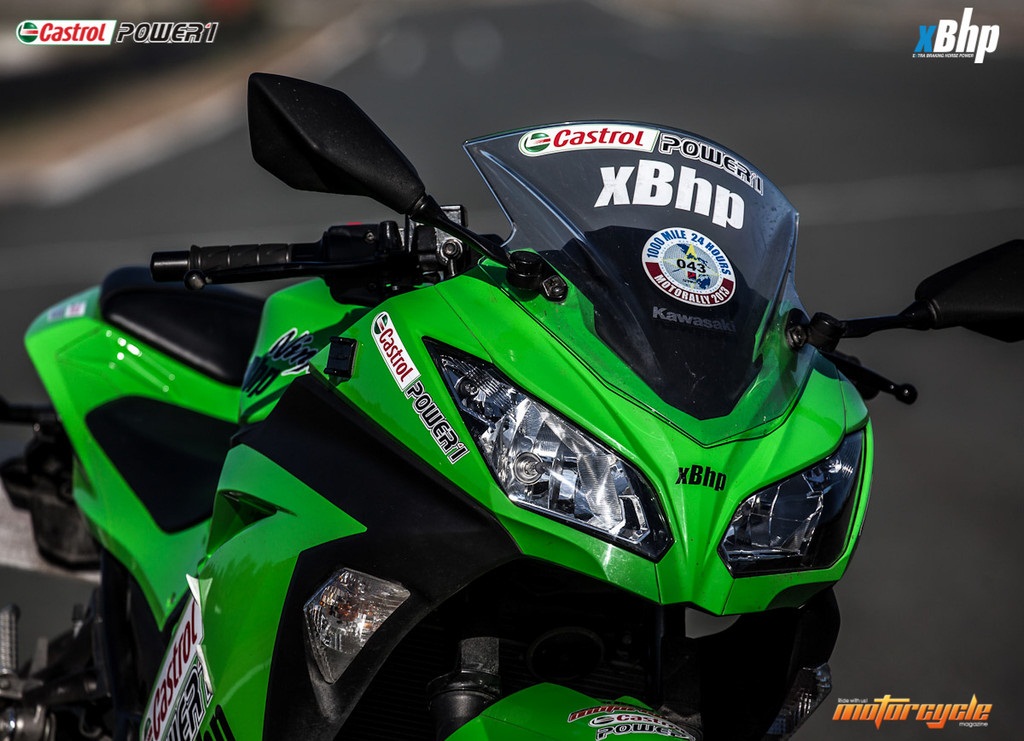
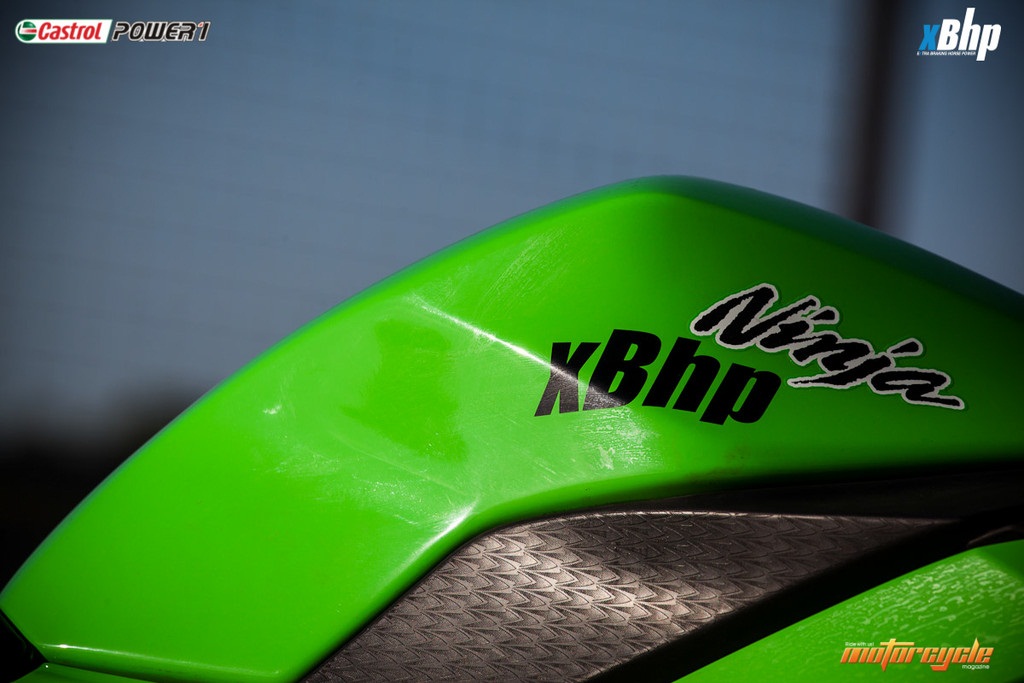
Looks & Styling: The initial official photos of this green baby that were released in the latter half of 2012 didn’t leave any chance for disappointment. What the Kawasaki designers had pulled out was nothing short of a rabbit out of the hat. The 2013 Ninja 250R looked drop-dead gorgeous in pictures and does so in flesh. It’s got sharper looks like that of a supermodel that puts it in the league of the ZX-10Rs looks wise, and perhaps even better. The tank is even more chiselled, and so is the tail, and together they play a big role in giving the bike a very mean look. The rounded exhaust pipe gives way for an all new angular, powder coated, black exhaust pipe with a chrome heat-shield. The new pipe not only looks good, it also sounds a lot better, particularly once you rev the bike past the 5000 RPM mark. The previous singular-body headlight has been done away with and gives way to the angular twin headlight system that vaguely reminds one of its bigger sibling, the Ninja ZX10R. Then there’s the all new digital + analog console instead of the plain jane fully analog unit on the previous 250R. The new unit has a large analog tachometer, a smaller digital speedometer display that also has 2 tripmeters, an odometer and a digital clock too. The bike comes to life with a cool animation on the digital console as you turn on the key. The backlight color is moonlight white. The numbers on the digital unit were clearly visible while riding even during bright daylight. And finally, the baby Ninja also gets the much awaited ‘pass’ light switch that was missing on the older models.




Ride posture and comfort: The 2013 Ninja 250R comes with an all new suspension and frame and looks like a super-sport 600 cc bike, but feels much more compact, agile and lighter than the older model when you are actually riding it. The riding posture is practically the same; however, thanks to overall compactness and agility, the newer one feels sportier than the previous 250R. The seat seemed just a wee bit taller but the handlebar-seat-footpeg relationship seems almost the same as with the older version.


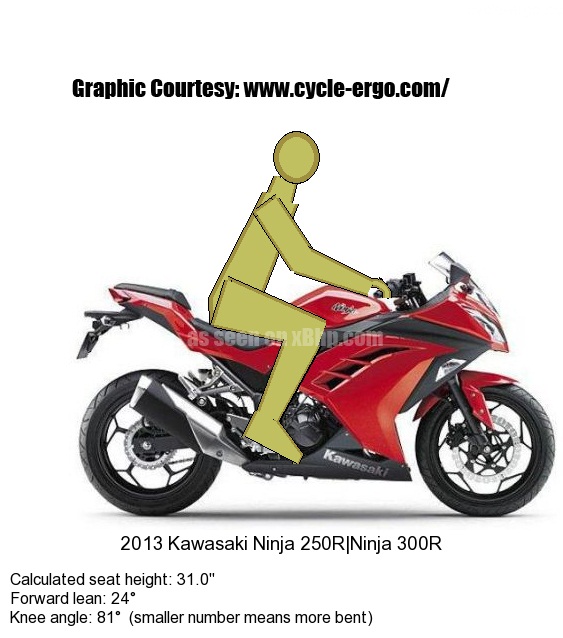
Engine: The 2013 Ninja 250R will be powered by an all new 249 cc, 4-stroke, fuel-injected, liquid cooled parallel twin engine pumping out 31.5 BHP at 8500 RPM mark, which is slightly less than the older baby Ninja that gave around 33 BHP at 11000 RPM, but the low end torque feels significantly better with this new engine. Inside, the engine is made of sleeveless, die-cast aluminium plating for better heat dissipation. The pistons are also anodized. There is a bigger oil sump as well to further aid in the cooling process, thus to keep the engine stress free even in demanding conditions. As we said earlier, it is the mid range where the 2013 Ninja 250 really shines. You will be required to do a bit of gear shifting in the city traffic to keep going without hiccups, but overtaking the speeding cars on the highway isn’t going to be much of an issue. The gear shifts are smooth and positive.
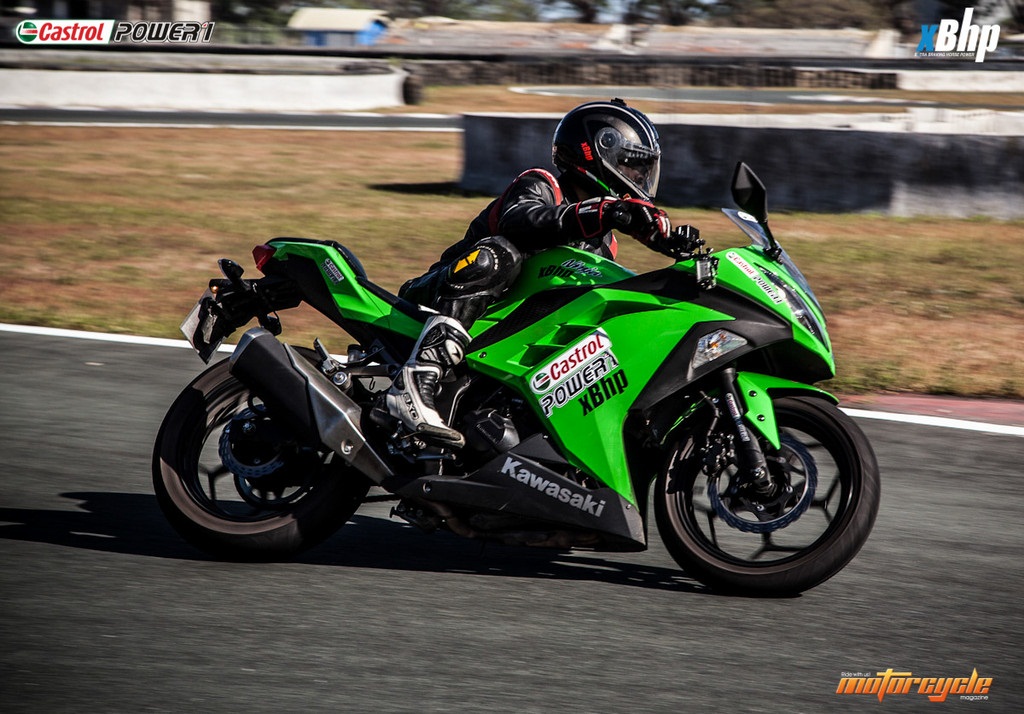
Performance & handling: Handling wise, the Ninja 250R is undoubtedly the best machine in its category and otherwise. The newer Ninja carries the same DNA and handles like a charm. During our approximately 1500 KM ride in Philippines, the 2013 Ninja 250R felt at ease both during the sustained high-speed runs on the expressways and the bumper-to-bumper city traffic during peak hours, showing no signs of stress or overheating at anytime.
We also got an opportunity to take it for a few laps on the Clark International Speedway in Philippines where it once again proved that it is the uncrowned king of the tracks. The sharp and tricky corners, including the corkscrew, were handled with so much ease that this track felt like home and the bike was inviting us to push ourselves more and more.


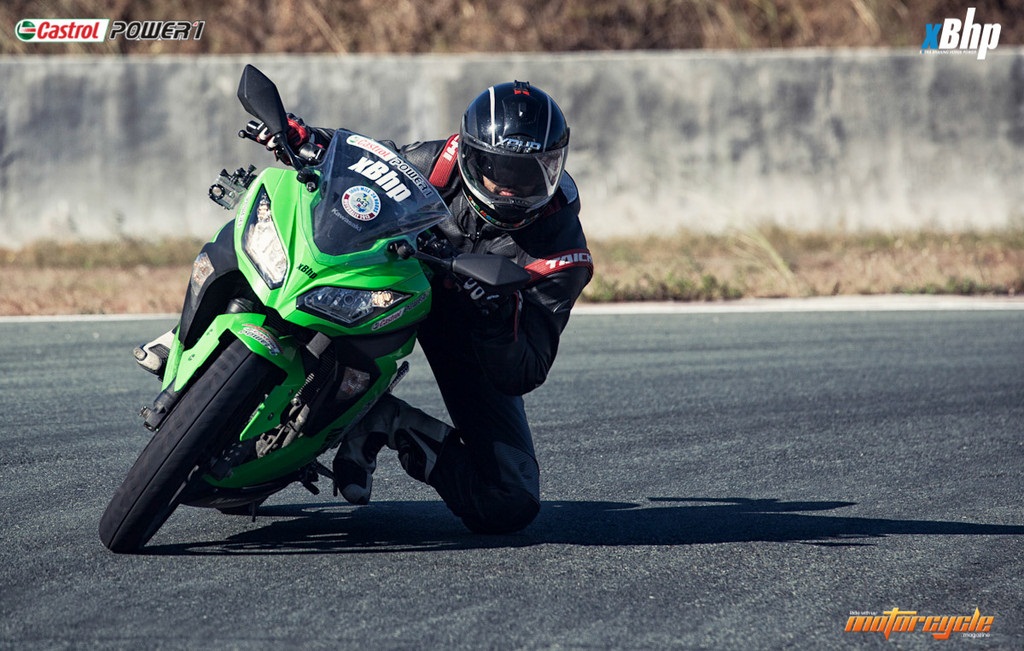

These markings on the sliders should tell you a lot about the way the new baby Ninja handles
Braking: Braking has always been the USP of the Ninja 250. It is not just best in class but beats several bigger and more expensive bikes in this department. The 2013 Ninja carries the same 290 mm petal disk at the front and the 220 mm petal one on the rear, giving it the same phenomenal stopping power that its predecessor had.


Fuel Economy: Though we are pretty sure if you are planning to buy this little green monster, fuel economy will be the last thing in your mind. But for the numbers sake, we got an overall fuel average of around 25.5 KMPL, which is pretty close to the claimed figure of around 26 KMPL.
Price: The newer and the older Ninja 250R are both available in Philippines at around 250,000 PHP or 332,795 Rupees. So we can see that Kawasaki is offering the latest goodies at no extra cost to the consumers, which makes it even more desirable.
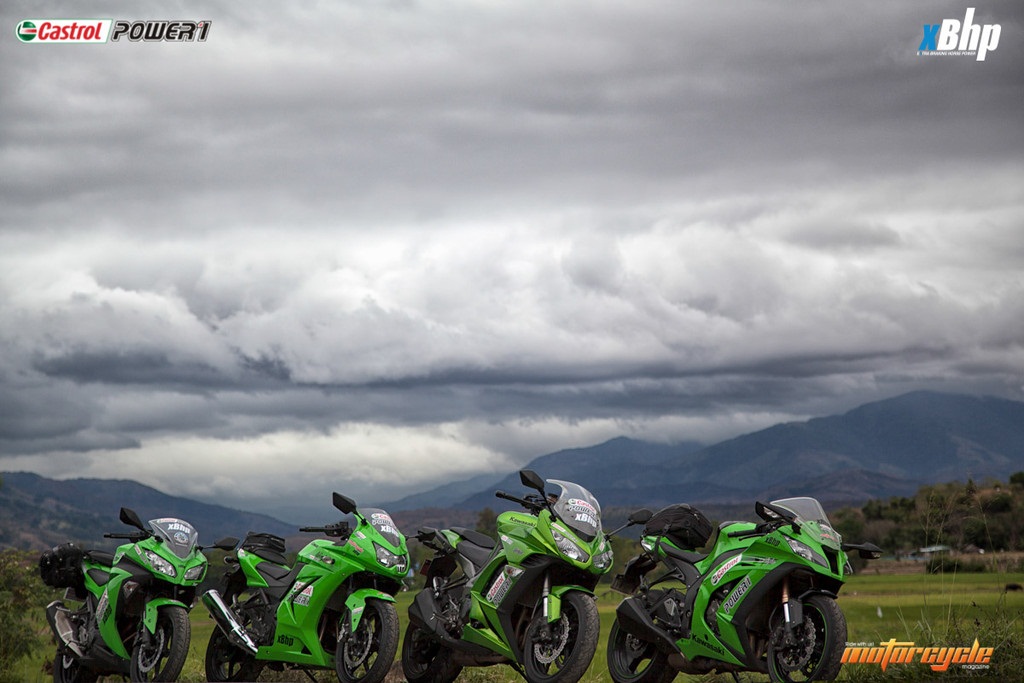
Overall: The 2013 Kawasaki Ninja 250R stood true to its name and left us happy and craving for it. It not only carries the Ninja 250R DNA but also excels in all departments and performs better than its predecessors. However, the bigger question right now is whether or not this baby will make its way into India, or whether a bigger displacement machine (300 cc Ninja) would land it here. (We personally think that the 300 would be brought here by Kawasaki.) This confusion should get clear soon as we get closer to the speculated launch dates of the new Ninja. Whether Kawasaki brings the 250 or the 300 or both, we have no doubt that it is going to be a winner as the engineers at Kawasaki have perhaps mastered the art of making a perfect quarter liter bike. The Ninja 250R hasn’t been the segment bestseller for no reason.


P.S.: What if we have the Ninja 300 in India: The only bike that could pose any danger to the dominance of the Ninja 250R was the Honda CBR250R, thanks to its much cheaper price tag. The CBR250R gave more bang for the buck for average Indian biker who isn’t really interested in a superb performer but wants as much visual appeal as a Ninja owner, and decent performance. The Ninja 300, if brought in India, would again draw the attention of potential buyers who were looking beyond the usual 250s that we have presently in the market. And as there is no replacement for displacement, the 300 would pack in some more punch to brag about and to actually use on the track and the on road. Also for those who want to stand out of the crowd but don’t have deeper pockets, this would provide a better option.


Benelli TNT 600GT Review
 Jan 2015 Sunil Gupta
Benelli,Bikes,Motorcycles
Jan 2015 Sunil Gupta
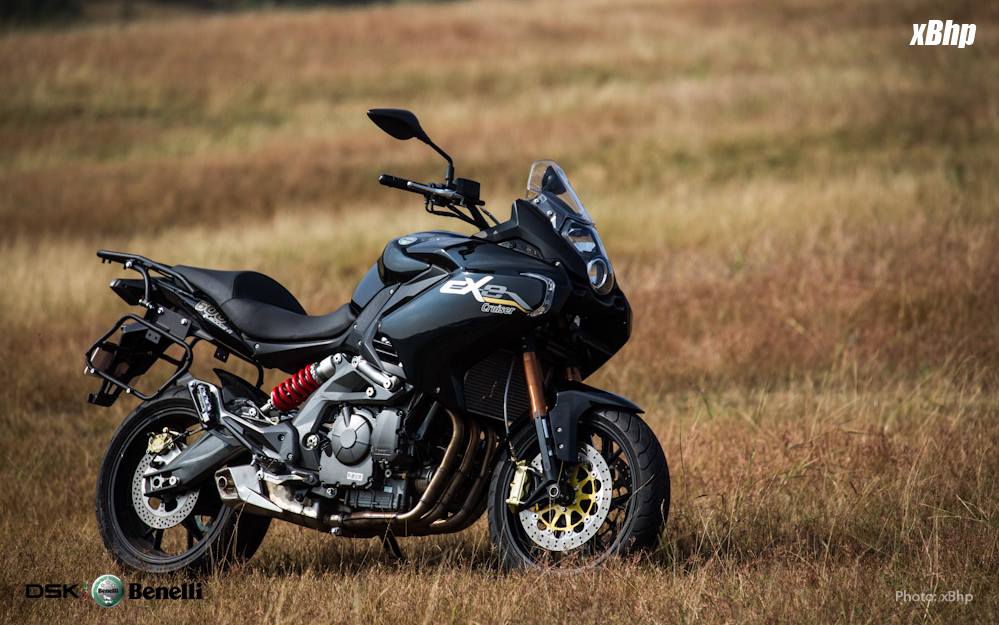
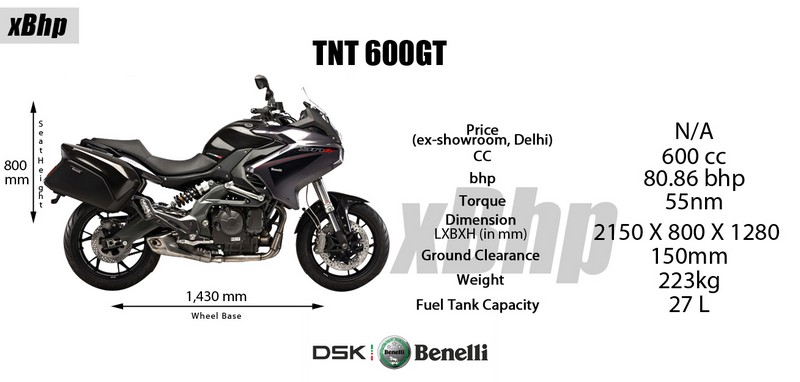
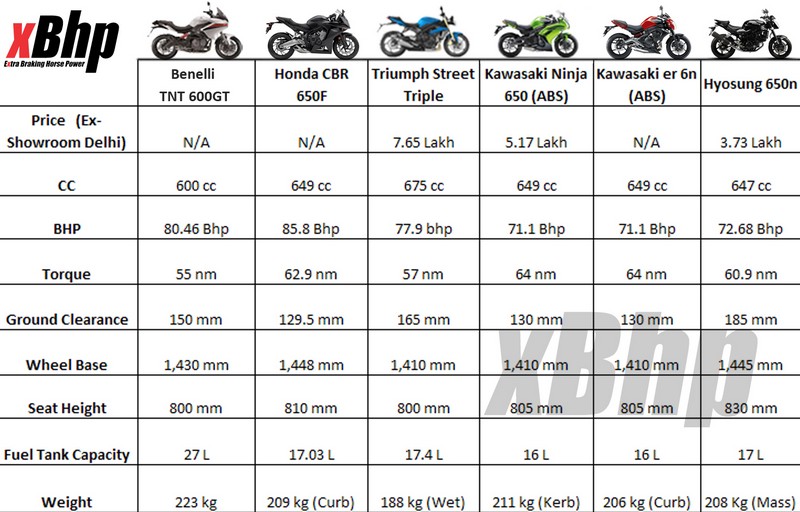
Benelli,Bikes,MotorcyclesIf your memory serves you right, you’d remember a mid-size semi-faired bike with a couple of panniers thrown in, sharing the stage with all the other nakeds during the DSK-Benelli joint venture announcement. I saw the same bike at EICMA at the Benelli stall. The bike showcased there was the Benelli TNT 600GT, which is a touring variant of Benelli’s popular TNT 600 naked with a wider seat, semi-fairing, huge tank (27 L), and a dual projector headlamp setup. Powering the Benelli TNT 600GT is the same liquid-cooled, DOHC inline-four machine that is fitted onto its naked sibling, the TNT 600. Available on tap from this engine are 82 horses at 11,000 rpm and around 56 Nm of torque at 8000 rpm. This fuel injected engine is mated to a 6-speed gearbox, which transfers the 82 horses to the rear wheel in a rather calm and subdued manner. There is no sudden rush of adrenalin even if you twist the throttle vigorously, but a smooth and seemingly unhurried surge of power. This makes the TNT 600GT a suitable bike for those who are planning to upgrade to a powerful yet unintimidating machine that would take care of their city commutes as well as occasional long hauls to the Himalayas or some other unexplored territory. A change of tyres to something which can handle gravel and off roads would however be prudent.
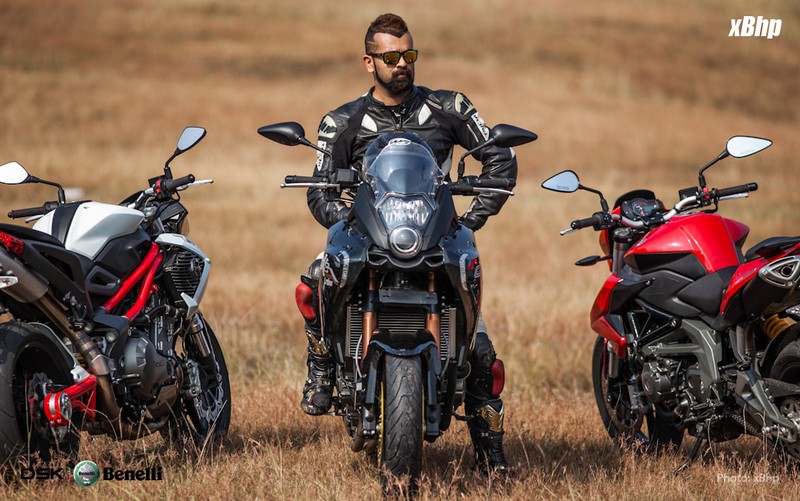


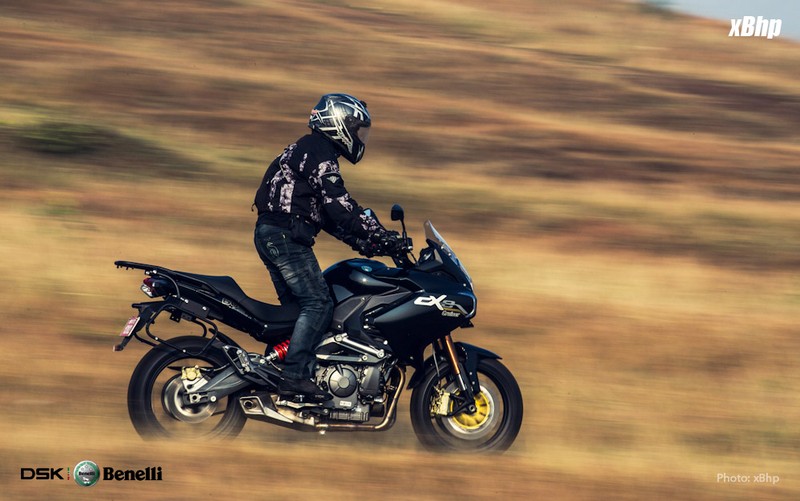
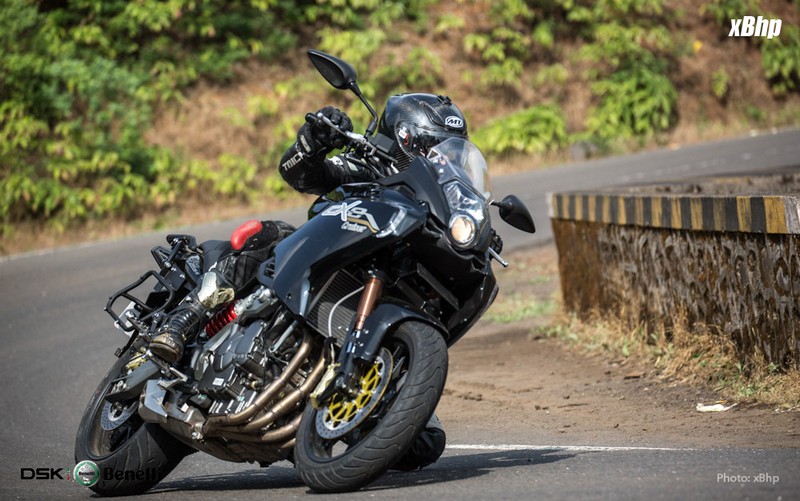
Absorbing the impact from the road is the suspension system consisting of a 50mm USD fork at the front and a single side mounted monoshock at the rear. Braking was well taken care of by two 320 mm twin discs up front and a 260 mm single disc at the rear. This bigger tank and the fairing do make the Benelli TNT 600GT appear huge from some angles; however, once you sit on it that bulkiness seems to disappear completely. From the saddle, the GT looks well balanced. Even riders of short stature would find themselves at ease sitting on it. Despite all its visible bulk, the best thing about the 600GT was the way it handles. Thanks to the sorted chassis and the suspension setup, the bike simply surrenders itself to the rider and does exactly what he wants it to do and goes exactly where he wants it to go, be it in crawling city traffic or high-speed runs on the highway. Ample low end torque let it take the bumper-to-bumper city traffic with utmost ease. Thanks to the ultra-sticky Pirelli rubber, it seemed eager to take on the corners of Lavasa with aplomb and even while riding in the Pune city traffic on a Monday evening for around an hour, the bike showed no signs of overheating and that for me was a wonderful thing. Fit and finish wise as well, the bike didn’t leave us disappointed.


The color options that are going to be available in India for the Benelli TNT 600 GT



Benelli TNT 600i Review & First Impressions
 Jan 2015 Sunil Gupta
Benelli,Bikes,Motorcycles
Jan 2015 Sunil Gupta
Benelli,Bikes,MotorcyclesThe Benelli 600i was a sweet surprise. I will start off with a verdict first: This is one of the best 600s I have ever ridden.
Looks:
Edgy and futuristic. Except for the front headlight which is pretty ordinary (but by no means bad) compared to the rest of the bike, the whole package is attractive. I rode the red one and it was the red we are used to seeing on Ducatis and Ferraris, in other words – Italian red. Nothing suits better than red on an Italian machine somehow, eh? Well, this is another proof.
The frame is comprised of a front steel trestle and rear aluminum. I would have preferred the trestle to be red as well ala the 899, perhaps it would it give the bike a sportier look? (see below)
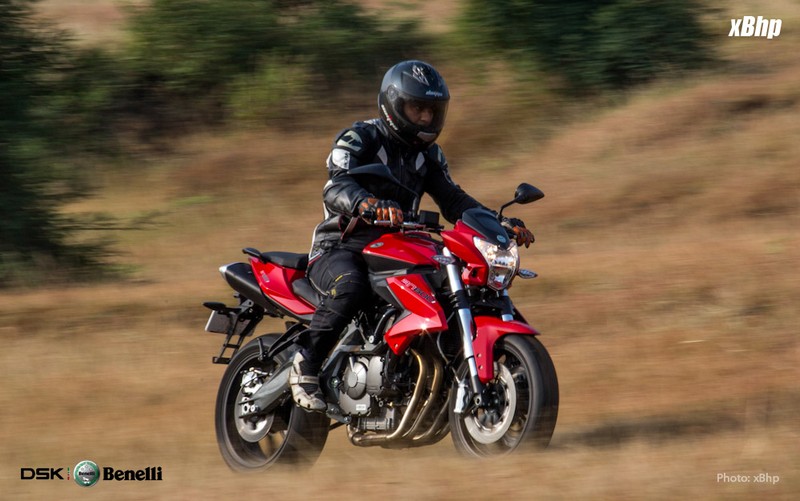
The instrument cluster is again minimalistic, but by no means ugly. The panels lines are angular and the stickering minimal.
The best part of the bike for me was the rear with its dual edgy and triangular underseat exhausts. It should look better with tail tidy and mini aftermarket indicators. I find no reason (other than perhaps gaining more power) that one should replace the stock exhausts with aftermarket ones. They also look and perfectly match the lines of the bike.
The side scoops give the bike a meaty streetfighter look. I would still prefer a projector lamp up front ala the 600T should Benelli thing of making this bike a perfect looker.
Overall the bike looks very attractive, though not obviously Italian (like the 899). The fit and finish is top notch and you would have to try pretty hard to fight the fact that it is made in China (with all due respect many luxury products and electronics are indeed made in PRC).
Performance and Engine:

There are hardly any 600s in the Indian market today. And I suspect that the BN600i will be amongst the more exciting ones. Once you thumb the starter the bike gives you instant aural pleasure. It is already loud and sweet in it’s stock form. The seating posture is comfortable enough for long rides and it feels torquey right off the mark though the real fun starts at around 4500 rpm. It is an inline four (unlike the 899 which is an inline three) and it revs pretty high for a street naked – 82 Bhp at 11500 rpm and 52Nm at 10500 rpm.
The bike feels pretty light and peppy. Despite being an inline four 600 the initial pull is good enough for slow traffic. Overtaking is also relatively easy with a linear powerband that also makes it suitable for touring. A fly screen and saddlebags should turn it into a good long distance machine. Maybe spacers would help take off more loads from the wrists for that odd Iron Butt ride you may plan.
It will also serve to be a great transitory bike before jumping onto a litre class from a quarter litre. The power is not brutal and the overall nature of the bike is forgiving. In fact I sometimes thought I was a riding a Japanese, yes it was that smooth (despite it being a media test bike).
I was particularly at home in the corners with the bike – light and flickable. Though definitely ABS would make it more newbie friendly, the brakes do a good job.
It has also got the best ground clearance (178.5mm), the best being that of the Hyosung GT650N at 185mm in this CC segment, so you can think of taking it to Ladakh with appropriate tyre, underbelly plate and a handlebar riser mods.
I think this will be one of the hottest selling bikes in India, if they price it right and have the appropriate service backup and spare part inventory.




Benelli TNT 899 Review
 Jan 2015 Sunil Gupta
Benelli,Bikes,Motorcycles
Jan 2015 Sunil Gupta
Benelli,Bikes,MotorcyclesLegend has it that the first TNT 1130 super naked models were almost untamable, wheelie addicts with a certain raw character that you will rarely find in the super refined engines of today. This was in 2004, when the first naked TNT came out. Things have changed since then. The current TNT 899 Naked which I rode is touted to be much more refined and docile monster (pardon the pun which might refer to a certain model of another Italian marque). The engine of this bike was derived from the original 1130 superbike engine that Benelli had developed.
The 899 used to come in two flavors, the T and the S, the latter being introduced in 2008. The two versions differ in suspension, with the S having a fully adjustable front fork. Now it has been consolidated, but surprisingly leaving the ability to adjust the front fork behind. There is still some confusion as to which models are still available globally, but in all probability it will be only 899 TNT, the T version.
She’s got the Looks
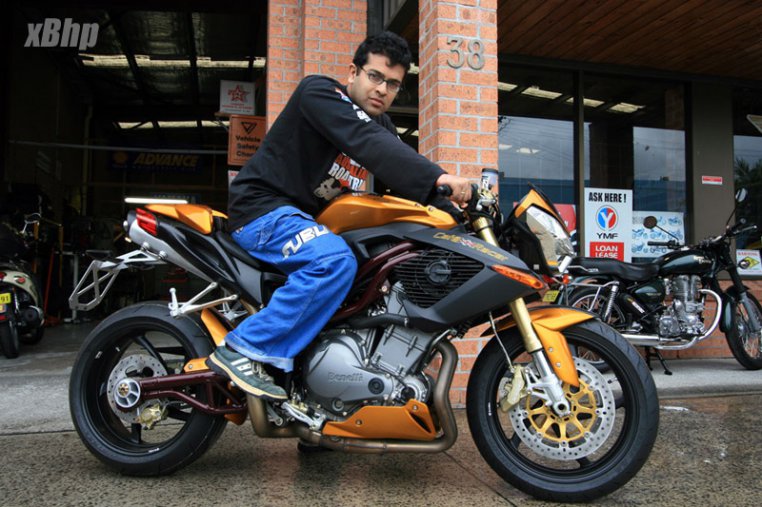
I first sat on a Benelli back in 2007 in Sydney
This was shot by Kulpreet Singh way back in 2007 on The Great Australian Roadtrip (which was done on two Hyosung Gt650Rs, 22000 kms) in Wollongong, Australia near Sydney. I spotted this Benelli and was excited to see the exotic for the first time in my life. I did not know that one day I would be riding it on the Indian roads! This is the 1130 Cafe Racer. I usually never sit and pose on bikes which I do not test ride / own but I made an exception to this one! And what a coincidence – both the brands : Hyosung and Benelli are bought to India by the same company – DSK!
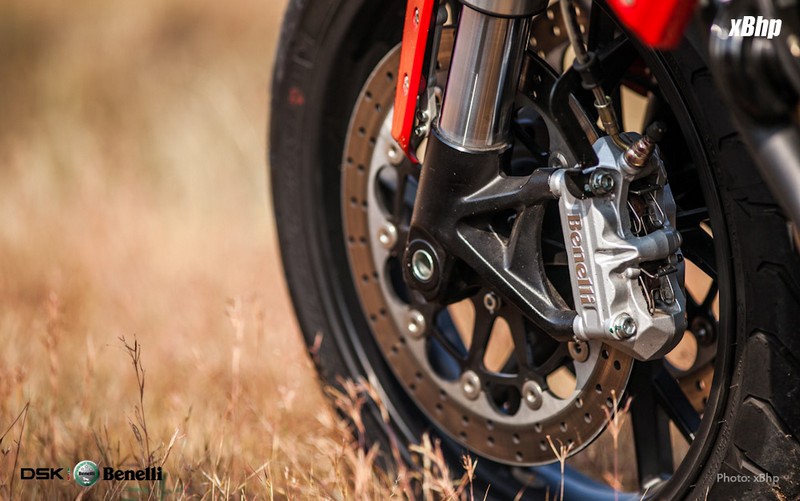
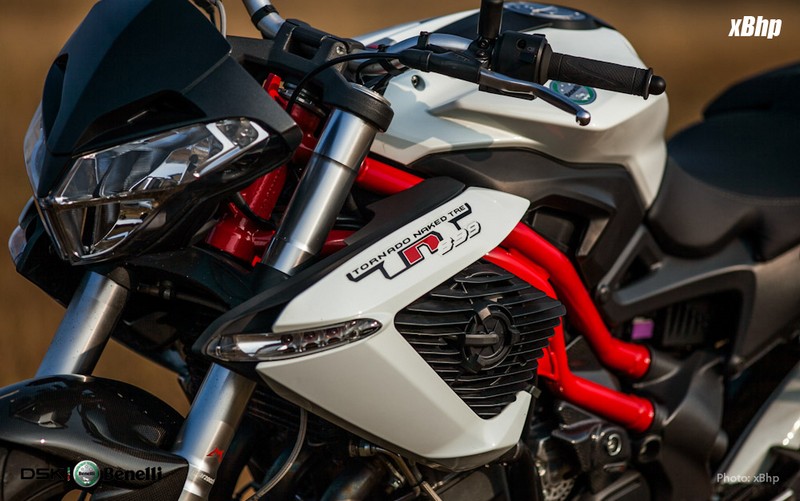
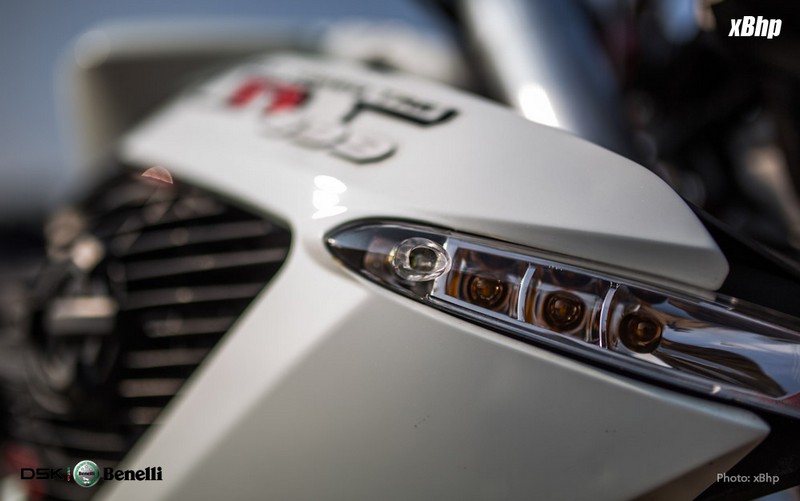
It is touted to be one of the best renditions of the naked motorcycle theme, and I agree. Being an Italian it had to look radical. The first look will leave you intrigued. There is a lot going on to keep your eyes busy. From the unique side mounted radiators to the suave petal discs and the unique front static headlight arrangement that is complemented by the underseat exhaust flanked by interesting two piece taillights and a red swingarm and frame which stands out.
The front 3/4th view looks the best and very meaty for the 899. The most unique visual feature of the 899 has to be the side mounted radiators. But the Benellis have been known to put their radiators in strange places. The Benelli Tornado Tre 1130 had its radiator under the seat (!) and two radiator fans right below the tail, giving it a faux exhaust look which looked really cool!
The instrument console is pretty basic but again functional.
The build quality and workmanship of the 899 (which is made in Italy and not in China) is excellent.
Firing it Up
The 899 is an inline three setup. The sound is literally music to your ears, it is not as refined as an inline four, but it is not as raw as a Vtwin either. It is loud enough to warrant for some sort of modification while being homologated for sale in India. I hope that doesn’t affect too much performance.
And off you go
The bike feels solid once you sit on it. I was a little disconcerted when I realized that the front headlight is static, taking a bit away from the naked theme, but after a while I didn’t really realize it. The gear shifts are precise and the first gives you a reassuring thud. Release the clutch and the 118 Bhp / 88 Nm of torque do their bit to coax you into twisting that throttle until the bike gets into a frenzy, which it does at around 8000 rpm. Soon enough you want to behave like a hooligan on it. The upright stance coupled with a slightly aggressive rearset pegs encourages you to flick the bike in corners like I did en route to Lavasa. In no time I was thrashing it like a superbike, the sound goading me on. The Lavasa surrounds propelled me into day dreaming that I was riding somewhere in Italy, which I have come to love so much in the last few years of riding there.
I took it off road and over potholes too. The suspension, I felt, was a little too hard but then I was riding it on all kinds of road a little too hard.
Make no mistake, even though it is ‘just’ 118 odd bhp, remember its from a 900cc mill and it is Italian. The overall package is very attractive, though I would have loved to have ABS and traction control on it to make it a complete package. What is interesting though is that Kawasaki seems to offer ABS as standard on the Z800 in India. But the 899 is a lot lighter than the Z800 (see compare charts). What is more interesting is the Ducati Streetfighter is the only modern Ducati that doesn’t have ABS! Makes me wonder what might be the reason? However, I am used to riding a Yamaha FZ1000, which is 150 Bhp without these aids, however they do make life easier and safer on the roads. The Brembo brakes however do ensure enough bite via 2 x 320 mm discs up front and one 240 mm disc at the rear.
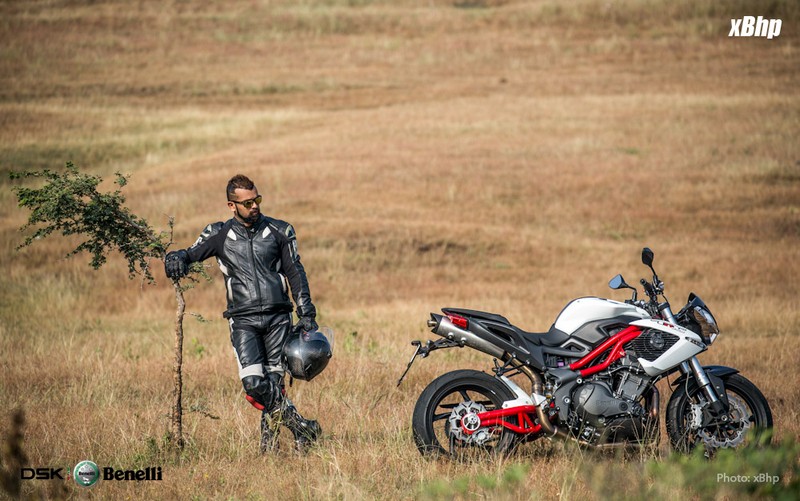
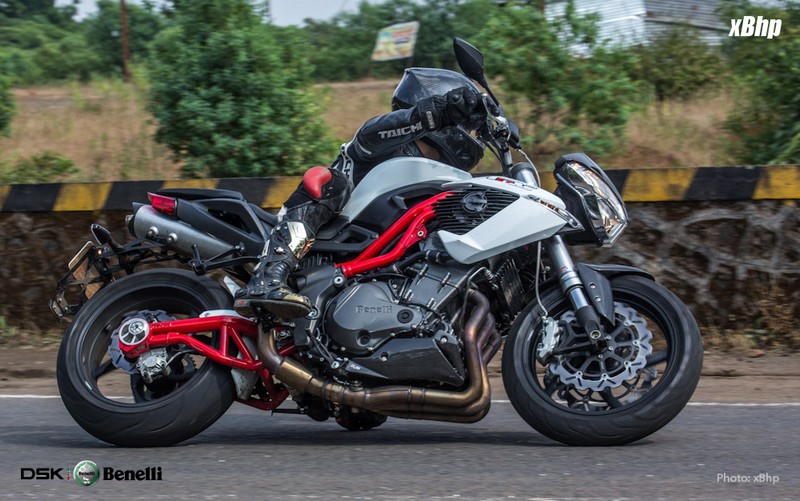

To sum it up the 899 will be a great option for a mid range power naked. Everything now depends on the pricing, if it is priced around 7.5 ex, it should be a winner!
Make no mistake, even though it is ‘just’ 118 odd bhp, remember its from a 900cc mill and it is Italian. The overall package is very attractive, though I would have loved to have ABS and traction control on it to make it a complete package.




Triumph Bonneville Review
 Dec 2014 Sunil Gupta
Bikes,Motorcycles,Triumph
Dec 2014 Sunil Gupta
Bikes,Motorcycles,Triumph
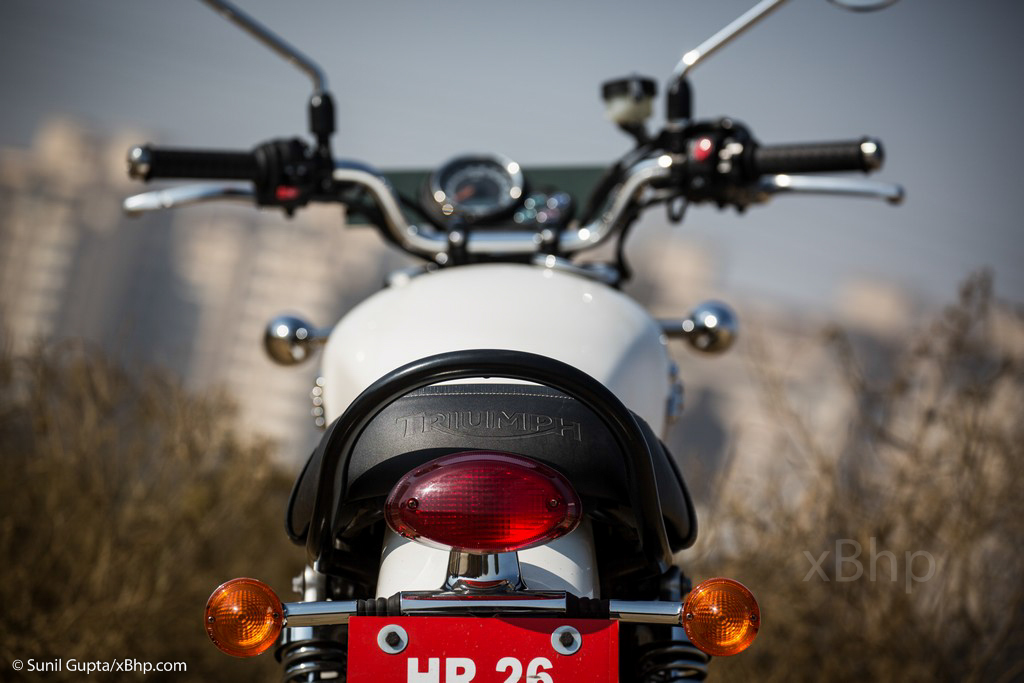
Mixing the soulful charm of a classic with the functionality of a modern machine is not an easy task, at least not as apparently simple as it appears with the Bonneville. Visually it is a peace offering – evoking warmth inside akin to that inside glow on meeting an old loved friend. It is so ‘motorcycle-like’ in elements, proportions, appeal and as a whole. You want to ride it but without rushing into it. Quite unintentionally, you slow down as you walk towards it, go around it with a light hand brushing all over and then take a short step back before finally swinging a leg over that saddle. Those proportions don’t hide the low height courtesy those 17 inch die-cast wheels. So the saddle height (740 mm or 29 inches) is accommodative for anyone standing north of 5 ft. vertical. And yet for my ‘well-fed’ 5’11” frame, the feeling of being at home on the rider’s seat was apparent. Conclusion: good static ergonomics huh!


Okay, let’s be systematic in knowing the steed first before jumping on to the nitty-gritty. The Bonnie’s design harks back to some 5 decades in the past when it was the iconic symbol of independence riding astride rebellion. It was the ride of the era and the dream of every youngster, middler and oldie in love with two wheels alike. And it comes alive again on our shores. Powered by that 865cc air-cooled (with an oil-cooler though) DOHC (double over-head cam) parallel twin with the famed 360o firing interval, this is motorcycling at the simplest and yet phenomenally effective. 68 PS at 7500 rpm and 68 NM torque at a low 5800 rpm means you have the best of both worlds wrapped and rolling under that right palm. Pull through the gears for a quick getaway or laze around town in 4th just needing a slight twist of the throttle to get past the slow-hogs. Easy riding which allows you to sit up. The engine is silky smooth and there was no hint of any fuelling glitch except just off-throttle from idle – a slight hesitation there but that could have been the dubious Gurgaon fuel quality at work. The fuel injection is well worked through – yes – those fake carburettors are fakes as carbs, but real at the throttle bodies. The rpm’s build up briskly though the engine doesn’t make much noise. That plain-Jane aural signature could be a disappointment to some, but for the likes of yours truly who staunchly believes in Theodore Roosevelt’s famous advice on speaking softly and carrying a big stick, the sound is just right!
Also Read: Triumph Thunderbird Storm Review
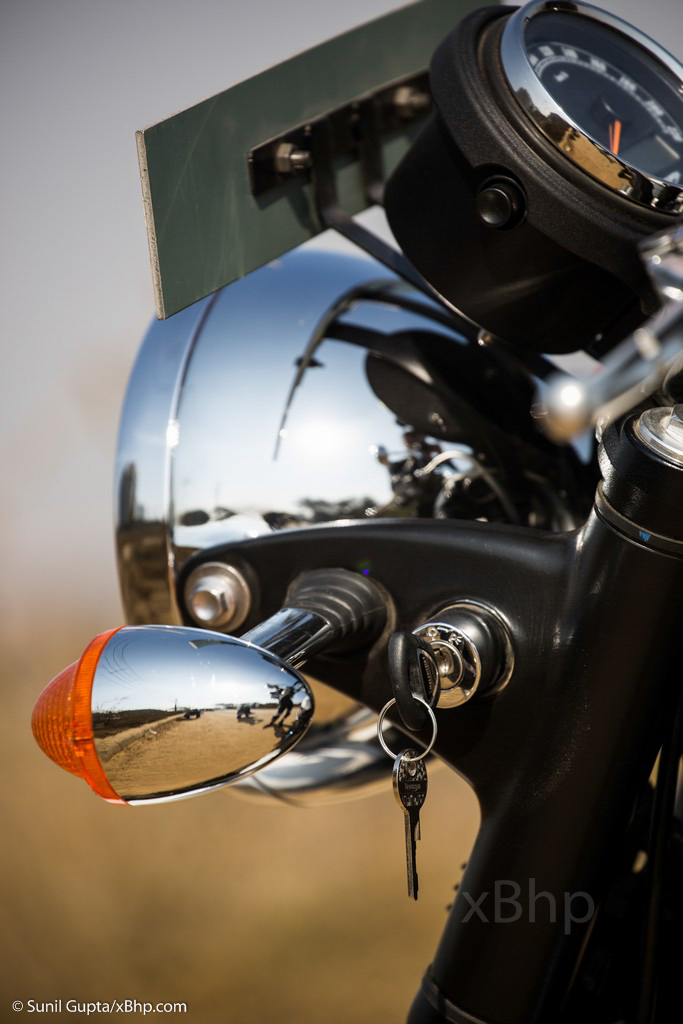
Switch on the ignition – that is if you can find the ignition key slot on the left side headlamp bracket! Truly unique for any motorcycle I have ever ridden. Thumb the starter and the softly tuned thoroughly unstressed engine comes to life and quickly settles to a steady idle even on a chilly morning. It’s a British bike after all and so the cold is never an issue! Blip the throttle and the engine responds with alacrity. Pull in the surprisingly light clutch, shift to first and get underway. Oh! Was riding an 800+ cc bike ever so simple. Work through the gears and as long as you’re retro on the throttle, the Bonnie gives no hint of a relatively large powerplant. The traditionally shaped tank nestles between the knees, the bars provide the right leverage and yet the sheer light-footedness of the bike takes you by surprise. The staid geometry (4.5 inches of trail and 27o rake) coupled with 17 inch wheels and narrow section tyres (110 up front and a 130 at the rear) makes this bike handle like a motorcycle a third its weight and engine capacity. Flickability is crisp without an iota of loss in straight-line stability, thanks to that longish 1490 mm wheelbase coupled with a rigid frame and swing-arm. The suspension is simple, telescopic forks up front and twin shock-absorbers at the rear. The simplicity, though evocative and passably effective, is probably the only weakness in the Bonnie if you feel like exploiting that sweet engine and spot on geometry. The rear gets sprightly and the front flighty on anything but smooth tarmac while cranked over at speed. But go easy as the character of the bike demands and all is perfect.

The brakes are great. Feedback was superb and grip was amazing. You could grade the braking, especially up front, to the tiniest degree. In all probability the superb Metzelers the bike comes shod with have a substantial role to play in this as in the handling. The Bonnie is not light, tipping the scales at 225 kilos wet but on the move, all that weight does the vanishing trick pronto! The almost 2.5 ft. wide handlebars provide enough leverage to lift half a ton given the right fulcrum and so make handling the bike a breeze even while rolling it around the garage. The bars though feel a trifle close to the body and could have been less pulled back. The instrumentation is bare basic and could have been made more attractive and comprehensive but then the blending of the classic and modernity imposes its own rules on the design. The tell-tale lights for high beam, neutral, trafficators etc. are bright enough while the analogue-digital combo display (the analogue speedo is graduated in both kmph and mph) tells the usual tales about fuel level, odo readings, trip reads and rpm.


The one issue on the bike is the absolute absence of wind protection. There’s nowhere to hide and when the pace is upped to triple digits (in kmph usually), the wind blast is not just tiring but can also be destabilizing. Of course with the bike having been around so long and also so very popular, there are loads of aftermarket screens available and waiting for the buyer. Same with the fuel tank filler cap that’s devoid of a lock, a must in a country like ours not just to save the fuel from being pilfered but also the cap itself from being stolen! Speaking of fuel, the consumption is claimed at anywhere between 50-68 miles per gallon which works out to between 18-24 kmpl – not bad at all for an 865cc bike. The smallish 16 litre tank can at best take you a little north of 250 odd km before you start looking for a refill. Not bad but not very nice either for a bike that can be used for a fair bit of touring. Speaking of touring, the stock seat is comfy enough for a couple of hours or more but would leave you butt sore at the end of a long day. On the other hand, we the people of India are used to a series of long days even on the torture rack of the Duke 200 (yours truly included) and have walked away after repeated forays, without carrying away chronic piles!
The Bonnie, on the whole, is a bike you cannot dislike even though you might not outright love it or get excited about. I am though of that ‘in love with it’ category and like the bike not just for its sheer unpretentiousness but also for its true-to-form functionality. I want my rides to do what I ask than to do, respond measure for measure to my inputs and the Bonnie does that. She handles nimble but sure, runs like a Gazelle (standstill to a 100 kmph in less than 6 seconds) or hums like a bee. She feels solidly put together and purports more to being a companion than a servant. You’ll love the retro styling and the modern everything else. You might not like the mirrors, the number plate placement or the visible cables, but these are mere tiny blips on the radar of motorcycling that in general is glowing with fun. And topping it all, at a little above 6 lac INR, the Triumph Bonneville packs more bang for every buck that any other around. Let’s go get it.
Text: Sandeep Goswami (Old Fox)
Photos: Sunil Gupta (sunilg)




KTM RC 390 and RC 200 Review
 Oct 2014 Sunil Gupta
Bikes,KTM,Motorcycles
Oct 2014 Sunil Gupta
Bikes,KTM,MotorcyclesThe KTM RC 390 Review and the KTM RC 200 ridden on Bajaj’s Chakan track near Pune. Also find specifications, price and comparisons with the competition in this review.


Photos: Gourab Das / xBhp assisted by Sundeep Gajjar / motoGrapher


Today is the age of smart ideas. And how smart it is to make just one good engine and put it in different style of motorcycles? Jackpot! That is what KTM and Bajaj did. And the possibilities are endless. You already have a racer and a street naked and if KTM would, you could have an adventure bike and a cruiser too! Heck, they can even have a scaled down version of the xBow car with this 44 HP engine! And of course a trial bike, if India so shows that it desires one badly enough.
So there you have – an entire lineup to choose from. And it will appeal to the ENTIRE spectrum of motorcyclists, brilliant!


Ready to Race, yes sir, the RC 390 is for you.
Ready to Hoon, yes sir, the Duke 390 is for you.
Ready to Discover, yes sir the Adventure 390 is for you.
Ready to Relax, yes sir the CC 390 is for you.
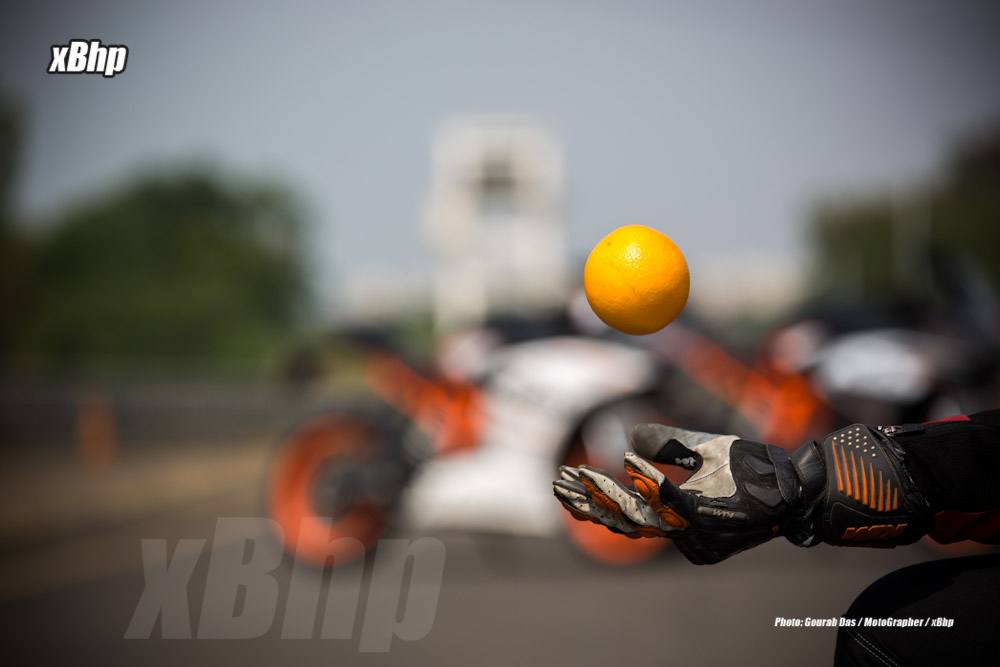
Not Ready yet? Go home and peel off an Orange son.
The KTM – Bajaj partnership was a masterstroke. Building small capacity quality high performance affordable motorcycles have launched KTM into an orbit other manufacturers will find difficult to match. This could have been done by Ducati, BMW or any of the big four Japs, but no, a relatively small Austrian company riding piggy-back on an Indian motorcycle giant steals the show. And it all started with the KTM 200 back in Dec 2011. That knocked the socks off all the other manufacturers who were probably wondering in their board rooms – what the hell just happened? The Honda CBR250r is a great bike. So is the Yamaha YZF-R15. But how can you compare these with an affordable but very high quality high performance machine. It is just not possible without planning and foresight. Everyone else is just too late and I am not quite sure what are they waiting for?
Anyways, it seems only Oranges are invited to this party for now and so let the juice flow…
xBhp was invited by Bajaj to ride the RC390 and the RC200 (the latter having its moment of glory stolen as everyone was so much in love with the 44 horses possessed by the 390!). So let’s start with the obvious…


Looks: Hot, hot, hot!
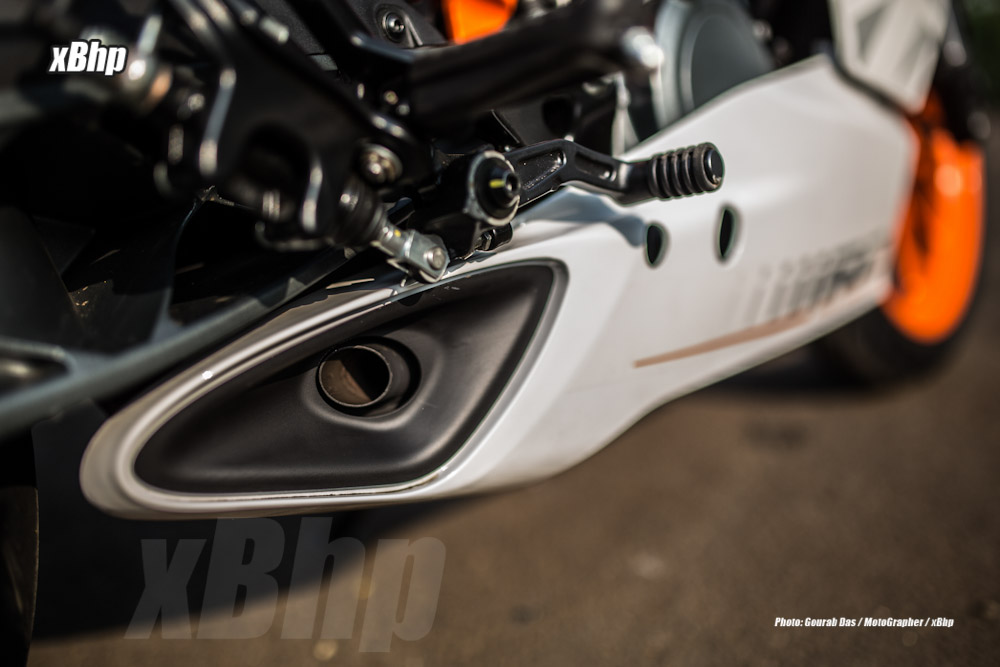
It is not easy to make something look different and beautiful today where there are plethora of options, yet KTM has wisely borrowed just enough lines from the RC8 1190 while dropping the debatably weird front and choosing to go with the new and relatively fresh horizontal dual projector setup. The profile of the bike hits the right spot, the proportions dead right and it looks like a big sports bike. The front and rear is however a different story. The bike is pretty sleek, measuring 748mm at its widest (Ducati Panigale is 810 mm in comparison), if you look orthogonally from the rear. However, move just a bit to get a rear three-quarter view and it will blow your mind with its sizeable fairing surface area and the under-belly exhaust blending beautifully down below. The triangular exhaust end complements the rest of the angular lines on the bike.
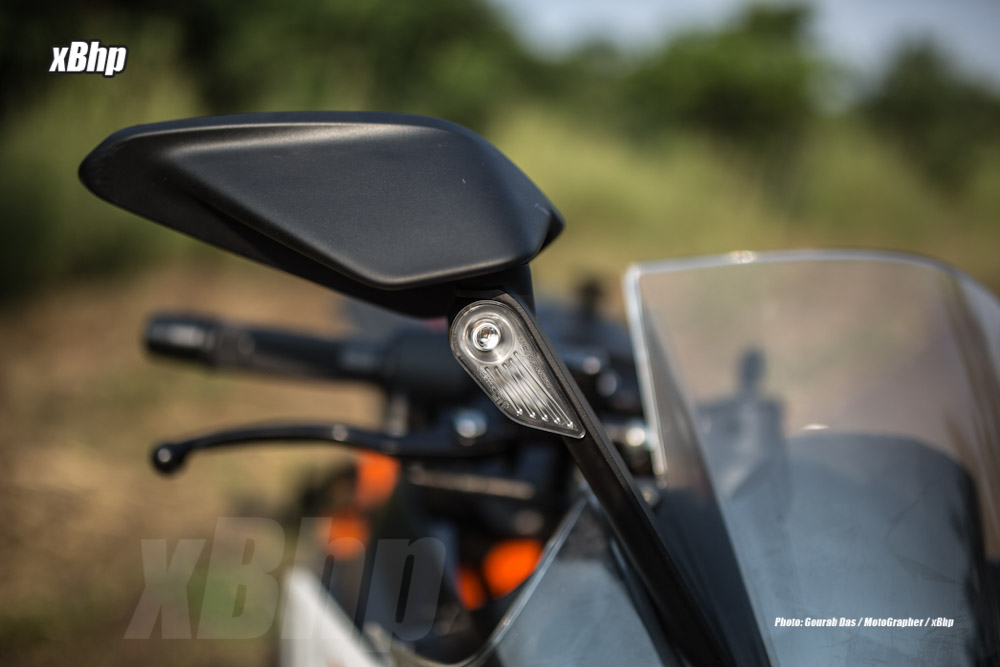
There is no shortage of clever design trickery on the bike. From the neatly integrated turn indicators on the mirror to the transparent fairing cowl/windscreen that does its job without making the bike look big. I would have preferred the bike to actually look bigger; hence a part of the windscreen could have been dark to accentuate that.
The starkest component of the bike would be its orange steel Trellis frame which gives it a very purposeful and different look.
Another great job by KTM on the RC390 is the rear seat which actually closely imitates a plastic cowl, seamlessly integrating with the bike’s plastic under-tail. However it is a proper soft seat with grab bars tucked away on the sides.
The bike will also come across as being a little too steep once you sit on it with an aggressive riding position, but people who know its purpose will not complain.
So as far as the looks are concerned, I think it is the most beautiful bike made in India today. Something that I said in 2003, when the Hero Honda Karizma was first launched.
I wish I had something like this in my college days; it would have been a blast to pose on! However, those were the days when Hero Honda CBZ was the hottest bike in town. The youngsters (not that I am old!) today must realize how fortunate they are!




Feels: Great!
There are many instances where bikes look great but something doesn’t feel right once you make the connect which happens when you sit on the saddle and bend forward to grab those handlebars. The RC390 knows how to make friends. I was instantly in a position that though is a typical sports-bike crouch, was still not too uncomfortable but felt ‘race ready’. If you like tanks as big as the Hyosung GT250 which you can practically sleep on, then look elsewhere. This one’s slim and trim in all aspects except for those heavy-muscled horses raring for a gallop. I suspect that even riders above 6 feet will be at home on the bike (I stand at some 5 feet 10 inches or so barefoot).
The ergonomics are decent and there is nothing out of reach. You have enough space to move yourself back and push against the stepped-up seat to give you a nice crouch on the straights to slipstream behind other riders or go WOT to warp speeds. And it ‘feels’ very light because it is light! At 147 kg dry, it feels as if you can literally lift the bike up single-handed! This translates into quick manoeuvrability of course, but the design ensures there is enough down-force and stability even at the speeds reaching 170 kmph plus (and probably more once we start seeing the mods coming in).
So there you have it, it looks good and it feels great! But does it really go?


Performance on the track
The only other bike closest to this segment which I have ridden on track is the Ninja 250R. And that was an amazing bike, one that inspired great confidence in the corners and the braking was phenomenal, even without ABS.
So how does the RC390 fare? The Bajaj Chakan track is 3.2 kms long with a long straight of 1.2 kms and a series of quick consecutive turns. The tarmac is decent with bit of gravel and dust on the sides more often than not. These were the conditions that the RC390 was ridden in. They proved to be sufficient to get an idea of what it might be capable of on a full-fledged track like the Buddh International Circuit (BIC) near Delhi. I have seen people do wonders with the Duke 390 on it, so this will be quite something do deal with, even if it is being ridden along with 600s, provided the rider is good.


The acceleration is decent and it will make anyone more than happy, provided they are upgrading from a machine like the Ninja 250R or the CBR250r. If you think you will be happy on this as a secondary machine to your Fireblade 1000RR just because it is cheaper to drop and take on the edge, then you will be deeply disappointed. People often make this mistake. You will never get that power. However, this can be a great machine to learn on how to take corners flat out without worrying about too much power at the exit. It has got all the ergonomics and character of a 1000RR race bike without the unusable power. Plus 17 lacs vs. 2 lacs is not even an argument! This bike screams: First tame me and then think of a 600, and then a 1000! Its affordable good-looking practicality in metal, plastic and rubber.
According to me the perfect garage would be to have a naked like the Yamaha FZ1 for close-quarter urban riding, an adventure bike like the Triumph 800 for touring and the RC390 for the track. A good rider on the RC390 on BIC can probably do something like 2.30. In comparison, Gurvinder from Delhi often clocks 2.05 on his Kawasaki ZX10R on his fast days at the same venue.
The bike is very flickable, but not so much as to cause sudden entries into corners and throw you off guard. While the ByBre (By Brembo) 300 mm brakes
is adequate, the feel and feed-back is not as good as the Ninja 250R, but the ABS works very well indeed and the icing on the cake is that it can be switched off by pressing down on a button next to the digital display.
Lots of components are derivatives of the Duke 390 including the chassis which is tweaked to be sportier. The wheelbase is shortened to 1340 mm (from 1367 mm on the Duke 390) and the steering rake is reduced by 1.5 degrees, all for those cat-like responses to the steering inputs.
Hard leans are supported by the Metzeler M5s (110 /70-17 up front and 150/60-17 in the rear). For serious track riding you may want to opt for the stickier Metzeler Sportec M7 RR tyres, which I suspect won’t be available officially in India.
The engine is wonderful at 9000 rpm producing 44 Hp. With 35 Nm of torque (compared to say 15 Nm in Yamaha R15) it will be good for city rides and touring as well I presume.
There have been a few instances of Duke 390 getting overheated, especially in the summers, however they seem to have been sorted out in the recent production runs. Hope KTM have a permanent fix on this setup, more so since this one is fully faired.
I managed to touch a top speed of 173kmph with a GoPro on my head and a not so comfortable helmet. I suspect 180 kmph on the speedo should not be too unrealistic on a properly run-in bike and a 1.5 kms straight.
Some people might also be concerned about the vibrations from the bike; it being a single cylinder their concerns are not entirely unfounded. However I am happy to report that the vibrations did not make it into my conscious field – i.e. I did not feel them substantially enough to be noticed, probably more because there’s a lot more to do at 3-digit speeds than worry about some vibrations! If it crops up in the long run and after a few thousand kms of bumpy rides on the test track we call Indian roads, then that would be another matter.


KTM 390 CUP: The real use of the bike
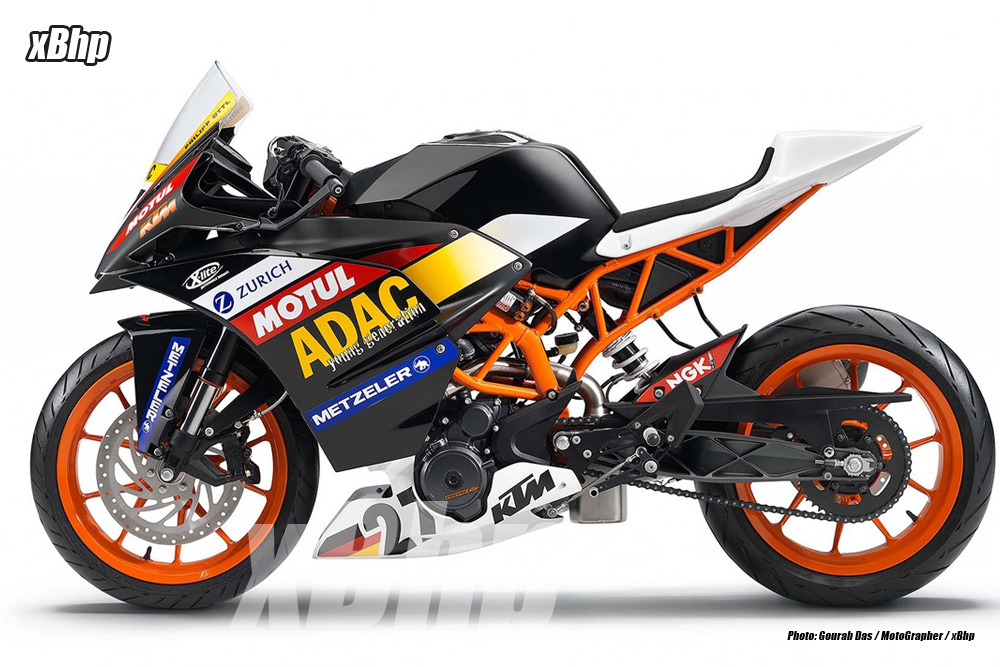
The RC390 is being used for the ADAC Junior Cup which is organized in Germany since the past 21 years, primarily to promote young talent in motorcycle racing. Till last year ADAC was using a 125CC two stroke single cylinder with a super-tuned 35 Hp engine. Since 2014 it has switched to the KTM RC390, which is called the KTM RC390 CUP edition. This is a testimony to how good and perfectly timed this bike is for the world.
This also shows that it is high time for India to start something seriously in racing. We are currently around one plus billion people and have no one to represent us at the international stage in racing. This is VERY SAD to me. Bikes like the RC390 will hopefully be used the correct way and not only for posing and street racing.
There are a few changes to the bike to make it the CUP edition, for example:
Extra parts not needed in a race like blinkers etc. are removed. Power is downgraded to ~40 Bhp, the underbelly exhaust replaced by a Titanium Exhaust system and the bike gets kitted with the KTM Powerparts for the RC390 road version. KTM claims that in this setup the bike can reach speeds of up to 190 Kmph which I find a little hard to believe since I topped out at 174 or so myself at the Chakan track in Pune, but it’s not impossible. The gear shift pattern can also be altered easily aiding turns, especially extreme right hand leans. Fork and suspension struts were modified which are now entirely adjustable with regard to spring preload and damping. Even the front brake pads were adjusted to the permanently higher loads while racing by extending the diameter from 280 to 320 mm. The footrest system is further relocated to the back, hand levers (foldable and adjustable), lever hoop guards left and right and the knee slider can be found in the KTM PowerParts range.
Special stress has also been given to the fact that the CUP bike can take a decent amount of crashes without getting substantially damaged, so that’s good news for track junkies.
Instead of the Metzeler Sportec M5 that are fitted on the road RC390, the CUP version is fitted with Metzeler Sportec M7 RR tyres, that are also available for purchase for the average consumer.
In fact as late as August, British Superbike bosses were in talks with KTM UK about introducing a 1-make series next season with the RC390.
So everyone is recognizing the potential that is there in the bike, but will India use it how it is supposed to be? We shall see. Fingers crossed there.


KTM RC200
In all the hullaballoo about the RC390, let’s not forget the younger (and no less capable sibling) – the RC 200. I had a ride around the track and managed a 1.52 minutes lap, record according to Bajaj officials is 1.44 on the RC200 on the Chakan facility. The bike looks almost the same, but the tyres are MRF and not METZELER.
This is another great moment for Indian motorcyclists as they get more options to choose from. But the real thing is whether the bike will be actually be used to actually hone racing talent in India or it will end up just being another misfit (tourer)!


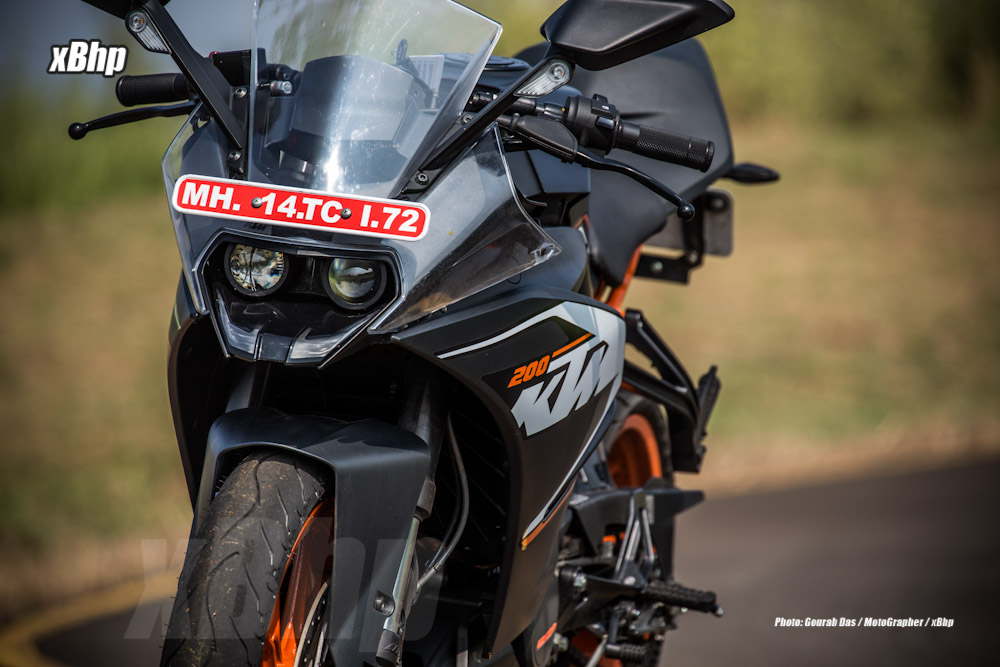
The KTM RC 390 is produced in India and it gives the company the opportunity to price it extremely competitively as compared to the rest of the world as we found out.

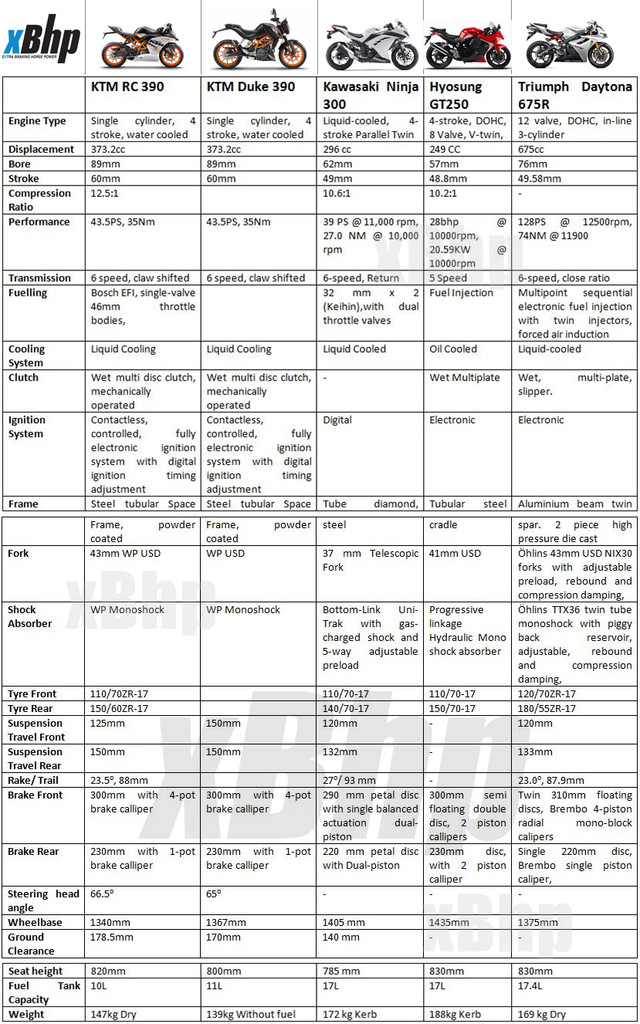
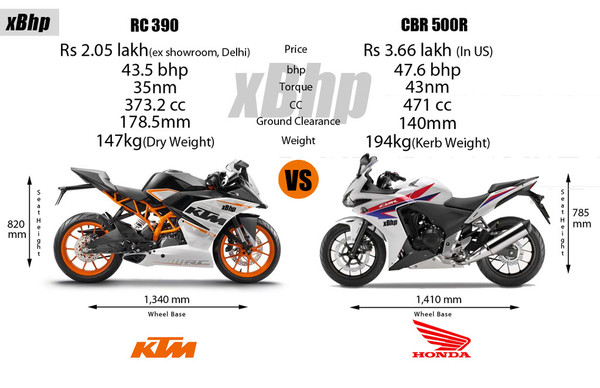
This is how the KTM RC390 stacks up against the competition –



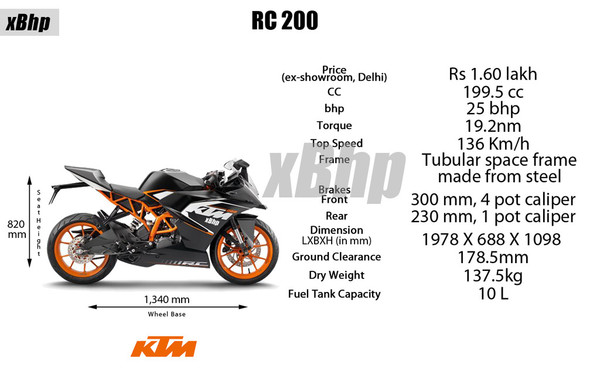
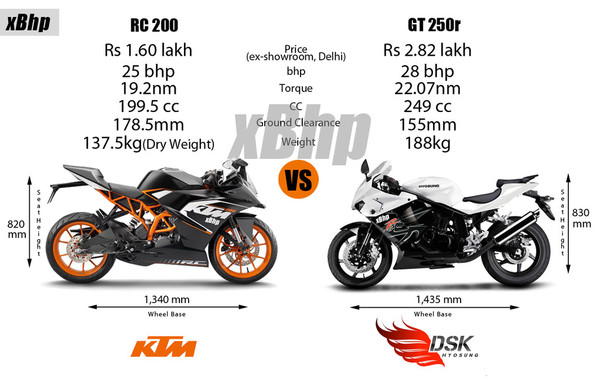
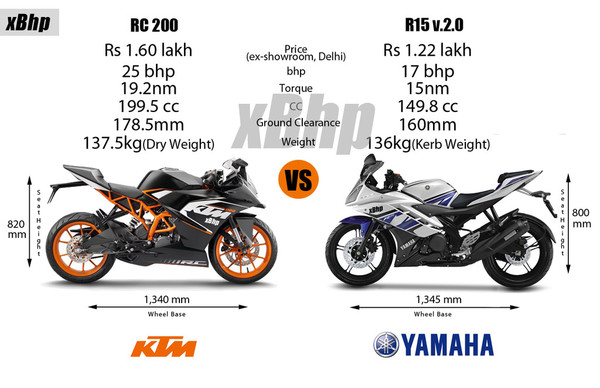
The KTM RC200 in comparison with the competition –


Suzuki Gixxer 155 Review
 Sep 2014 Sunil Gupta
Bikes,Motorcycles,Suzuki
Sep 2014 Sunil Gupta
Bikes,Motorcycles,Suzuki
Text: Avinash Noronha/ The Monk
Photos: Sunil Gupta/ sunilg
The Suzuki Gixxer 155 is the latest attempt by the Japanese manufacturer to get a foothold in the ever growing motorcycle market of India. The bike’s name has been derived from the extremely popular GSX-r series that has been running strong for almost three decades. Dating back to March 1985 when the first GSX-r 750 was launched, this series of motorcycles have come a long way, gaining thousands of diehard fans worldwide. Suzuki Motorcycle India has taken a big gamble by using the legendary name, the Gixxer, as the motorcycles were popularly known, for its 155cc offering in the country. How will the fans react to a small capacity bike being honoured with this iconic series and does the Suzuki Gixxer 155 have the DNA to match its name. Well, we need to ride it to find out. And what better place than the curvy tarmac of Lavasa on a wet monsoon morning to have some fun on this ‘street sport’ motorcycle.


Suzuki has come up with a new category – the street sport tag. But the Gixxer 155 does realistically belong to the executive commuter segment and it has the Yamaha FZ fair and in its crosshairs. The bike is designed to appeal to the younger crowd who want a powerful, good looking bike which wouldn’t burn a hole through their pocket! And in that Suzuki looks to have a winner on their hands. The bike does not just look muscular but is also built like a tank. With the typical robust Suzuki quality, which looks like it will last a century! The beefy front forks, the muscular chiselled tank, the devil horn like grab rails, all give the bike a wicked look. The chunky exhaust makes the bike look bigger than it actually is. The 140 section rear tyre has a rounder profile and doesn’t look as broad as it is, but is a boon while cornering. The rear LED tail lamp is a welcome addition, but doesn’t gel so well with the rest of the bike, while the rear mud flap is broad enough to keep those behind you clean. A little too broad some might say, and therefore is easily removable to make it sleeker. The switchgear on the motorcycle is top-notch and works smoothly. But the best bit is the extremely comfortable saddle which is where the rider would always want to be, and gives you a great view of a well thought out console. The fully digital display is clear and gives all the information you require, it is visible in bright sunlight and is orange backlit for night riding. The mirrors on the bike are simple and give an adequate view of the traffic as you leave it behind!


And that is the biggest strength of the Gixxer, the ability to leave traffic standing as you make a quick getaway. Suzuki has put in a lot of effort to ensure that you have an adrenalin packed ride every time you go for a spin on this bike. Some of the top race engineers who are involved in WSBK and MotoGP worked on the design of this bike according to the company. The lightweight chassis helps this motorcycle achieve the lightest in category kerb weight of just 135 kg. The Gixxer, as with other offerings from the company, is equipped with SEP (Suzuki Eco Performance). SEP is a relatively new design process of the company wherein maximum performance is extracted without compromising on the efficiency. Companies are generally vague on how did they go about achieving this, but Suzuki did give us a few hints. To reduce mechanical losses and maximize combustion efficiency, lighter engine components have been used. An inverted triangle shaped piston skirt has also been utilised to increase bottom end torque, smaller and lightweight rocker arms and a reduced angle of the valves have all helped better combustion, aided by the good looking dual type exhaust. The bike also sports a 41mm fork at the front and a 7 step adjustable mono shock at the rear to give it better overall rigidity. The 154.9cc engine produces a healthy 14.8 Ps @ 8000 rpm of power and 14Nm of torque @ 6000 rpm. All this from an Air-Cooled Carburetted engine, which makes it quite impressive, both on paper and presumably also in practice.


True that motorcycles are not made to be ridden on paper, they are best take onto some smooth sinewy tarmac like Lavasa. Unfortunately our flag off point was at the wrong end of Pune, which meant we had to traverse through a big part of the city to head towards Lavasa. But even dark clouds have a silver lining, and our route was littered with many dark clouds! We rode the commuter bike through the busy streets of Pune during rush hour traffic before we could see a patch of highway tarmac. This gave us a wonderful opportunity to experience the motorcycle where it would spend the majority of its time. Weather was anything but ideal, a light drizzle ensuring that the roads were wet and slippery and potholes filled with rain water. Ideal conditions for testing out a bike’s capabilities! And the Gixxer passed with flying colours; it is light and nimble and easy to flick through traffic. The MRF tyres the bike is shod with provides adequate grip even in low traction conditions. Braking is a breeze what with that 240mm responsive front disc, those beefy 41mm front forks and a light stiff chassis, the bike never feels perturbed. The low end torque allows one the convenience of riding without too many gear changes and the ergonomics ensure the rider is in a commanding position to see all that is going on in traffic.
Once we had stormed out of traffic and leaned into the curves of Lavasa, the bike was in its elements. Throwing the Gixxer around on the wet roads up there was far easier than expected. Holding steady through the corners, the bike egged on the rider to go faster. And even though this is a peppy bike with good pull through the rev range, you do get reminded that this is a 150cc every time you try overtaking a bigger vehicle uphill. It feels as if it has run out of juice just that tab bit too early. Which was surprising considering that this bike pulled uphill in second gear with a pillion on board at 14 kmph without the engine even lugging! Presumably the low end torque comes at a price. The overall ride quality on good tarmac was an extremely pleasing affair and will surely bring a smile on the face of the rider.


My list of grievances from this motorcycle is rather short, starting with the headlight. The 35W bulb might be adequate for most city riding, but a 55W would have been a blessing on the highways. There should have at least been an option of a rear disc brake, and I do hope Suzuki will add this feature in the near future. The pillion seat is not the most comfortable in the market, with the pillion complaining that the edges were pressing against the posterior! The rear mud flap could have had a sleeker design and the kick lever would have looked better with a simpler design. Barring these minor setbacks, the Suzuki Gixxer 155 is a wonderful bike.
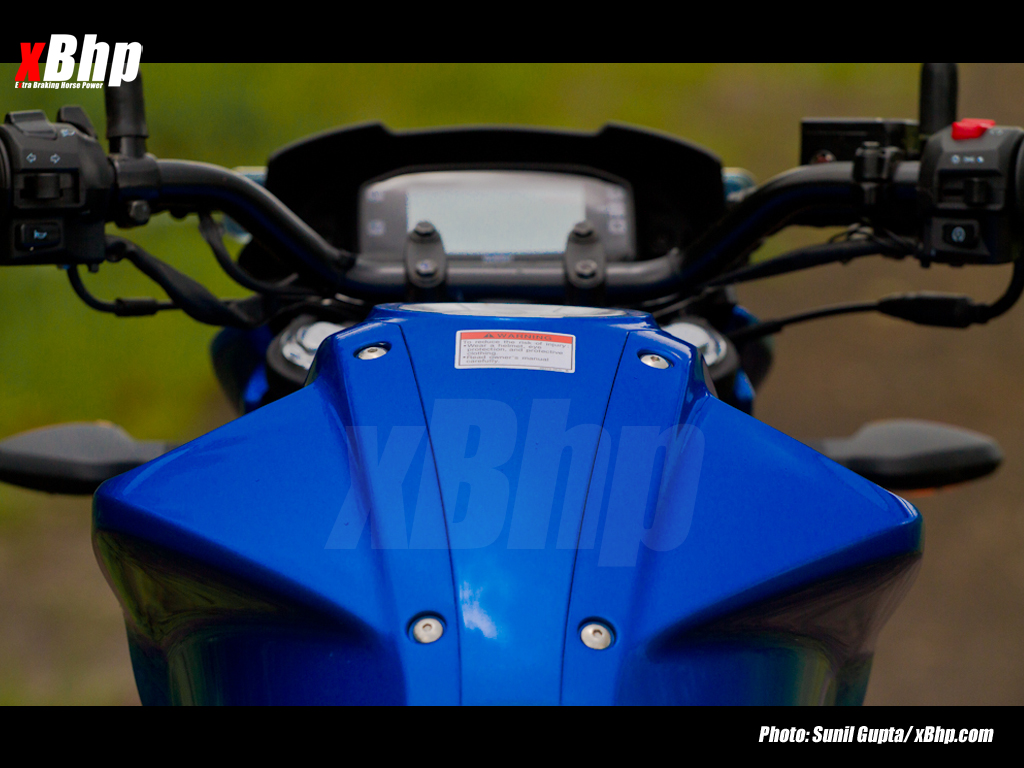


The Gixxer 155 may be very humble in comparison to its elder siblings, but Suzuki has done an awesome job of bringing out a fun motorcycle to commute on. The company has got a winner on its hands and priced at INR 72199 ex-showroom Delhi, it undercuts the Yamaha FZ series by a few thousands, making it a very attractive proposition for the buyer. How well will the Gixxer fare in the Indian market depends entirely on how aggressively Suzuki markets the product.


Yamaha FZ-s Fi Review
 Sep 2014 Sunil Gupta
Bikes,Motorcycles,Yamaha
Sep 2014 Sunil Gupta
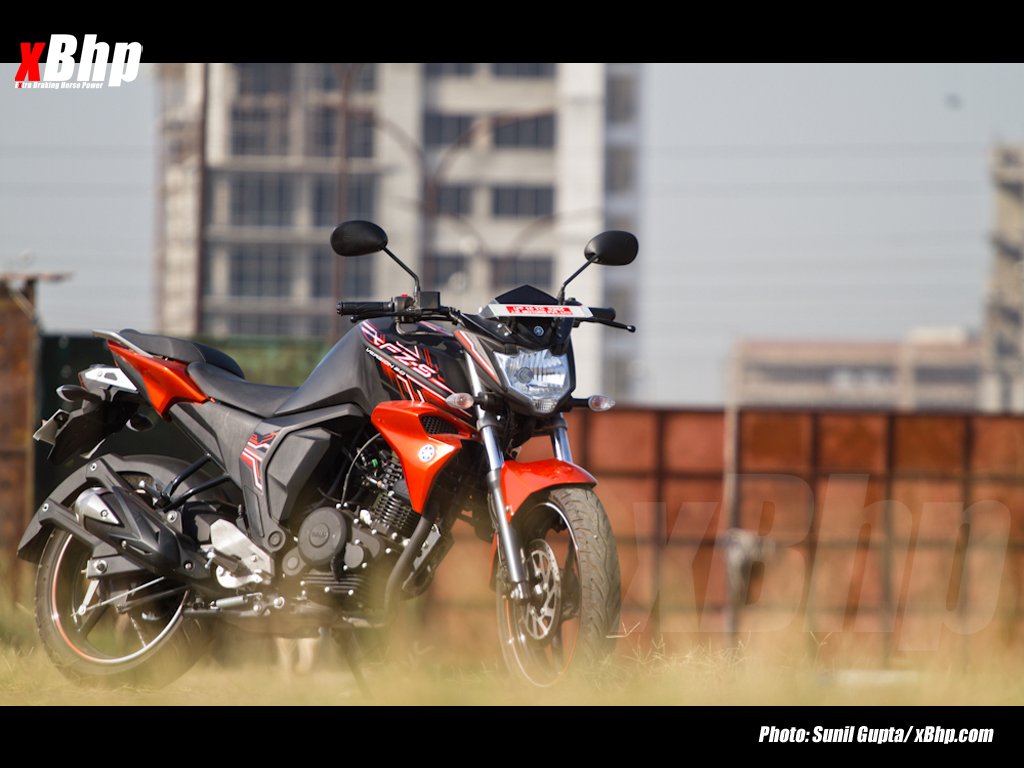
Bikes,Motorcycles,YamahaThe Yamaha FZ had taken Generation Y’s imagination by storm when it was first launched in India in 2008. With its aggressive street naked styling, fat rear tyre and a fatter fuel tank, the bike raised the bar for other manufacturers to follow. Added to it was the Yamaha build quality, and the company had a winner on its hands. After many minor visual updates over the past 6 years, the Japanese manufacturer has finally answered the fervent prayers of its fans and brought out a revamped bike to once again make a splash in the Indian market. Is the new bike worth being called an upgrade? Let’s find out!

Text: Avinash Noronha (The Monk)
Photos: Sunil Gupta (sunilg) and Ashish Guliani (orange)


The bike looked great in its original avatar and Yamaha has been smart in not making too many changes. It maintains its trademark aggressive looks, but adds a touch of finesse to the package. The front of the bike gets a facelift with a new sharper headlight dome, and that is just the start of the sharpness! The console is now a clean meter with none of the ‘videogamish’ colours on it. All the information that one wants is clearly visible even in bright sunlight on the all-digital display. The new addition is an ‘Eco’ meter which lets you know when you are riding in the economy range of the bike – a useful feature for those who use this motorcycle to commute. The switches and plastic quality is as expected from Yamaha, though the RVMs do stand out as a trifle cheap in comparison to the rest of the build and also in terms of aesthetics. The tank, tailpiece, taillight and grab rail have all been given the edgy treatment and do add to the visual appeal of the bike. The differences are not drastic, but do add a youthful touch to the V2.0. Some people might find the rear tyre hugger to be very drab as it hides the rear tyre and robs a bit of the macho attitude of the motorcycle. The all new split seats on the other hand are a welcome change in the looks department and give the bike a more purposeful look as compared to its predecessor.


But the real update to the motorcycle lies under the tank in the form of the Blue Core Technology being used in the bike. The Blue Core technology is not so much a new technology as a different outlook towards design. Yamaha, like other manufacturers, have understood that in this category of motorcycles, fuel efficiency will always be a factor. And this is the underlying focus right from the R&D stage itself. Where the engine is designed not just for maximum power, but also towards improving efficiency and reducing emissions. And to this end, Yamaha have succeeded by increasing efficiency by a claimed 14% and bringing down CO2 emissions by 29% as well as reducing the engine weight by around 1.5 kg. Impressive things which are not immediately apparent. Instead of the carburettor, the new FZ now runs on fuel injection. It has made the throttle response on the motorcycle far better. The power is delivered smoothly across the rev range and one does not feel any sudden surge of power or flat spots when accelerating. Hidden in this upgrade is a development that people normally do not expect in an upgrade – a drop in power! Yes, the V2.0 gets a marginally smaller engine down to 149cc from the earlier 153cc engine, with a drop in power by 1Ps. On paper, this sounds bad, but in real world conditions you just won’t notice, thanks to the smoother power delivery and the fantastic chassis that the company has designed. In fact both these things go a long way in making the FZ V 2.0 a better package to navigate through the crowded urban traffic, where this motorcycle will find itself most of the time. Yamaha also claims that the motorcycle will be 14% more fuel efficient compared to its previous iteration – a good move indeed in a ‘mileage’ sensitive market where fuel prices are increasing on a daily basis. The youngsters, for whom fuel efficiency is a major deciding factor, will now find it even harder to ignore the FZ.


The ride quality of the FZ-s V2.0 is excellent and leaves the rider more than just satisfied. The bike is balanced perfectly and with the new diamond frame and now Fi engine, the bike can be turned on a dime. The V2.0 also sheds some 3 kg to make it an even sweeter proposition. The bike handles like a dream and is a complete point and shoot package, never giving the rider anything to fret about. The tyres from MRF do a wonderful job in the dry and stick to the tarmac under hard braking as well as some spirited cornering. And we also had the chance to take it out for a spin in the dirt and the tyres held their own along with the plush suspension giving a composed feeling when bumping around in the mud. The flip side is the rear drum brake; we did hope to see the V2.0 sport a disc at the rear and are a tad disappointed, though this would of course increase costs. The split seats are broad, soft yet firm and give both the rider and pillion a reason to be happy, at least on short city rides. Whether it is flicking the bike through traffic or taking corners too enthusiastically, the bike feels sure footed at all times and reminds you that it is a true blue Yamaha! The slightly shorter overall length and wheelbase of the bike helps in change of direction, though it does not take anything away from its straight line stability.


Is the FZ-s V2.0 a real upgrade over the original? Well we do think so. The revamped Blue Core engine, the Fi, new lighter frame, stickier MRF tyres and fresh styling make it a worthwhile upgrade. What makes it an even better deal is that this bike would cost only around five thousand more than its predecessor. Well worth the extra dough you have to shell out. The motorcycle is available in 4 new colours – Astral Blue, Moonwalk White, Cyber Green and Molten Orange. Though how will the Yamaha fans react to the reduced power and engine capacity is yet to be seen.


TVS Scooty Zest 110 Review
 Aug 2014 Sunil Gupta
Scooters,TVS
Aug 2014 Sunil Gupta
Scooters,TVSText: Sandeep Goswami/ Old Fox
Photos: Sunil Gupta/ Sunilg
That the all-new TVS Scooty Zest 110 is ‘actually’ new and not just a sticker n paint rehash is written all over it. And it is a new product not just physically but also in the way it has been shaped by the market and shall in turn shape it. Read along to know what all goes into making even such a diminutive and ordinary two-wheeler a potential success story in the present era of those never ending demands for more power and performance from anything and everything on wheels.
We were invited for the Chennai launch of the Scooty Zest 110 followed by the first ride experience at TVS’s Hosur plant test track. The Scooty brand-name goes back to 1994 when TVS launched the scooter targeted at both the genders but did a review a couple of years later realizing that more women were buying it than men! And so the Scooty then was repositioned exclusively as a woman’s two-wheeler. And ended up becoming the largest selling women two wheeler brand by notching up 25,000 units sold in a month for a stretch at one time! The Zest 110, a couple of decades later, has also been aggressively positioned as being tailor-made for young women. But a lot of specialized market research and analysis over these 18 years has been the additional spur for this decision. TVS has used what is called the ‘Trigger and Barrier’ study for market research which entails detailed questioning of the target group both for the ‘triggers’ for purchasing the scooter (earning capacity, utility, need for freedom etc) and the ‘barriers’ that hinder the purchase (social restrictions, perception as being unsafe, seen as unnecessary for women in a patriarchal society etc). Of course even the best of surveys and market research eventually depends on its analysis, interpretation and implementation of the findings. For example the ‘triggers’ are the most effective positives to talk about when presenting the product as in advertisements. The barriers are sought to be demolished by the effectivity of the product itself. To further encourage the ‘triggers’ and lessen the power of the ‘barriers’, TVS launched the TVS Scooty Institute way back in 1998 to facilitate rider training for women and girls. The certificate course fee was Rs. 350/- a week and any girl over 16 years of age could take it. The trainers are all TVS certified women riders. Thousands of women have ended up taking the course which still is available in some 80 centers and its details can be accessed at the link here.

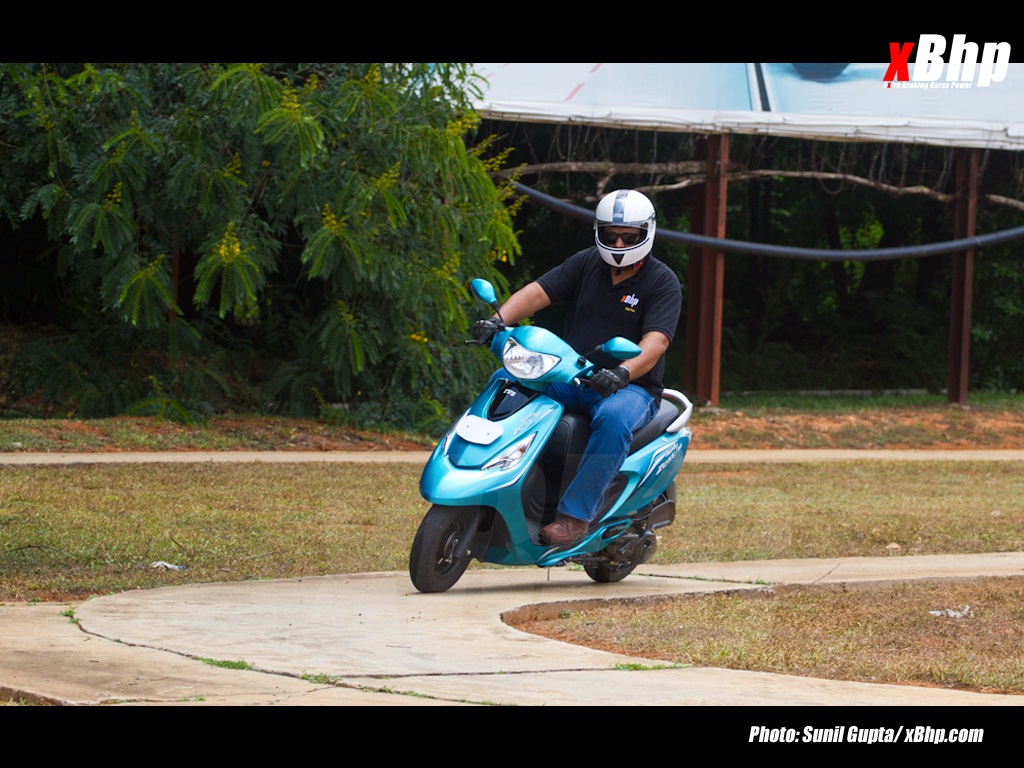

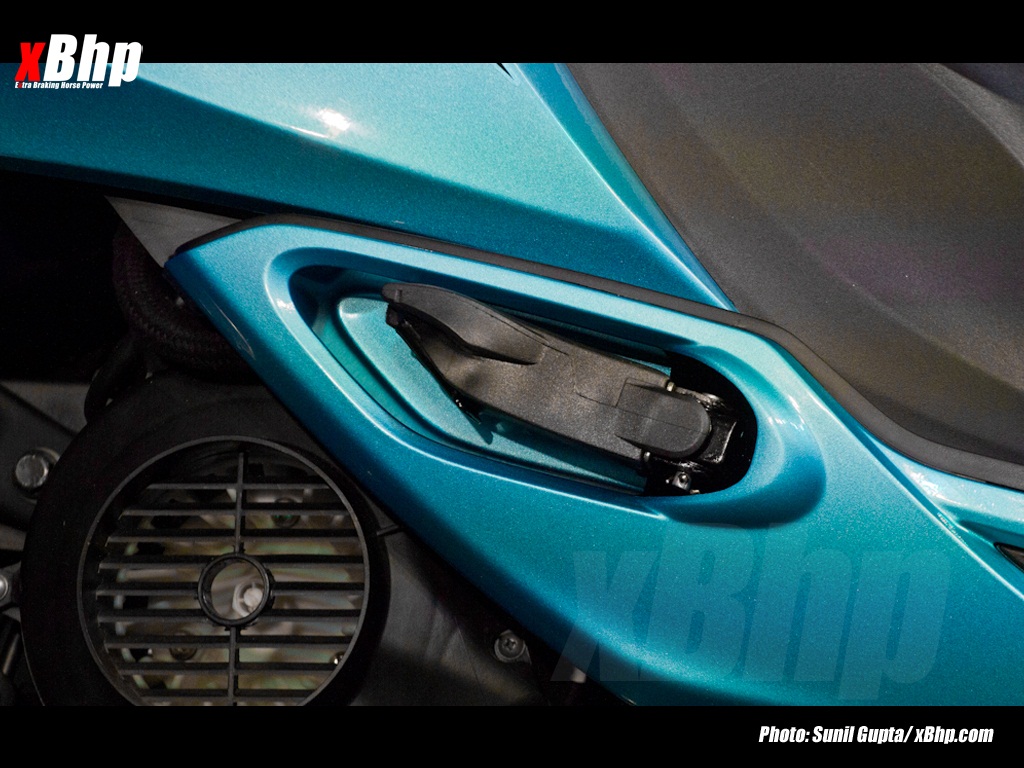
Coming back to the Scooty Zest 110, this is a pretty and compact scooter that looks proportionate and welcoming. Neat flowing lines that ostensibly merge the contradictory sharp and curvy elements, it is a statement of practicality with a definite personality. The fit and finish is top notch, the glossy paint, the well fitting plastic embellishments and the all black engine underneath save for that shiny stainless steel exhaust shroud. Solidity in feel is a difficult task to achieve in a scooter especially since it has so much covering the actually ‘solid’ machinery underneath. But the Zest’s plastics do feel robust and should be immune to the age old build quality issues TVS products have been plagued with over the years. In fact this build quality has seen a strong and definite improvement since the Phoenix 125 launch. The Zest has that premium product feel about it though how well it retains it during usage in our dusty, dirty, humid and while running on our ‘violently trafficked’ roads remains to be seen.

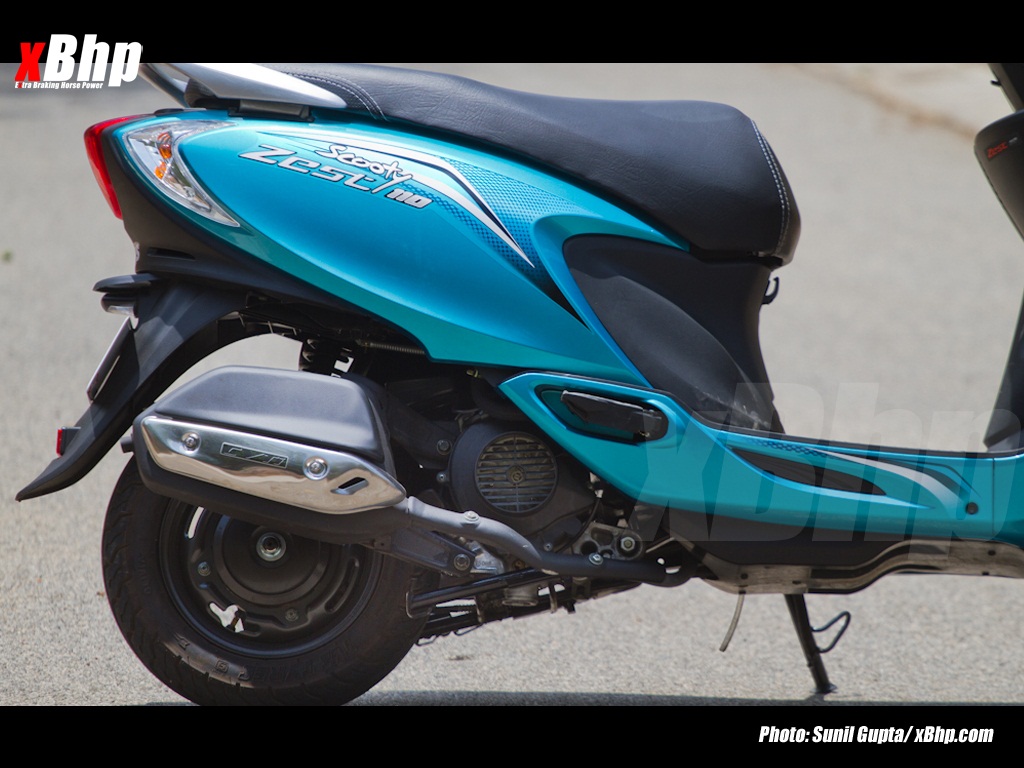
Even though the Zest engine comes from the existing Scooty range, it is distinctly tweaked up to be peppy and torquey in its working range and yet return good fuel efficiency to keep the recurring cost of ownership low. The 109cc 8 bhp carbureted single cylinder unit feeds power to the rear wheel through revised ratios in the CVTi automatic transmission, an ‘optimized for flow’ air filter airbox and a stiffened chassis with sharp steering geometry all put together make this 98 kilo light-weight a delight to ride. The acceleration is surprisingly more than you expect from it and has excellent pull till the 60 kph mark (which TVS says is attained in a shade less than 12 seconds). Beyond 60 kph, the speed build up is gradual and peters off at somewhere about the 90 kph indicated mark. Couple the peppiness with an assured 62 kmpl (of course when ridden sanely and not wide-open-throttle), a smooth engine and light weight and you have a definitely likeable urban runabout in your hands.

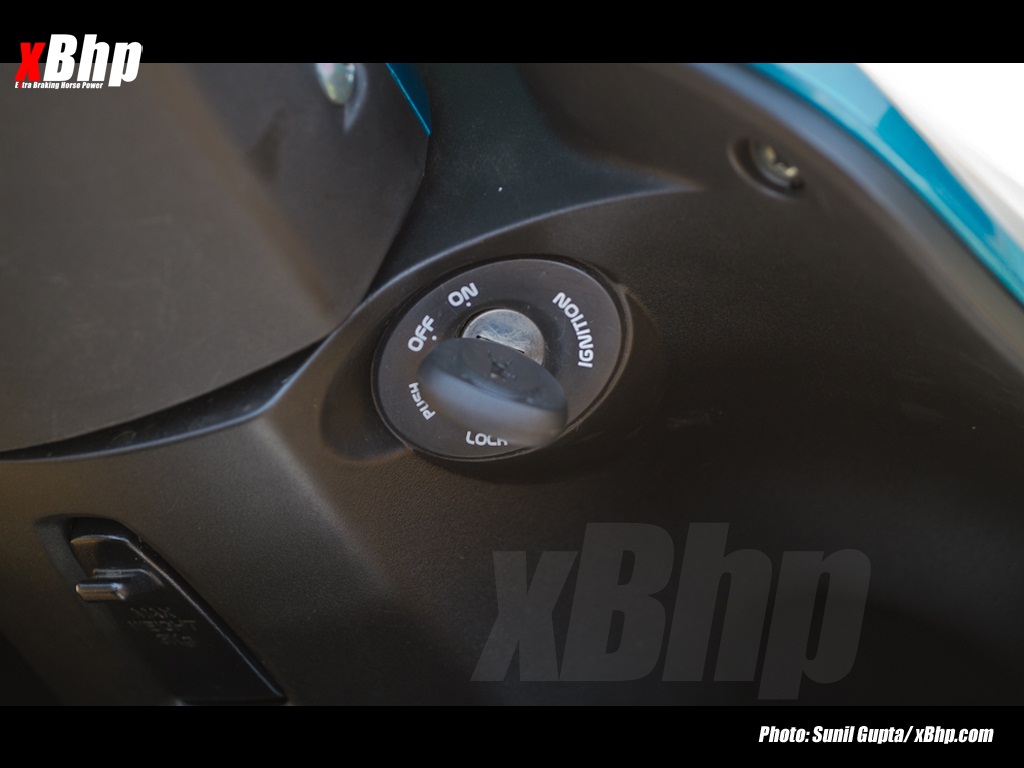
The rear brake needs to be pulled in for the starter to work. The engine starts and quickly settles to a fast but stable idle. There’s an auto-choke installed to help in cold weather starts. The side-stand has a beeper that sounds if it is deployed while the engine is running. Roll the throttle and the Zest starts rolling, gathering speed quickly, quietly and efficiently. The steering is sharp, thanks to the steep geometry and short wheelbase, but there is no adverse effect of this sharpness on straight line stability. For a motorcyclist, the Zest steers on the mere thought of a steering input but in the world of scooters, this is just the way it is. The front telescopic fork and the rear mono-shock with that single-sided swing arm make for a great combination of secure handling and good comfort for the rider. The rear did not bottom out even when we hit a substantial dip in the test track at around 70 kph riding 2-up. Which probably is as good as it gets. Ground clearance during high speed turns appeared less with the main stand grinding away at times but then that’s not the way the vehicle is meant to be ridden anyways. It’s a daily runabout, a true blue commuter and not a performance machine.
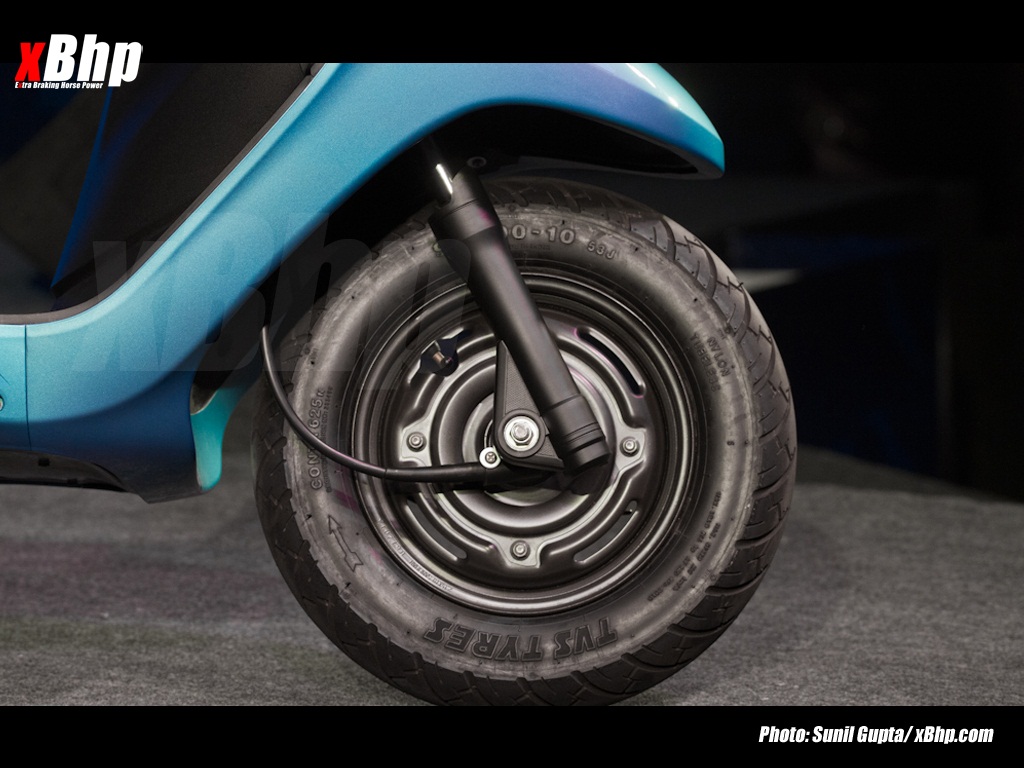
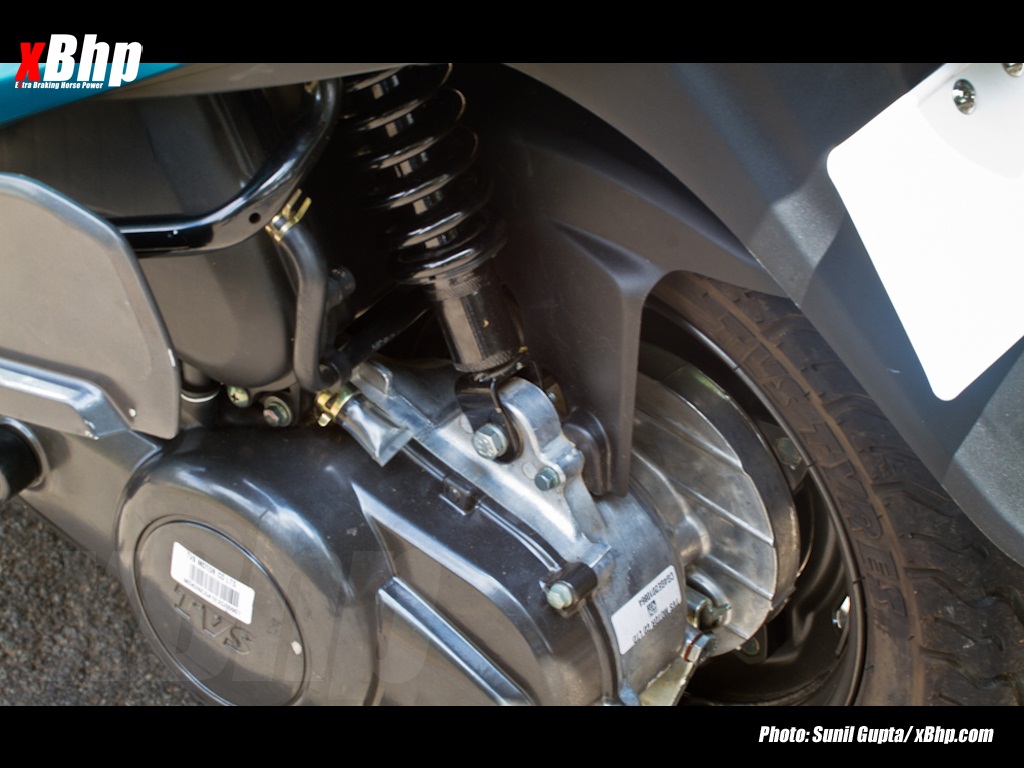

The drum brakes at both are good despite an unusual quirk associated with them. The front drum at 110mm is smaller in diameter to the rear at 130mm! It is usually the other way round with most 2-wheelers. And the same reversed logic gets applied to the tyres (tubeless which is another big plus) too with the front being wider at 100mm than the rear at 90mm! Topsy turvy huh? The reason for this cited by the technical development team being that scooters by virtue of their design (engine at the rear etc) are rear weight biased which only gets worse when a pillion joins in. And hence the rear brake is a lot more effective in retardation than the front (remember friction or traction, if you please, increases in direct proportion to the load on the tyre). That explains the bigger rear drum but what about the wider front tyre? Again the same rear weight bias requiring a wider front to compensate for the low weight transfer under maneuvers and braking. The wide front should make the steering heavier but this does not happen mainly because of the steep rake, short trail and good leverage from the wide handlebars. Braking even with the drums is good and we did not detect any tendency to fade from repeated use. The scooty felt stable and composed even during attempted panic stops.
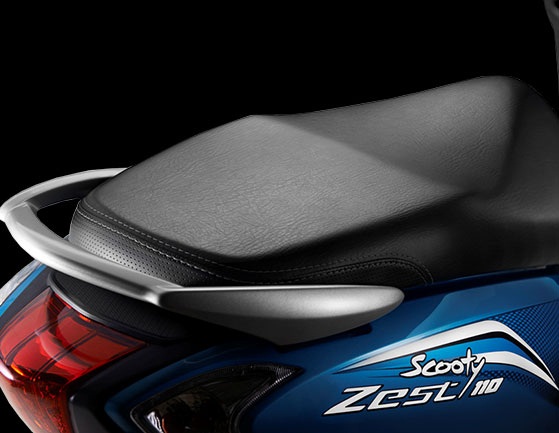


Talking of ‘width’, the Zest’s seat is probably the widest amongst all small scooters and definitely so among motorcycles. The foam is density tailored to avoid pressure points and even-out the load across the entire seat surface. The seat cover is a breathable synthetic non-slip type materiel and double stitched not just to look good but to stay good longer. I wish I could have something even close to this on my Duke 200. And at 760 mm high, the seat height is just right for any rider between 5ft and 6ft. The wide gap between the seat and the handlebar aiding this accommodation of varying rider physique. The textured non-slip foot board does away with the need for rubber floor mats and similar pattern finds its place on the funky looking front glove compartment. There’s ample storage with the 19 ltr under-seat one being the best of the lot what with that squarish shape and clean insides except for a small bump. There’s also a retractable bag hook under the handlebar and another fixed one under the seat. And a helmet lock is provided too. There are also plans to give a 12v socket under the seat. The one negative here is the angle at which the seat opens up. Near vertical, it has to be held up with one hand or it drops shut. Ensuring it opens to an angle a little beyond the vertical is needed. The foot-rests fold backwards into their recesses, their backward folding helping the rider avoid chaffed calves as she walks the scooter around, say while parking it. Upward folding ones hit the calves or ankles.


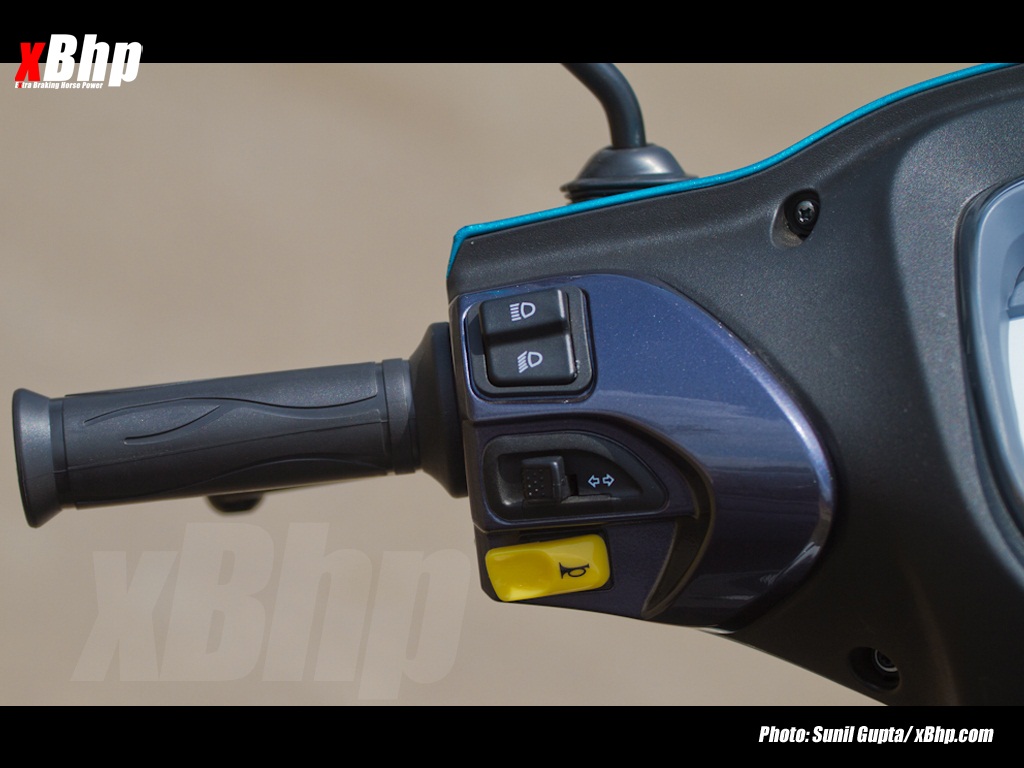

Switchgear clusters are painted and have an up-market feel about them. Lights are good, the 35w headlamp with the multi-plane reflector seems bright enough. The tail lamp/brake light combo is a long life low load LED cluster while the flashers have bulbs in them. The fuel tank can swallow 5 ltrs of the amber liquid and take you around for a little more than 300 kms. Nothing exceptional but then much the norm in the class. The body coloured leaf-shaped mirrors are vibration free and offer a good view of the rear. The low effort ‘EaZy’ centre-stand is another plus and that light throttle should find appeal with the ladies. The back-lit instrument cluster has a speedo and a fuel gauge. Alongwith the tell tale lights come the ‘power’ and ‘economy’ mode lights. The ‘power’ indicator starts blinking if the engine idles for a little more than a minute urging the rider to switch it off and start when ready to move. The provision of a kick start in addition to the electric start is a good thing as all back-ups usually are. The small ‘clip type’ parking brake that holds the rear brake pressed is a well-tried piece (I remember using it on the Kinetic Honda 20 years ago) that should find a place on every scooter.


So how good is it? Pretty good and does the job very well. Only for the girls? Not necessarily – the boys too can have as much fun on it and also revel in its undiluted practicality. Will it sell? Why not and going by what the competition offers, the Scooty Zest 110 is either mostly at par with them or better and so it should. Would I buy it/ if I needed an auto-geared scooter, I would.
Price: 42,300 INR ex-showroom Delhi
Tech Specs
ENGINE
Type: Single cylinder 4 stroke, CVTi air cooled engine
Displacement: 109.7 cc
Power in KW @ rpm: 5.9 @ 7500
Torque in Nm @ rpm: 8.8 @ 5500
CHASSIS
Wheelbase: 1250 mm
(L x W x H) (mm x mm x mm): 1770 x 660 x 1139
Kerb Weight: 98.5 kg
Seat Height: 760 mm
TYRE SIZE
Tyre Size FR: 90 / 100 – 10, Tubeless
Tyre Size RR: 90 / 90 – 10, Tubeless
BRAKES
Brake: Drum Front 110 mm
Brake: Drum Rear 130 mm
SUSPENSION
Front: Telescopic
Rear: Double rated Hydraulic Mono Shock
ELECTRICALS
Ignition Systems: Digital IDI Ignition
Battery: 12 V, 5 Ah
Headlamp: 12 V, 35 / 35 W
Tail Lamp / Brake Lamp: 12 V, 3W (LED)
Turn Signal Lamp: 12 V, 10 W
FUEL
Fuel Tank Capacity: 5 Litres


