


Since '02 xBhp is different things to different people. From a close knit national community of bikers to India's only motorcycling lifestyle magazine and a place to make like-minded biker friends. Join us

Castrol Power 1

Regularly check tyre pressures.

Our Partner

Announcement

Collapse
No announcement yet.

Helmets

Collapse
X
 
  • Filter
  • Time
  • Show
Clear All
new posts

  • Re: Helmets

    Originally posted by black asp View Post
    Got your point but that post came out as something different.

    CHEERS
    I know you did, you come across as a knowledgeable and sensible person to me from our past conversations. And I know the interpretation was wrong, cheers mate.

    Comment


    • Re: Helmets

      Originally posted by MidnightEvil Parth View Post
      I know you did, you come across as a knowledgeable and sensible person to me from our past conversations. And I know the interpretation was wrong, cheers mate.
      Excuse me for that.
      Yamaha RXZ 5 speed (sold)
      Bajaj Pulsar 220 DTS fi( sold)
      Bajaj Discover 112(2006)
      Yamaha R15 V2(2011)
      Yezdi 250 model B(1978)
      RX 135 4 speed(1998)
      Yamaha Rajdoot 350(1989-unrestored)
      Bajaj Pulsar 220 DTS-i (2011)Crashed and sold :'(
      Bajaj Pulsar 220 DTS-i (2009-Fastest Indian)

      Comment


      • Re: Helmets

        Originally posted by MidnightEvil Parth View Post
        I would say you never did a thorough research then sir.

        ECE doesn't need to be printed, firstly. I do not need it printed at all, a sticker is better infact. It should come with the standard ECE print booklet.
        Secondly DOT is a honorary and a very inferior standard, I don't even want DOT written on my helmet ! It is that inferior.

        Keeping LS2 at side for no DOT ? I would call this a half baked research honestly.

        Atom is a good helmet though, but nothing close to LS2 quality.
        At the price below 10 k,I guess hjc Cl-17 is a good pick,though the shell is polycarbonate,it has passed snell- M2015,and the shell manufacturing,sizes, available graphics etc seems to be uniform for all countries.

        Comment


        • Re: Helmets

          Originally posted by Thamps View Post
          At the price below 10 k,I guess hjc Cl-17 is a good pick,though the shell is polycarbonate,it has passed snell- M2015,and the shell manufacturing,sizes, available graphics etc seems to be uniform for all countries.
          HJC cL17 is a darn good helmet without a doubt.

          Comment


          • Re: Helmets

            Hi All,

            Im planning to buy a helmet. Was looking for ECE & DOT certified helmets when i came across the news about Non ISI helmets rule. Can anyone share a light on the same.


            Thanks.

            P.S. Do suggest me some good helmets in the range of 3000-5500 INR.

            Comment


            • Re: Helmets

              Originally posted by Bharat9581 View Post
              Hi All,

              Im planning to buy a helmet. Was looking for ECE & DOT certified helmets when i came across the news about Non ISI helmets rule. Can anyone share a light on the same.


              Thanks.

              P.S. Do suggest me some good helmets in the range of 3000-5500 INR.
              Final verdict by govt not out yet. If you want to be law abiding go for ISI helmet. Studds thunder I found to be the best ISI helmet, better than the studds shifter even though it's cheaper. Studds scorpion is also good along with Vega Cara.

              Comment


              • Re: Helmets

                Originally posted by Bharat9581 View Post
                Hi All,

                Im planning to buy a helmet. Was looking for ECE & DOT certified helmets when i came across the news about Non ISI helmets rule. Can anyone share a light on the same.


                Thanks.

                P.S. Do suggest me some good helmets in the range of 3000-5500 INR.
                Do not, I repeat, do not look for DOT standard. It's just honorary.

                If you want safety, get ECE Certified one.
                Would recommend SMK Twister.

                If you want to be law abiding, get a Studds Shifter.

                Comment


                • Re: Helmets

                  Originally posted by MidnightEvil Parth View Post
                  Do not, I repeat, do not look for DOT standard. It's just honorary.

                  If you want safety, get ECE Certified one.
                  Would recommend SMK Twister.

                  If you want to be law abiding, get a Studds Shifter.
                  I know that DOT is just a certification the helmets manufacturers have to comply unlike mandatory testing of ECE certification. But we will be sure that the manufacturer tested the helmet to comply with DOT certification. Im not taking a stand alone DOT helmet. I want a Dual Certification. ECE+ISI seems to be non existent. I dont wanna break the law or my head. Both are important.

                  So, that.

                  Thanks.

                  Comment


                  • Re: Helmets

                    Originally posted by Bharat9581 View Post
                    I know that DOT is just a certification the helmets manufacturers have to comply unlike mandatory testing of ECE certification. But we will be sure that the manufacturer tested the helmet to comply with DOT certification. Im not taking a stand alone DOT helmet. I want a Dual Certification. ECE+ISI seems to be non existent. I dont wanna break the law or my head. Both are important.

                    So, that.

                    Thanks.
                    DOT is not tested on every helmet for you to consider that manufacturer tested it, probably they never did.
                    DOT also has residual forces much, much higher than ECE or even ISI.

                    Dual certification is a gimmick and nothing else in case of DOT+ECE.
                    A cost saving process infact by the manufacturer to avoid printing it ECE or DOT market specifically.

                    Get ECE, done.

                    I have no idea why you would knowingly try to find a helmet with this gimmick.

                    Comment


                    • Re: Helmets

                      Originally posted by Bharat9581 View Post
                      I know that DOT is just a certification the helmets manufacturers have to comply unlike mandatory testing of ECE certification. But we will be sure that the manufacturer tested the helmet to comply with DOT certification. Im not taking a stand alone DOT helmet. I want a Dual Certification. ECE+ISI seems to be non existent. I dont wanna break the law or my head. Both are important.

                      So, that.

                      Thanks.
                      Originally posted by MidnightEvil Parth View Post
                      Do not, I repeat, do not look for DOT standard. It's just honorary.

                      If you want safety, get ECE Certified one.
                      Would recommend SMK Twister.

                      If you want to be law abiding, get a Studds Shifter.

                      DOT is not "just a certification". It is the US Department Of Transportation certification, federally mandated for any helmet intended for on-road use (i.e. not applicable to off-road helmets) in the United States. While the standards are different from those of the ECE certification, they certainly aren't trivial (and in a couple of cases, are even more stringent).

                      The DOT cert is also not "just honorary". While manufacturers are supposed to do their own testing to the DOT standard and then self-declare that the helmet meets the DOT standard, DOT helmets do get tested by the Department Of Transportation after they are brought to market, and the penalty for failing the test is USD$5000 *per helmet produced*, which adds up really quickly; there's a strong incentive to ensure the helmet meets the standards. And all that comes before the potential for multi-million dollar civil lawsuits from consumers if a manufacturer sold DOT-labeled helmets that didn't actually meet the standard and resulted in injury (US: land of the lawsuit).

                      There have been numerous tests over the years by (mostly) motorcycling-oriented magazines to determine which test is the "best". What they've found is that in the real world, the DOT standard provides plenty of safety margin even on the high-speed roads in the US. The Snell standard is actually worse than DOT in a way, because in order for a helmet to pass the Snell tests, it ends up having a stiffer shell, which the comparison tests found to result in a greater likelihood that the helmet shell will crack rather than deform. Cracking reduces the amount of impact the shell can distribute, resulting in higher forces transmitted to the head of the wearer.

                      The ECE standard does incorporate higher standards in some areas, and you won't go wrong buying on that cert. However, ECE does *not* require a penetration test as part of the standard, while DOT *does* require it, so a DOT helmet has at least some attention given to preventing things from puncturing the shell, whereas ECE helmets are not required to provide this kind of protection. Also, DOT requires that the helmet be labeled with date of manufacture, while ECE has no such requirement; thus, you have no real idea how long that ECE helmet sat on the shelf before you bought it, and EPS does degrade over time.

                      Edited to add: oh, and DOT requires two consecutive impacts to the same point on the shell without exceeding a cumulative amount of G's, whereas ECE only requires a single impact.

                      Here's a nice article with some explanations:

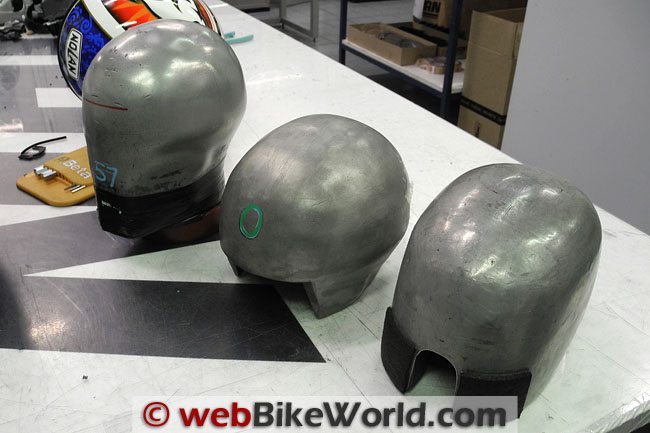
                      How to make a motorcycle helmet, Part 2, Motorcycle Helmet Safety Standards and the Nolan Helmet factory tour.
                      Last edited by The Mountain; 10-18-2018, 11:18 PM.
                      ATGATT: All The Gear, All The Time!

                      Current bike: Yamaha XT1200Z Super Tenere

                      Put the phone away, put your helmet on, and ride!

                      Scooters are like fat girls: fun to ride, but embarrassing if your friends see you with one.

                      Comment


                      • Re: Helmets

                        Originally posted by The Mountain View Post
                        . The Snell standard is actually worse than DOT in a way, because in order for a helmet to pass the Snell tests, it ends up having a stiffer shell, which the comparison tests found to result in a greater likelihood that the helmet shell will crack rather than deform. Cracking reduces the amount of impact the shell can distribute, resulting in higher forces transmitted to the head of the wearer.


                        Here's a nice article with some explanations:

                        https://www.webbikeworld.com/dot-vs-...ety-standards/
                        I guess the article refers to Snell m2005.then there was Snell m2010 which considered all the criticisms and was changed accordingly.then came m2015(current one) with small changes, which brings it closer to ECE specs.does that make Snell the best certification standard at present.!?
                        Last edited by Thamps; 10-18-2018, 11:08 PM.

                        Comment


                        • Re: Helmets

                          Originally posted by Thamps View Post
                          I guess the article refers to Snell m2005.then there was Snell m2010 which considered all the criticisms and was changed accordingly.then came m2015(current one) with small changes, which brings it closer to ECE specs.does that make Snell the best certification standard at present.!?
                          The article references Snell m2010 (but not 2015, despite being written in 2017). Snell is a lot closer to ECE than it used to be, but the standard isn't really covered in the article. I suspect that Snell still focuses on shock resistance rather than shock absorbance. Further, Snell is a voluntary standard rather than a mandatory one such as DOT or ECE, which is why it isn't really covered in the article. Since Snell isn't a government standard you won't find any road-legal helmets that are Snell-only; they'll be (something else) plus Snell. It's important to note that virtually no "convertible" helmets i.e. helmets with a hinged chin bar are Snell-compliant, but are very popular with the touring crowd. The reason Snell is important (particularly for US riders) is that Snell *is* accepted by various racing bodies, whereas DOT is not, so you can pull on your Snell-approved DOT helmet and head out to a track day.

                          It's only fairly recently that ECE helmets started to show up in significant numbers in the US, and ECE is not considered a substitute for DOT, so those helmets will be certified for multiple standards (the vast majority of DOT helmets will pass ECE, though due to the DOT penetration requirement the reverse is not necessarily true). This allows manufacturers to maintain a single production line for a particular helmet model, instead of juggling US-spec models vs. Euro-spec models; if everything they sell is certified in both markets, they make more money by providing more options for riders.
                          ATGATT: All The Gear, All The Time!

                          Current bike: Yamaha XT1200Z Super Tenere

                          Put the phone away, put your helmet on, and ride!

                          Scooters are like fat girls: fun to ride, but embarrassing if your friends see you with one.

                          Comment


                          • Re: Helmets

                            Originally posted by The Mountain View Post
                            DOT is not "just a certification". It is the US Department Of Transportation certification, federally mandated for any helmet intended for on-road use (i.e. not applicable to off-road helmets) in the United States. While the standards are different from those of the ECE certification, they certainly aren't trivial (and in a couple of cases, are even more stringent).

                            The DOT cert is also not "just honorary". While manufacturers are supposed to do their own testing to the DOT standard and then self-declare that the helmet meets the DOT standard, DOT helmets do get tested by the Department Of Transportation after they are brought to market, and the penalty for failing the test is USD$5000 *per helmet produced*, which adds up really quickly; there's a strong incentive to ensure the helmet meets the standards. And all that comes before the potential for multi-million dollar civil lawsuits from consumers if a manufacturer sold DOT-labeled helmets that didn't actually meet the standard and resulted in injury (US: land of the lawsuit).

                            There have been numerous tests over the years by (mostly) motorcycling-oriented magazines to determine which test is the "best". What they've found is that in the real world, the DOT standard provides plenty of safety margin even on the high-speed roads in the US. The Snell standard is actually worse than DOT in a way, because in order for a helmet to pass the Snell tests, it ends up having a stiffer shell, which the comparison tests found to result in a greater likelihood that the helmet shell will crack rather than deform. Cracking reduces the amount of impact the shell can distribute, resulting in higher forces transmitted to the head of the wearer.

                            The ECE standard does incorporate higher standards in some areas, and you won't go wrong buying on that cert. However, ECE does *not* require a penetration test as part of the standard, while DOT *does* require it, so a DOT helmet has at least some attention given to preventing things from puncturing the shell, whereas ECE helmets are not required to provide this kind of protection. Also, DOT requires that the helmet be labeled with date of manufacture, while ECE has no such requirement; thus, you have no real idea how long that ECE helmet sat on the shelf before you bought it, and EPS does degrade over time.

                            Edited to add: oh, and DOT requires two consecutive impacts to the same point on the shell without exceeding a cumulative amount of G's, whereas ECE only requires a single impact.

                            Here's a nice article with some explanations:

                            https://www.webbikeworld.com/dot-vs-...ety-standards/
                            DOT is just a certification in India, there is no body to keep a check on the compliance.

                            Furthermore they are tested by the Federal government in the US, not in India, this is why even cheaper ₹1500 shells from Studds or even ₹200 buckets from a local vendor get a DOT sticker ! I have no idea how reliable these are.

                            You are actually saying SNELL is stiffer design based, yes it is, that resists puncture of the helmet shell, but again SNELL is just voluntary and in the 2015 form, much more reliable than DOT. This is why tracks in the US explicitly demand SNELL.

                            Another point to be noted is that DOT does not test roll off safety, there is no chin bar testing, no testing of visor strength, while all of this is always tested on the SNELL or the ECE. (there is a limit of guess, 65mm deflection of the chin bar on DOT, just wish they actually tested this, would it make a difference ? there is also chin strap retention test in the DOT standard, again, never tested)

                            But I will stick to my point - SNELL, SHARP, TUV, RES/NTC are not widely accepted standards and I will just keep to ECE or DOT.

                            Also yes, ECE does require a single test and this has it's own logic, the limit for ECE is 300g, in one single impact, while DOT has a limit over that in two impacts, I agree, but that two times, is it even tested ?
                            Not to mention testing for two impacts is not a good idea, and results in helmets that are way too hard for the average crash, resulting in overly aggressive G-loads.


                            This is a report from 2015.
                            It pretty much says: DOT's budget only allows 10 models of helmets to be actually tested, therefore there are A LOT of helmets that don't meet DOT standard but they have DOT stickers(because manufactors claim they met DOT standard). And DOT's solution is to lower the cost of testing by only measuring the thickness of the helmets. This will only be enforced by states that have mandatory helmet law, so those states will buy the cheaper tool kit and test only the thickness of the helmets, if they are not thick enough they fail the standard. manufactors are given 2 year to replace their models to satisify this new standard.

                            So unsafe DOT sticker helmets can still be sold outside of those states(including foreign countries like ours, India ! )

                            in those states that have helmet laws, unsafe helmets become DOT approved as long as their shell and liner are thick enough under 22N of force. (this is to assume those states do test those helmets)

                            That report was posted by federal government itself, and not by some motorcycle article website, earns it's credibility.


                            ECE has much widespread batch testing and a more comprehensive test which as stated above, tests chin bar strength, visor and fastener strength.

                            Also about the velocity of the ECE helmet testing.
                            This is from ECE test regulations itself, should help.

                            7.4.1.1.2.3. The helmet shall be tested in any condition in which it may be placed on the market, that is both with and without accessories if they are supplied as original equipment. Helmets placed on the market with a visor shall be tested with the visor in the closed position. 7.4.1.1.3. Test The drop height shall be such that the unit constituted by the headform and helmet falls on the test anvil at a velocity which, immediately before impact, is equal to 8.5 (-0.0/+0.15) m/s. 7.4.1.2. Apparatus (see annex 8, fig. 1b) 7.4.1.2.1. Description The test apparatus shall comprise: (a) An anvil rigidly fixed to a base; (b) A free fall guidance system; (c) A mobile system supporting the helmeted headform; (d) A headform conforming to that referred to in paragraph 7.4.1.2.6., and (e) A system which may be adjusted such that the point of impact can be brought into correspondence with the upper part of the face of the anvil. (f) A means of recording the continuously changing transmitted anvil force during the impact. (g) A suitable energy-absorbing base and catch net to prevent damage to the helmet after the impact.

                            And oh, I never meant to trash DOT standard, just stating what DOT is in my understanding, ECE and DOT both have their flaws, but I will stay with my ECE lid until something major changes on the part of DOT. Though I agree, DOT is a very respectful standard, just not on the Indian soil.

                            Also a thing to be noted - stated multiple times above - ECE does not require a printed or ECE stickers on the helmet shell, but the certification should be sewn on the chin strap or the helmet padding. This is how it goes, and it is certainly not as good as DOT which comes with a sticker. ECE helmets do accompany a booklet with them, which can tell you the year of manufacturing and what not, depending on your will to actually read that booklet.

                            About safety and self certification of DOT, about the lawsuit and the fines, in 2006, office of Vehicle Safety bought 40 odd DOT helmets to verify safety qualifications, 13 ended for questionable safety, other 5 for more problems and 7 had to be completely recalled off the market. Just from this small testing, we do learn a lot. Guess what, around 42000 helmets left the factory with a DOT sticker, 42000 of those 7 failed standards.
                            Last edited by MidnightEvil Parth; 10-19-2018, 08:22 AM.

                            Comment


                            • Re: Helmets

                              Guys I'm in the market for a new helmet, budget is till 10k, can extend 2k more if needed.
                              Have narrowed down to 3 choices and i am confused between them,
                              HJC CL17, Scorpion Exo 390 & Scorpion Exo 410 Air.
                              Anyone has tried Exo 410 Air?
                              Vehicle owned is Apache 310RR.
                              Priority is low wind noise and safety.

                              Comment


                              • Re: Helmets

                                Originally posted by Jitu Badlani View Post
                                Guys I'm in the market for a new helmet, budget is till 10k, can extend 2k more if needed.
                                Have narrowed down to 3 choices and i am confused between them,
                                HJC CL17, Scorpion Exo 390 & Scorpion Exo 410 Air.
                                Anyone has tried Exo 410 Air?
                                Vehicle owned is Apache 310RR.
                                Priority is low wind noise and safety.
                                Also had LS2 ff323 to the list, this is a fiberglass shell.

                                I would pick the HJC fg17 or the CL17. Despite being polycarbonate, the shell actually is very good quality.

                                Exo 410 is discontinued and replaced by exo 390 (regular shell), exo 420 (race-dynamics shell) [These are shell designs only, make some sense with dynamics, nothing major]

                                If you can, get someone to carry EXO420 for you from abroad. Very good helmet. If possible, this is a better overall option than HJC.

                                Comment

                                Working...
                                X