



Since '02 xBhp is different things to different people. From a close knit national community of bikers to India's only motorcycling lifestyle magazine and a place to make like-minded biker friends. Join us

Castrol Power 1

Be smooth with your gear shifts.

Our Partner

Announcement

Collapse
No announcement yet.

INFO: A Guide On Technical Jargons

Collapse
This is a sticky topic.
X
X
 
  • Filter
  • Time
  • Show
Clear All
new posts

  • Re: INFO: A Guide On Technical Jargons

    Originally posted by arijitmaniac View Post
    Excellent explanations right...

    weights on the ends of the handlebars to prevent the vibrations.
    Originally posted by Divya Sharan View Post
    When people say that vibrations are natural to RTR, they're right. ...

    This is what I feel is the main cause of RTRs feeling vibey!
    Originally posted by nadz11.ns View Post
    I don't know how it could be avoided, senior members can comment on this better, but as fas as vibrations are concerned, every mechanical machine will vibrate..

    Also, you might have heard about the balancer shaft or something like that in technical specs of cars/bikes. What are these ?

    It may not be much, but i tried [MENTION=32286]psr[/MENTION] sir.. Is there anything wrong with what I have written ? Would love to correct my info if I am wrong.
    Thanks a lot for the reply guys. Learning a lot over the past few months courtesy you people and xbhp!
    Imagine a vibe free rtr throughout the rev range what a delight!!
    Ok just a Few more questions, In bikes, does a dohc provide a smoother ride compared to the same engine with a sohc?
    Does liquid cooling reduce the vibrations produced by the engine?

    Sent from my Blade using xBhp Connect mobile app

    Comment


    • Re: INFO: A Guide On Technical Jargons

      Read whole thread today..

      Sent from my Nokia Lumia 620 using Tapatalk
      Life Motto: live, love, laugh... but when all goes wrong:ready, aim, FIRE!!...


      D.I.Y Motorcycle Shift Sock

      Comment


      • Re: INFO: A Guide On Technical Jargons

        Originally posted by Abishek94 View Post
        Thanks a lot for the reply guys. Learning a lot over the past few months courtesy you people and xbhp!
        Imagine a vibe free rtr throughout the rev range what a delight!!
        Ok just a Few more questions, In bikes, does a dohc provide a smoother ride compared to the same engine with a sohc?
        Does liquid cooling reduce the vibrations produced by the engine?

        Sent from my Blade using xBhp Connect mobile app
        @ nadz11.ns You have explained quite well...
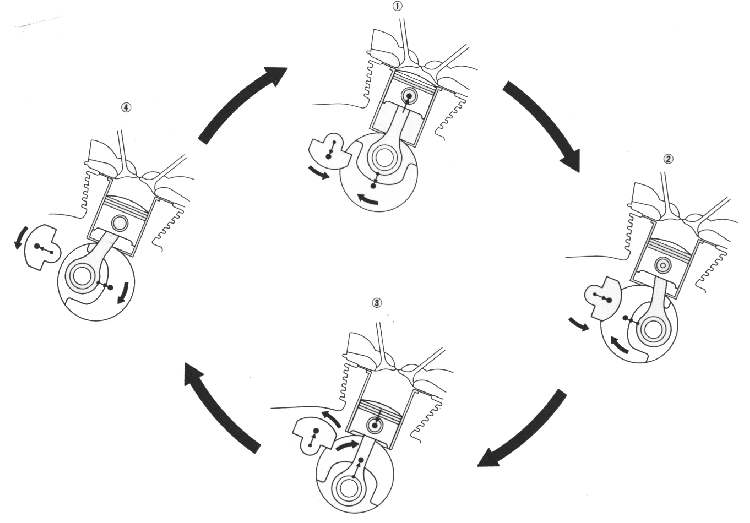
        In an IC engine the vertical movement of a Piston is transferred to a Rotary movement in the Crank Shaft through offset connecting rod .

        Engine crankshaft animation - YouTube

        The vibration produced in the engine is mostly due to Ignition timing , Combustion power, and Crankshaft to Piston off set balancing. Some engines try to minimize this vibration through balancer which run a small off set weight in opposite phase to the crankshaft movement , thus canceling it.


        Some engines use Offset Crank .
        When Was The Last Time,You Did Something For The First Time.

        Comment


        • Re: INFO: A Guide On Technical Jargons

          I hope this is the right thread to post this. I'm sorry if this is not. I'm a newbie as you can see

          I have had this doubt for a long time. What is the proper way to brake? With the clutch or without? I feel the engine and brake pads/shoes would be damaged if you brake suddenly without clutch.


          PS. I searched my level best to see if there's something related to it. I couldn't find it. If there's please direct me!

          Comment


          • Re: INFO: A Guide On Technical Jargons

            Well am no expert, but every component which is rigid (undamped) carries/transfers vibration from source throughout the body.

            In Automobiles the sources of vibrations are 1. Engine/ Motor
            2. Road or sometimes in worst case wind blowing head on will create plastic parts(farings - if thin & loose) vibrate.

            Its so simple that these vibs are carried, because every part is connected. Also while designing each part, caution is taken that the natural frequency of part will never fall under vibration range of bike or road. This is why some bike parts are chenged w.r.t locations/road conditions.

            If any parts resonates with right aplitude (measured in "g" values), its broken.
            Vibs can be damped using mounting cushions/dampers etc.. so even if frequency matches, amplitide will not be enough to break the part.

            Normal bikes will experience vibes upto 20g s in frame & 3-7g s in damped parts.
            Frequency will be in range of 50-500 Hz or more if revs are more.
            SK

            Western ghats-Weekends Love!!!

            Bhutan - 2017
            Nepal 2014

            Bhiwadi - Leh 2014
            Bhiwadi - Shimla Kufri 2014
            Badrinath Mana 2015 Bhiwadi - Mandawa 2015

            Comment


            • Re: INFO: A Guide On Technical Jargons

              Originally posted by srj.dvy View Post
              I What is the proper way to brake? With the clutch or without? I feel the engine and brake pads/shoes would be damaged if you brake suddenly without clutch.

              ALWAYS WITHOUT CLUTCH... clutch is for transmission of gears only. if you use clutch while braking, engine braking is cut off and there is no engine control. i think you are not used to, the term engine control. take you bike to a slope. start riding down and come to 2nd gear.

              the bike wont cross beyond 40 km/hr due to its engine braking and giving better control. now if you depress clutch, the bike picks up speed on slope due to nil engine braking , just as in neutral, and when you use brakes, the force needed will be much higher to stop, thus damaging brake system more.

              and i think, you want to protect each and every part on bike as new. in a nut shell, its never possible, one or the other part needs to be compromised for the larger safer run. good bikers use every part in a sync manner, than putting pressure on just 1 part.

              please think more on your sentence, "I feel the engine and brake pads/shoes would be damaged if you brake suddenly without clutch. "

              then do you intend to stop it then, without brake wear? brakes are the cheapest to afford on a bike. remember that.

              your doubt really consists of many parts, and i feel the easiest way is to read wikipedia. some links are here

              Clutch control - Wikipedia, the free encyclopedia ( read deceleration )

              Engine braking - Wikipedia, the free encyclopedia

              normal braking is a bit different from panic braking.

              braking starts from faster observation, releasing throttle, changing seating posture, bringing the engine braking first and then using front and rear brakes in sync as needed. said that, it also depends on your bike setup, tyres, its air pressures, suspension, brake system that you have ...
              Last edited by Legend Racer; 04-18-2014, 12:28 PM.
              I'm a responsible rider.It doesn't matter what you ride,but what matters is how you ride.

              Comment


              • Re: INFO: A Guide On Technical Jargons

                Originally posted by Legend Racer View Post
                ALWAYS WITHOUT CLUTCH... clutch is for transmission of gears only. if you use clutch while braking, engine braking is cut off and there is no engine control. i think you are not used to, the term engine control. take you bike to a slope. start riding down and come to 2nd gear.

                the bike wont cross beyond 40 km/hr due to its engine braking and giving better control. now if you depress clutch, the bike picks up speed on slope due to nil engine braking , just as in neutral, and when you use brakes, the force needed will be much higher to stop, thus damaging brake system more.

                and i think, you want to protect each and every part on bike as new. in a nut shell, its never possible, one or the other part needs to be compromised for the larger safer run. good bikers use every part in a sync manner, than putting pressure on just 1 part.

                please think more on your sentence, "I feel the engine and brake pads/shoes would be damaged if you brake suddenly without clutch. "

                then do you intend to stop it then, without brake wear? brakes are the cheapest to afford on a bike. remember that.

                your doubt really consists of many parts, and i feel the easiest way is to read wikipedia. some links are here

                Clutch control - Wikipedia, the free encyclopedia ( read deceleration )

                Engine braking - Wikipedia, the free encyclopedia

                normal braking is a bit different from panic braking.

                braking starts from faster observation, releasing throttle, changing seating posture, bringing the engine braking first and then using front and rear brakes in sync as needed. said that, it also depends on your bike setup, tyres, its air pressures, suspension, brake system that you have ...


                Thanks a lot mate.. Well the word engine control is new to me but I've experienced what you mentioned there...
                And about what I said I actually wanted to write about the inverse of what I mentioned there, which is won't the engine be damaged by braking without clutch.. coz whenever I do that I feel there's a lot of stress put on the engine than braking with clutch.
                And I feel the sync you mentioned about comes naturally to all bikers? And I'll check those links as soon as I get home thanks for the help.

                Sent from my HTC One X using xBhp Connect mobile app

                Comment


                • Re: INFO: A Guide On Technical Jargons

                  Originally posted by srj.dvy View Post
                  And about what I said I actually wanted to write about the inverse of what I mentioned there, which is won't the engine be damaged by braking without clutch.. coz whenever I do that I feel there's a lot of stress put on the engine than braking with clutch.

                  Sent from my HTC One X using xBhp Connect mobile app
                  first of all, before you post, read it a couple of times, make sure, its what you want to tell others. simply typing and posting is bad in public.

                  and im thinking hard how on earth would braking be stress on engine? come on, once engine is started and bike rolls, it has to stop at sometime, isnt? maybe, you are not used to use gears as the torque in engine. see, shifting gears is preliminary to braking often. now to do this, there are 2 ways, with your eyes and ears.

                  i assume that your bike got tachometer. use your eyes to see and shift appropriately. to use ears you must be an experienced rider, not being offensive here. after practising with eyes and tacho you will be able to judge the gear the engine needs just by its sound.
                  some say this as, getting intimate with your ride...

                  sharing a link the manual guide though here its about car, the tacho stuff is almost same.

                  please dont get confused that clutch is needed for braking. some best riders dont even require clutch to transmit gears...its just about getting the right rpm inside engine and pre loading the shifter. you are confused, maybe because, you fear of stalling the bike while braking.

                  during braking the speeds are getting reduced and you must down shift aptly , which is where clutch comes in. once you practise these please learn about blip and shift technique later.
                  I'm a responsible rider.It doesn't matter what you ride,but what matters is how you ride.

                  Comment


                  • Re: INFO: A Guide On Technical Jargons

                    Hi guys,
                    have a question, posted it on CBR 150R thread but didn't get any answer so posting it here.
                    I have been riding R15 since last 3.5 yrs and as soon as CBR 150 R was launched, was exited and instead of celebrating people started verbal battles and started mentioning pros and cons of each bike.


                    one of which was an closed loop FI in CBR 150 R, as far as I know an closed loop uses the measurement of exhaust gases(using o2 sensor/Lambda sensor) for precise fueling. but there's a catch, a closed loop is used only in the initial RPM's i.e. below 60% of max RPM(according to BikeBoy.org - Fuel Injection – Open Loop and Closed Loop) since CBR has 11.5 k as cutoff, the closed loop will work until somewhere around 5-5.5 k, and post this it works as a regular open loop(found in R15)


                    Now here's my question, CBR being a short stroke has to revved hard to extract power (suggested by owners themselves, the shifting of gears has to be done post 5-5.5 k) so why is the CBR having a closed loop instead of open loop system when most of the time it will work post the required RPM of Closed Loop.


                    right now trying to learn about FI's.

                    CHEERS

                    Comment


                    • Re: INFO: A Guide On Technical Jargons

                      Originally posted by Samarth 619 View Post

                      1. it dampens your actions, so they don't translate into the same control that hard suspensions give. You don't feel your actions are helping to "control" the bike. Your lean angles while turning will not inspire confidence,

                      2. When you apply the front brakes, the entire chassis "nose-Dives" forward as the front suspension contracts. When you accelerate hard, your rear suspension contracts so you can feel the frame lift from front, but you can't feel the front wheel at all- whether its in air or not.

                      3. Racing or hard riding, you won't "feel the road" with such a soft setup. That means, you won't get feedback from the road, and won't be able to judge the grip properly too.

                      4. On corners, on a soft setup, you will feel bouncy through the corner. One corner is ok, but if you have to pass through some fast corners one after another- you're going to be confused.
                      Compare this to a harder suspension where you'll feel the bike to be taut and within control.
                      .

                      I think @Old Fox sir can explain the suspension thing better...
                      I have the softest suspension setup on my Duke 200 and I don't feel the confidence while leaning into corners(whatever little I do). I never bothered to change the setup since I did not know their effects.
                      Will try hardening the rear suspension a couple of points and check the difference..
                      But the tool for doing it is not included in the tool box which makes it a bit inconvenient.
                      Thanks for the in depth explanation. I could imagine myself going into corners while reading I usually do at lavasa(Pune)..!!


                      Sent from my iPhone using Tapatalk

                      Comment


                      • Re: INFO: A Guide On Technical Jargons

                        Originally posted by Legend Racer View Post
                        ALWAYS WITHOUT CLUTCH... clutch is for transmission of gears only. if you use clutch while braking, engine braking is cut off and there is no engine control. i think you are not used to, the term engine control. take you bike to a slope. start riding down and come to 2nd gear.

                        the bike wont cross beyond 40 km/hr due to its engine braking and giving better control. now if you depress clutch, the bike picks up speed on slope due to nil engine braking , just as in neutral, and when you use brakes, the force needed will be much higher to stop, thus damaging brake system more.

                        and i think, you want to protect each and every part on bike as new. in a nut shell, its never possible, one or the other part needs to be compromised for the larger safer run. good bikers use every part in a sync manner, than putting pressure on just 1 part.

                        please think more on your sentence, "I feel the engine and brake pads/shoes would be damaged if you brake suddenly without clutch. "

                        then do you intend to stop it then, without brake wear? brakes are the cheapest to afford on a bike. remember that.

                        your doubt really consists of many parts, and i feel the easiest way is to read wikipedia. some links are here

                        Clutch control - Wikipedia, the free encyclopedia ( read deceleration )

                        Engine braking - Wikipedia, the free encyclopedia

                        normal braking is a bit different from panic braking.

                        braking starts from faster observation, releasing throttle, changing seating posture, bringing the engine braking first and then using front and rear brakes in sync as needed. said that, it also depends on your bike setup, tyres, its air pressures, suspension, brake system that you have ...
                        I had the habit of always braking with clutch pressed in. But for the last few days, I have been practising braking without pressing clutch. What I experience is that if I just close the throttle and apply the brakes without pulling clutch, I experience a sudden jerk forward. Am I doing something wrong?

                        And sometimes when we just have to close the throttle (without applying brakes), should we still not press the clutch?

                        Comment


                        • Re: INFO: A Guide On Technical Jargons

                          Originally posted by hss View Post
                          I had the habit of always braking with clutch pressed in. But for the last few days, I have been practising braking without pressing clutch. What I experience is that if I just close the throttle and apply the brakes without pulling clutch, I experience a sudden jerk forward. Am I doing something wrong?

                          And sometimes when we just have to close the throttle (without applying brakes), should we still not press the clutch?
                          Of course you would because the forces of engine braking are also acting when you are decelerating and not pressing clutch..


                          Sent from my iPhone using Tapatalk

                          Comment


                          • Re: INFO: A Guide On Technical Jargons

                            Originally posted by hss View Post
                            ...

                            And sometimes when we just have to close the throttle (without applying brakes), should we still not press the clutch?
                            Nope, don't disengage clutch while closing throttle, unless of course you want to change gear.
                            There is no honest path to prosperity - KoKa
                            Useful Resources Over Internet

                            Comment


                            • Re: INFO: A Guide On Technical Jargons

                              Originally posted by wallpapers123 View Post
                              Of course you would because the forces of engine braking are also acting when you are decelerating and not pressing clutch..


                              Sent from my iPhone using Tapatalk
                              So, how can this be prevented? I am sure it wouldn't be normal to experience this forward jerk everytime once has to brake. It's more annoying for the pillion.

                              ----consecutive posts auto-merged-----

                              Originally posted by SparKot View Post
                              Nope, don't disengage clutch while closing throttle, unless of course you want to change gear.
                              Sorry, didn't get you. When you say don't disengage clutch while closing throttle, you mean engage the clutch meaning press the clutch while closing throttle. Is that right?

                              Comment


                              • INFO: A Guide On Technical Jargons

                                Originally posted by hss View Post
                                So, how can this be prevented? I am sure it wouldn't be normal to experience this forward jerk everytime once has to brake. It's more annoying for the pillion.
                                The amount of engine braking will defer for every bike and how smoothly or aggressively you are releasing the throttle.
                                I believe slipper clutches have lesser engine braking than wet clutches..
                                Please quote someone if I'm wrong..


                                Sent from my iPhone using Tapatalk

                                Comment

                                Working...
                                X
