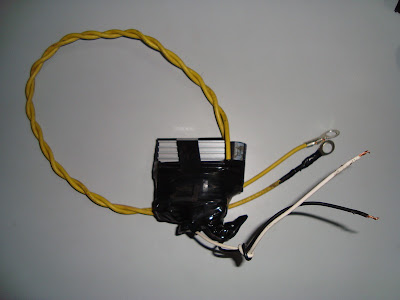



Now thinking of a good casing to mount it and connect to battery, i tested it for 15mins and it was fine except the cap getting heat. So will mount the cap also on heat sink and test for 30mins and then fit it as finally.
Announcement
Collapse
No announcement yet.
Converted my Pulsar 150 Classic to ALL DC
Collapse
X
-
Yes, as Abhi said, check the polarity of the Capacitor. But BTW in my case the Caps do heat up a lot, may be because of the diodes it self. Just be sure the circuit if fine.As i said earlier i am getting 25v output but as Abhijit said if connected tightly it should work fine. And the heat of cap is normal itseems, that was the first time i touched the cap and i felt that was abnormal
Now thinking of a good casing to mount it and connect to battery, i tested it for 15mins and it was fine except the cap getting heat. So will mount the cap also on heat sink and test for 30mins and then fit it as finally.Been There, Done That; Better!
-
Problem continues...


While testing i removed the battery from its place and connected a bulb and the rectifier. I tested it like this for 20mins and there was no heating issue or anything and the battery was charging @ 13.xx volts where as the battery had 12.7x volts current.
Now the story begins
I connected the battery to its regular wires, also connected the rectifier behind a switch so that i can turn on only during night.
Tested the charging voltage in different stages and here is the report.
Stock Charging Volt with Headlight OFF --> 13.8 to 14.2
Stock Charging Volt with Headlight ON --> 12.8 to 13.2
Rectifier + Stock Charging Volt with Headlight OFF --> 12.2 to 12.5
Rectifier + Stock Charging Volt with Headlight ON --> 12 to 12.2
Isn't it strange that when i turn ON the rectifier the power is dropping instead of increasing.
Now should i proceed with it or not!!!
Comment
-
Your wiring circuit is correct right. Other than that no idea why this happened. I do get a lower voltage at idle with headlight ON. This is because headlight takes power from the battery and the coil can not charge it enough. But lower voltage without any load too? That's strange.Your biking tells a lot about the person you are!
Comment
-
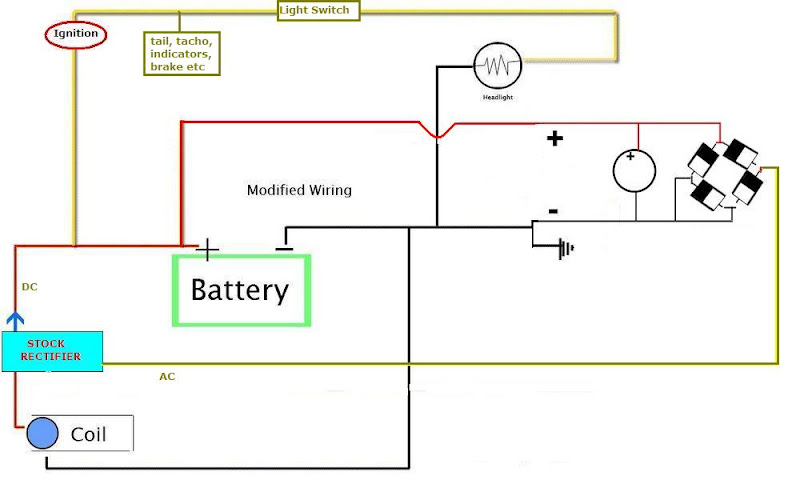
Wiring diagram

Rahul sorry for editing ur copyrighted image
Last edited by Shreeni0403; 05-30-2009, 11:38 AM.
Comment
-
As far as I know, every bike with AC Headlights have different coil for the purpose. So even though your wiring may route from the rectifier, it's best tap it from the coil. In my case Red stripe in Yellow, carries the AC current to the Headlights.My stock headlight gets power from the RR Unit, not directly from coil. AFAIK its the same in all bikes.Been There, Done That; Better!
Comment
-
But the current direct from the coil is unregulated! The RR unit regulates this current. So, it is not advisable to bypass the RR unit.Originally posted by rahuldevnath View PostSo even though your wiring may route from the rectifier, it's best tap it from the coil.Your biking tells a lot about the person you are!
Comment
-
RR Unit regulates the AC Current? Are you sure?But the current direct from the coil is unregulated! The RR unit regulates this current. So, it is not advisable to bypass the RR unit.
The power going to headlight is not regulated. Our custom rectifier, is actually regulating it with the capacitor.
But all in all, the setup should work whichever way it suites your bike. Shree, do dome real world testing, see if your battery is discharging.Been There, Done That; Better!
Comment
-
I have done some research on the internet about the role of the RR unit on bikes. This unit does 2 thing - regulates the voltage and rectifies it to DC.Originally posted by rahuldevnath View PostRR Unit regulates the AC Current? Are you sure?
Our bikes have a permanent magnet charging system - the magnetic field strength is fixed. So, as the engine speed increases, the output voltage of the coil too increases. This regulator maintains it at around 13.8V.
How is the regulation done? Our bikes uses short circuit regulation scheme. The RR unit monitors coil voltage. As soon as it increases above a preset level, it short circuits the coil. Note that it does not open circuit the coil - this would have led to sparking in the RR unit and this principle is used by the ignition coil. These short circuits maintains voltage level. But there is a catch - heat generation occurs due to which cooling is needed in forms of heatsinks. As a significant amount of energy is wasted in form of heat, this system is not very efficient.
Note - this is the reason why we need to change the RR unit too when we change to avenger coil. The stock RR unit can be burnt due to excessive heat generation.
This output is now rectified using full wave rectification circuits to generate DC. The AC output of the rectifier is not rectified. It is just regulated.Your biking tells a lot about the person you are!
Comment


Comment