







For the last couple of years, the electric motorcycle conversation has revolved mainly around four questions: how far it will go, how quickly it can charge, what the performance will be, and how much money it will save compared with a petrol bike. Those questions still matter. But for a motorcycle enthusiast, they are only part of the story, and that image is changing now.
Today, electric bikes are becoming faster, smarter and more capable, giving motorcycle enthusiasts a reason to look beyond traditional engines. More importantly, riders who would have dismissed an electric motorcycle a few years ago are now beginning to test-ride them seriously. Improved performance, better technology and the arrival of enthusiast-focused models have changed the conversation.
The real question for riders isn’t whether electric is growing. It’s whether it can finally deliver the performance, practicality, and ownership experience enthusiasts actually want.
What’s Making Electric Motorcycles More Appealing to Riders Today?
The biggest shift in electric bikes is that they are no longer designed only to save fuel. Modern bike manufacturers are now building for riders, not just commuters, and here’s what has changed:
- Rider-focused engineering – sharper frames, better suspension tuning, stronger acceleration, and connected electronics that feel closer to a modern petrol bike.
- Instant torque – an electric motor gives full pull the moment you twist the throttle, so overtaking and city riding feel comfortable.
- Genuine performance on tap – Ola’s top Roadster X+ (9.1 kWh) claims up to 501 km of range, a 125 km/h top speed, and 0–40 km/h in 2.7 seconds, per Motoautiv. The cheaper Roadster X variants run a modest 7 kW motor with 140–252 km of claimed range, per ZigWheels. Not every electric bike is fast, but the category has clearly outgrown the plain commuter formula.
Are Electric Bikes Delivering the Performance Enthusiasts Want?
Yes, modern high-performance electric bikes are increasingly satisfying enthusiasts with massive torque, rapid acceleration, and high-top speeds. But for real riders, performance is more than a top-speed number, and here electric has an interesting edge.
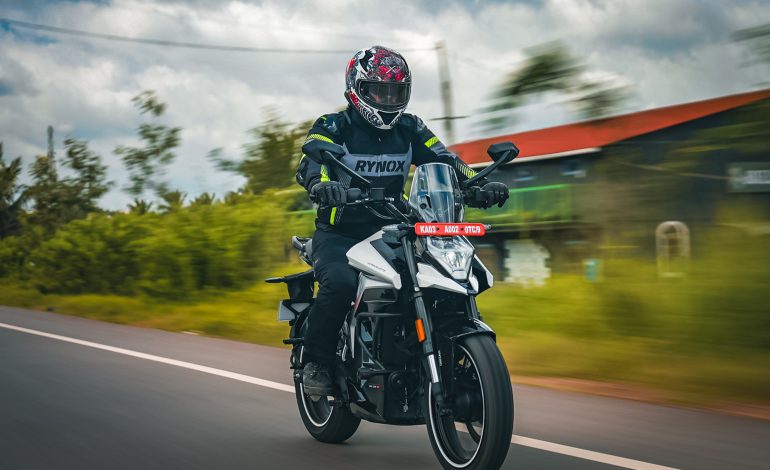
Take the Ultraviolette F77 Mach 2, built right here in Bengaluru. On paper, it’s a proper performance machine, with a claimed top speed of 155 km/h and 100 Nm of torque from its bigger battery, per Ultraviolette’s own specs. In the real world, it sprints from 0 to 100 km/h in about 7.7 seconds, and BikeWale’s test riders found it handled a tight circuit like a genuine sportsbike. That’s a bike you’d enjoy carving corners on. The magic word here is torque, and it’s worth explaining. A petrol bike has to rev up before it gives you its strongest pull. But an electric motor gives you full pull the instant you twist the throttle – no waiting, no gear changes, no clutch. For a rider, that means overtakes feel immediate and city riding feels effortless. Roll on the power and the bike goes.
For riders who spend most of their time in urban traffic or on twisty roads, that immediate response can feel surprisingly engaging, even without the drama of a traditional petrol engine.
How Practical Are Electric Bikes for Everyday Riding?
Electric bikes are already quite practical for everyday urban riding. Their suitability depends more on charging access, range requirements, and riding habits when the use case extends beyond the daily commute.
For most riders, the practicality of an electric bike comes down to how well it fits into their daily routine. For city commuting, electric motorcycles can make a strong case. For enthusiasts, practicality is less about daily commuting alone and more about whether a motorcycle fits their riding habits. Riders with predictable daily routes and access to home charging are finding electric motorcycles easier to live with than expected. The challenge remains long-distance touring, where charging availability and charging time still require planning.
Electricity is generally cheaper than petrol for the same distance, and electric bikes have fewer moving parts and don’t require regular engine oil changes. For riders who cover significant kilometres every day, these savings can become meaningful over time.
Do Electric Bikes Make Sense from an Ownership Cost Perspective?
Here’s where electric bikes really pull ahead. The purchase price of an electric bike is only one part of the ownership equation. For riders who use their motorcycle regularly, the bigger question is what it costs to keep it running over several years.
Lower energy and maintenance costs are certainly part of the appeal, especially for riders who use their motorcycles frequently. However, for many enthusiasts, cost savings are becoming an added benefit rather than the primary reason for considering electric motorcycles.
Alongside energy and maintenance expenses, insurance remains an important ownership cost for any motorcycle. Third-party cover is mandatory by law in India, while bike insurance can help protect riders against financial losses arising from accidents, theft, fire, and vehicle damage. For electric motorcycles, this becomes particularly relevant because battery repairs or replacement can be expensive.
What Should Riders Check Before Buying an Electric Motorcycle?
A little research or homework has to be done before you buy an electric bike to avoid regret later. Here’s a simple checklist worth running through:
- Real-world range: Company figures are measured in ideal conditions. Ask owners or reviewers what the bike does in traffic, on the highway, and in hot weather.
- Battery warranty: The battery is the heart and the costliest part. Check how many years and how many kilometres it’s covered for before you sign anything.
- Home charging: Do you have a safe spot and a socket for overnight charging? If you live in an apartment without a charging point, sort that out first.
- Service and spares network: Newer electric brands don’t always have wide service reach yet. Make sure support is available near you.
- The right insurance: An electric bike has parts a normal petrol bike doesn’t — the battery, the motor, the charger. The right electric bike insurance policy can cover these EV-specific bits, including battery damage and add-ons that protect your charging equipment.
Tick these off, and you’ll avoid the most common first-timer mistakes. Rush past them, and you might learn an expensive lesson.
Will Electric Motorcycles Become a Mainstream Choice for Enthusiasts?
Electric motorcycles are unlikely to replace petrol motorcycles overnight. Petrol bikes still offer quick refuelling, familiar technology, and a well-established service network. However, the gap is steadily narrowing. Better battery technology, expanding charging infrastructure, and the arrival of performance-focused electric motorcycles are making the category increasingly attractive to enthusiasts.
As these developments continue, the arguments against electric motorcycles are becoming less convincing. The next phase of growth is no longer driven only by commuters looking to reduce fuel costs. More riders are beginning to explore electric motorcycles because they offer a different riding experience without compromising as much on performance or everyday usability.
Final Verdict: Is Going Electric Really Worth it for an Enthusiast?
Electric motorcycles may not replace petrol-powered machines for every rider, especially those who value engine character, long-distance touring convenience and traditional riding involvement. However, today’s electric bikes are no longer limited to being practical commuter machines.
With stronger performance, instant torque, increasingly capable chassis setups and more enthusiast-focused models entering the market, electric motorcycles have earned a place in the discussion. For many riders, the question is no longer whether electric bikes can be enjoyable. It is whether they now offer a riding experience worth experiencing firsthand.