









PROLOGUE
There is a famous quote in motorcycling world “Rider matters, ride doesn’t”. That’s what motivated me since I started riding 8 years back. I have covered 3,00,000+ kms on two wheels, mostly on my Royal Enfield Thunderbird on which I have covered 225,000 km so far spanning Kashmir to Kanyakumari. But, it was always my dream to travel long distances on a small capacity engine. I opted for Honda Navi in October 2016 and started exploring places nearby. The 800 km Rajasthan odyssey fuelled me with enough of confidence to take on the Jalori Pass. Jalori Pass is located in Himachal Pradesh, and at an altitude of 10,800 ft, is considered to be one of the toughest passes in India due to steep inclination and black ice formation. I planned this ride with a couple of bikers from Chandigarh of BikerZone motorcycling club.
Text & Photos: Sakshar Ray Chaudhuri

RIDE ITINERARY
Day Zero:
We had three days in hand and hence the planning was done accordingly. Due to lack of traffic on the highways, I prefer riding during nighttime. Feb 24th was an official holiday for us. I finished up my office work by 8 PM on 23rd and left for Chandigarh at 8:30 PM. It was a windy, bone-chilling night. We reached Karnal at around 11 PM and stopped for dinner at Jhilmil dhaba. I rendezvoused with Ronit, a rider from Kolkata over there. Due to light weight of Honda Navi, the bike was shaking whenever there was a strong blow of wind. I was able to maintain continuous speed of 65-70 kmph on the highway. We took the diversion toward Shimla from Zirakpur and continued further till Panchkula. I had a plan to stay at my co-rider Archit’s place in Panchkula. I reached Panchkula at 3 am and jumped in the bed right way.
Day One:
We were back on the saddle on 24th Feb at 8 AM. It was a sunny morning and we headed towards the fuel station in Panchkula. Navi had consumed close to 450 INR worth of gasoline from Delhi to Panchkula. We tanked up and headed towards the beautiful Himalayan Expressway stretching from Panchkula towards Solan and thereafter towards Shimla. The first 20 kms of ride was awesome, after which we encountered the bad patches due to ongoing six-laning project till Solan. We had breakfast in Dharampur and then headed towards Shimla and thereby towards Narkanda. I had to refuel on the outskirts of Shimla as Navi was able to cover only 120 km on the hills. We were doing consistent speeds of 40 kmph during this section. Power loss on Navi was quite expected, but it performed pretty well on the hill climbs, including step inclination in Barog section. By 3 PM, we were in Narkanda. The photo-sessions in between consumed a lot of time, but it was quite necessary for a trip like this. Due to Shivratri, most of the hotels and restaurants were closed in Narkanda and we had a tough time finding a room for us. Finally, we settled for 2 rooms right at the backyards of the bus stop. The evening was spent watching the mesmerizing sunset against the backdrop of Dhauladhar range. While Narkanda was getting dark and the temperature was hitting sub-zero, we were gearing up for an adventure filled day ahead.


Day Two:
We started our day at 7 AM sharp. Considering the fact that we are going to cover both Hatu peak as well as Jalori Pass, I tanked up in Narkanda. From Narkanda to Hatu peak was the tricky part as the roads were covered with black ice as well as hard ice. The first 3 km was of steep gradient, which I could feel from the engine sound of Navi. There were icy patches here and there, but the road was ice free. Suddenly, I felt that my bike is skidding while on the roll. It was a small patch of black ice on the road, which had frozen at night. We could manage reaching till the point where the depth of the ice was less than 1 ft and then had to return back from 500 meters from Hatu peak.
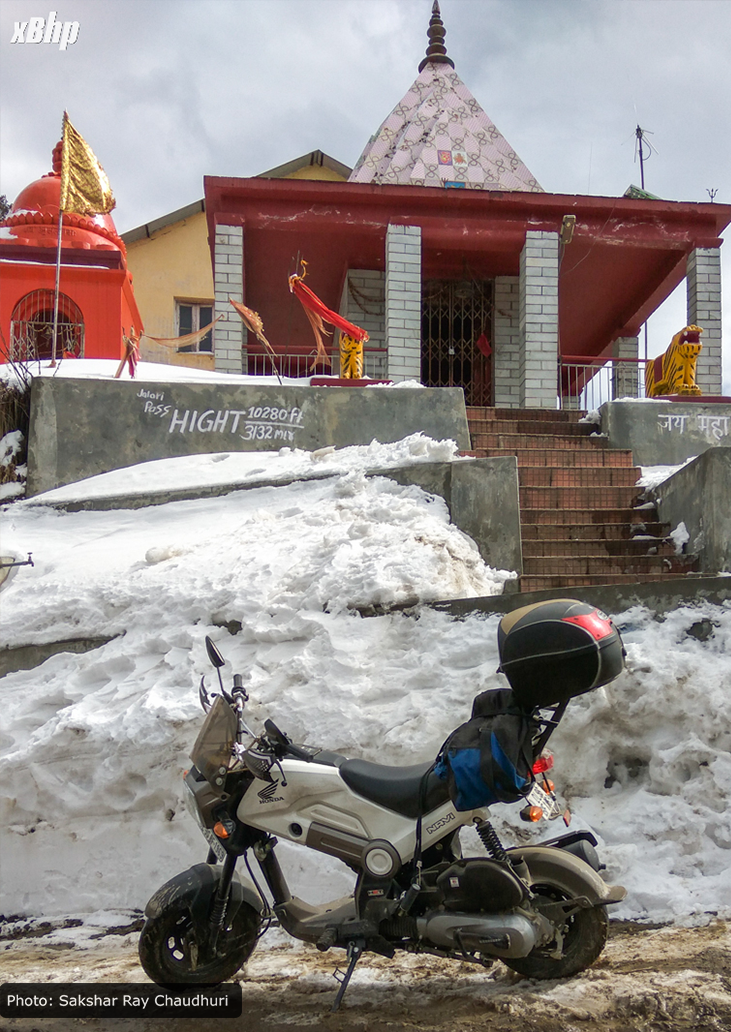
Then we headed towards Jalori pass. From Hatu peak, it was via Narkanda-Kumarsain-Kingal route. We encountered a major landslide just ahead of Kingal, which took an hour’s time to clear. The steep gradient starts from Khanag and it becomes muddy and full of slush 3 km from Jalori top. The incline is steep and the road is full of slush, black ice and slippery surface. One mistake and you will fall deep in the valley. The Navi did not give up. It went all the way till the top flawlessly. To make the ride more interesting, we planned to go down towards Jibhi side where the steepness is on the higher side. While climbing up from Jibhi side, Navi got stuck in black ice and I had to get down from the bike to push it for around 10 meters and to get the momentum back again. We had spent a good amount of time at the Jalori top and then headed back towards Kingal. We had a plan to stay at Suni village but due to lack of accommodation, we had to stay back at Tattapani. The road from Jalori to Suni village is picturesque and a dream route for any biker.



Day 3:
We had a long day on the highway where we had to cover 450 km. It was a boring and crowded day on the highway.
I realized that the heaven is right here on the earth and we just came back from there.
Tips for riding on smaller capacity motorcycles:
1. Keep it light, as much as you can
2. Make sure that you are taking into consideration the wind blast from other vehicles.
3. Calculate and carry enough fuel. Top up as soon as you can.
4. Keep your loved ones aware of your plans.
5. In steep gradients, start by accelerating slowly and then keep the momentum going.
6. Do not brake on hard/black ice.
7. Boots with good grip on slippery surface are always helpful while riding on black/hard ice.