








Bihar’s traffic enforcement landscape has changed significantly over the past few years. The state has been expanding its camera-based challan infrastructure, particularly on national highways passing through major urban centres like Patna, Gaya, and Muzaffarpur, and on key arterial roads. For anyone buying a used car that has been registered and operated in Bihar, understanding the challan situation is an important part of due diligence, even if it’s not yet as widely discussed as it is in metros like Delhi or Mumbai.
Why Challans Follow the Vehicle
The core issue is one most used car buyers in India still don’t fully appreciate: a traffic challan issued to a vehicle’s registration number follows the vehicle, not the individual who committed the violation. When the Motor Vehicles Amendment Act, 2019 came into effect, it didn’t just raise fine amounts dramatically; it also strengthened the digital linkage between the vehicle’s RC and its outstanding liabilities. A car with unpaid challans is a car with an unresolved administrative burden, and that burden transfers to whoever holds the RC.
For Bihar specifically, the risk profile varies by the car’s usage history. A car that has primarily been used within Patna city and has been through the camera corridors on Boring Road, Bailey Road, or the new stretches near the Gandhi Setu, areas where enforcement has been more active, is more likely to have a challan history than one used in smaller towns. Highway-driven cars face their own challan risks, particularly for speed violations on NH-30, NH-19, and other corridors where automated speed enforcement has been deployed.
One of the complications specific to Bihar (and several other states) is that the challan database may have some pending entries from earlier enforcement periods that weren’t fully digitised. This means a manual check through the state RTO may sometimes reveal entries that don’t show up in national-level online checks. While this is less common than it once was, digital integration has improved significantly, it’s worth knowing for older vehicles.
How to Check Before Buying
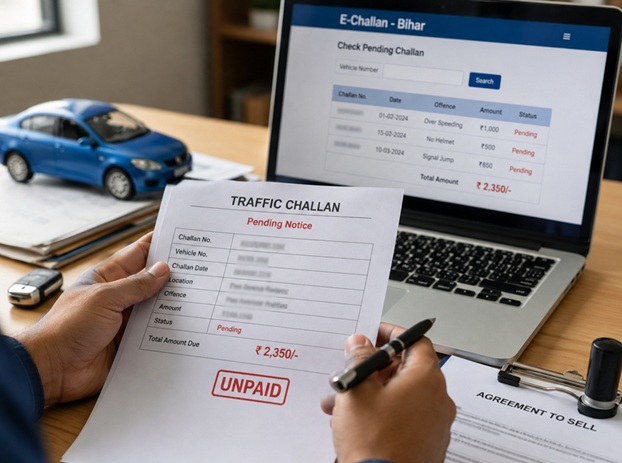
The practical step before any used car purchase in Bihar is a traffic challan check using the vehicle’s registration number. The national portal pulls from VAHAN and state-level systems and will show pending challans. If any show up, the amount and the issuing authority will be visible, giving you both the financial figure and the context of where and when the violation occurred.
For buyers who are purchasing from private sellers and don’t have the benefit of a certified platform’s pre-verification, doing this check independently is straightforward. The vehicle’s registration number (visible on the RC) is all you need.
Checking the e challan bihar status specifically is particularly useful if the vehicle has been used primarily within Bihar, as state-specific checks sometimes return more complete data than the national-level portal for state-registered vehicles.
The financial stakes are real. Post-2019, a single speed violation in a designated zone can attract a fine of ₹1,000-₹2,000 for the first offence, rising steeply for repeat violations. Lane discipline and signal violations carry similar or higher penalties. If a car has accumulated multiple unpaid challans over several years, the total can easily run into the tens of thousands, a significant and unpleasant discovery to make after the purchase is complete.
In the used car context, a challan check is a two-minute step with potentially significant financial implications. It should be as standard as asking for the service history.
Bihar’s major highways, NH-30 running through Patna, NH-19 connecting to Varanasi and beyond, and the Purnia corridor, have seen systematic camera-based enforcement deployment over the past two to three years. Long-distance vehicles, including cars used for intercity travel between Bihar’s cities, are more likely to have highway speed enforcement challans than cars used purely within city limits. If the car you’re evaluating has been used as a travel vehicle rather than a pure city car, factor this into your verification approach.
The overlap between state-level and national-level challan databases is another operational nuance to be aware of. Some challans issued through local district traffic enforcement in Bihar may appear in the state system before they propagate to the national VAHAN portal. If your initial national-level check shows nothing but you suspect the car has been through active enforcement corridors, requesting an RTO check through the Bihar transport office is a belt-and-suspenders approach that adds verification depth.
Running a traffic challan check before any purchase is a simple safeguard, and checking e challan Bihar specifically surfaces any state-issued dues before you commit.
Finally, the used car transfer process in Bihar, as in all states, can sometimes proceed through RTOs where the challan-flagging mechanism isn’t uniformly implemented. Don’t assume that because the RC transfer was processed without a flag, there are no pending dues. The liability remains against the registration regardless of how the transfer was completed.