





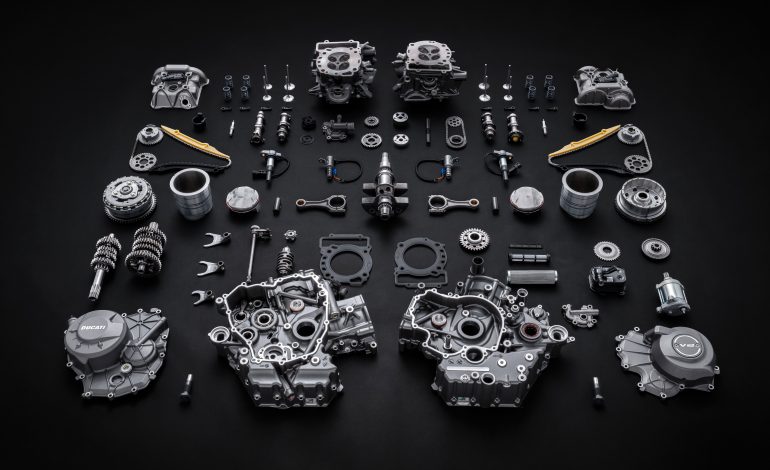

The new Ducati V2 engine is the Italian marquee’s lightest twin-cylinder engine. It is designed to offer maximum riding enjoyment, thanks to torque-rich power delivery at all revs and sportbike engine performance at high revs.
This new twin-cylinder is homologated according to the Euro5+ standard, has a displacement of 890 cc, is equipped with the IVT (Intake Variable Timing) variable valve timing system, and aluminium liners, and weighs just 54.4 kg, setting new benchmarks for lightness in the Ducati range (-9.4 kg compared to the Superquadro 955, -5.9 kg compared to the Testastretta Evoluzione, -5.8 kg compared to the Scrambler Desmodue). The spring valve timing system, introduced with the V4 Granturismo and confirmed on the new V2, allowed the definition of an engine that emphasizes regularity at low revs and economy of maintenance. The valve clearance is checked every 30,000 km, confirming reference intervals for the category.
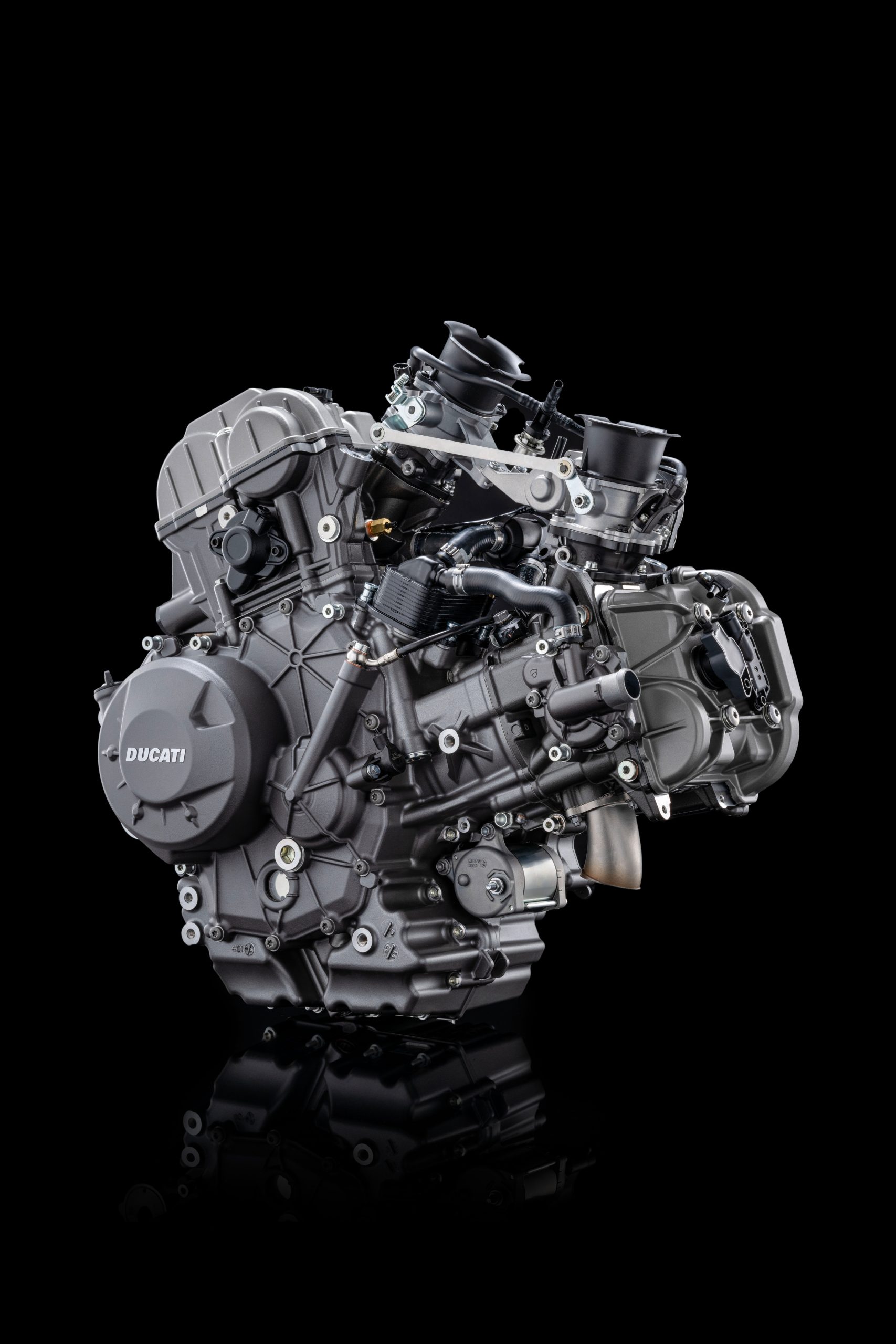
The typical versatility of Ducati twin-cylinders is one of the qualities of the new V2, which adapts perfectly to various motorcycles in the range due to its compactness and the performance it can offer. This is also thanks to the decision to define two different configurations, characterized by different power values (120 or 115 hp at 10,750 rpm) and corresponding deliveries. The maximum torque value is 93.3 Nm or 92.1 Nm at 8,250 rpm. The limiter, in fifth and sixth gear, is set at 11,350 rpm.
On the sportier 120 hp version, by adopting the racing exhaust for track use, maximum power increases to 126 hp (+6 hp) at 10,000 rpm and torque to 98 Nm (+5 Nm) at 8,250 rpm, with a weight saving of 4.5 kg.
The 115 hp version is equipped with a more powerful alternator, to properly manage even the heaviest electrical loads. The connecting rod and flywheel are reinforced to tackle even the most challenging adventures and offer a smoother response in relaxed riding.
Variable timing control
Thanks to the IVT (Intake Variable Timing) system, the new Ducati twin-cylinder guarantees a very linear torque delivery even at low revs, with prompt and enjoyable throttle response, and sportbike engine performance at high revs. More than 70% of the maximum torque is already available at 3,000 rpm, and between 3,500 and 11,000 rpm, the torque value never drops below 80%.
To optimize engine performance, the intake valve opening finger rockers have DLC (Diamond-Like Carbon) treatment, as on the Desmosedici MotoGP. The distribution control is by chain, while the valve recall occurs via a spring control. The intake valve stems are hollow, for greater efficiency of the distribution system thanks to a 5% weight saving. The valves are chrome-plated.
The engine crankcases, obtained by die casting, are shaped in such a way as to incorporate the water chamber around the cylinder liners. Like the Superquadro engine, the new V2 is equipped with aluminium liners, inserted into the housing holes of the crankcase during the initial assembly phases. This design allows the head to be fixed directly on the crankcase, combining the need for rigidity of the engine structure with a significant advantage in terms of its dimensional compactness. The liners, with their thin walls, also make effective heat exchange possible with the coolant flowing along the walls.
The new Ducati V2 allows the definition of more compact motorcycles thanks to particularly small dimensions due to the water pump positioned on the head of the front cylinder. This solution minimizes the exposed rubber tubing of the cooling circuit, improving the appearance of bikes where the engine is left exposed.
For the same reasons, the new twin-cylinder is equipped with a water/oil heat exchanger positioned inside the V of the cylinders, which allows for the elimination of the oil cooler. This technical solution reduces size and weight and improves the aesthetic impact of the engine.
As on the new Panigale V4, the gearbox is equipped with Ducati Quick Shift (DQS) 2.0. The second-generation DQS uses a strategy based solely on the gear sensor, thus allowing for the use of a pedal command without microswitches. This solution offers the rider a more direct feeling, with reduced travel and without that “rubbery” sensation typical of traditional quick shifters, and makes it easier to find neutral. The 8-disc slipper clutch, derived from the most recent version used by the Testastretta 11°, mitigates the retrograde torque with the throttle closed and when downshifting, improving the stability of the bike during more decisive braking phases.
The new Ducati V2 will also be available in a reduced-power version on bikes intended for A2 license holders.
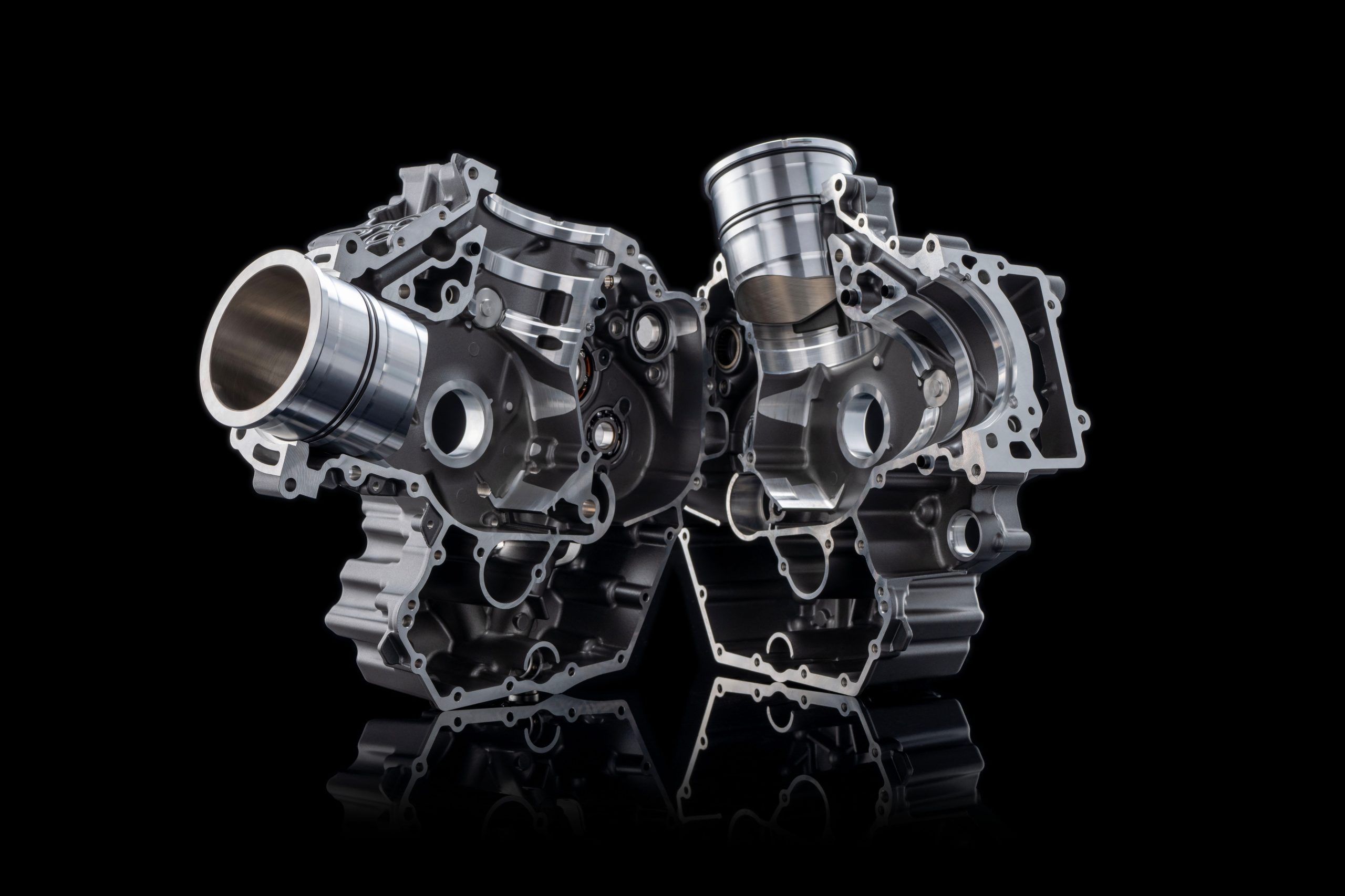
Main technical data of the new Ducati V2
- 890 cc 90° V-twin engine
- Weight 54.4 kg (-9 kg vs. Superquadro 955, -5.89 kg vs. Testastretta Evoluzione, -5.82 kg vs. Desmodue Scrambler)
- Chain-driven distribution with double overhead camshaft, IVT variable valve timing on the intake, 4 valves per cylinder. 38.2 mm hollow-stem intake valves, 30.5 mm exhaust valves.
- Bore x stroke 96 x 61.5 mm
- Compression ratio 13.1±0,5:1
- Maximum power 88 kW (120 hp) at 10,750 rpm – 126 hp with racing exhaust and maximum torque 93.3 Nm at 8,250 rpm
- Version with more powerful alternator and shortened ratios for the first two gears, maximum power 85 kW (115.6 hp) at 10,750 rpm and maximum torque of 92.1 Nm at 8,250 rpm
- Aluminium cylinder liner
- Euro 5+ homologation
- Multi-disc wet clutch, servo-assisted and with anti-hopping function
- Semi-dry sump lubrication with pressure pump and scavenge pump
- Power feed with 52 mm diameter throttle body
- Six-speed gearbox with the option of fitting the Ducati Quick Shift (DQS) 3.0
- Oil change scheduled at 15,000 km
- Check and eventual valve clearance adjustment scheduled at 30,000 km
- CO² emissions (WMTC): 120 g/km