

Since '02 xBhp is different things to different people. From a close knit national community of bikers to India's only motorcycling lifestyle magazine and a place to make like-minded biker friends. Join us

Castrol Power 1

Always keep the chain well lubricated.

Our Partner

Announcement

Collapse
No announcement yet.

Converted my Pulsar 150 Classic to ALL DC

Collapse
X
 
  • Filter
  • Time
  • Show
Clear All
new posts

  • rahuldevnath
    replied
    Huh? That's surprising. It is not so on my bike. I get 13.x V at all rpms. One thing - won't the lights blow off at 42V?
    Strange, without a capacitor you get 13.xx Volts??

    It's not my bike, as I have checked the same on UG3, 150 as well, while installing HID on my friend's bike. But it doesn't blows the bulb, as though the voltage goes till 42V, Amps is around 0.9 comes to 37W! .

    Leave a comment:


  • abhijeet080808
    replied
    Originally posted by rahuldevnath View Post
    I tried it without the custom rectifier installed, without capacitors. In all cases, I checked it long enough to be sure that at 4K RPM you get constant 42V on UG3.
    Huh? That's surprising. It is not so on my bike. I get 13.x V at all rpms. One thing - won't the lights blow off at 42V?

    Leave a comment:


  • rahuldevnath
    replied
    I tried it without the custom rectifier installed, without capacitors. In all cases, I checked it long enough to be sure that at 4K RPM you get constant 42V on UG3.

    Leave a comment:


  • abhijeet080808
    replied
    Originally posted by rahuldevnath View Post
    I tried measuring the current directly from coil as well right before the BCU of the UG3. To my surprise the current jumps anywhere from 14 to 40+ volts, and about 5 to 11 Amps.

    That's the same reason why Shree quoted very high voltage, even when it's after RR unit.

    Though the AC is goes through the RR, I doubt the power going to headlight is regulated.
    If you would have measured it before using the custom rectifier it would have been around 14V. The RR unit short circuits the coil as soon as it detects higher voltage. But this process takes a small amount of time. So invariably, small spikes do escape. These spikes charge the capacitor of the custom rectifier. And as a result, the 40V readings!

    Leave a comment:


  • rahuldevnath
    replied
    I have done some research on the internet about the role of the RR unit on bikes. This unit does 2 thing - regulates the voltage and rectifies it to DC.

    Our bikes have a permanent magnet charging system - the magnetic field strength is fixed. So, as the engine speed increases, the output voltage of the coil too increases. This regulator maintains it at around 13.8V.

    How is the regulation done? Our bikes uses short circuit regulation scheme. The RR unit monitors coil voltage. As soon as it increases above a preset level, it short circuits the coil. Note that it does not open circuit the coil - this would have led to sparking in the RR unit and this principle is used by the ignition coil. These short circuits maintains voltage level. But there is a catch - heat generation occurs due to which cooling is needed in forms of heatsinks. As a significant amount of energy is wasted in form of heat, this system is not very efficient.

    Note - this is the reason why we need to change the RR unit too when we change to avenger coil. The stock RR unit can be burnt due to excessive heat generation.

    This output is now rectified using full wave rectification circuits to generate DC. The AC output of the rectifier is not rectified. It is just regulated.
    The method of regulating the voltage even of AC seems to be as you have described. But working on my UG3, especially the coil, I found out that the current going to headlight via RR unit is not regulated.

    It seems that the Rectifier, rectifies DC and regulates the AC, but not the one going for the headlight.

    I tried measuring the current directly from coil as well right before the BCU of the UG3. To my surprise the current jumps anywhere from 14 to 40+ volts, and about 5 to 11 Amps.

    That's the same reason why Shree quoted very high voltage, even when it's after RR unit.

    Though the AC is goes through the RR, I doubt the power going to headlight is regulated.

    Leave a comment:


  • abhijeet080808
    replied
    Originally posted by Shreeni0403 View Post
    Somebody courier me ZMA or AVVY's rectifier for testing will return it back
    What are you up to?

    Leave a comment:


  • abhijeet080808
    replied
    Originally posted by rahuldevnath View Post
    RR Unit regulates the AC Current? Are you sure?
    I have done some research on the internet about the role of the RR unit on bikes. This unit does 2 thing - regulates the voltage and rectifies it to DC.

    Our bikes have a permanent magnet charging system - the magnetic field strength is fixed. So, as the engine speed increases, the output voltage of the coil too increases. This regulator maintains it at around 13.8V.

    How is the regulation done? Our bikes uses short circuit regulation scheme. The RR unit monitors coil voltage. As soon as it increases above a preset level, it short circuits the coil. Note that it does not open circuit the coil - this would have led to sparking in the RR unit and this principle is used by the ignition coil. These short circuits maintains voltage level. But there is a catch - heat generation occurs due to which cooling is needed in forms of heatsinks. As a significant amount of energy is wasted in form of heat, this system is not very efficient.

    Note - this is the reason why we need to change the RR unit too when we change to avenger coil. The stock RR unit can be burnt due to excessive heat generation.

    This output is now rectified using full wave rectification circuits to generate DC. The AC output of the rectifier is not rectified. It is just regulated.

    Leave a comment:


  • rahuldevnath
    replied
    But the current direct from the coil is unregulated! The RR unit regulates this current. So, it is not advisable to bypass the RR unit.
    RR Unit regulates the AC Current? Are you sure?

    The power going to headlight is not regulated. Our custom rectifier, is actually regulating it with the capacitor.

    But all in all, the setup should work whichever way it suites your bike. Shree, do dome real world testing, see if your battery is discharging.

    Leave a comment:


  • Shreeni0403
    replied
    Somebody courier me ZMA or AVVY's rectifier for testing will return it back

    Leave a comment:


  • abhijeet080808
    replied
    Originally posted by rahuldevnath View Post
    So even though your wiring may route from the rectifier, it's best tap it from the coil.
    But the current direct from the coil is unregulated! The RR unit regulates this current. So, it is not advisable to bypass the RR unit.

    Leave a comment:


  • Shreeni0403
    replied
    I connected the rectifier i did to the old headlight wire. Thats all.

    Leave a comment:


  • rahuldevnath
    replied
    My stock headlight gets power from the RR Unit, not directly from coil. AFAIK its the same in all bikes.
    As far as I know, every bike with AC Headlights have different coil for the purpose. So even though your wiring may route from the rectifier, it's best tap it from the coil. In my case Red stripe in Yellow, carries the AC current to the Headlights.

    Leave a comment:


  • Shreeni0403
    replied
    My stock headlight gets power from the RR Unit, not directly from coil. AFAIK its the same in all bikes.

    Leave a comment:


  • rahuldevnath
    replied
    No problem with copyright!

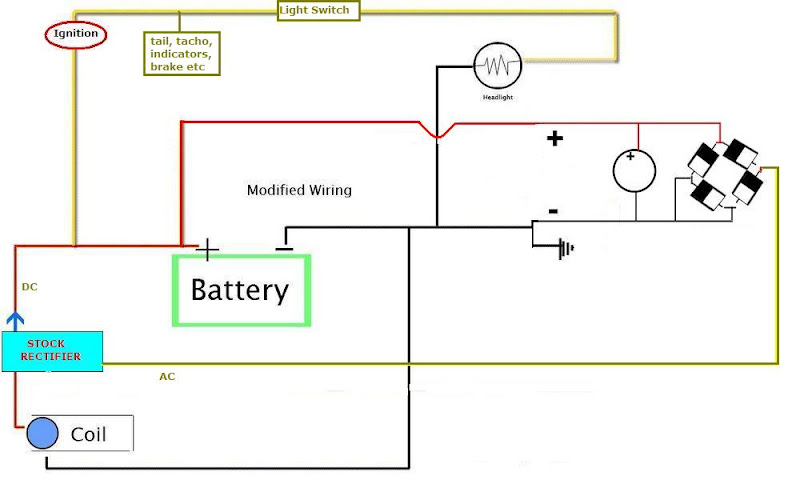
    No with your circuit, how did you manage to tap the wire after the stock rectifier? Is it not possible to tap right from the coil?

    Leave a comment:


  • Shreeni0403
    replied
    Wiring diagram


    Rahul sorry for editing ur copyrighted image
    Last edited by Shreeni0403; 05-30-2009, 11:38 AM.

    Leave a comment:

Working...
X