


Since '02 xBhp is different things to different people. From a close knit national community of bikers to India's only motorcycling lifestyle magazine and a place to make like-minded biker friends. Join us

Castrol Power 1

All the gear all the time (ATGATT).

Our Partner

Announcement

Collapse
No announcement yet.

Converted my Pulsar 150 Classic to ALL DC

Collapse
X
 
  • Filter
  • Time
  • Show
Clear All
new posts

  • Originally posted by sajanjosepht View Post
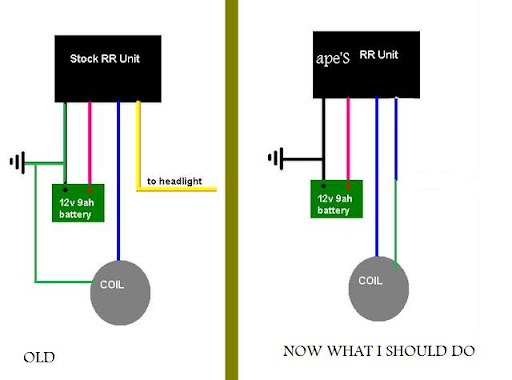
    Obiviously its grounded as you can see from the diag. Sreeni you have to disconnect the stock RR and the batt negative terminal( we've to check the voltage and amps from the RR before connecting to the circuit) Bolt the new RR to a convient place along with the earth wire from the RR. To get a full wave bridge, u need to isolate the grounding of the light coil and take the lead out by using any of the batt charging coil wire as we dont require it any more. Hope u got it what I meant. Am I right Abhi? Dont worry about the identifying the light wires, you need to open the stator cover for isolating the grounding, that time you can have a close look and count with the higher no of poles, that is our boy. Rest of it are pretty straight, Feed these two leads of light coil straight away to the new RR. (Lead colour will be the same for the AC wires). There is one more wire ie. the +ve output connect it to the batt switch in the ignition switch. Thats it, check the voltage and current with a meter if its between 13-14.5 and the current should be more than 5A u are done. Connect the -ve terminal once u are ok with the readings. Always make sure that you are not making short lenghthed any of the wires coming out of the coil for connecting the other light coil (By doing so, any time you can go back to the stock wiring by undoing these all) Never pull out any wires from that harness as the water can easily get into the stator and u will end up in a thick soup.

    U want my email and contact no or Abhi's? Confirm it. This will work as the general electrical systems are almost alike.
    This bike has a single stator coil. No separate AC, DC at the coil. (Look at the diag). Only the RR unit does that separation. So, you will need a separate extra wire.
    Your biking tells a lot about the person you are!

    Comment


    • Originally posted by abhijeet080808 View Post
      This bike has a single stator coil. No separate AC, DC at the coil. (Look at the diag). Only the RR unit does that separation. So, you will need a separate extra wire.
      Diag is not full and clear so I cant figure out correctly. Then wats next to the magneto coil (wire from magneto indicated as light) See the full diag, stator sec. pulse coil to CDI (DC CDI!! this wont start without a batt like bulls?) the left most, center coil is the batt coil I hope, and the third coil shown separatly is named as light. See that? Take a zoom view.

      How did u take out the coil lead out and routed to RR?, I checked with the harness, the black wire to the RR was grounded within the harness. Evenif you ungrounded and using the stock harness to connect the new RR, in effect its grounded. Thus I took a seperate wire from the coil socket directly to the RR.
      Do it Yourself, what so ever, if Possible
      -----------------------------------------
      sigpic
      After Market HID Projector Mod for Pulsar 150
      Flasher Enabled Head Light Flash for Just Rs.1/-

      Comment


      • The thing to the right of the coil is the pulsar coil for ignition, to the left is the freaking neutral indicator. And this is a DC CDI.

        Sreeni has shown me this diag before too. I told him at that time that this is not from an Uni. He tells me its from his manual. Now, Uni has a freaking DC CDI?! No way!

        And, in case of my wiring, I used 2 separate thicker wires from the 2 ends of the coil. Did not use any stock wires.

        And, oh, he is asking for your contact details!
        Your biking tells a lot about the person you are!

        Comment


        • Originally posted by abhijeet080808 View Post
          The thing to the right of the coil is the pulsar coil for ignition, to the left is the freaking neutral indicator. And this is a DC CDI.

          Sreeni has shown me this diag before too. I told him at that time that this is not from an Uni. He tells me its from his manual. Now, Uni has a freaking DC CDI?! No way!

          And, in case of my wiring, I used 2 separate thicker wires from the 2 ends of the coil. Did not use any stock wires.

          And, oh, he is asking for your contact details!
          Yeah right, I figured out after ur tip, thanks Abhi. If its from his mannual we've to accept it. What are the pros and cons of AC/DC CDI's? Beeing a DC CDI, stator will've more power than AC types? due to the absence of AC coil for CDI?

          Sreeni, have u tried to start ur bike without batt by kicker? I think its possible if RR is present.

          Oh really? let'm say
          Do it Yourself, what so ever, if Possible
          -----------------------------------------
          sigpic
          After Market HID Projector Mod for Pulsar 150
          Flasher Enabled Head Light Flash for Just Rs.1/-

          Comment


          • The stator power is not really affected. But a DC CDI will have enough power at idle rpm to fire the spark plug evenly while a AC CDI may have problem. Thats it. So, a DC CDI will result in more efficient sparks at lower rpms. But, the DC CDI depends on the battery health too.

            Sreeni, can you please confirm that Uni has DC CDI. It should be mention in the specifications part of the manual.

            According to HH website. Uni has Digital CDI! Who knows what that is!
            Your biking tells a lot about the person you are!

            Comment


            • Originally posted by sajanjosepht View Post
              Obiviously its grounded as you can see from the diag. Sreeni you have to disconnect the stock RR and the batt negative terminal( we've to check the voltage and amps from the RR before connecting to the circuit) Bolt the new RR to a convient place along with the earth wire from the RR. To get a full wave bridge, u need to isolate the grounding of the light coil and take the lead out by using any of the batt charging coil wire as we dont require it any more. Hope u got it what I meant. Am I right Abhi? Dont worry about the identifying the light wires, you need to open the stator cover for isolating the grounding, that time you can have a close look and count with the higher no of poles, that is our boy. Rest of it are pretty straight, Feed these two leads of light coil straight away to the new RR. (Lead colour will be the same for the AC wires). There is one more wire ie. the +ve output connect it to the batt switch in the ignition switch. Thats it, check the voltage and current with a meter if its between 13-14.5 and the current should be more than 5A u are done. Connect the -ve terminal once u are ok with the readings. Always make sure that you are not making short lenghthed any of the wires coming out of the coil for connecting the other light coil (By doing so, any time you can go back to the stock wiring by undoing these all) Never pull out any wires from that harness as the water can easily get into the stator and u will end up in a thick soup.

              U want my email and contact no or Abhi's? Confirm it. This will work as the general electrical systems are almost alike.
              I didn't understand Head or Tail.
              I want your number and mail address, i already have Abhi's.

              Comment


              • Originally posted by sajanjosepht View Post
                Yeah right, I figured out after ur tip, thanks Abhi. If its from his mannual we've to accept it. What are the pros and cons of AC/DC CDI's? Beeing a DC CDI, stator will've more power than AC types? due to the absence of AC coil for CDI?

                Sreeni, have u tried to start ur bike without batt by kicker? I think its possible if RR is present.

                Oh really? let'm say
                MY BIKE WILL START WITHOUT BATTERY.
                IT WILL START EVEN WITHOUT RR UNIT.

                PM YOUR EMAIL ID, I SHALL MAIL U MUCH CLEAR WIRING DIAGRAM.
                Originally posted by abhijeet080808 View Post
                The stator power is not really affected. But a DC CDI will have enough power at idle rpm to fire the spark plug evenly while a AC CDI may have problem. Thats it. So, a DC CDI will result in more efficient sparks at lower rpms. But, the DC CDI depends on the battery health too.

                Sreeni, can you please confirm that Uni has DC CDI. It should be mention in the specifications part of the manual.

                According to HH website. Uni has Digital CDI! Who knows what that is!
                NO CLUE !! NOT IN MANUAL!!

                WHEN DID HH WEBSITE STARTED GIVING INFO ON UNI

                Comment


                • Well, if it starts without Battery as well as RR unit, your CDI seems to be AC CDI. In that case, this diag may be wrong. Please confirm by comparing some important wires' colour codes as see if they match! Better start looking at the wires from the CDI. Are they the same as here?
                  Your biking tells a lot about the person you are!

                  Comment


                  • Abhi suggested something like this...


                    Comment


                    • Originally posted by abhijeet080808 View Post
                      Well, if it starts without Battery as well as RR unit, your CDI seems to be AC CDI. In that case, this diag may be wrong. Please confirm by comparing some important wires' colour codes as see if they match! Better start looking at the wires from the CDI. Are they the same as here?

                      Abhi's right, it should be then a AC CDI, without batt and RR how will the DC CDI will work? But its not our current concern, u need to boost the batt for that your latest diagram is correct. Pull out the grounding and manage somehow to take out a wire for that from the stator cover and feed these two wires directly to the new RR without using the stock harness. Connect the other ends to batt and gnd. Done, DONT FORGET TO MEASURE THE OUTPUT BEFORE SWITCHING ANYTHING.

                      I'll PM my contact details to u now. Sorry for the delay I was off for 2 days. R u still confused with what I've done? Its not that complex, once u have the basic awareness, any one can follow like me, am from commerce field. Defnitly u've it, else u wont come up with these
                      Last edited by sajjt; 10-19-2009, 11:39 AM.
                      Do it Yourself, what so ever, if Possible
                      -----------------------------------------
                      sigpic
                      After Market HID Projector Mod for Pulsar 150
                      Flasher Enabled Head Light Flash for Just Rs.1/-

                      Comment


                      • Abhi, we've increased the bat charging rate to its max, will if affect the batt life? If not why the OEM is not coming with a better charging rate? Its not a costly affair too. I heard from somewhere that a healthy charging rate is 10% of the cap of the batt. After reaching to the full charge, it wont take any more but the charger is forcing irrespective of the levels. In home invertors there's a circuit to cut off the batt charger to avoid overcharging, any possibility to adopt? Pls comment.
                        Do it Yourself, what so ever, if Possible
                        -----------------------------------------
                        sigpic
                        After Market HID Projector Mod for Pulsar 150
                        Flasher Enabled Head Light Flash for Just Rs.1/-

                        Comment


                        • Originally posted by sajanjosepht View Post
                          Abhi, we've increased the bat charging rate to its max, will if affect the batt life? If not why the OEM is not coming with a better charging rate? Its not a costly affair too. I heard from somewhere that a healthy charging rate is 10% of the cap of the batt. After reaching to the full charge, it wont take any more but the charger is forcing irrespective of the levels. In home invertors there's a circuit to cut off the batt charger to avoid overcharging, any possibility to adopt? Pls comment.
                          I think the stock RR Unit also takes care of cutting off the power, am not sure with the APE RR unit.

                          I am telling this with respect to AMMETER indication. Once battery is full the Ammeter needle used to settle in middle (no charge/discharge).

                          Comment


                          • Originally posted by Shreeni0403 View Post
                            I think the stock RR Unit also takes care of cutting off the power, am not sure with the APE RR unit.

                            I am telling this with respect to AMMETER indication. Once battery is full the Ammeter needle used to settle in middle (no charge/discharge).
                            None of these RR have this function to my knowledge as it feeds only on a healthy rate it wont hurt the batt.

                            And for the Ammeter reading, its just an indicator, if the batt chrg/dischrg only it will show+/-, else, no activity It cant show the batt is full or not.
                            While charging we assume that its not full.
                            Do it Yourself, what so ever, if Possible
                            -----------------------------------------
                            sigpic
                            After Market HID Projector Mod for Pulsar 150
                            Flasher Enabled Head Light Flash for Just Rs.1/-

                            Comment


                            • Originally posted by sajanjosepht View Post
                              Abhi, we've increased the bat charging rate to its max, will if affect the batt life? If not why the OEM is not coming with a better charging rate? Its not a costly affair too. I heard from somewhere that a healthy charging rate is 10% of the cap of the batt. After reaching to the full charge, it wont take any more but the charger is forcing irrespective of the levels. In home invertors there's a circuit to cut off the batt charger to avoid overcharging, any possibility to adopt? Pls comment.
                              Look, if we keep a battery at its normal voltage of 13.8V, it will take current only if it is not fully charged. If the voltage is fixed, it doesn't matter how powerful the source is. The current is fixed.

                              The more heavily discharged it is, the more current it will consume. So, if we connect a fully discharged battery to 13.8V, it will consume very high current which can explode the battery. So, in case of a discharged battery we need to limit the current nominally to 10% of the Ah rating.

                              Suppose, we increase this voltage to above 13.8V. The current flow will increase again and this may heat up the battery. This current is of no use to the battery, as it is already 100% charged. So, it is given off as heat. This evaporates the water in the battery and you need frequent top ups.

                              So, when is this high voltage needed? Its only benefit is to charge up a weak battery quickly. A 14.x V source can charge up a battery quicker than a 13.8V source. But, after the battery has finished charging, the voltage needs to be decreased. This is what exactly happens in an home inverter or battery charger when trickle charge is activated.

                              Now, why does manufacturer fix the voltage level in the RR unit to 14V often? This is to quick charge a battery after the starter uses up some of the charge. But this is harmful in the long run after the battery gets fully charged. On the other hand, a 13.8V source will need some time to charge, hence the battery may not be fully charged by the next time you need to use the starter.

                              So, best for the battery - 13.8V, best for you - 14.x V! And power source does not matter.

                              That is the way voltage is. It does not matter if you connect you connect a 220V bulb light to a 100kV electric station or a home generator. If voltage applies is a proper 220V, it will not burst!
                              Your biking tells a lot about the person you are!

                              Comment


                              • Originally posted by abhijeet080808 View Post
                                Look, if we keep a battery at its normal voltage of 13.8V, it will take current only if it is not fully charged. If the voltage is fixed, it doesn't matter how powerful the source is. The current is fixed.

                                The more heavily discharged it is, the more current it will consume. So, if we connect a fully discharged battery to 13.8V, it will consume very high current which can explode the battery. So, in case of a discharged battery we need to limit the current nominally to 10% of the Ah rating.

                                Suppose, we increase this voltage to above 13.8V. The current flow will increase again and this may heat up the battery. This current is of no use to the battery, as it is already 100% charged. So, it is given off as heat. This evaporates the water in the battery and you need frequent top ups.

                                So, when is this high voltage needed? Its only benefit is to charge up a weak battery quickly. A 14.x V source can charge up a battery quicker than a 13.8V source. But, after the battery has finished charging, the voltage needs to be decreased. This is what exactly happens in an home inverter or battery charger when trickle charge is activated.

                                Now, why does manufacturer fix the voltage level in the RR unit to 14V often? This is to quick charge a battery after the starter uses up some of the charge. But this is harmful in the long run after the battery gets fully charged. On the other hand, a 13.8V source will need some time to charge, hence the battery may not be fully charged by the next time you need to use the starter.

                                So, best for the battery - 13.8V, best for you - 14.x V! And power source does not matter.

                                That is the way voltage is. It does not matter if you connect you connect a 220V bulb light to a 100kV electric station or a home generator. If voltage applies is a proper 220V, it will not burst!
                                Wow thats something worth to read Abhi, but no word on why these OEMs sticks to mean amps range than a full throttle of current produced from the alt? Bit confused still. I understand that the voltage has a significant role in charging at the same time does the current also have same importance in this? Like you pointed about the 100Kv eg, I've another thing to dig, its just like we use thick wires for higher current conductivity. We know the difference in using a thick wire and puny wire perfo. Likewise, does the current makes the diff in charging? Sorry if I make a blunt statement. I think u can gimme a simple briefing on this.
                                Do it Yourself, what so ever, if Possible
                                -----------------------------------------
                                sigpic
                                After Market HID Projector Mod for Pulsar 150
                                Flasher Enabled Head Light Flash for Just Rs.1/-

                                Comment

                                Working...
                                X