

Since '02 xBhp is different things to different people. From a close knit national community of bikers to India's only motorcycling lifestyle magazine and a place to make like-minded biker friends. Join us

Castrol Power 1

Tubeless tyres are better than tubed ones.

Our Partner

Announcement

Collapse
No announcement yet.

The Honda CB Twister

Collapse
X
 
  • Filter
  • Time
  • Show
Clear All
new posts

  • Originally posted by madhav766 View Post
    @Baazigar... u finished 30k on ur bike ryt? have ur front cowls ever vibrated? I get this loud "trrrrrrrrrr" from the cowl. It spoils the ride quality

    Madhav ensure while service is done at ASC they stick back the cowls in posistion.....front cowl is held with an adhesive. As far as warranty on your tyre I belive if at all a warrnty is there then it's by MRF/TVS (respective maufacturers) and not from Honda... Same case is with battery. When I purchased the bike on my owners manual they put a stamp that said I will have the barttery chacked every month to claim any battery warranty So I visit ASC every month on 14th jusdt to have my battery checked. I ensure they create a job sheet and mention battery check on it.. i am a tough customer for them and since I also have a CBR their mouth is zipped tight

    Comment


    • Originally posted by rameshap View Post
      Madhav ensure while service is done at ASC they stick back the cowls in posistion.....front cowl is held with an adhesive. As far as warranty on your tyre I belive if at all a warrnty is there then it's by MRF/TVS (respective maufacturers) and not from Honda... Same case is with battery. When I purchased the bike on my owners manual they put a stamp that said I will have the barttery chacked every month to claim any battery warranty So I visit ASC every month on 14th jusdt to have my battery checked. I ensure they create a job sheet and mention battery check on it.. i am a tough customer for them and since I also have a CBR their mouth is zipped tight
      Respect. teach me please... I'm a tom cat at this stuff!
      Don't matter what it is: Touring; Racing; Commuting. All I know is, I belong on the saddle.

      Rides : Honda CB Twister(Feb 2011 - Present) | TVS Apache RTR 180 ABS(Sept 2012 - May 2016) | Honda CBR250R C-ABS Repsol(March 2017 - Present)

      Break-in tension? Read this.

      Love camping and riding? Google - On Rustic Routes.

      Comment


      • @bazigar


        while riding on pothole roads if some idiot come infront of your bike ....its not that easy to hold your handle bar straight on pot holes....to avoid hitting that idiot ,in panic we will turn on left or right....and pull front brake out of panic...bike became unstable or get wheel lock in front tyre....

        thats why i said never use front brake in pot hole road.... rear brakes are more helpful in pot hole .....since we are not going to ride more than 30kmph in on potholes.

        i need to train my brain to use rear brakes in those nasty roads.
        PROUD OWNER OF CB TWISTER

        FUNNY INDIAN BIKE PICS

        Comment


        • Originally posted by fybercyber View Post
          @bazigar


          while riding on pothole roads if some idiot come infront of your bike ....its not that easy to hold your handle bar straight on pot holes....to avoid hitting that idiot ,in panic we will turn on left or right....and pull front brake out of panic...bike became unstable or get wheel lock in front tyre....

          thats why i said never use front brake in pot hole road.... rear brakes are more helpful in pot hole .....since we are not going to ride more than 30kmph in on potholes.

          i need to train my brain to use rear brakes in those nasty roads.
          fybercyber,Agree 100% with you.its a classic case of accident where people slam front brakes hard while taking sharp turn to left/right to avoid hitting road idiots..this leads to front wheel lock and loss of balance...and then you easily fall off from bike.This happened to me once...in my case the idiot was a street dog.Do not use front brakes while taking a sharp turn.just use the rear brake hard & if you have time left shift to lower gear.this way you will continue with maneuvering bike away from road idiots which is not possible if wheel gets locked.Use front brakes when bike is in straight line.combination of front and rear gives best stopping power and by shifting to lower gear the engine braking will further help reduce braking distance.

          Comment


          • Originally posted by Pinaki View Post
            Why ? .

            Tell me why ?
            pinaki,it will be difficult to expain..but let me try using my engineering knowledge.According to motoman,his technic will not give more power then what is claimed by bike manufacturer,but it will only save loss of power due to bad running in.now loss of power due to bad running in according to motoman himself is only 2-10% of total power.IN other words if Twister's maximum speed is say 100km/hr then even with worst kind of running in,Twister will still make enough power to reach at least 90km/hr.and since we have not done worst kind of running in.. lets put our losses in between 2-10% ie only 4% loss.so motomans technique will save approx.4% power(maximum 10%) as compared to manufactures method given in user manual.Now coming to business point Motoman nowhere says that his technique will not result in any loss of fuel efficiency.If there was no loss of fuel efficiency..then I am sure motoman would have surely claimed that his technique will not result in loss of fuel efficiency..motoman fails to address this point.we sure want more power but...not at the cost of lower fuel efficiency.
            coming to technicality,the main point of engine running-in is to get best possible Piston ring seal.we know that piston ring seal is achieved due to combustion gases passes over the top of the ring,and then getting behind the piston ring to force it outward against the cylinder wall.The controversial point according to me is when he says "If the rings aren't forced against the walls soon enough, they'll use up the roughness before they fully seat. Once that happens there is no solution but to re hone the cylinders, install new rings and start over again." my point is what is the meaning of word "use up"?how can piston ring use up(i.e destroy)the roughness of cylinder honning without itself getting polished?piston ring material is always softer then cylinder honning and hence piston rings will get polished while rubbing against the harder cylinder honing pattern material.Only the rate of piston ring getting polished will differ depending on load ..i.e if you ride slow i.e low load then rings will get polished slowly and if you ride hard i.e high load then rings will get polished faster.Now if he says only faster polishing(i.e running bike hard)will lead to entire ring wear and slow running will not lead to entire ring wear.... is in my opinion is wrong because piston rings are of circular shape so the contact points of rings around cylinder bore is uniform around the circular area of piston rings..otherwise at lower speeds all combustion gases would have entered and mixed with engine oil.
            Advantage of slow running-in according to me is that piston ring surface at the end of running in period will be smoother and hence seal better and with hard running is piston ring surface will comparatively rough.A smooth surface will always seal better then rough surface.
            Last edited by sachin1111; 10-15-2011, 01:59 AM.

            Comment


            • Loss of power may or may not manifest as loss of speed . Power, in engineering terms, does not equate to speed . It may result in loss of torque & acceleration . It may result in loss of over all efficiency of the engine . Whereas honda engineers strive hard to increase engine efficiency by 1% , a loss of 2-10% is significant . Moreover , the lost power shall be lost as heat or noise or vibration , and increase the maintenance needed on the engine and reduce it's operational life ,something that you do not want . So it is more of concern how that power is lost rather than how much .
              The piston & cylinder is never entirely circular or matched in shape .
              Piston rings have some spring action , but the force it exerts on the cylinder wall is too small to cause a gas-seal at operational temperature and the pressures involved .
              The seal occurs on a perfect run-in , while the piston rings polish the cylinder wall to a perfectly matching shape .
              Piston ring material is not softer , but is harder than the cylinder material .
              At manufacture , the inside of the cylinder is honed to form a crosshatch pattern on it . It is like numerous tiny mountains . The piston is supposed to bore(polish) away the troughs ( tops of these mountains ) and give correct shape to the valleys during run in by friction alone .
              If insufficient & slow load is put on the engine during this stage .. the piston rings just pushes over the trough's metal into the valleys causing a fill of the crosshatch pattern instead of polishing it to shape . This is called glazing .
              This is why it is said that the crosshatch pattern is used up . i.e Without forming a gas-tight seal shape by being polished (as originally intended while honing it) ; the pattern has now been lost (flattened) by glazing instead .
              During the combustion , some gas does pass between the cylinder wall and piston rings .. and mixed with the engine-oil like you say . This is called blow-by . This is mainly what makes your engine oil go dirty over usage . A glazed engine shall suffer from severe blow-by needing quicker oil-changes too . Blow-by gases contain sulphuric acid etc corrosive contaminants . They damage other parts like bearings too . In such engines, the blow-by tarnish is plainly visible on the piston ,when taken apart . I have seen it .
              Loss of fuel during compression shall also be considerable at those pressures , speed & temperatures . Compression will also be less , resulting in inefficient burning of fuel . i.e less fuel economy and more exhaust emissions .
              Engine oil shall pass the cylinder-rings gap and get burned up , requiring higher frequency of top ups . Oily carbon deposits on spark plugs . Oily carbon deposits on valve seats and piston head .
              So a glazed engine shall be overall inefficient , high-maintenance , noisy , hot , dirty inside & at exhaust, fuel inefficient and die rather early . Other than not performing well during it's lifetime .

              Well , this is what that guy (motoman) proposes . Being ill equipped to test out the theory , I do not necessarily agree or disagree with him . But what he says does stand sound mechanical engineering logic & follows commonsense too , I will give him that at least . That is until someone finds me a plausible loophole in the theory .
              Last edited by Pinaki; 10-15-2011, 04:43 AM.

              Comment


              • since power and torque is not same..lets only talk about loss of power because motoman only talks about loss of power.he has not mentioned anything about loss of torque...this adds to more controversial point as there is lack of clarity by motoman.
                What is the difference between Power and Torque of a motorcycle? | Bike Chronicles of India
                the whole point of motomans theory of loss of power is due to loss of seal and not due to other losses such friction /vibration etc.The frictional and vibration losses will anyway occur whether seal is good or bad.loss of seal as you said will lead to loss of compression pressure/blow by/glazing/engine oil contamination/carbon deposits etc.
                I do not agree with two of your following points
                1)"Piston rings polish the cylinder wall"
                2)"Piston ring material is not softer , but is harder than the cylinder material"

                my view on point no1 is that It is the piston ring that takes shape of cylinder wall/liner by wearing itself out and forms the seal.cylinder wall does not change its shape.If piston ring is made of harder material then piston rings will not wear off...only the cylinder wall will erode.(i.e harder material will destroy the softer material).this way the cylinder wall diameter will increase and then Replacing cylinder liner ie bore will be much more expensive then replacing much cheaper piston rings.so the idea is to increase the cylinder wall life as this will also increase piston ring life.piston rings material mostly of chrome molybdenum/steel alloy and cylinder liner of cast iron alloy/aluminum alloy.
                Fuel contains some amount of sulphur(adulterated fuel has high amount of sulphur as kerosine is used)this sulphur when burns it forms sulphuric acid which is highly corrosive in nature.it causes corrosive damage to cylinder wall/liner slowly over the period of engine life.sulphuric acid after getting burned forms sulphur dioxide that comes out from exhaust.
                I appreciate motoman for his new thinking and theory but nobody seems to have proved him either right or wrong.I think only bike manufacturers can prove him right or wrong because it will require sophisticated equipment to reach some conclusion.till then people like us will continue to debate on this topic
                Last edited by sachin1111; 10-15-2011, 12:39 PM.

                Comment


                • Originally posted by sachin1111 View Post
                  ..piston rings material mostly of chrome molybdenum/steel alloy and cylinder liner of cast iron alloy/aluminum alloy..
                  Which of these two material is harder ??
                  Try a file or hack-saw on any steel, followed by any cast-iron or aluminum-alloy .
                  Come to think of it .. if cast-iron were harder/stronger than steel .. why would they take trouble building blast-furnaces to make steel out of iron ?
                  Reversely , if they needed stronger material for cylinder than the piston-rings , they could much easier and cheaply make the cylinder out of steel rather than cast-iron or aluminuim-alloy . Nahi ?
                  Last edited by Pinaki; 10-15-2011, 03:30 PM.

                  Comment


                  • piston ring material is based on many factors,like compression pressure,peak pressure,temperature etc.piston ring material could also be of gray cast iron with chromium plating on top.when i said alloy of steel..it does not mean pure steel.there are other metals mixed in steel in different proportion to achieve certain requirements..such as high mechanical strength,elasticity,wear resistance,corrosion resistance,resistance to high temperature etc.piston ring material has to be compatible with not just cylinder wall but also with piston on which these rings are fitted.otherwise they will also erode piston ring grooves.now all these properties cannot be achieved with pure steel.hence other metals are added to achieve these objectives.its a bit complex material science i would say & manufecturers spend lot of money on R & D on this.
                    Last edited by sachin1111; 10-15-2011, 05:19 PM.

                    Comment


                    • Fellow twister owners... Please guide me! I want to go on a tour, 2-3 days maybe. Covering 400-500km per day. Is it possible on our bike? What are the guidelines i will have to keep in mind? Should i have the ASC tune my bike up for the journey? Any suggestions are welcome!
                      Don't matter what it is: Touring; Racing; Commuting. All I know is, I belong on the saddle.

                      Rides : Honda CB Twister(Feb 2011 - Present) | TVS Apache RTR 180 ABS(Sept 2012 - May 2016) | Honda CBR250R C-ABS Repsol(March 2017 - Present)

                      Break-in tension? Read this.

                      Love camping and riding? Google - On Rustic Routes.

                      Comment


                      • Originally posted by sachin1111 View Post
                        piston ring material is based on many factors,like compression pressure,peak pressure,temperature etc.piston ring material could also be of gray cast iron with chromium plating on top.when i said alloy of steel..it does not mean pure steel.there are other metals mixed in steel in different proportion to achieve certain requirements..such as high mechanical strength,elasticity,wear resistance,corrosion resistance,resistance to high temperature etc.piston ring material has to be compatible with not just cylinder wall but also with piston on which these rings are fitted.otherwise they will also erode piston ring grooves.now all these properties cannot be achieved with pure steel.hence other metals are added to achieve these objectives.its a bit complex material science i would say & manufecturers spend lot of money on R & D on this.
                        Steel is not a elementary metal . It is an alloy , i.e mix of metals . So the phrase you just used "pure steel" is an oxymoron .
                        Iron is mixed with various other elements to get steel , for various properties & purposes . Steel is not mixed with other elements to alter it's properties . Why on earth would they again alloy an alloy , in two distinct steps ??
                        Whatever the mix .. steel is always stronger and harder than cast-iron or aluminum or aluminum alloy . Piston rings are made of steel .
                        If the cylinder were to polish down the piston rings , by design .. then we'd have the crosshatch honing on the piston rings .. instead of the cylinder . Mucho less trouble too . No ?
                        Anyway , I think you have somehow formed this misconception that the piston rings get polished to the shape of the cylinder, during run-in .. which is the crux of your not grasping the matter in hand . It is vice versa . Once you clear this concept .. you'll see what this motoman's method is all about .

                        Comment


                        • Originally posted by Pinaki View Post
                          Steel is not a elementary metal . It is an alloy , i.e mix of metals . So the phrase you just used "pure steel" is an oxymoron .
                          Iron is mixed with various other elements to get steel , for various properties & purposes . Steel is not mixed with other elements to alter it's properties . Why on earth would they again alloy an alloy , in two distinct steps ??
                          Whatever the mix .. steel is always stronger and harder than cast-iron or aluminum or aluminum alloy . Piston rings are made of steel .
                          If the cylinder were to polish down the piston rings , by design .. then we'd have the crosshatch honing on the piston rings .. instead of the cylinder . Mucho less trouble too . No ?
                          Anyway , I think you have somehow formed this misconception that the piston rings get polished to the shape of the cylinder, during run-in .. which is the crux of your not grasping the matter in hand . It is vice versa . Once you clear this concept .. you'll see what this motoman's method is all about .
                          pinaki, i think the word "Honed" is not understood properly.cylinder wall's honed surface will wears out the piston ring material and in this process the honed surface will also wear out. honed surface has very abrasive particles on it.this abrasive material is harder then piston ring material and that is why piston ring will wear out to cylinder material.understand that abrasive material is not cast iron or steel,its just sort of fixed in cylinder wall surface which forms peaks and valleys.(like a sandpaper)
                          I agree with you that piston rings could be made from steel,but its also true that piston rings are also made of cast iron.so as long long as honed surface is present..the cylinder wall material is harder then piston ring material...right? During running in honed abrasive particles on cylinder wall will remove/shave off some of piston ring material and during this process the honed surface also gets destroyed due to friction.so its like a war between abrasive honed surface & piston ring where both honed surface and piston ring wear out...until they reach a compromise where both just touch each other forming a seal..but no more further friction.
                          Last edited by sachin1111; 10-16-2011, 03:12 PM.

                          Comment


                          • Originally posted by sachin1111 View Post
                            pinaki, i think the word "Honed" is not understood properly.cylinder wall's honed surface will wears out the piston ring material and in this process the honed surface will also wear out. honed surface has very abrasive particles on it.this abrasive material is harder then piston ring material and that is why piston ring will wear out to cylinder material.understand that abrasive material is not cast iron or steel,its just sort of fixed in cylinder wall surface which forms peaks and valleys.(like a sandpaper)
                            I agree with you that piston rings could be made from steel,but its also true that piston rings are also made of cast iron.so as long long as honed surface is present..the cylinder wall material is harder then piston ring material...right? During running in honed abrasive particles on cylinder wall will remove/shave off some of piston ring material and during this process the honed surface also gets destroyed due to friction.so its like a war between abrasive honed surface & piston ring where both honed surface and piston ring wear out...until they reach a compromise where both just touch each other forming a seal..but no more further friction.
                            Nopes . No other material , abrasive particles , materials etc is used on the cylinder wall ... The crosshatch pattern is formed on the bare metal (cast-iron) of the cylinder itself by cutting it in (with a rotary tool) . This is called honing . I have seen it being done with my own two eyes many times while re-boring a old cylinder . Not unlike as in "honing your knife" .
                            Yes , piston rings can be made of cast-iron too .. but then they are coated with an hard material like chrome . Cylinder is just cast-iron(or aluminum alloy) , never coated in any way . I don't know what you mean by "harder" , but the rings are mucho more resistant to abrasion than the cylinder walls .
                            I say this because in case of an engine incident , I see that cylinder wall gets scratched easily . Piston rings are not .
                            Last edited by Pinaki; 10-16-2011, 05:11 PM.

                            Comment


                            • Originally posted by Pinaki View Post
                              Nopes . No other material , abrasive particles , materials etc is used on the cylinder wall ... The crosshatch pattern is formed on the bare metal (cast-iron) of the cylinder itself by cutting it in (with a rotary tool) . This is called honing . I have seen it being done with my own two eyes many times while re-boring a old cylinder . Not unlike as in "honing your knife" .
                              Yes , piston rings can be made of cast-iron too .. but then they are coated with an hard material like chrome . Cylinder is just cast-iron(or aluminum alloy) , never coated in any way . I don't know what you mean by "harder" , but the rings are mucho more resistant to abrasion than the cylinder walls .
                              I say this because in case of an engine incident , I see that cylinder wall gets scratched easily . Piston rings are not .
                              I don't know about re-boring old cylinder in workshops...may be they don't have necessary equipment(other then lathe and drills) to place/fix separate abrasive material in cylinder wall...and therefore make use of cylinder itself.but that's not the case with companies like Honda.their machines are way more advanced and its easy for them to fix separate abrasive in their molding machines.have you seen any brand new engine honing surface?
                              Anyways check the below link that conforms my views about..the new piston rings physically wear into the cylinder wall until a compatible seal between the two is achieved...which is not possible unless piston ring material is softer then honed surface of cylinder wall,secondly it also mentions about abrasive stones fixed on hones surface to shave off the piston ring material so that seal between piston ring and cylinder wall is achieved.
                              New Engine Break-in Procedure
                              Last edited by sachin1111; 10-16-2011, 07:47 PM.

                              Comment


                              • Originally posted by sachin1111 View Post
                                I don't know about re-boring old cylinder in workshops...may be they don't have necessary equipment(other then lathe and drills) to place/fix separate abrasive material in cylinder wall...and therefore make use of cylinder itself.but that's not the case with companies like Honda.their machines are way more advanced and its easy for them to fix separate abrasive in their molding machines.have you seen any brand new engine honing surface?
                                Anyways check the below link that conforms my views about..the new piston rings physically wear into the cylinder wall until a compatible seal between the two is achieved...which is not possible unless piston ring material is softer then honed surface of cylinder wall,secondly it also mentions about abrasive stones fixed on hones surface to shave off the piston ring material so that seal between piston ring and cylinder wall is achieved.
                                New Engine Break-in Procedure
                                That website is perfectly correct . You are misreading it .
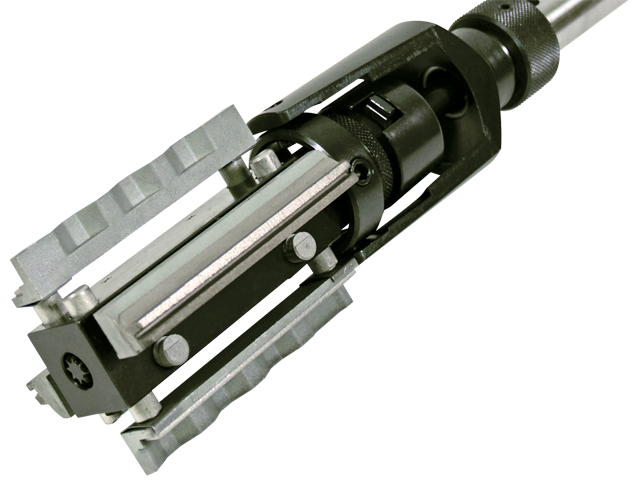
                                A "hone" is a rotary tool used for honing . Abrasive stone etc fixed on the hone's surface . This abrasive stone hone on the tool rotates at high speed and is used to precisely cut the crosshatch pattern on the cylinder wall . No separate abrasive etc layer is placed on the cast-iron cylinder wall . Infact, the cylinder has to be very thoroughly cleaned after the process to remove all residual particulate matter . Then a thin oil is applied to arrest oxidation by air & moisture .
                                These are various rotary hone tools ( source - wikimedia ) . Those flat blades you can see protruding to the side are the abrasive stones that cuts the pattern into the cylinder wall . The mount is motorised to rotate at high speeds , similar to a common dremel (power-drill) tool . Yes, I have seen such tool in use . It is a common appliance used in metalworking & machining . Nothing hi-tech about it too .

                                Last edited by Pinaki; 10-17-2011, 01:54 AM.

                                Comment

                                Working...
                                X